

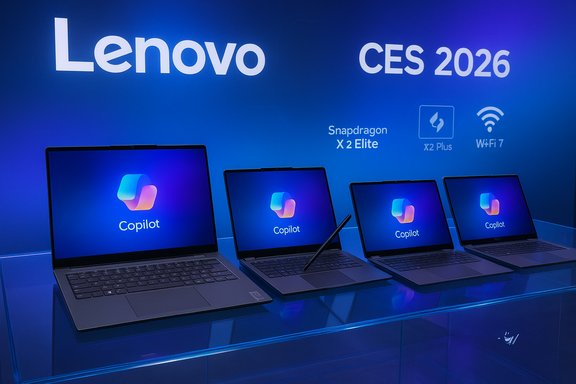
Lenovo’s leaked lineup of Snapdragon X2-powered Copilot+ laptops for CES 2026 redraws the map for Windows on Arm devices: a premium Yoga Slim 7x built around Qualcomm’s top-bin X2 Elite silicon sits alongside three IdeaPad models that favor the newly revealed Snapdragon X2 Plus platform, creating a clear two-tier strategy that emphasizes battery life and thin-and-light portability over flagship-class “Extreme” performance.
The Snapdragon X2 family — marketed as Snapdragon X2 Elite and X2 Elite Extreme — marks Qualcomm’s most aggressive push yet into Windows laptop silicon, pairing redesigned Oryon CPU cores with a beefed-up Hexagon NPU (advertised at up to 80 TOPS) and a refreshed Adreno GPU architecture. Early coverage and Qualcomm’s unveil at its Snapdragon Summit make clear that X2’s primary mission is to enable on-device AI (Copilot+ experiences) at dramatically higher performance and energy efficiency than prior Snapdragon laptop generations. Microsoft’s Windows release cadence also matters here: the company has tested a device-targeted platform branch (widely discussed in industry leaks as “26H1” or “Bromine”) to validate drivers, NPU runtimes and low-level OS plumbing needed by X2-class silicon before rolling features broadly. That platform gating explains why OEMs are lining up factory images and early hardware for the first half of 2026 device window.
Source: Windows Latest Exclusive: Lenovo has Snapdragon X2 Elite (X2-E88-100) and X2 Plus PCs up its sleeve for CES 2026
 Background
The Snapdragon X2 family — marketed as Snapdragon X2 Elite and X2 Elite Extreme — marks Qualcomm’s most aggressive push yet into Windows laptop silicon, pairing redesigned Oryon CPU cores with a beefed-up Hexagon NPU (advertised at up to 80 TOPS) and a refreshed Adreno GPU architecture. Early coverage and Qualcomm’s unveil at its Snapdragon Summit make clear that X2’s primary mission is to enable on-device AI (Copilot+ experiences) at dramatically higher performance and energy efficiency than prior Snapdragon laptop generations. Microsoft’s Windows release cadence also matters here: the company has tested a device-targeted platform branch (widely discussed in industry leaks as “26H1” or “Bromine”) to validate drivers, NPU runtimes and low-level OS plumbing needed by X2-class silicon before rolling features broadly. That platform gating explains why OEMs are lining up factory images and early hardware for the first half of 2026 device window.Overview of the Lenovo leak: what we received
Windows Latest’s exclusive leak (the specifications we received) describes four new Copilot+ PCs headed for Lenovo’s CES 2026 showcase:- Lenovo Yoga Slim 7x (14") — positioned as Lenovo’s most premium Snapdragon laptop in this wave; reportedly configurable up to the Snapdragon X2 Elite (model referenced: X2E88100 / 18-core top-tier part). Highlights claimed include a 2.8K PureSight Pro OLED, 9MP MIPI IR webcam, a 70 Wh battery with up to ~29 hours target life, and a 1.17 kg starting weight.
- Lenovo IdeaPad 5x 2‑in‑1 (14") — a convertible in the IdeaPad family using the Snapdragon X2 Plus platform (not Elite), notable for dual‑slot RAM, upgradable storage, included Lenovo Pen Gen 2 (AES 3.0), and a 14" WUXGA OLED 400‑nit display option. The ARM variant contrasts with an AMD Ryzen AI sibling that will use a larger battery in some configurations.
- Lenovo IdeaPad Slim 5x (13″ and 15″) — two thin-and-light clamshells aimed at mainstream buyers, both running Snapdragon X2 Plus silicon; the 13" model prioritizes extreme portability (≈1.2 kg, ~14 mm), while the 15" model offers a 2.5K OLED option and larger battery choices. Battery life claims for Slim 5x models are up to 21 hours.
Snapdragon X2: technical context and why it matters
What X2 brings to Windows laptops
Qualcomm’s Snapdragon X2 family represents a generational step over the original Snapdragon X Elite line with several key technical claims that shape OEM design decisions:- Up to 18 CPU cores in select X2 Elite Extreme SKUs (an 12+6 clustering shown in vendor materials). Peak boost clocks on top-tier parts may reach 5.0 GHz on one or two cores, a notable single‑thread milestone for Arm laptop silicon.
- A substantially larger Hexagon NPU — public materials and press reporting list up to 80 TOPS for certain X2 SKUs — explicitly framed for sustained on‑device inference that underpins Copilot+ features and offline model execution.
- Updated Adreno X2 GPU architecture and higher memory bandwidth (LPDDR5X packages and SiP options), plus modern connectivity like Wi‑Fi 7 and Bluetooth 5.4. These capabilities aim to improve graphics, media and multitasking performance while keeping thermals and power in check.
Where X2 Plus fits
The leak introduces a second Qualcomm label — Snapdragon X2 Plus — used by Lenovo for mid-range IdeaPad devices. Qualcomm’s public messaging focuses on X2 Elite and X2 Elite Extreme as the headline chips; “X2 Plus” appears to be a narrower OEM-facing tier aimed at mainstream thin-and-light designs that prioritize thermal efficiency and battery life over the absolute top single-thread clocks of Extreme parts. The leak’s placement of X2 Plus in IdeaPad models aligns with common OEM segmentation: Elite for premium thin‑and‑light, Plus for mainstream, Extreme for performance-class devices.Model-by-model deep dive
Lenovo Yoga Slim 7x (14", codename/config: up to X2 Elite X2E88100)
The Yoga Slim 7x is presented as Lenovo’s flagship Snapdragon laptop in this leak: a 14" chassis that targets premium users who want both mobility and enhanced local AI capability. Key leaked highlights:- SoC: Up to Snapdragon X2 Elite, with the leak naming the 18‑core X2E88100 variant. This places the Yoga Slim 7x into the highest performance tier Lenovo has allocated to Arm systems in this cycle.
- Display: Up to 14" 2.8K PureSight Pro OLED, 120 Hz VRR, 1100 nits HDR peak (VESA DisplayHDR True Black). That brightness and qualification put the panel in the premium bracket for creators and mobile reviewers.
- Weight and chassis: Extremely thin at 13.9 mm and a starting weight around 1.17 kg, consistent with the “true thin-and-light” positioning claimed in the leak.
- Battery: Leaked spec lists a 70 Wh battery and vendor target of ~29 hours of battery life in LVP (light-use) conditions, plus a 65 W Type‑C adapter and rapid-charge claims. Battery-life targets in OEM specs should be treated cautiously until retail tests verify them.
- Webcam: Unusually high for a thin laptop — 9MP MIPI IR with E‑camera shutter and 4‑microphone Voice ID array, implying a leaning toward conferencing and secure sign‑in use cases.
- Memory & Storage: Up to 32 GB LPDDR5X and up to 2 TB PCIe Gen 4 M.2 SSD, plus Wi‑Fi 7 and Bluetooth 5.4.
Lenovo IdeaPad 5x 2‑in‑1 (14") with Snapdragon X2 Plus
The IdeaPad 5x convertible is noteworthy for blending mainstream affordability with some upgrade flexibility uncommon in thin ARM devices:- SoC: Snapdragon X2 Plus platform (not Elite). That keeps it in the IdeaPad tier while giving it Copilot+ readiness.
- Chassis & I/O: Convertible 360° hinge, included Lenovo Pen Gen 2 (AES 3.0), and dual‑slot RAM with an upgradable M.2 SSD slot — a rare feature for Snapdragon-based thin convertibles.
- Display & Camera: 14" WUXGA OLED (400 nits) and an FHD IR webcam with privacy shutter; the screen is described as “everyday premium” with VESA HDR certification.
- Battery: 60 Wh listed for the ARM model; Lenovo’s AMD Ryzen AI sibling reportedly uses an 84 Wh pack, highlighting that OEM choices will vary substantially by silicon.
Lenovo IdeaPad Slim 5x (13" and 15") with Snapdragon X2 Plus
Two clamshell variants aim to normalize Snapdragon-based laptops across mainstream screen sizes:- 13" model: Ultra-travel friendly — ≈1.2 kg and 14 mm thin, with a 13.3" WUXGA LCD 400‑nit panel and up to 54 Wh battery. It’s described as market‑selective in distribution.
- 15" model: Offers up to a 2.5K 165 Hz OLED panel on the larger chassis and a 70 Wh battery option; starting price estimates around $899 are quoted in the leak for the 15" SKU.
Cross‑checking and verification: what’s corroborated and what’s speculative
- Snapdragon X2 family headline specs — including the up-to-18-core configuration, LPDDR5X support, Wi‑Fi 7 and the 80 TOPS Hexagon NPU — are confirmed across multiple press outlets that covered Qualcomm’s Snapdragon Summit announcement. These independent reports align with the architectural claims that justify a new Windows platform branch.
- The specific Lenovo model-level details (weights, battery targets, unique camera resolutions, pricing starts and exact display SKUs) come from the Windows Latest leak material and are not published by Lenovo or Qualcomm. Those are therefore leak-level claims and should be treated with caution until Lenovo publishes official specs.
- Benchmarks and performance numbers shown in early X2 Extreme hands‑on articles come from engineering samples or vendor platforms; multiple outlets caution that retail device firmware, thermal design and driver stacks materially affect final performance. That caveat applies directly to any extrapolations the leak makes about Yoga Slim 7x’s sustained performance or the broader family’s battery-life claims.
Strengths: why this lineup matters for Windows on Arm
- Practical segmentation: Lenovo’s approach — putting X2 Elite in a single Yoga SKU and X2 Plus across multiple IdeaPad models — is a pragmatic compromise. It lets Lenovo show a headline premium Arm result without forcing every SKU into the highest-cost silicon bin. This increases the odds of reasonable pricing across form factors.
- Focus on battery and thinness: X2’s architectural improvements were crafted with efficiency in mind; combined with Lenovo’s thin-and-light chassis choices, these laptops have a clear value proposition for users who prioritize all‑day battery life with capable local AI. Qualcomm’s messaging about improved efficiency and OEM expectations about H1 2026 device arrival line up here.
- On-device AI readiness: If Lenovo ships these with validated platform images that include Hexagon runtimes and tuned drivers, Copilot+ features and local inference may be usable out of the box — a genuine usability improvement versus prior generations where day‑one software gaps were common. Microsoft’s device‑specific branch strategy supports that scenario.
- Upgradeability (IdeaPad 5x 2‑in‑1): The presence of dual RAM slots and an extra M.2 bay in an ARM convertible — if confirmed — would be a rare and welcome move away from permanently soldered memory that has characterized many previous Arm notebooks.
Risks and open questions
- Driver and software maturity: The single most important variable for Windows on Arm is the software stack — signed DCH drivers, NPU runtimes (Hexagon), and application support for Arm and multi‑accelerator workflows. Microsoft’s platform branch reduces the risk, but it does not replace broad ISV participation or thorough retail validation. Expect gaps in some legacy or pro workflows at launch.
- Thermals vs. thinness tradeoffs: The Yoga Slim 7x claims premium performance within a very thin and light chassis. Historically, delivering sustained multi‑core throughput in that form factor without thermal throttling is one of the hardest engineering problems. OEM tuning matters more than the SoC spec sheet.
- Battery-life marketing vs. reality: Leaked battery targets (e.g., ~29 hours) are plausible in light-use scenarios but should be viewed as vendor targets that depend on a specific test profile. Independent battery tests on retail units will be the true arbiter.
- Channel fragmentation for enterprise IT: A device-gated platform branch creates a short-term management complexity for IT teams that must validate Bromine/26H1 images separately. Enterprises should plan device validation labs if they intend to adopt first-wave Copilot+ X2 devices at scale.
- Pricing and SKU finalization: Leak pricing (e.g., Yoga Slim 7x starting at $949.99 and IdeaPad Slim 5x 15" at $899) should be treated as provisional. OEMs frequently adjust MSRPs based on final components, regional supply and optional bundles.
Practical guidance for buyers and IT teams
- If you prioritize battery life, portability and day‑to‑day productivity with AI features, these Lenovo Snapdragon X2 devices (if real) will be worth evaluating once retail units are available. The Yoga Slim 7x would be the premium pick among them for on-device AI and display quality.
- For professional creative or legacy x86 workloads, wait for retail reviews that test native Arm app performance and emulation behavior. Benchmark numbers from engineering samples do not guarantee parity in real-world creative pipelines.
- Enterprises should require OEM confirmation on whether devices ship with Microsoft’s device-gated platform image (26H1/Bromine) and request driver/firmware change logs and servicing details as part of procurement validation. Plan for imaging and security baselines specific to Bromine devices.
- If upgradeability matters (RAM, SSD), prioritize configurations or models that explicitly support replaceable storage and memory; the IdeaPad 5x 2‑in‑1’s reported dual‑slot RAM and expandable M.2 bay merit attention if accurate.
Where this fits in the broader market
Qualcomm’s X2 narrative and Lenovo’s apparent product segmentation show a maturing Windows-on-Arm ecosystem: silicon vendors are building laptop-class chips with serious NPU muscle, OEMs are selectively adopting them for thin-and-light segments, and Microsoft is providing a guarded platform path to reduce day‑one risk. This three‑way co‑engineering model — silicon, OEM and OS — is the core structural change that could accelerate Arm adoption in the Windows laptop market if execution holds. Yet the market will keep its eye on a few decisive factors:- Retail battery and thermal tests across real-world workloads
- ISV support for native Arm builds of flagship applications
- Final pricing and regional availability, which determine how many mainstream buyers will try an Arm device versus sticking with x86 alternatives from Intel and AMD or Apple’s M-series laptops.
Conclusion
Lenovo’s leaked CES 2026 roadmap — centered on a Yoga Slim 7x carrying Snapdragon X2 Elite silicon and multiple IdeaPad models on Snapdragon X2 Plus — signals a cautious, realistic push to bring X2’s on-device AI and efficiency advantages to market without overcommitting the entire portfolio. The technical case for Snapdragon X2 is strong: higher core counts, a much larger Hexagon NPU and modern GPU/I/O all support richer Copilot+ experiences. Independent reporting has corroborated Qualcomm’s headline claims, and Microsoft’s device‑targeted platform planning reduces day‑one integration risk. At the same time, OEM leaks are provisional: specific weights, battery targets, camera resolutions and starter prices should be treated as credible but unconfirmed until Lenovo publishes official specifications or retail units are reviewed. Buyers and IT teams should watch retail reviews and OEM documentation closely before making purchasing decisions. The coming months — CES 2026 announcements, retail listings, and hands‑on reviews — will decide whether Snapdragon X2’s promise translates into practical, everyday Windows laptops.Source: Windows Latest Exclusive: Lenovo has Snapdragon X2 Elite (X2-E88-100) and X2 Plus PCs up its sleeve for CES 2026
