

Lenovo’s new Yoga Mini i lands at CES 2026 as a startling example of how much performance and polish vendors can now cram into a palm‑sized chassis — a 0.65‑liter, 600‑gram aluminum cylinder that pairs Intel’s new Core Ultra X7 Series 3 silicon with a surprisingly complete I/O stack and a handful of AI‑centric conveniences aimed at the modern hybrid worker.
The last 24 months have been a renaissance for mini PCs. Advances in SoC efficiency, LPDDR5x memory bandwidth, and NVMe storage density have enabled vendors to reposition compact desktops not just as media boxes or thin‑client replacements, but as legitimate productivity machines and lightweight AI endpoints. Market forecasts point to continued, double‑digit growth in mini PC host revenues and interest from both enterprise and consumer segments, driven by space‑constrained offices, hybrid work routines, and the need for local inferencing in certain AI workflows. Lenovo’s announcement at CES 2026 positions the Yoga Mini i as a direct answer to that demand: a product that wears its “Yoga” lineage visually with an aluminum shell and subtly aggressive industrial design while borrowing the platform-level hardware required to run Windows 11’s Copilot+ features smoothly.
Source: Windows Central https://www.windowscentral.com/hardware/lenovo/lenovo-yoga-mini-1-pc-announcement-ces-2026/
 Background
The last 24 months have been a renaissance for mini PCs. Advances in SoC efficiency, LPDDR5x memory bandwidth, and NVMe storage density have enabled vendors to reposition compact desktops not just as media boxes or thin‑client replacements, but as legitimate productivity machines and lightweight AI endpoints. Market forecasts point to continued, double‑digit growth in mini PC host revenues and interest from both enterprise and consumer segments, driven by space‑constrained offices, hybrid work routines, and the need for local inferencing in certain AI workflows. Lenovo’s announcement at CES 2026 positions the Yoga Mini i as a direct answer to that demand: a product that wears its “Yoga” lineage visually with an aluminum shell and subtly aggressive industrial design while borrowing the platform-level hardware required to run Windows 11’s Copilot+ features smoothly. Overview: What Lenovo announced
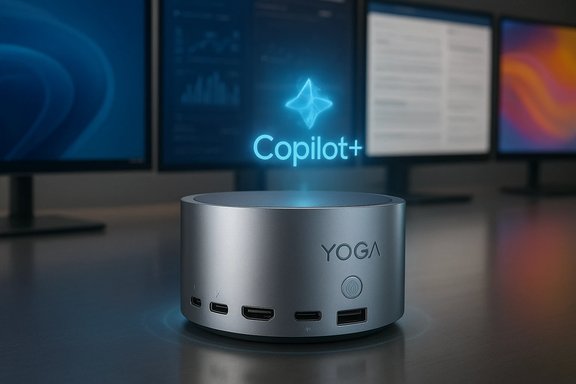
The headline specs and positioning are straightforward and ambitious:- A 0.65‑liter circular/aluminum chassis measuring 130 x 130 x 48.6 mm (5.12 x 5.12 x 1.91 in) and weighing roughly 600 g (1.32 lb).
- Up to Intel Core Ultra X7 Series 3 (model X7‑358H) with integrated graphics — the Panther Lake generation targeted at thin, high‑performance mobile and compact desktop designs.
- Memory and storage options up to 32 GB LPDDR5x‑8533 MT/s and 2 TB M.2 PCIe Gen4 NVMe SSD. Lenovo notes LPDDR5x is soldered. Power delivery is via a 100 W USB‑C adapter.
- A surprisingly generous native port slate: dual Thunderbolt 4 ports, two USB‑C 3.2 (Gen 2) ports (one rated for 100 W PD), one USB‑A 3.2 Gen 2, HDMI 2.1, a 2.5 GbE RJ‑45 jack, and a 3.5 mm combo audio jack. Lenovo claims support for “up to four high‑resolution displays” natively.
- Built‑in speaker and microphone array for conferencing, an ambient notification light that senses presence, Wi‑Fi sensing to wake the device when it detects movement in Wi‑Fi reflections, and a fingerprint sensor embedded in the power button for Windows Hello authentication.
- Availability slated for June 2026 with a starting price of $699.99.
Design and build: tiny but premium
Chassis and industrial design
The Yoga Mini i’s circular, palm‑scale silhouette is a departure from the typical rectangular mini PC. The aluminum shell gives it a premium feel closer to Lenovo’s Yoga laptops than the usual plastic micro‑box. The small footprint — roughly the size of a large coaster — makes it genuinely portable for local re‑deployment (from office desk to home workstation), even if it’s not a lap‑top replacement. Short commutes between meeting rooms or hot‑desking scenarios are where this design shines.Thermal and power considerations
Packing a Core Ultra X7‑class chip into such a small enclosure raises inevitable questions about sustained performance and thermal throttling. Lenovo’s press material lists a 100 W USB‑C adapter for peak power but does not disclose the sustained TDP or the internal cooling architecture in detail. That omission is common in early CES data sheets — buyers should expect Lenovo to publish more detailed thermal and performance profiles closer to retail availability. Early hands‑on coverage hints that Lenovo is prioritizing short‑burst performance and efficiency rather than extended, heavy compute sessions.Hardware and performance: how much can a 0.65L box do?
Processor and AI capabilities
The Yoga Mini i is offered with Intel’s Core Ultra X7 Series 3 silicon, topping out at the X7‑358H. That SKU is part of Intel’s Panther Lake refresh, designed to deliver higher CPU core counts, increased integrated GPU capability (Xe3), and stronger NPU/TOPS performance for AI acceleration than prior mobile‑class chips. For routine productivity, media editing, and Windows Copilot+ features, this platform should be more than adequate; for extended local model training or heavy GPU workloads it will, predictably, fall behind a tower or a dedicated desktop GPU.Memory and storage
Lenovo quotes up to 32 GB LPDDR5x at 8533 MT/s and up to 2 TB PCIe Gen4 M.2 storage. The LPDDR5x memory is soldered, which improves power and performance but removes upgradeability — a common trade‑off for ultra‑compact designs. It’s not yet clear whether the M.2 SSD is user‑replaceable; Lenovo’s materials stop short of saying whether the Mini i offers tool‑free access to the drive bay. Expect specific SKUs to be configured with larger storage at purchase time if upgradability is limited.Real‑world expectations
- For standard office productivity (web, video conferencing, Office apps, light photo editing), the combination of the X7‑358H and 16–32 GB LPDDR5x will be fast and responsive.
- For heavier GPU‑bound tasks (3D rendering, modern AAA gaming), integrated Xe3 will be capable but not class‑leading. Buyers who need discrete GPU power should look at small form‑factor desktops with add‑in slots or external GPU solutions.
- For on‑device AI features (Copilot+ UI, some local inferencing), the new Core Ultra family brings meaningful acceleration, but local model performance will still depend on the workload size and NPU support in apps.
Ports and connectivity: more I/O than it has any right to
One of the Yoga Mini i’s most surprising engineering wins is its connectivity. Lenovo fits:- 2x Thunderbolt 4 (one located on the side),
- 2x USB‑C 3.2 Gen 2 (one supporting 100 W PD),
- 1x USB‑A 3.2 Gen 2,
- 1x HDMI 2.1,
- 1x 2.5 GbE RJ‑45, and
- 1x 3.5 mm audio combo jack.
Software‑level features and AI integration
Copilot+ ready
Lenovo positions the Yoga Mini i as a Windows 11 Copilot+ capable device. The Core Ultra X7 hardware, combined with LPDDR5x memory and NVMe storage, provides a practical foundation for Copilot+ tasks, local models, and on‑device acceleration where supported. This reflects a broader industry trend to ship highly capable edge devices that can handle basic AI workloads without constant cloud dependency.Presence sensing and privacy implications
Two of the Yoga Mini i’s more novel features are Wi‑Fi sensing and an ambient status light that reacts to presence and notifications. Wi‑Fi sensing uses subtle changes in a Wi‑Fi signal’s reflection pattern to detect movement; Lenovo says it can be used to wake the device when someone walks into the room. While the feature is clever and can save power, it raises reasonable privacy and behavioral‑tracking concerns. The implementation details — what data is stored, whether sensing can be disabled, and how the system indicates it is actively sensing — will be critical for enterprise buyers and privacy‑sensitive consumers. Early hands‑on reports demonstrate the feature works as advertised but recommend easy opt‑out and clear OS‑level controls.Biometric security
A fingerprint reader integrated into the power button provides fast Windows Hello authentication — a feature that many mini PCs omit due to space constraints. This is a welcome addition for security conscious users and enterprises. Lenovo has precedent for integrating biometric features into compact Yoga and ThinkPad hardware across previous generations, and the Mini i follows that thread.Use cases: who benefits most?
The Yoga Mini i slots neatly into several clear usage profiles:- Remote or hybrid professionals who need a tidy, always‑on desktop for conferencing, document workflows, and occasional creative work.
- Designers and knowledge workers who use multi‑display setups but prefer a tiny, aesthetically pleasing host on the desk.
- Small businesses and point‑of‑sale/hospitality counters that value compact, low‑noise machines with a complete port list.
- Home offices where space is at a premium and an on‑device AI assistant and quick setup matter.
Competition and positioning
Lenovo is not alone in pushing the mini PC envelope. Apple’s Mac mini remains a benchmark for compact performance in the Apple ecosystem, while Intel NUCs, Zotac, Geekom, and boutique SFF builders offer a range of configurations from barebone to near‑workstation class. What differentiates the Yoga Mini i is the combination of a premium finish, AI‑focused marketing (Copilot+ readiness), and an unusually full suite of native ports for a device its size. Pricing at $699.99 (base) places it aggressively against many entry‑level NUC and Mac mini SKUs, assuming comparable RAM/storage configurations in retail SKUs.Pricing, availability, and purchase guidance
Lenovo expects a June 2026 launch with a $699.99 starting price in the U.S. That price positions the Mini i as a mid‑range mini PC with premium materials and features. As with any small form factor device with soldered memory, buyers should:- Decide upfront on how much RAM they need, because LPDDR5x is soldered and not upgradable post‑purchase.
- Confirm the exact SSD configuration and whether that drive can be swapped or upgraded later.
- Look for retail SKUs that match the intended workload (e.g., 32 GB/1–2 TB for heavier multitasking).
Strengths — what Lenovo got right
- Design and finish: The aluminum cylinder looks and feels premium in a space where plastic is still common.
- I/O density: Dual TB4, HDMI 2.1, 2.5 GbE, USB‑A — that’s exceptional for a device under a liter.
- AI and platform readiness: Core Ultra X7 silicon and LPDDR5x give the Mini i credible Copilot+ credentials for day‑to‑day AI tasks.
- Integrated security and convenience: Fingerprint in power button, built‑in mic/speaker, and presence‑aware features simplify real‑world use.
Risks and unanswered questions
- Sustained thermal performance: Small chassis mean compromises; Lenovo’s current materials don’t publish sustained TDP figures or throttling behavior. This matters for buyers who expect consistent long‑running performance.
- Upgradeability tradeoffs: Soldered LPDDR5x eliminates future RAM upgrades. M.2 SSD upgradeability is not yet confirmed in Lenovo’s early documentation. Buyers must plan configuration at purchase.
- Privacy and manageability: Wi‑Fi sensing and ambient presence lights are clever, but enterprise purchasers will need granular controls and documentation to meet privacy and compliance requirements. Clear software‑level toggles and enterprise management hooks should be validated before bulk deployment.
- Real‑world multi‑display claims: “Up to four high‑resolution displays” is plausible on paper, but practical throughput depends on resolution, refresh rate, and combined display pipeline load; independent testing will be necessary.
Practical recommendations
- If portability and desk aesthetics are priorities and your workflows are productivity‑centric, configure the Mini i with at least 16–32 GB of RAM and a 1 TB NVMe to avoid future regret.
- Wait for independent benchmarks (CPU sustained performance, thermal throttling, multi‑display output quality) before committing the Mini i to GPU‑heavy or prolonged compute tasks.
- For enterprise procurement, require Lenovo to document Wi‑Fi sensing behavior, opt‑out capabilities, and any telemetric data collection. Ensure the device can be managed and disabled by IT policy if necessary.
Verdict: A smart, bold step for the mini PC category
Lenovo’s Yoga Mini i is a well‑executed, ambitious attempt to redefine what a mini PC can be in 2026: small, refined, and capable of running modern AI‑aware Windows workflows while offering unusually generous I/O for its size. For workers and small businesses who prize desk real estate, minimal noise, and polished hardware, the Mini i is an attractive option — provided Lenovo’s retail SKUs and thermal behavior match the promise in its press materials. At the same time, trade‑offs around upgradeability and sustained high‑load performance are real and unavoidable in this form factor. The Yoga Mini i is best read as a desktop for efficient, AI‑augmented productivity work rather than a replacement for compact workstations that need discrete GPU horsepower or long, uninterrupted compute runs.Closing thoughts
The Yoga Mini i demonstrates that mini PCs have evolved from novelty to credible desktop alternative. Lenovo’s blend of premium design, broad connectivity, and AI‑forward silicon makes the Mini i a noteworthy entrant in the 2026 mini PC market — one that will likely accelerate interest in compact, stylish desktops across both consumer and enterprise segments. As the market for small form factor systems continues to grow, Lenovo’s move signals that top‑tier vendors are no longer willing to compromise user experience for size alone. For readers planning purchases or IT teams evaluating compact endpoints, the practical path is to watch for hands‑on benchmarking and a full specification sheet from Lenovo at retail launch, then choose SKUs that match your long‑term memory and storage needs. The Yoga Mini i’s promise is clear — the real test will be how well its engineering choices translate to everyday performance when it ships in June 2026.Source: Windows Central https://www.windowscentral.com/hardware/lenovo/lenovo-yoga-mini-1-pc-announcement-ces-2026/
