

Levi Strauss & Co. has moved core technology workloads to Microsoft Azure and is using Microsoft Fabric, OneLake, Fabric IQ, GitHub Copilot, and more than 1,000 deployed agents to modernize reporting, forecasting, migration work, and employee workflows across the global retailer. The immediate story is cloud migration; the larger story is how a 171-year-old apparel company is trying to turn its data estate into an operating system for AI. Microsoft gets a showcase customer, Levi’s gets a platform for speed, and IT leaders get another reminder that “AI transformation” usually begins with less glamorous work: standardizing data, retiring fragmentation, and making infrastructure boring enough to trust.
The newest Microsoft customer story about Levi Strauss & Co. is framed as a cloud modernization win, but the more interesting claim is organizational. Levi’s is not merely saying that Azure replaced legacy infrastructure. It is saying that moving to a standardized cloud foundation made new kinds of work possible: semantic reporting, AI-assisted infrastructure code, agent-driven workflows, and a faster go-to-market engine.
That is a familiar Microsoft pitch in 2026, but Levi’s makes it unusually concrete. The company says Fabric IQ is being used to deliver end-to-end reporting for cost data across the whole company, and one employee with what the team calls a “digital buddy” can manage cost reporting at a scale that previously required more human coordination. That line will understandably draw attention, because it compresses the enterprise AI story into a single image: a specialist, an agent, and a business process that no longer behaves like a spreadsheet relay race.
The temptation is to read this as a story about Copilot replacing work. The better reading is that Levi’s is trying to change the surface area of work. If reliable data is available in OneLake, if Fabric IQ can provide a shared semantic layer, and if agents can operate against that context, then the bottleneck shifts from finding and reconciling information to deciding what actions the business wants to automate or accelerate.
That is why this matters to WindowsForum readers who may not care much about jeans. The same architecture Microsoft is showcasing here is the one it is pushing into the broader enterprise stack: Azure as the substrate, Fabric as the data plane, Copilot as the interface, and agents as the workflow layer. Levi’s is a retail brand, but the pattern is recognizably the future Microsoft wants for every IT department.
Levi’s says the move to Azure was a “huge unlock,” and that phrasing is important because it places migration at the beginning of the AI story rather than at the end of an infrastructure project. For many enterprises, cloud migration used to be justified by elasticity, data-center consolidation, or reduced capital spending. Now the justification is increasingly strategic: without a common cloud data and application foundation, the AI layer has nothing trustworthy to reason over.
That does not make migration simple or automatically successful. Azure Migrate and GitHub Copilot can help plan, generate infrastructure-as-code, and reduce repetitive engineering work, but they do not remove the need for architectural judgment. A generated deployment template is useful only if the team understands the security model, network topology, cost implications, and operational failure modes behind it.
Levi’s appears to be arguing that its migration work created a foundation sturdy enough for higher-order automation. That is the version of cloud transformation Microsoft most wants customers to internalize. The cloud is no longer just where workloads run; it is where enterprise memory, governance, developer tooling, security controls, and AI orchestration are supposed to converge.
That distinction matters. A retailer like Levi’s has product data, supply-chain data, sales data, cost data, store data, finance data, customer signals, and planning data. Those data sets may have different owners, definitions, refresh cycles, and quality problems. Without a semantic layer, an AI system can confidently answer the wrong question because the enterprise itself has not agreed on the meaning of the words in the prompt.
Microsoft Fabric is meant to reduce that fragmentation by providing a unified analytics platform with OneLake as a common data lake. Fabric IQ then sits higher in the stack, adding context that can be reused by reporting, agents, and other AI experiences. For the business user, the promise is less time translating between systems. For IT, the promise is fewer bespoke data marts and less brittle point-to-point reporting logic.
The risk, as always, is that the semantic layer becomes yet another place where complexity accumulates. If definitions are not governed, if ownership is unclear, or if business units quietly maintain their own parallel truths, AI will amplify inconsistency rather than eliminate it. Levi’s success will depend not merely on deploying Fabric IQ, but on keeping its business vocabulary disciplined as the company changes.
That is the unglamorous core of enterprise AI: not the agent demo, but the data contract behind it. The demo can be built in weeks. The shared meaning that makes it safe to scale is a management system.
For sysadmins and infrastructure engineers, this cuts both ways. Copilot can lower the barrier to writing Terraform, Bicep, ARM templates, scripts, pipelines, documentation, and migration scaffolding. It can also create a false sense of confidence when people who are newly empowered to generate code are not equally prepared to review, test, secure, and maintain it.
The Levi’s quote that Copilot “turned every single person on the team into a developer” is the kind of line that will delight executives and make senior engineers inhale sharply. Development is not only typing code. It is version control, testing, threat modeling, observability, rollback planning, peer review, incident response, and long-term ownership.
Still, the underlying shift is real. AI coding assistants are changing who can participate in infrastructure work, especially in teams where tribal knowledge used to be trapped in a few specialists. A strong platform team can use Copilot to scale good patterns. A weak one can use it to generate technical debt faster than before.
The distinction is governance. Levi’s appears to be using Copilot within a larger modernization program rather than as a free-for-all prompt box. That matters because AI-assisted infrastructure code is powerful precisely where mistakes are expensive. A bad line in an application can break a feature; a bad line in infrastructure can expose data, inflate cloud bills, or weaken production resilience.
An enterprise can create hundreds of narrow agents very quickly if the tooling is friendly and the demand is high. The harder work is deciding which agents deserve to exist, what data they can access, how they authenticate, how they are monitored, how they fail, and who owns their behavior when the process changes. Agent sprawl is the new shadow IT if governance does not keep pace.
Microsoft’s broader agent strategy increasingly points toward orchestration: multiple purpose-built agents coordinated through a unified experience, often inside Teams or Microsoft 365 workflows. Levi’s has also been associated with the idea of a “super agent” that helps employees navigate systems and workflows. That model is appealing because most enterprise work is not contained in one application; it crosses email, chat, documents, ERP systems, analytics tools, and ticketing queues.
But orchestration creates a new dependency chain. If an agent relies on bad data, stale permissions, unclear process ownership, or brittle integrations, the user may experience the failure as an AI problem even when the root cause is old-fashioned enterprise mess. Agents make workflows feel conversational, but the back end still has to behave like production software.
The optimistic view is that Levi’s is building toward a cleaner, more responsive business nervous system. The cautious view is that every agent added to the estate becomes another object to govern, secure, audit, and retire when it no longer matches the business process. Both views can be true at once.
That is why the go-to-market language in the Microsoft story matters. Levi’s executives describe a process that runs from product design to store shelf as being rewired for agility. In apparel, that chain includes trend sensing, assortment planning, sourcing, manufacturing, logistics, allocation, pricing, and merchandising. Every delay compounds.
AI is attractive here because it can compress the distance between signal and action. Forecasting can improve if data is timely and trusted. Reporting can become less manual if the definitions are standardized. Employees can spend less time hunting for answers if agents can retrieve and synthesize information across systems.
Yet retail is also a sector where AI overreach can backfire quickly. Forecasting models can misread demand. Automation can optimize for the wrong metric. Customer personalization can slide into creepiness. Labor-saving narratives can generate skepticism among employees whose expertise is being partially encoded into tools they do not control.
Levi’s seems to understand that the AI layer must be tied to business process rather than novelty. The examples Microsoft highlights are not science fiction: cost reporting, migration work, training sessions, hackathons, forecasting, and employee support. That is where enterprise AI is most credible right now. The revolution arrives first as fewer meetings, fewer manual reports, faster templates, and fewer hours lost to system archaeology.
That is the strategic point. Microsoft does not want enterprises to think of AI as a single chatbot subscription. It wants them to see AI as a system that spans devices, identity, productivity apps, developer tools, cloud infrastructure, data governance, and business workflows. Once that view takes hold, the value proposition shifts from “buy Copilot” to “standardize on the Microsoft platform so Copilot has somewhere useful to work.”
This is also why Windows remains relevant in a cloud-and-AI story. The endpoint is the place where employees encounter the platform, where identity and policy are enforced, and where AI features increasingly surface in everyday work. Copilot+ PCs, Windows 11, and Intune are not the center of Levi’s Azure migration story, but they are part of the same enterprise control plane.
For IT pros, the implication is that Microsoft’s AI ecosystem will reward shops that already have strong Microsoft hygiene: Entra ID, Intune, Defender, Purview, Teams, SharePoint, GitHub, Azure, and Fabric. Organizations with fragmented identity, unmanaged endpoints, inconsistent data governance, or half-modernized application estates will still be able to deploy AI features, but they may struggle to extract durable value.
That is not an accident. Platform companies use new technology waves to pull customers deeper into the platform. Microsoft is doing that with AI as deliberately as it once did with Office, Windows Server, Active Directory, and Azure.
Levi’s cloud foundation gives Microsoft a security story to tell because Azure, Fabric, Microsoft 365, GitHub, and endpoint management can be governed through a coherent identity and policy framework. That is the theory. In practice, enterprise environments are full of exceptions: inherited permissions, stale groups, overshared documents, service accounts, undocumented integrations, and emergency access pathways that were never cleaned up.
The shift from dashboards to agents makes these issues more urgent. A dashboard usually exposes what its designer decided to expose. An agent invites users to ask unexpected questions. That flexibility is the value proposition, but it also expands the testing surface.
There is also the risk of automation acting on incomplete context. An agent that drafts a report is one thing. An agent that recommends inventory changes, generates code, updates infrastructure, or triggers workflows introduces a different class of operational risk. The more useful agents become, the more they need the controls associated with software systems rather than office macros.
This is where enterprise AI will mature or stall. The first wave was about access and enthusiasm. The next wave is about auditability, lifecycle management, least privilege, data lineage, and reliable rollback. Levi’s 1,000-agent milestone is impressive only if the company can keep those agents understandable and governable as the number grows.
The most durable AI transformations will be the ones that make employees more capable rather than merely more measurable. Training sessions and hackathons are important because they give workers a role in discovering use cases instead of treating AI as something imposed from above. GitHub Copilot becomes less threatening when it is framed as a tool that helps a team handle infrastructure-as-code work it previously could not scale.
Still, empowerment is not automatic. If AI tools raise output expectations without changing planning assumptions, burnout follows. If agents absorb the easy work and leave humans with only ambiguous edge cases, jobs can become more stressful. If employees do not understand how AI-generated work is evaluated, they may either over-trust it or avoid it.
Levi’s modernization mindset seems to be focused on agility and customer connection, not just headcount avoidance. That is the right framing, but the proof will be in how these tools are managed over time. A “digital buddy” can be a useful companion, or it can become a euphemism for invisible pressure to do more with less.
The best version of this future is not that every employee becomes a developer in the literal sense. It is that more employees can shape the systems around them, automate repetitive work, and interrogate business data without waiting in a queue for scarce technical specialists. That would be a real change in how enterprise IT distributes power.
There are several concrete takeaways for WindowsForum’s mix of admins, developers, and Microsoft-watchers:
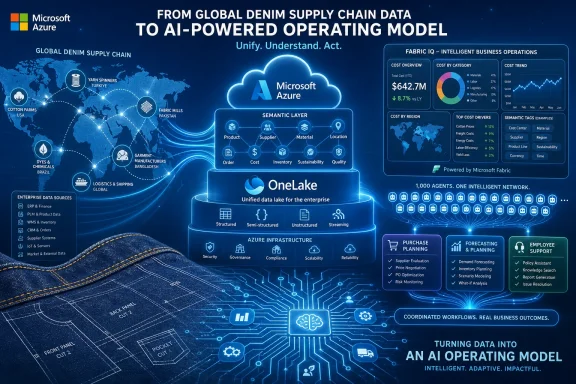 Levi’s Is Selling Denim, but Microsoft Is Selling the Operating Model
The newest Microsoft customer story about Levi Strauss & Co. is framed as a cloud modernization win, but the more interesting claim is organizational. Levi’s is not merely saying that Azure replaced legacy infrastructure. It is saying that moving to a standardized cloud foundation made new kinds of work possible: semantic reporting, AI-assisted infrastructure code, agent-driven workflows, and a faster go-to-market engine.That is a familiar Microsoft pitch in 2026, but Levi’s makes it unusually concrete. The company says Fabric IQ is being used to deliver end-to-end reporting for cost data across the whole company, and one employee with what the team calls a “digital buddy” can manage cost reporting at a scale that previously required more human coordination. That line will understandably draw attention, because it compresses the enterprise AI story into a single image: a specialist, an agent, and a business process that no longer behaves like a spreadsheet relay race.
The temptation is to read this as a story about Copilot replacing work. The better reading is that Levi’s is trying to change the surface area of work. If reliable data is available in OneLake, if Fabric IQ can provide a shared semantic layer, and if agents can operate against that context, then the bottleneck shifts from finding and reconciling information to deciding what actions the business wants to automate or accelerate.
That is why this matters to WindowsForum readers who may not care much about jeans. The same architecture Microsoft is showcasing here is the one it is pushing into the broader enterprise stack: Azure as the substrate, Fabric as the data plane, Copilot as the interface, and agents as the workflow layer. Levi’s is a retail brand, but the pattern is recognizably the future Microsoft wants for every IT department.
The Cloud Migration Was the Boring Part, and That Is the Point
Enterprise cloud stories often flatten into marketing verbs: accelerate, unlock, transform, empower. In practice, the work is less cinematic. Companies have to inventory applications, untangle dependencies, decide which systems are worth modernizing, and move decades of operational assumptions into platforms with different security, cost, and governance models.Levi’s says the move to Azure was a “huge unlock,” and that phrasing is important because it places migration at the beginning of the AI story rather than at the end of an infrastructure project. For many enterprises, cloud migration used to be justified by elasticity, data-center consolidation, or reduced capital spending. Now the justification is increasingly strategic: without a common cloud data and application foundation, the AI layer has nothing trustworthy to reason over.
That does not make migration simple or automatically successful. Azure Migrate and GitHub Copilot can help plan, generate infrastructure-as-code, and reduce repetitive engineering work, but they do not remove the need for architectural judgment. A generated deployment template is useful only if the team understands the security model, network topology, cost implications, and operational failure modes behind it.
Levi’s appears to be arguing that its migration work created a foundation sturdy enough for higher-order automation. That is the version of cloud transformation Microsoft most wants customers to internalize. The cloud is no longer just where workloads run; it is where enterprise memory, governance, developer tooling, security controls, and AI orchestration are supposed to converge.
Fabric IQ Is Microsoft’s Bet That AI Needs Meaning, Not Just Data
The most consequential phrase in the Levi’s story may be semantic intelligence layer. Fabric IQ is designed to give business meaning to the data available through Microsoft Fabric and OneLake, so systems and agents can interpret information in terms closer to how the company actually operates. In plain English: it is not enough for an AI tool to access tables; it needs to understand what those tables mean.That distinction matters. A retailer like Levi’s has product data, supply-chain data, sales data, cost data, store data, finance data, customer signals, and planning data. Those data sets may have different owners, definitions, refresh cycles, and quality problems. Without a semantic layer, an AI system can confidently answer the wrong question because the enterprise itself has not agreed on the meaning of the words in the prompt.
Microsoft Fabric is meant to reduce that fragmentation by providing a unified analytics platform with OneLake as a common data lake. Fabric IQ then sits higher in the stack, adding context that can be reused by reporting, agents, and other AI experiences. For the business user, the promise is less time translating between systems. For IT, the promise is fewer bespoke data marts and less brittle point-to-point reporting logic.
The risk, as always, is that the semantic layer becomes yet another place where complexity accumulates. If definitions are not governed, if ownership is unclear, or if business units quietly maintain their own parallel truths, AI will amplify inconsistency rather than eliminate it. Levi’s success will depend not merely on deploying Fabric IQ, but on keeping its business vocabulary disciplined as the company changes.
That is the unglamorous core of enterprise AI: not the agent demo, but the data contract behind it. The demo can be built in weeks. The shared meaning that makes it safe to scale is a management system.
GitHub Copilot Moves From Coding Assistant to Migration Tool
Levi’s says GitHub Copilot has changed the scope of a roughly 40-person team by helping more employees contribute to development-style work, including infrastructure as code during migration. That is a notable evolution in how Copilot is being positioned. It is no longer just a developer productivity tool for writing application logic; it is becoming part of the modernization assembly line.For sysadmins and infrastructure engineers, this cuts both ways. Copilot can lower the barrier to writing Terraform, Bicep, ARM templates, scripts, pipelines, documentation, and migration scaffolding. It can also create a false sense of confidence when people who are newly empowered to generate code are not equally prepared to review, test, secure, and maintain it.
The Levi’s quote that Copilot “turned every single person on the team into a developer” is the kind of line that will delight executives and make senior engineers inhale sharply. Development is not only typing code. It is version control, testing, threat modeling, observability, rollback planning, peer review, incident response, and long-term ownership.
Still, the underlying shift is real. AI coding assistants are changing who can participate in infrastructure work, especially in teams where tribal knowledge used to be trapped in a few specialists. A strong platform team can use Copilot to scale good patterns. A weak one can use it to generate technical debt faster than before.
The distinction is governance. Levi’s appears to be using Copilot within a larger modernization program rather than as a free-for-all prompt box. That matters because AI-assisted infrastructure code is powerful precisely where mistakes are expensive. A bad line in an application can break a feature; a bad line in infrastructure can expose data, inflate cloud bills, or weaken production resilience.
One Thousand Agents Is a Milestone, Not a Strategy
Levi’s says it now has more than 1,000 agents deployed, with more planned. That number is striking, and it will probably become the headline in many retellings. But the raw count is less meaningful than the operating model behind it.An enterprise can create hundreds of narrow agents very quickly if the tooling is friendly and the demand is high. The harder work is deciding which agents deserve to exist, what data they can access, how they authenticate, how they are monitored, how they fail, and who owns their behavior when the process changes. Agent sprawl is the new shadow IT if governance does not keep pace.
Microsoft’s broader agent strategy increasingly points toward orchestration: multiple purpose-built agents coordinated through a unified experience, often inside Teams or Microsoft 365 workflows. Levi’s has also been associated with the idea of a “super agent” that helps employees navigate systems and workflows. That model is appealing because most enterprise work is not contained in one application; it crosses email, chat, documents, ERP systems, analytics tools, and ticketing queues.
But orchestration creates a new dependency chain. If an agent relies on bad data, stale permissions, unclear process ownership, or brittle integrations, the user may experience the failure as an AI problem even when the root cause is old-fashioned enterprise mess. Agents make workflows feel conversational, but the back end still has to behave like production software.
The optimistic view is that Levi’s is building toward a cleaner, more responsive business nervous system. The cautious view is that every agent added to the estate becomes another object to govern, secure, audit, and retire when it no longer matches the business process. Both views can be true at once.
Retail Is the Right Test Case Because Retail Punishes Latency
Retail is a brutal environment for slow decision-making. Demand shifts quickly, inventory ages, promotions compress margins, supply chains wobble, and consumer expectations are shaped by whatever the fastest digital experience taught them yesterday. A company like Levi’s cannot treat data latency as an internal inconvenience; it becomes a customer-facing cost.That is why the go-to-market language in the Microsoft story matters. Levi’s executives describe a process that runs from product design to store shelf as being rewired for agility. In apparel, that chain includes trend sensing, assortment planning, sourcing, manufacturing, logistics, allocation, pricing, and merchandising. Every delay compounds.
AI is attractive here because it can compress the distance between signal and action. Forecasting can improve if data is timely and trusted. Reporting can become less manual if the definitions are standardized. Employees can spend less time hunting for answers if agents can retrieve and synthesize information across systems.
Yet retail is also a sector where AI overreach can backfire quickly. Forecasting models can misread demand. Automation can optimize for the wrong metric. Customer personalization can slide into creepiness. Labor-saving narratives can generate skepticism among employees whose expertise is being partially encoded into tools they do not control.
Levi’s seems to understand that the AI layer must be tied to business process rather than novelty. The examples Microsoft highlights are not science fiction: cost reporting, migration work, training sessions, hackathons, forecasting, and employee support. That is where enterprise AI is most credible right now. The revolution arrives first as fewer meetings, fewer manual reports, faster templates, and fewer hours lost to system archaeology.
Microsoft Gets a Showcase for Its Full-Stack AI Ambition
For Microsoft, Levi’s is almost too perfect a case study. It has a globally recognized brand, a long history, complex operations, and a modernization narrative that touches Windows, Surface, Intune, Microsoft 365 Copilot, GitHub Copilot, Azure, Fabric, OneLake, Foundry, and agents. The story is not about one product; it is about Microsoft’s whole stack becoming harder to separate.That is the strategic point. Microsoft does not want enterprises to think of AI as a single chatbot subscription. It wants them to see AI as a system that spans devices, identity, productivity apps, developer tools, cloud infrastructure, data governance, and business workflows. Once that view takes hold, the value proposition shifts from “buy Copilot” to “standardize on the Microsoft platform so Copilot has somewhere useful to work.”
This is also why Windows remains relevant in a cloud-and-AI story. The endpoint is the place where employees encounter the platform, where identity and policy are enforced, and where AI features increasingly surface in everyday work. Copilot+ PCs, Windows 11, and Intune are not the center of Levi’s Azure migration story, but they are part of the same enterprise control plane.
For IT pros, the implication is that Microsoft’s AI ecosystem will reward shops that already have strong Microsoft hygiene: Entra ID, Intune, Defender, Purview, Teams, SharePoint, GitHub, Azure, and Fabric. Organizations with fragmented identity, unmanaged endpoints, inconsistent data governance, or half-modernized application estates will still be able to deploy AI features, but they may struggle to extract durable value.
That is not an accident. Platform companies use new technology waves to pull customers deeper into the platform. Microsoft is doing that with AI as deliberately as it once did with Office, Windows Server, Active Directory, and Azure.
The Security Story Is Bigger Than the Demo
AI-enabled modernization raises a familiar security problem in a new form: the easier it becomes to access enterprise knowledge, the more important it becomes to know who should see what. Agents that summarize, retrieve, generate, and act across systems can accidentally become permission amplifiers if the underlying controls are sloppy.Levi’s cloud foundation gives Microsoft a security story to tell because Azure, Fabric, Microsoft 365, GitHub, and endpoint management can be governed through a coherent identity and policy framework. That is the theory. In practice, enterprise environments are full of exceptions: inherited permissions, stale groups, overshared documents, service accounts, undocumented integrations, and emergency access pathways that were never cleaned up.
The shift from dashboards to agents makes these issues more urgent. A dashboard usually exposes what its designer decided to expose. An agent invites users to ask unexpected questions. That flexibility is the value proposition, but it also expands the testing surface.
There is also the risk of automation acting on incomplete context. An agent that drafts a report is one thing. An agent that recommends inventory changes, generates code, updates infrastructure, or triggers workflows introduces a different class of operational risk. The more useful agents become, the more they need the controls associated with software systems rather than office macros.
This is where enterprise AI will mature or stall. The first wave was about access and enthusiasm. The next wave is about auditability, lifecycle management, least privilege, data lineage, and reliable rollback. Levi’s 1,000-agent milestone is impressive only if the company can keep those agents understandable and governable as the number grows.
The Human Story Is Not Just Productivity
Microsoft’s customer stories naturally emphasize productivity, and Levi’s executives talk about expanding the scope of work without drastically expanding team size. That is a rational business goal. It is also a sentence employees will read carefully.The most durable AI transformations will be the ones that make employees more capable rather than merely more measurable. Training sessions and hackathons are important because they give workers a role in discovering use cases instead of treating AI as something imposed from above. GitHub Copilot becomes less threatening when it is framed as a tool that helps a team handle infrastructure-as-code work it previously could not scale.
Still, empowerment is not automatic. If AI tools raise output expectations without changing planning assumptions, burnout follows. If agents absorb the easy work and leave humans with only ambiguous edge cases, jobs can become more stressful. If employees do not understand how AI-generated work is evaluated, they may either over-trust it or avoid it.
Levi’s modernization mindset seems to be focused on agility and customer connection, not just headcount avoidance. That is the right framing, but the proof will be in how these tools are managed over time. A “digital buddy” can be a useful companion, or it can become a euphemism for invisible pressure to do more with less.
The best version of this future is not that every employee becomes a developer in the literal sense. It is that more employees can shape the systems around them, automate repetitive work, and interrogate business data without waiting in a queue for scarce technical specialists. That would be a real change in how enterprise IT distributes power.
The Levi’s Blueprint Has Edges IT Teams Should Not Ignore
The practical lesson from Levi’s is not that every company should rush to deploy 1,000 agents. It is that AI scale depends on boring prerequisites: cloud migration, unified data, identity discipline, endpoint consistency, developer tooling, and a culture willing to redesign workflows instead of sprinkling Copilot over old process maps.There are several concrete takeaways for WindowsForum’s mix of admins, developers, and Microsoft-watchers:
- Levi’s is treating Azure migration as an AI prerequisite, not merely as an infrastructure refresh.
- Fabric IQ and OneLake matter because agents need trusted business meaning, not just access to raw enterprise data.
- GitHub Copilot is moving into infrastructure and migration workflows, which raises both productivity potential and review obligations.
- A large agent estate requires lifecycle governance, ownership, security review, and retirement plans before sprawl becomes unmanageable.
- Microsoft’s AI pitch is increasingly full-stack, tying together Windows endpoints, cloud infrastructure, data platforms, developer tools, and collaboration software.
- The most credible enterprise AI gains are still found in unglamorous workflows such as reporting, forecasting, migration scripting, and internal process navigation.
References
- Primary source: Microsoft
Published: 2026-06-09T23:30:08.420764
Levi Strauss & Co. builds a more resilient, AI-enabled business with Azure | Microsoft Customer Stories
Heritage brand Levi Strauss & Co. builds a resilient and innovative new chapter in the cloud with Azure.www.microsoft.com
- Official source: news.microsoft.com
- Official source: azure.microsoft.com

Many agents, one team: Scaling modernization on Azure | Microsoft Azure Blog
Announcing new agentic capabilities in Azure Copilot and GitHub Copilot for modernization that are built to scale and designed for control. azure.microsoft.com
- Official source: blogs.microsoft.com
How Microsoft is empowering Frontier Transformation with Intelligence + Trust - The Official Microsoft Blog
At Microsoft Ignite in November, we introduced Frontier Transformation — a holistic reimagining of business aligning AI with human ambition to help organizations achieve their highest aspirations and growth potential. While AI Transformation centered on efficiency and productivity, Frontier... blogs.microsoft.com
- Related coverage: pymnts.com

Levi Strauss Taps Microsoft to Build ‘AI Superagent’ for Operations | PYMNTS.com
Levi Strauss & Co. is partnering with Microsoft to build an enterprise superagent designed to unify employee support, streamline retail operations and www.pymnts.com
- Official source: cdn-dynmedia-1.microsoft.com


- Official source: download.microsoft.com
- Related coverage: higherlogicdownload.s3.amazonaws.com
- Related coverage: crayon.com
