

On May 26, 2026, Microsoft published a customer story saying Danish financial technology provider SimCorp has unified its SimCorp One investment-management platform on Microsoft Azure, using standardized SaaS architecture, Azure Kubernetes Service, Microsoft Foundry, Azure OpenAI, and Azure AI Search to scale governed AI across global client environments. The interesting part is not that another enterprise software vendor moved to cloud; that story is now background noise. The more important move is SimCorp’s insistence that AI at institutional scale begins with boring platform discipline. In regulated finance, the race is not merely to add agents, copilots, or faster analytics, but to make them inherit the same controls that already govern identity, logging, operations, and audit.
The phrase “AI at scale” has become one of enterprise technology’s most exhausted slogans, but SimCorp’s Azure migration gives it a sharper meaning. The company is not describing a chatbot bolted onto a legacy investment platform. It is describing a re-architecture of the operational substrate beneath portfolio management, risk analysis, middle-office workflows, and back-office processing.
That distinction matters because SimCorp sells into one of the least forgiving software markets: global investment operations. Asset managers, pension funds, and insurers do not simply want better dashboards. They want faster decisions, cleaner data, consistent controls, and fewer reconciliation headaches, all while regulators and internal auditors demand proof that the machinery is working as claimed.
Microsoft’s customer story frames SimCorp’s strategy around a deceptively simple principle: migrate data, not environments. Instead of lifting each client’s bespoke estate into the cloud and preserving its quirks, SimCorp rebuilt client environments on a standardized SaaS architecture and moved data and integrations through controlled cutovers. That is a tougher organizational sell than a simple cloud migration, but it is also the only version likely to survive contact with AI governance.
The message for WindowsForum readers is broader than SimCorp itself. The next phase of enterprise AI will reward companies that already did the unglamorous work: platform standardization, identity discipline, infrastructure as code, telemetry, policy enforcement, and repeatable deployment. Everyone else will discover that an “AI strategy” built on inconsistent environments is really just a new way to multiply risk.
SimCorp’s new model pushes against that old bargain. At the core of SimCorp One is a modular tenant architecture in which each client environment is assembled from standardized platforms and application modules drawn from a shared code base. The client may receive a different mix of modules, but the underlying way those modules are built, deployed, monitored, and governed remains consistent.
That is the cloud-native argument in its strongest form. SaaS is not just subscription licensing or someone else’s servers. SaaS becomes economically and operationally meaningful when the provider can improve one shared platform rather than maintain a museum of client-specific deviations.
The risk, of course, is that financial institutions are not generic tenants. They operate across jurisdictions, asset classes, mandates, and control regimes. SimCorp’s bet is that regional and regulatory variation should be handled through governed configuration, policy, and modular composition — not through handcrafted environments that become harder to patch, inspect, and evolve.
That bet is especially relevant now because AI systems amplify hidden differences. A traditional workflow might tolerate a few inconsistent reports or local integration oddities. An AI-powered workflow that retrieves, reasons over, or acts on that data may turn the same inconsistencies into decision risk. Standardization is not a cosmetic platform preference; it is a precondition for trustworthy automation.
SimCorp standardized on Azure Kubernetes Service to run workloads consistently across regions. That choice is notable because Kubernetes can be either a platform enabler or a platform tax, depending on how it is operated. SimCorp’s own framing suggests it wants the orchestration benefits without turning AKS itself into a bespoke internal product that consumes engineering attention.
That is a mature cloud posture. Many enterprises adopted Kubernetes because it promised portability and scale, only to discover that the real cost lived in cluster lifecycle management, policy drift, network design, observability, and the endless choreography of upgrades. AKS does not remove those responsibilities, but it gives Microsoft-native shops a managed foundation that can integrate with Azure identity, policy, monitoring, and security tooling.
For regulated workloads, that integration is not a footnote. Identity and access controls need to be centrally managed. Logs need to be complete enough to support incident response and audit. Policies need to be applied consistently rather than reconstructed region by region. Automated deployment pipelines need to make the desired state reproducible, not merely convenient.
SimCorp’s platform story therefore reads less like “we moved to Azure” and more like “we reduced the number of places where governance can be forgotten.” That is the version of cloud migration IT leaders should care about.
Anyone who has lived through enterprise migrations knows why this is painful. Old environments encode business logic, political compromises, undocumented dependencies, and years of operational exception handling. Moving the data while rebuilding the environment forces hard conversations about what must survive, what must be refactored, and what was never as essential as users claimed.
But that discomfort is also where the value lives. If a vendor simply lifts every client’s environment into cloud infrastructure, the provider may gain elastic capacity and better procurement optics, but it has not solved operational fragmentation. It has merely moved fragmentation to a more expensive and more programmable place.
By contrast, controlled cutovers into standardized environments create a path toward consistent operations. Provisioning can be automated. Deployments can be repeatable. Configuration can be inspected. Integrations can be tested against known patterns. Incident response can begin from a shared map instead of a client-specific archaeological dig.
This is why the strategy is particularly relevant for AI. Agentic workflows are only as trustworthy as the systems they can observe and the boundaries they must obey. If the platform cannot prove which data an agent accessed, which policy applied, which identity was used, and which action was taken, then AI becomes an audit problem disguised as productivity software.
This is where SimCorp’s architecture matters more than the model branding. In investment operations, data is not merely content for a prompt. It is position data, market data, risk data, instrument data, accounting data, compliance data, and client-specific operational context. If those layers are fragmented, stale, or inconsistently governed, AI will accelerate confusion rather than decision-making.
Azure AI Search is important in this context because retrieval is becoming one of the core patterns for enterprise AI. Models need grounding in organizational data, and users need confidence that responses reflect current, permissioned, traceable information. A system that retrieves the wrong document, ignores entitlements, or blends tenant data improperly is not a productivity enhancement; it is a control failure.
SimCorp’s use of a shared platform foundation gives its AI ambitions a clearer shape. Product teams can pursue domain-specific use cases while centralized governance defines common standards, evaluation criteria, and approved components. That hub-and-spoke approach is increasingly common among enterprises trying to prevent AI experimentation from becoming a thousand uncontrolled pilots.
There is still plenty that the customer story does not prove. It does not tell outsiders how SimCorp validates model outputs, measures hallucination risk, handles human approval, or documents agentic actions in live workflows. But it does show the architectural direction: AI capabilities are being asked to inherit the platform’s controls rather than route around them.
They should also be read with the usual caution. TEI studies are commissioned research, and they typically model a composite organization based on interviews rather than measuring every customer’s real-world outcome. That does not make the numbers meaningless, but it does mean they are directional evidence rather than a universal promise.
The more revealing details are the kinds of benefits being claimed. A composite client replaces legacy systems, reduces maintenance costs, improves operational efficiency, saves user time, and launches new products or enters new markets faster. Those are not narrow AI benefits. They are consolidation benefits.
That matters because the economics of AI in enterprise software are still being sorted out. Many organizations are paying for AI pilots before they can show durable productivity gains. SimCorp’s story suggests that the stronger financial case may come from combining AI with platform consolidation: fewer systems, fewer manual handoffs, fewer environment-specific processes, and faster access to governed data.
In other words, AI may be the banner, but system simplification may be the engine. If SimCorp customers are saving time, cutting operational drag, and moving faster, the gains probably come from the integrated platform as much as from any individual AI capability. That is not a criticism. It is the lesson.
That is compelling for regulated customers. A financial software vendor does not want every product team inventing its own model access pattern, monitoring scheme, prompt store, evaluation method, and access-control model. A common AI stack reduces duplication and gives governance teams a smaller surface area to understand.
But the same integration that makes Azure attractive also deepens dependency. SimCorp’s architecture now leans on AKS, Azure identity and monitoring primitives, Azure AI Search, Azure OpenAI in Foundry Models, and Microsoft’s broader AI governance story. That may be exactly the right trade for SimCorp, but it is still a trade.
Cloud lock-in is often discussed too simplistically. The issue is not whether a company can theoretically move containers or data elsewhere. The issue is how deeply operational practice, security evidence, automation, observability, and developer workflows become tied to a particular provider’s assumptions. The more regulated the environment, the more expensive that evidence chain is to rebuild.
For many enterprises, the answer will still be yes. A single coherent control plane may be preferable to a theoretically portable but practically fragmented multi-cloud estate. SimCorp’s move suggests that in regulated AI, the winning platform may not be the one with the most abstract portability, but the one that makes governance easiest to prove.
Kubernetes gives software teams a common substrate for deploying containerized services, scaling workloads, and separating application concerns from infrastructure details. But Kubernetes also introduces a sprawling operational domain that can become its own center of gravity. If every team touches clusters differently, the platform loses the very consistency it was meant to provide.
SimCorp’s standardized tenant model reduces that risk by making AKS part of a repeatable delivery system. Infrastructure, application services, configurations, and integrations are provisioned through automated pipelines. The platform is not assembled by hand for each client; it is produced through code.
That is the difference between cloud-native aspiration and cloud-native operation. The former appears in architecture diagrams. The latter appears when engineers can roll out environments predictably, inspect drift, apply policy, monitor behavior, and recover from failures without rediscovering each tenant’s personality.
For Windows and Microsoft administrators watching from adjacent domains, the pattern should feel familiar. The enterprise lesson of the last decade has been that manual configuration does not scale. Whether the target is Windows endpoints, Entra identity, Azure resources, Kubernetes clusters, or AI services, the administrative center of gravity keeps moving toward declarative policy and automated enforcement.
The Microsoft story says analytics that once took minutes can now complete in seconds and that users can save up to 10 hours per week. Those claims should be understood in context: the practical value is not simply speed, but moving analysis closer to the moment of decision. In volatile markets, the timing of insight can matter as much as the insight itself.
At the same time, the financial services context makes AI harder. A hallucinated summary in a consumer app is annoying. A flawed interpretation in an investment workflow can become a compliance, fiduciary, or operational problem. The burden on the platform is therefore heavier than in less regulated industries.
This is why SimCorp’s emphasis on auditability and visibility is not just vendor boilerplate. If AI is going to participate in investment workflows, institutions will need to know how decisions were informed, what data was used, which controls applied, and where human judgment remained in the loop. “Trust us, the model is smart” will not pass an internal risk committee.
The stronger claim SimCorp can make is that AI is being embedded into a platform already designed around governed operations. That does not eliminate AI risk, but it changes the starting point. Instead of trying to wrap controls around scattered experiments, SimCorp is attempting to make controls part of the environment in which AI capabilities are born.
For software teams, AI-assisted coding can accelerate prototyping and reduce friction in routine development tasks. But in regulated software, faster code generation is not automatically better. The value depends on whether testing, review, security scanning, dependency management, and deployment controls keep pace.
That is where SimCorp’s platform discipline again becomes relevant. If development teams are producing changes faster, the delivery system must be able to absorb that speed safely. Automated pipelines, standardized environments, and shared observability become more important, not less.
There is a subtle inversion here. AI is often sold as a way to make developers more productive, but developer productivity can become a liability if the organization lacks strong engineering governance. The bottleneck moves from writing code to proving that code is secure, reliable, compliant, and operable.
SimCorp’s story does not provide enough detail to judge its software development lifecycle, but its architecture points toward the correct pressure point. AI-assisted development should be paired with more repeatable platform controls. Otherwise, enterprises risk generating change faster than they can govern it.
Legacy investment systems were often optimized for stability and institutional specificity. Those qualities still matter, but they can conflict with the need to deploy AI-enabled workflows quickly and consistently. If each client environment is a snowflake, every new AI feature becomes a bespoke governance exercise.
The standardized SaaS model changes the economics of innovation. A provider can develop a capability once, validate it against common controls, and roll it out across tenants with the right configuration and entitlement boundaries. That is how consumer cloud services have operated for years, but enterprise financial technology has more constraints and a higher trust burden.
SimCorp’s Deutsche Börse ownership also adds strategic context. Deutsche Börse’s 2023 move to acquire SimCorp was part of a broader push into data, analytics, and investment management solutions. A unified Azure-based SaaS platform fits that direction because it makes SimCorp less like a traditional software vendor and more like a recurring, data-centric infrastructure provider for buy-side institutions.
The competitive question is whether clients will accept that standardization is now the price of faster innovation. Some will resist because customization has long been a comfort blanket. But the AI era is making that blanket expensive.
SimCorp’s architecture gives agents a more plausible home than many environments would. A standardized SaaS platform with shared identity, logging, monitoring, and policy enforcement is exactly the kind of place where agentic workflows can be bounded. The system can define what an agent may access, what it may do, and what must be recorded.
But the hardest questions remain organizational, not technical. Which actions should an AI system be allowed to take without human approval? Which recommendations require explanation? How should institutions measure model drift or workflow degradation? Who is accountable when a tool-assisted decision produces a poor outcome?
In investment operations, the safest near-term use cases are likely to be insight retrieval, summarization, exception triage, reconciliation assistance, reporting acceleration, and workflow guidance. The more directly an agent touches trading decisions, portfolio changes, compliance judgments, or client-facing commitments, the more intense the control requirements become.
SimCorp’s public framing wisely emphasizes governed intelligence rather than autonomous finance. That language matters. The future may include increasingly capable agents, but regulated institutions will not adopt them simply because the models improve. They will adopt them when the platform can make their behavior inspectable and their boundaries enforceable.
SimCorp’s Azure platform reset is the same governance pattern applied to investment management SaaS and AI. The unit of control has changed, but the administrative lesson is familiar: consistency beats heroics. A well-governed platform should make the secure path the default path.
That is also why the story matters beyond finance. Every organization experimenting with AI will eventually face the same questions SimCorp is trying to answer now. Where does the data live? Who can access it? How are actions logged? How are environments deployed? How does policy follow the workload? How do we prove any of this to an auditor, a regulator, or a customer?
The answer cannot be a spreadsheet of exceptions and a promise that the AI team is careful. It has to be platform architecture. It has to be repeatable. It has to survive scale.
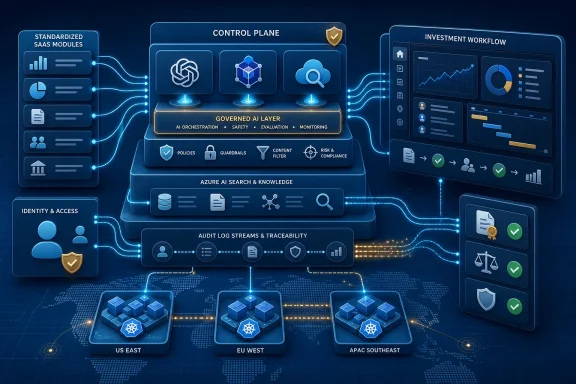 SimCorp Treats AI as a Platform Problem, Not a Feature Race
The phrase “AI at scale” has become one of enterprise technology’s most exhausted slogans, but SimCorp’s Azure migration gives it a sharper meaning. The company is not describing a chatbot bolted onto a legacy investment platform. It is describing a re-architecture of the operational substrate beneath portfolio management, risk analysis, middle-office workflows, and back-office processing.That distinction matters because SimCorp sells into one of the least forgiving software markets: global investment operations. Asset managers, pension funds, and insurers do not simply want better dashboards. They want faster decisions, cleaner data, consistent controls, and fewer reconciliation headaches, all while regulators and internal auditors demand proof that the machinery is working as claimed.
Microsoft’s customer story frames SimCorp’s strategy around a deceptively simple principle: migrate data, not environments. Instead of lifting each client’s bespoke estate into the cloud and preserving its quirks, SimCorp rebuilt client environments on a standardized SaaS architecture and moved data and integrations through controlled cutovers. That is a tougher organizational sell than a simple cloud migration, but it is also the only version likely to survive contact with AI governance.
The message for WindowsForum readers is broader than SimCorp itself. The next phase of enterprise AI will reward companies that already did the unglamorous work: platform standardization, identity discipline, infrastructure as code, telemetry, policy enforcement, and repeatable deployment. Everyone else will discover that an “AI strategy” built on inconsistent environments is really just a new way to multiply risk.
The Real Migration Was Away From Bespoke Operations
For years, enterprise software vendors were rewarded for flexibility that often looked like customization. A large client had its preferred workflows, its own integrations, its own operational habits, and sometimes its own local regulatory wrinkles. The vendor adapted, the client signed, and the complexity bill arrived later.SimCorp’s new model pushes against that old bargain. At the core of SimCorp One is a modular tenant architecture in which each client environment is assembled from standardized platforms and application modules drawn from a shared code base. The client may receive a different mix of modules, but the underlying way those modules are built, deployed, monitored, and governed remains consistent.
That is the cloud-native argument in its strongest form. SaaS is not just subscription licensing or someone else’s servers. SaaS becomes economically and operationally meaningful when the provider can improve one shared platform rather than maintain a museum of client-specific deviations.
The risk, of course, is that financial institutions are not generic tenants. They operate across jurisdictions, asset classes, mandates, and control regimes. SimCorp’s bet is that regional and regulatory variation should be handled through governed configuration, policy, and modular composition — not through handcrafted environments that become harder to patch, inspect, and evolve.
That bet is especially relevant now because AI systems amplify hidden differences. A traditional workflow might tolerate a few inconsistent reports or local integration oddities. An AI-powered workflow that retrieves, reasons over, or acts on that data may turn the same inconsistencies into decision risk. Standardization is not a cosmetic platform preference; it is a precondition for trustworthy automation.
Azure Becomes the Control Plane SimCorp Can Point Auditors Toward
Microsoft’s role in this story is not subtle. Azure is the control plane SimCorp has chosen for identity, logging, monitoring, security policy, regional operations, and the AI stack. For Microsoft, this is exactly the kind of customer story it wants in 2026: not a flashy consumer AI demo, but a regulated enterprise saying Azure lets it standardize the boring parts of trust.SimCorp standardized on Azure Kubernetes Service to run workloads consistently across regions. That choice is notable because Kubernetes can be either a platform enabler or a platform tax, depending on how it is operated. SimCorp’s own framing suggests it wants the orchestration benefits without turning AKS itself into a bespoke internal product that consumes engineering attention.
That is a mature cloud posture. Many enterprises adopted Kubernetes because it promised portability and scale, only to discover that the real cost lived in cluster lifecycle management, policy drift, network design, observability, and the endless choreography of upgrades. AKS does not remove those responsibilities, but it gives Microsoft-native shops a managed foundation that can integrate with Azure identity, policy, monitoring, and security tooling.
For regulated workloads, that integration is not a footnote. Identity and access controls need to be centrally managed. Logs need to be complete enough to support incident response and audit. Policies need to be applied consistently rather than reconstructed region by region. Automated deployment pipelines need to make the desired state reproducible, not merely convenient.
SimCorp’s platform story therefore reads less like “we moved to Azure” and more like “we reduced the number of places where governance can be forgotten.” That is the version of cloud migration IT leaders should care about.
“Migrate Data, Not Environments” Is the Sentence That Explains the Strategy
The most important phrase in Microsoft’s story is SimCorp’s decision to “migrate data, not environments.” It sounds like a migration tactic, but it is really an operating philosophy. The company is saying that the value of the move comes from rebuilding around a standard SaaS architecture, not from preserving each customer’s historical technical shape.Anyone who has lived through enterprise migrations knows why this is painful. Old environments encode business logic, political compromises, undocumented dependencies, and years of operational exception handling. Moving the data while rebuilding the environment forces hard conversations about what must survive, what must be refactored, and what was never as essential as users claimed.
But that discomfort is also where the value lives. If a vendor simply lifts every client’s environment into cloud infrastructure, the provider may gain elastic capacity and better procurement optics, but it has not solved operational fragmentation. It has merely moved fragmentation to a more expensive and more programmable place.
By contrast, controlled cutovers into standardized environments create a path toward consistent operations. Provisioning can be automated. Deployments can be repeatable. Configuration can be inspected. Integrations can be tested against known patterns. Incident response can begin from a shared map instead of a client-specific archaeological dig.
This is why the strategy is particularly relevant for AI. Agentic workflows are only as trustworthy as the systems they can observe and the boundaries they must obey. If the platform cannot prove which data an agent accessed, which policy applied, which identity was used, and which action was taken, then AI becomes an audit problem disguised as productivity software.
SimCorp’s AI Ambition Depends on the Data Layer Behaving Itself
The Microsoft story says SimCorp is using Microsoft Foundry, Azure OpenAI in Foundry Models, and Azure AI Search to embed AI directly into investment workflows. The capabilities described are familiar: faster insight discovery, reduced decision latency, automated operational processes, and improved analytics performance. The harder question is whether those capabilities can be made safe enough for financial institutions to trust.This is where SimCorp’s architecture matters more than the model branding. In investment operations, data is not merely content for a prompt. It is position data, market data, risk data, instrument data, accounting data, compliance data, and client-specific operational context. If those layers are fragmented, stale, or inconsistently governed, AI will accelerate confusion rather than decision-making.
Azure AI Search is important in this context because retrieval is becoming one of the core patterns for enterprise AI. Models need grounding in organizational data, and users need confidence that responses reflect current, permissioned, traceable information. A system that retrieves the wrong document, ignores entitlements, or blends tenant data improperly is not a productivity enhancement; it is a control failure.
SimCorp’s use of a shared platform foundation gives its AI ambitions a clearer shape. Product teams can pursue domain-specific use cases while centralized governance defines common standards, evaluation criteria, and approved components. That hub-and-spoke approach is increasingly common among enterprises trying to prevent AI experimentation from becoming a thousand uncontrolled pilots.
There is still plenty that the customer story does not prove. It does not tell outsiders how SimCorp validates model outputs, measures hallucination risk, handles human approval, or documents agentic actions in live workflows. But it does show the architectural direction: AI capabilities are being asked to inherit the platform’s controls rather than route around them.
The Forrester Numbers Are Useful, but They Are Not the Whole Story
Microsoft and SimCorp cite a Forrester Total Economic Impact study that puts a 134 percent return on investment over three years around SimCorp One, along with improved operational efficiency, lower total cost of ownership, productivity gains, and faster time to market. Those figures are attention-grabbing, and they will be the numbers sales teams remember.They should also be read with the usual caution. TEI studies are commissioned research, and they typically model a composite organization based on interviews rather than measuring every customer’s real-world outcome. That does not make the numbers meaningless, but it does mean they are directional evidence rather than a universal promise.
The more revealing details are the kinds of benefits being claimed. A composite client replaces legacy systems, reduces maintenance costs, improves operational efficiency, saves user time, and launches new products or enters new markets faster. Those are not narrow AI benefits. They are consolidation benefits.
That matters because the economics of AI in enterprise software are still being sorted out. Many organizations are paying for AI pilots before they can show durable productivity gains. SimCorp’s story suggests that the stronger financial case may come from combining AI with platform consolidation: fewer systems, fewer manual handoffs, fewer environment-specific processes, and faster access to governed data.
In other words, AI may be the banner, but system simplification may be the engine. If SimCorp customers are saving time, cutting operational drag, and moving faster, the gains probably come from the integrated platform as much as from any individual AI capability. That is not a criticism. It is the lesson.
Microsoft Foundry Is the Strategic Glue, but Azure Lock-In Is the Trade
Microsoft Foundry sits in this story as the strategic layer that connects models, agents, tooling, governance, and Azure infrastructure. For Microsoft, Foundry is meant to make Azure feel like the safest place to build enterprise AI because the development environment, model catalog, security posture, and operational controls can live under one umbrella.That is compelling for regulated customers. A financial software vendor does not want every product team inventing its own model access pattern, monitoring scheme, prompt store, evaluation method, and access-control model. A common AI stack reduces duplication and gives governance teams a smaller surface area to understand.
But the same integration that makes Azure attractive also deepens dependency. SimCorp’s architecture now leans on AKS, Azure identity and monitoring primitives, Azure AI Search, Azure OpenAI in Foundry Models, and Microsoft’s broader AI governance story. That may be exactly the right trade for SimCorp, but it is still a trade.
Cloud lock-in is often discussed too simplistically. The issue is not whether a company can theoretically move containers or data elsewhere. The issue is how deeply operational practice, security evidence, automation, observability, and developer workflows become tied to a particular provider’s assumptions. The more regulated the environment, the more expensive that evidence chain is to rebuild.
For many enterprises, the answer will still be yes. A single coherent control plane may be preferable to a theoretically portable but practically fragmented multi-cloud estate. SimCorp’s move suggests that in regulated AI, the winning platform may not be the one with the most abstract portability, but the one that makes governance easiest to prove.
AKS Is Doing the Quiet Work Behind the AI Headline
The AI branding will draw the clicks, but AKS is doing much of the architectural labor. SimCorp says it is moving a large and growing portion of workloads onto AKS while trying not to make AKS itself a product it must operate. That sentence captures one of the central tensions of modern platform engineering.Kubernetes gives software teams a common substrate for deploying containerized services, scaling workloads, and separating application concerns from infrastructure details. But Kubernetes also introduces a sprawling operational domain that can become its own center of gravity. If every team touches clusters differently, the platform loses the very consistency it was meant to provide.
SimCorp’s standardized tenant model reduces that risk by making AKS part of a repeatable delivery system. Infrastructure, application services, configurations, and integrations are provisioned through automated pipelines. The platform is not assembled by hand for each client; it is produced through code.
That is the difference between cloud-native aspiration and cloud-native operation. The former appears in architecture diagrams. The latter appears when engineers can roll out environments predictably, inspect drift, apply policy, monitor behavior, and recover from failures without rediscovering each tenant’s personality.
For Windows and Microsoft administrators watching from adjacent domains, the pattern should feel familiar. The enterprise lesson of the last decade has been that manual configuration does not scale. Whether the target is Windows endpoints, Entra identity, Azure resources, Kubernetes clusters, or AI services, the administrative center of gravity keeps moving toward declarative policy and automated enforcement.
The Financial Services Angle Raises the Bar
SimCorp’s customers operate in markets where delay, error, and opacity carry financial consequences. A portfolio manager waiting for overnight analytics is not just inconvenienced; they may be slower to react to changing risk. An operations team manually reconciling data across systems is not just inefficient; it is exposed to process failure.The Microsoft story says analytics that once took minutes can now complete in seconds and that users can save up to 10 hours per week. Those claims should be understood in context: the practical value is not simply speed, but moving analysis closer to the moment of decision. In volatile markets, the timing of insight can matter as much as the insight itself.
At the same time, the financial services context makes AI harder. A hallucinated summary in a consumer app is annoying. A flawed interpretation in an investment workflow can become a compliance, fiduciary, or operational problem. The burden on the platform is therefore heavier than in less regulated industries.
This is why SimCorp’s emphasis on auditability and visibility is not just vendor boilerplate. If AI is going to participate in investment workflows, institutions will need to know how decisions were informed, what data was used, which controls applied, and where human judgment remained in the loop. “Trust us, the model is smart” will not pass an internal risk committee.
The stronger claim SimCorp can make is that AI is being embedded into a platform already designed around governed operations. That does not eliminate AI risk, but it changes the starting point. Instead of trying to wrap controls around scattered experiments, SimCorp is attempting to make controls part of the environment in which AI capabilities are born.
The Developer Story Is Also a Governance Story
Microsoft’s customer story notes that SimCorp developers use GitHub Copilot as part of an AI-assisted development approach. That detail could have been a throwaway productivity line, but it fits the broader pattern. AI is entering both the product surface and the engineering process behind it.For software teams, AI-assisted coding can accelerate prototyping and reduce friction in routine development tasks. But in regulated software, faster code generation is not automatically better. The value depends on whether testing, review, security scanning, dependency management, and deployment controls keep pace.
That is where SimCorp’s platform discipline again becomes relevant. If development teams are producing changes faster, the delivery system must be able to absorb that speed safely. Automated pipelines, standardized environments, and shared observability become more important, not less.
There is a subtle inversion here. AI is often sold as a way to make developers more productive, but developer productivity can become a liability if the organization lacks strong engineering governance. The bottleneck moves from writing code to proving that code is secure, reliable, compliant, and operable.
SimCorp’s story does not provide enough detail to judge its software development lifecycle, but its architecture points toward the correct pressure point. AI-assisted development should be paired with more repeatable platform controls. Otherwise, enterprises risk generating change faster than they can govern it.
The SaaS Reset Reflects a Broader Industry Shift
SimCorp is not alone in pushing financial software toward SaaS, modularity, and managed cloud infrastructure. The industry has been moving away from large on-premises estates and toward platforms that promise faster upgrades, integrated data, and lower operational overhead. What is different now is that AI has raised the penalty for delaying that transition.Legacy investment systems were often optimized for stability and institutional specificity. Those qualities still matter, but they can conflict with the need to deploy AI-enabled workflows quickly and consistently. If each client environment is a snowflake, every new AI feature becomes a bespoke governance exercise.
The standardized SaaS model changes the economics of innovation. A provider can develop a capability once, validate it against common controls, and roll it out across tenants with the right configuration and entitlement boundaries. That is how consumer cloud services have operated for years, but enterprise financial technology has more constraints and a higher trust burden.
SimCorp’s Deutsche Börse ownership also adds strategic context. Deutsche Börse’s 2023 move to acquire SimCorp was part of a broader push into data, analytics, and investment management solutions. A unified Azure-based SaaS platform fits that direction because it makes SimCorp less like a traditional software vendor and more like a recurring, data-centric infrastructure provider for buy-side institutions.
The competitive question is whether clients will accept that standardization is now the price of faster innovation. Some will resist because customization has long been a comfort blanket. But the AI era is making that blanket expensive.
The Unasked Question Is How Far Agentic Workflows Should Go
Microsoft’s story includes the phrase agentic AI, which is now everywhere in enterprise technology. In principle, agents can reason across tasks, call tools, retrieve information, and help users complete multi-step workflows. In practice, the enterprise deployment of agents is still constrained by reliability, permissions, observability, and accountability.SimCorp’s architecture gives agents a more plausible home than many environments would. A standardized SaaS platform with shared identity, logging, monitoring, and policy enforcement is exactly the kind of place where agentic workflows can be bounded. The system can define what an agent may access, what it may do, and what must be recorded.
But the hardest questions remain organizational, not technical. Which actions should an AI system be allowed to take without human approval? Which recommendations require explanation? How should institutions measure model drift or workflow degradation? Who is accountable when a tool-assisted decision produces a poor outcome?
In investment operations, the safest near-term use cases are likely to be insight retrieval, summarization, exception triage, reconciliation assistance, reporting acceleration, and workflow guidance. The more directly an agent touches trading decisions, portfolio changes, compliance judgments, or client-facing commitments, the more intense the control requirements become.
SimCorp’s public framing wisely emphasizes governed intelligence rather than autonomous finance. That language matters. The future may include increasingly capable agents, but regulated institutions will not adopt them simply because the models improve. They will adopt them when the platform can make their behavior inspectable and their boundaries enforceable.
WindowsForum Readers Should Notice the Administrative Pattern
This story may look like Azure enterprise cloud news, but it echoes patterns Windows administrators have lived through for years. The endpoint management world moved from hand-built machines and local policy tweaks toward Intune, configuration profiles, compliance policies, telemetry, and conditional access. The server world moved from artisanal builds toward infrastructure as code and automated patching. The identity world moved from perimeter trust toward continuous evaluation.SimCorp’s Azure platform reset is the same governance pattern applied to investment management SaaS and AI. The unit of control has changed, but the administrative lesson is familiar: consistency beats heroics. A well-governed platform should make the secure path the default path.
That is also why the story matters beyond finance. Every organization experimenting with AI will eventually face the same questions SimCorp is trying to answer now. Where does the data live? Who can access it? How are actions logged? How are environments deployed? How does policy follow the workload? How do we prove any of this to an auditor, a regulator, or a customer?
The answer cannot be a spreadsheet of exceptions and a promise that the AI team is careful. It has to be platform architecture. It has to be repeatable. It has to survive scale.
SimCorp’s Azure Bet Leaves a Playbook, Not a Shortcut
SimCorp’s move is best read as a playbook for regulated AI rather than a shortcut to it. The company’s choices show what serious enterprise AI groundwork looks like when the stakes include auditability, market latency, operational resilience, and client trust.- SimCorp’s most consequential decision was to rebuild client environments around standardized SaaS architecture instead of preserving bespoke technical estates in the cloud.
- Azure Kubernetes Service gives SimCorp a common deployment substrate, but the value depends on automated pipelines, consistent policy, and disciplined operations around it.
- Microsoft Foundry, Azure OpenAI, and Azure AI Search matter because they let AI capabilities inherit a broader Azure governance model rather than exist as disconnected experiments.
- The cited ROI and efficiency figures are useful directional evidence, but the deeper business case is platform consolidation, not AI magic.
- The biggest unresolved issue is not whether agentic AI can be added to investment workflows, but how far institutions will allow it to act under regulated controls.
- For IT administrators, the practical lesson is that AI readiness looks a lot like old-fashioned operational maturity with better tooling and less tolerance for drift.
References
- Primary source: Microsoft
Published: 2026-05-27T00:30:09.923080
SimCorp unifies its SimCorp One platform on Azure to scale AI | Microsoft Customer Stories
SimCorp unified its SimCorp One platform on Azure to scale AI, standardize governance, and help customers deliver faster decisions and reduce effort.www.microsoft.com
- Related coverage: simcorp.com
Independent 2024 Total Economic Impact Study Revealed a 134% ROI with SimCorp One platform | SimCorp
2024 Total Economic Impact Study Revealed a 134% ROI with SimCorp One platformwww.simcorp.com
- Related coverage: tei.forrester.com

The Total Economic Impact™ Of SimCorp One
Cost Savings And Business Benefits Enabled By SimCorp One
tei.forrester.com
- Official source: blogs.microsoft.com
Microsoft at NVIDIA GTC: New solutions for Microsoft Foundry, Azure AI infrastructure and Physical AI - The Official Microsoft Blog
Microsoft combines accelerated computing with cloud scale engineering to bring advanced AI capabilities to our customers. For years, we’ve worked with NVIDIA to integrate hardware, software and infrastructure to power many of today’s most important AI breakthroughs. What’s new at NVIDIA GTC...blogs.microsoft.com - Official source: azure.microsoft.com
Microsoft Foundry | Microsoft Azure
Kickstart innovation with Microsoft Foundry, the AI app and agent factory designed to accelerate AI-driven, cloud-native development across industries.azure.microsoft.com
- Related coverage: crunchbase.com
- Related coverage: cbinsights.com
SimCorp - Products, Competitors, Financials, Employees, Headquarters Locations
SimCorp operates as a provider of integrated investment management solutions and services for the buy-side sector. Use the CB Insights Platform to explore SimCorp's full profile.www.cbinsights.com - Related coverage: pressmaverick.com
- Related coverage: morningstar.com
Deutsche Boerse: Exchange Group Announces Planned Takeover of Simcorp
Morningstar is an investment research company offering mutual fund, ETF, and stock analysis, ratings, and data, and portfolio tools. Discover actionable insights today.www.morningstar.com - Official source: ai.azure.com
