Hyland Moves Its Content Stack Closer to Azure’s Center of Gravity
Hyland’s deal with Microsoft lands at a moment when “AI readiness” has become the new migration pitch. Enterprises are no longer asking only whether a workload can run in the cloud. They are asking whether their data, documents, workflows, and compliance controls can be made useful to AI systems without blowing up governance models in the process.
That is where Hyland wants Content Innovation Cloud to sit. The company’s core argument is that enterprise AI cannot operate responsibly on a diet of disconnected PDFs, scanned forms, case files, customer records, archived correspondence, and SharePoint sprawl. The value is in the content, but so is the risk.
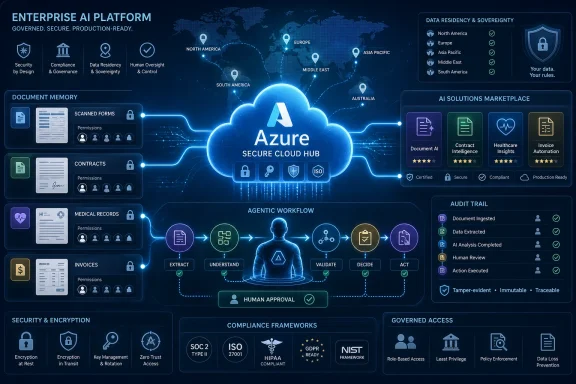
By bringing the platform to Azure, Hyland is not merely adding another hosting venue. It is placing its content services inside the same commercial, infrastructure, and AI orbit many large organizations already use for Microsoft 365, Entra identity, Purview governance, Azure AI services, and line-of-business modernization. That matters because enterprise architecture decisions increasingly hinge on reducing the number of trust boundaries an organization has to defend.
The partnership also gives Hyland a stronger answer to a persistent buyer objection: where exactly will the data live, who controls it, and how does that square with local regulation? Azure’s regional footprint gives Hyland a broader map to point to when customers in healthcare, insurance, finance, education, and government ask for data residency options. Those conversations are no longer edge cases; they are the center of enterprise software procurement.
The AI Story Is Really a Content Governance Story
The most revealing part of the announcement is not the phrase “agentic automation,” though it appears with the inevitability of the current market cycle. The revealing part is Hyland’s emphasis on governed content as the foundation for production AI. That is a more sober claim, and a more important one.
The industry has spent the past two years selling AI as a model problem. Choose the right model, tune the right prompt, connect the right copilots, and productivity will follow. But inside large organizations, the bottleneck is often far less glamorous: the AI system cannot see the right documents, cannot distinguish final from obsolete versions, cannot respect entitlements reliably, or cannot explain why it produced a recommendation based on a particular record.
Enterprise content management was once treated as a filing-cabinet discipline: capture, classify, retain, retrieve, archive. In the AI era, those old verbs become operational controls. A system that cannot determine whether a contract is current should not be drafting customer commitments. A claims assistant that cannot respect policyholder privacy should not be summarizing medical attachments. A government workflow bot that cannot preserve records rules is not a productivity tool; it is an audit finding waiting to happen.
Hyland’s opportunity is to reposition content management from back-office hygiene to AI enablement. That is a compelling repositioning, but it is not automatic. Customers will judge the Azure partnership by whether it makes governed content easier to use in actual workflows, not by whether it adds another logo slide to an AI deck.
Microsoft’s Marketplace Strategy Turns Procurement Into Platform Gravity
The Microsoft Marketplace component may sound like a sales-channel detail, but it is strategically important. Enterprise software buying has become as much about procurement mechanics as product capability. If a customer can retire an internal purchasing process by buying through an existing Microsoft agreement, the path from evaluation to deployment can shorten dramatically.
That is the premise behind marketplace-led cloud selling. Microsoft wants its marketplace to function as a trusted catalog for cloud solutions, AI applications, and agent-oriented software. Vendors want access to customers who already have Azure commitments and procurement relationships. Customers want fewer supplier onboarding cycles, fewer contract exceptions, and a clearer way to apply cloud spend to business initiatives.
For Hyland, being available through Microsoft Marketplace can make the platform easier to buy for Azure-centric enterprises. That does not guarantee adoption, but it removes friction from the part of the process where many enterprise deals stall. The technical buyer may care about architecture; the business sponsor may care about AI outcomes; the procurement team cares about contract path, spend alignment, and risk review.
Microsoft’s co-sell machinery also matters. A formal go-to-market arrangement means Hyland is not just placing a product in a digital catalog and hoping customers find it. The companies are aligning around enterprise use cases where content governance, workflow automation, and AI deployment intersect. In practical terms, that gives Microsoft field teams another story to tell when customers ask how to operationalize AI beyond Microsoft 365 Copilot experiments.
Regulated Industries Are the Real Prize
The announcement explicitly points toward sectors where content is both valuable and constrained: healthcare, insurance, financial services, education, and government. That focus is not incidental. These are the industries where AI demand is high, but the margin for governance failure is low.
Healthcare organizations sit on enormous volumes of clinical, administrative, billing, and imaging-related content. Insurers run on claims files, correspondence, policy documents, evidence packets, and regulatory records. Banks and public agencies face retention rules, jurisdictional restrictions, audit obligations, and strict access controls. In these environments, a generic AI assistant bolted onto a document store is not enough.
The harder problem is making AI context-aware without making it reckless. The system needs to know which documents matter, which versions are authoritative, which users are allowed to see which fragments, and how long records must be retained. Those are content services problems before they are AI problems.
Azure gives Hyland a stronger infrastructure story for those buyers. Microsoft’s cloud already has deep enterprise penetration and a compliance vocabulary familiar to regulated customers. Hyland brings domain-specific content management and workflow experience. The partnership is designed to make those two stories sound like one architecture rather than two vendors shaking hands in a press release.
Multicloud Remains the Escape Hatch Enterprises Still Demand
Hyland is careful to frame the Microsoft deal as part of a broader multicloud strategy rather than an exclusive pivot. That nuance matters. Large enterprises may standardize heavily on Azure, but they rarely live in a single-cloud fantasy world. Acquisitions, legacy systems, regional constraints, risk management policies, and departmental purchasing all produce hybrid and multicloud realities.
The Azure expansion gives customers more choice, but it also tests Hyland’s ability to preserve portability. If Content Innovation Cloud becomes meaningfully better on Azure than elsewhere, some customers will welcome the optimization while others will worry about lock-in. If it remains too abstracted from Azure’s native services, Microsoft-centric customers may wonder whether the partnership changes enough.
That tension is unavoidable. Deep integration creates value, but it also creates dependency. Enterprise buyers know this, and many now evaluate cloud partnerships by asking what happens if business, regulatory, or cost pressures force a change later. Hyland’s public emphasis on supporting customers “wherever they are” is therefore not just marketing language; it is a defensive necessity.
For Microsoft, the calculation is simpler. Every serious software platform that moves closer to Azure helps reinforce Azure as the place where enterprise AI projects become operational. The company does not need every partner to be exclusive. It needs the default path of least resistance to run through its cloud.
Agentic Automation Needs Boring Infrastructure More Than Bigger Promises
The phrase agentic automation is doing a lot of work in enterprise software right now. Vendors use it to describe AI-driven systems that can perform tasks, route work, trigger processes, and make decisions across applications with less human prompting. The concept is powerful, but the implementation depends on infrastructure that is decidedly unglamorous.
An agent that drafts a response, opens a case, retrieves a supporting document, updates a workflow, and notifies a user must operate inside a web of permissions and business rules. It must know when it has enough information and when it should escalate. It must leave a trace. It must not invent a record, ignore a retention rule, or surface confidential content to the wrong person.
That is why content governance is not a sidecar to agentic AI. It is one of the control planes. If enterprises are going to let AI systems act rather than merely answer, those systems need reliable access to the documents and metadata that define the business process. They also need the constraints that prevent action from becoming exposure.
Hyland’s pitch is that its platform can turn governed content into actionable intelligence. The phrase is polished, but the underlying need is real. Production AI will not be measured by demo quality; it will be measured by whether it can survive compliance review, user adoption, security scrutiny, and operational exceptions.
The WindowsForum Angle Is the Microsoft Cloud Flywheel
For WindowsForum readers, the news matters less because Hyland itself is a household name and more because it reflects Microsoft’s broader enterprise strategy. Azure is increasingly the gravitational center for Microsoft’s partner ecosystem, while Microsoft Marketplace is becoming the commercial front door for third-party cloud and AI software. That is a familiar pattern: Microsoft wins not only by building the platform, but by making the platform the easiest place to buy, deploy, govern, and justify adjacent software.
This has practical consequences for sysadmins and IT decision-makers. A Hyland-on-Azure deployment may reduce some integration friction in Microsoft-heavy environments, particularly where identity, security review, cloud procurement, and data residency policies already revolve around Microsoft tooling. It may also shift more content workloads into the same administrative orbit as other Azure services, changing how teams think about monitoring, access control, cost allocation, and incident response.
But convenience should not be mistaken for simplicity. Content platforms are sticky, deeply embedded systems. They touch records schedules, business processes, departmental habits, custom integrations, and compliance workflows. Moving or expanding them into Azure may be strategically attractive, but it still requires careful architecture and governance.
The most successful deployments will likely be those that treat the partnership as an opportunity to clean up content strategy, not merely rehost it. AI tends to expose organizational disorder. If the underlying document estate is duplicative, poorly classified, and inconsistently permissioned, putting it near Azure AI services does not magically make it trustworthy.
The Deal Makes Sense Because Both Sides Need the Same Missing Piece
Hyland needs scale, cloud relevance, and a stronger AI-era narrative. Microsoft needs partners that make Azure more useful for industry-specific, content-heavy workflows. The overlap is obvious: enterprises want AI, but they need it grounded in the information that actually runs the business.
The partnership also reflects a maturing AI market. In 2023 and 2024, many enterprise AI conversations were exploratory: pilots, proofs of concept, internal chatbots, and productivity experiments. By 2026, the pressure has shifted toward operational use, where executives expect measurable workflow impact and risk teams expect enforceable controls.
That shift favors vendors with credible governance stories. It also favors cloud platforms that can offer infrastructure, AI services, security tooling, commercial channels, and partner ecosystems as a bundle. Microsoft has been building precisely that bundle. Hyland is now trying to make sure its content layer is part of it.
The open question is execution. Partnerships are easy to announce and difficult to operationalize. Customers will want to see how deployment works across regions, how marketplace purchasing maps to existing agreements, how deeply Hyland integrates with Microsoft identity and AI services, and how the combined stack handles real-world governance edge cases.
The Practical Reading for Azure-Centric IT Teams
This announcement should not send every Hyland customer rushing to redraw architecture diagrams overnight. It should, however, prompt a more serious conversation about where enterprise content platforms sit in AI roadmaps. If AI strategy is being led entirely by application teams or data science groups, the organization may be overlooking the content layer that determines whether AI can safely act on business knowledge.
For Azure-centric shops, the immediate appeal is alignment. A content platform available through Azure and Microsoft Marketplace can fit more naturally into existing cloud governance and procurement models. That may be especially valuable for organizations already standardizing identity, security posture management, and compliance reporting around Microsoft tools.
For non-Azure or mixed-cloud organizations, the calculus is more nuanced. Hyland’s multicloud framing suggests customers should not read the deal as a forced migration signal. But over time, the richest integrations and most aggressive co-sell incentives may cluster where Microsoft sees strategic value. That is how platform ecosystems usually behave.
The best response is neither enthusiasm nor suspicion. It is due diligence. IT leaders should ask which workloads benefit from Azure deployment, which data residency requirements become easier to satisfy, which integrations improve, which costs shift, and which operational responsibilities remain unchanged.
Azure Gets Another Content On-Ramp, and Buyers Get Homework
The Hyland-Microsoft partnership is best understood as a content-governance play dressed in cloud expansion clothing. It gives Hyland more Azure reach, gives Microsoft another regulated-industry partner story, and gives customers another route to bring enterprise documents closer to AI-enabled workflows.
- Hyland Content Innovation Cloud is being made available on Microsoft Azure, expanding deployment options for customers with regional and data residency requirements.
- The companies are pairing the technical partnership with joint go-to-market and co-sell activity aimed at enterprise AI and workflow use cases.
- Microsoft Marketplace availability may simplify procurement for organizations that already buy cloud software through Microsoft agreements.
- The strongest fit is likely in regulated industries where unstructured content, compliance, and workflow automation are tightly connected.
- The partnership expands Hyland’s cloud options without being presented as an exclusive move away from multicloud deployment.
- The real test will be whether customers can use governed content in production AI systems without weakening security, compliance, or operational control.
The larger lesson is that enterprise AI is becoming less about spectacle and more about plumbing. Hyland and Microsoft are betting that the companies ready to move beyond pilots will need governed content, regional deployment flexibility, marketplace procurement, and AI infrastructure to work as one system. If that bet is right, the winners in the next phase of cloud AI will not be the vendors with the loudest demos, but the ones that make old business content safe enough, accessible enough, and useful enough for machines to act on it.
References
- Hyland and Microsoft Advance Enterprise AI with Content Innovation Cloud on Azure - Redmond Channel Partner Redmond Channel Partner · Wed, 03 Jun 2026 00:26:16 GMT