

LG’s CES 2026 OLED refresh is less about a single headliner and more about a pragmatic, multi‑tier push: the company is expanding its second‑generation 4‑layer Tandem WOLED technology into the flagship G6 line and—selectively—into the C6 family, pairing brighter panels with a beefed‑up Alpha 11 AI Processor Gen3 and a newly AI‑centric webOS 26; the result is meaningful picture‑quality gains on paper, but one very real caveat for buyers is the new SKU fragmentation that makes model codes more important than ever.
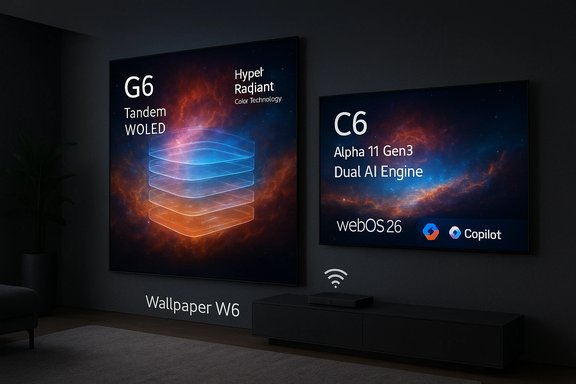
OLED makers have chased two stubborn tradeoffs for years: peak HDR headroom and ambient‑light usability. LG’s Tandem approach—stacking multiple emitter layers to boost light output while preserving OLED’s per‑pixel black—has been the company’s engineering answer to those limits. In 2026 LG markets this family of improvements under the banner Hyper Radiant Color Technology, combining panel stacking, optics, and processing to increase peak luminance, reduce reflection, and refine color reproduction. This year’s CES presentation doubles down on that thesis across three product axes: the G6 flagship range, a split‑tier C6 family (where Tandem is restricted to the largest sizes), and the return of a redesigned Wallpaper TV (W6) that adopts a near‑wireless “Zero Connect Box” approach to inputs. Those moves are complemented by webOS 26, which integrates multiple AI assistants, most notably Microsoft Copilot and Google Gemini, as well as an Alpha 11 Gen3 processor whose NPU and GPU upticks are central to LG’s claims about improved upscaling, tone mapping, and generative features.
For most readers shopping in 2026: the G6 is the clear technical flagship and the safe pick for early adopters who want the brightest, best‑processing OLED LG offers. The C6 remains the sweet spot for many buyers, but you must check whether the particular C6 you’re looking at is the Tandem‑equipped C6H variant or a standard C6/CS6. The W6 Wallpaper will be irresistible to design‑minded buyers with the budget and the installer resources to manage a flush, near‑wireless installation—but it’s also the model where real‑world caveats matter most.
LG’s strategic bet is simple and defensible: make OLED brighter and less reflective, pair it with stronger on‑device AI and gaming features, and give consumers more choices—at the cost of a more complex SKU map. That tradeoff will pay off for informed buyers who read labels carefully and wait for independent testing; for everyone else, the year ahead will be a period of clarification as reviews arrive and independent labs put LG’s new claims to the test.
Conclusion: CES 2026 showed LG moving OLED forward in measurable ways—brightness, reflection control, and smarter processing—while also reminding us that the devil for consumers is in the details. Verify SKUs, wait for independent labs on the headline numbers, and plan installations carefully if you’re tempted by the W6’s near‑invisible aesthetic. If LG’s vendor claims hold up under scrutiny, 2026 could be the year OLED finally sheds a major stigma: poor performance in bright rooms.
Source: 91mobiles.com CES 2026: LG’s G6 and C6 OLED series TVs get Tandem OLED panels, but there’s a catch | 91mobiles.com
 Background
OLED makers have chased two stubborn tradeoffs for years: peak HDR headroom and ambient‑light usability. LG’s Tandem approach—stacking multiple emitter layers to boost light output while preserving OLED’s per‑pixel black—has been the company’s engineering answer to those limits. In 2026 LG markets this family of improvements under the banner Hyper Radiant Color Technology, combining panel stacking, optics, and processing to increase peak luminance, reduce reflection, and refine color reproduction. This year’s CES presentation doubles down on that thesis across three product axes: the G6 flagship range, a split‑tier C6 family (where Tandem is restricted to the largest sizes), and the return of a redesigned Wallpaper TV (W6) that adopts a near‑wireless “Zero Connect Box” approach to inputs. Those moves are complemented by webOS 26, which integrates multiple AI assistants, most notably Microsoft Copilot and Google Gemini, as well as an Alpha 11 Gen3 processor whose NPU and GPU upticks are central to LG’s claims about improved upscaling, tone mapping, and generative features. How LG is distributing Tandem WOLED: G6 vs C6
G6: flagship gets the full Tandem treatment
LG’s 2026 G6 series is positioned as the company’s 4K OLED flagship and receives the second‑generation 4‑layer Tandem WOLED across most sizes. The marketing shorthand—Hyper Radiant Color Technology—highlights a roughly 20% peak brightness uplift versus last year’s G5 and claims of significantly higher luminance compared with entry‑level B‑series models. LG also applied a new anti‑reflective optical stack to the 55", 65", 77" and 83" G6 sizes that the company says cuts perceived glare by about 50%, helping preserve deep blacks in brighter rooms. Independent lab verification of absolute nit figures is still pending, but multiple outlets relayed the same vendor claims at CES. Key G6 highlights:- Second‑generation 4‑layer Tandem WOLED panel (branded Hyper Radiant Color).
- Brightness Booster Ultra pipeline and anti‑reflective coating on most larger sizes.
- Alpha 11 AI Processor Gen3 delivering higher NPU throughput for Dual AI Engine processing.
C6: a split family with a gotcha
Where LG’s messaging gets complicated is the C6 series. Rather than a single, consistent C‑line, LG is shipping three sub‑families: C6, CS6, and C6H. Crucially, only the C6H 77‑ and 83‑inch models get a Tandem upgrade; smaller C6 and CS6 sizes retain the older panel tech. That makes Tandem a selective premium inside the C lineup rather than a universal uplift—an important retail and buying detail that can be easily missed if shoppers assume every C6 is the same. Practical consequence: when comparing prices or pre‑ordering, the model suffix (G6 vs C6H vs C6/CS6) matters as much as the diagonal. Retailers and buyers will need to verify SKUs closely to avoid disappointment.Alpha 11 Gen 3: more than marketing?
LG calls the new SoC the Alpha 11 AI Processor Gen3, and it’s central to many of the company’s claims: faster CPU and GPU, and a much more capable NPU. LG’s materials and trade coverage quote a roughly 5.6× jump in NPU performance compared with the previous generation, alongside notable CPU/GPU gains. That compute headroom enables LG’s Dual AI Engine, which can run denoising and texture preservation in parallel, and underpins features such as advanced upscaling, HDR tone mapping, and some of the new generative abilities in webOS 26. Those processor claims are vendor supplied and should be verified in real‑world tests—benchmarks and reviewer measurements will be the true test of whether Alpha 11’s extra NPU translates into noticeable, repeatable picture improvements or merely marketing noise.webOS 26 and the Multi‑AI strategy
LG’s webOS 26 is not merely an incremental UI update; it’s a Multi‑AI play. The platform now integrates Microsoft Copilot for conversational, productivity‑style queries and Google Gemini for generative art tasks within Gallery+. LG also emphasizes privacy and latency benefits of on‑device inference for routine tasks while allowing complex generative jobs to fall back to cloud models when necessary. The practical benefits LG is pitching include personalized voice profiles (Voice ID), an “In This Scene” contextual concierge, and generative artwork creation directly on the TV. This multi‑assistant approach increases flexibility but raises legitimate questions:- Which assistant is the default, and how will LG present switching options in the UI?
- How are privacy and account linking handled across services (Copilot, Gemini)?
- Which features run locally on the TV and which require cloud processing or linked accounts?
Wallpaper W6: the return of near‑wireless OLED
LG revived the Wallpaper TV concept with the new OLED evo W6, a near‑wall‑flush panel in a 9 mm‑class chassis paired with a Zero Connect Box that moves all I/O and heavier electronics off the panel. The Zero Connect Box communicates wirelessly with the screen and can be placed up to 10 meters away per LG’s spec; the panel still requires mains power behind the wall. LG claims the wireless transmission is “visually lossless” and that the W6 benefits from the same Hyper Radiant Color Technology and Brightness Booster Ultra stack as the G6 family. The architectural tradeoffs are clear:- Pro: dramatically cleaner aesthetics and near‑flush mounting without visible cabling.
- Con: a new single point of failure (the Zero Connect Box) and potential environmental vulnerabilities—RF interference, building materials, or crowded Wi‑Fi bands could affect reliability or introduce latency, particularly for high‑refresh gaming.
Gaming and connectivity: very gamer‑friendly on paper
LG is courting gamers aggressively:- Native GeForce Now 4K/120Hz cloud gaming (on compatible models).
- Support for 4K at up to 165Hz in PC modes and standard console‑grade 4K/120Hz.
- Low‑latency Bluetooth controller support via Bluetooth Ultra Low Latency (ULL) and HDMI VRR with NVIDIA G‑Sync and AMD FreeSync.
- Pixel response time ≠ input lag. LG’s quoted 0.1 ms pixel switching is a panel metric; end‑to‑end input lag remains the key competitive metric and must be measured with the entire signal chain, including any wireless hop (Zero Connect) when relevant.
- These OLEDs retain HDMI 2.1 ports rather than adopting any newer HDMI spec touted elsewhere; that preserves the current ecosystem (VRR, ALLM, eARC, 4K/120/165Hz) but does not future‑proof for hypothetical next‑gen HDMI flavors.
What’s been verified and what still needs labs
LG’s CES materials and multiple trade outlets agree on the broad strokes: Tandem expansion into G6 and into certain large C6H SKUs; Alpha 11 Gen3 with a larger NPU; webOS 26 with multi‑assistant support; and the comeback of the Wallpaper W6 with a Zero Connect Box. Those are credible, consistent claims across the vendor and press briefing cycle. But several headline numbers are vendor‑measured and measurement‑sensitive:- The oft‑quoted 3.9× peak brightness claim is expressed for narrow test windows (e.g., 3% APL) and does not directly translate to sustained brightness across large scenes; independent lab testing across multiple APL windows (1%, 3%, 10%, full screen) is needed to compare real HDR performance.
- The 5.6× NPU performance claim for Alpha 11 Gen3 is a vendor metric. Real‑world throughput—how that extra compute affects upscaling, tone mapping latency, and end‑to‑end input lag—requires practical benchmarks.
- The Zero Connect wireless link’s “visually lossless” and low‑latency claims are plausible in lab demos but are environment‑dependent; interference, walls, and apartment RF congestion can change behavior. Independent home‑environment tests will be decisive.
Strengths: what LG got right
- Practical brightness improvements. If Tandem and Brightness Booster Ultra deliver as promised, OLED becomes genuinely more usable in bright rooms—solving a longstanding consumer pain point.
- End‑to‑end system thinking. LG pairs panel upgrades with a faster SoC (Alpha 11 Gen3) and software (webOS 26). That reduces the risk of a brighter panel being hamstrung by weak tone mapping or upscaling.
- Design pragmatism. The W6’s slightly thicker 9 mm‑class approach is a sensible engineering trade‑off that improves durability and thermal headroom versus wafer‑thin prototypes.
- Gamer features in the mainstream. GeForce Now 4K/120, 4K/165Hz PC modes, and Bluetooth ULL controller support represent concrete, usable features for gamers.
Risks and weaknesses
- SKU fragmentation and buyer confusion. The C6 split (C6 / CS6 / C6H) creates a patchwork of capabilities. Buyers must verify exact model codes to ensure they’re getting Tandem and anti‑reflection treatments.
- Vendor‑measured headline numbers. The most eye‑catching claims (3.9× brightness, 5.6× NPU) are reliant on specific test conditions; independent lab data is required for consumer confidence.
- Zero Connect dependency. The W6’s attractiveness rests on a wireless AV hop that adds a potential single point of failure and environmental sensitivity; that’s an installation and reliability risk compared with conventional wired systems.
- Connectivity conservatism. Sticking with HDMI 2.1 keeps compatibility but neglects to signal leadership on any forthcoming HDMI spec changes, which might matter to early adopters seeking maximum future‑proofing.
Practical buying checklist
- Confirm the exact model code before purchase: G6 = Tandem broadly; C6H 77"/83" = Tandem; smaller C6/CS6 = older panel.
- Wait for independent measurements of peak and sustained nits across multiple APL windows if HDR peak brightness is a deciding factor.
- If installing a W6 Wallpaper unit, plan for professional mounting, flush mounting tolerances, and in‑wall power routing; test the Zero Connect Box for latency and reliability in your environment.
- Gamers should demand real end‑to‑end lag measurements with their controllers and preferred consoles/PC configurations, and test VRR behavior in high‑refresh modes.
- Budget for a soundbar or AV system: ultra‑thin Wallpaper units rarely deliver satisfying integrated audio for cinema or immersive gaming.
Final assessment
LG’s CES 2026 slate is a coherent evolution rather than a radical reinvention. The company doubled down on OLED’s strengths—contrast, design, and now brighter HDR headroom—while acknowledging practical tradeoffs through more conservative engineering choices (the 9 mm‑class W6) and segmented SKUs to preserve price tiers. If the Tandem WOLED and anti‑reflective optics perform as LG claims, these models will materially reduce the living‑room compromises that have historically limited OLED in bright environments. That said, buyers should treat the most aggressive numbers as provisional. The 3.9× brightness and NPU multipliers are manufacturer‑measured and sensitive to measurement methodology. The real proof will come from independent lab testing, long‑term usage reports (for reliability and brightness durability), and hands‑on reviews that assess latency, VRR stability, and wireless reliability in the W6.For most readers shopping in 2026: the G6 is the clear technical flagship and the safe pick for early adopters who want the brightest, best‑processing OLED LG offers. The C6 remains the sweet spot for many buyers, but you must check whether the particular C6 you’re looking at is the Tandem‑equipped C6H variant or a standard C6/CS6. The W6 Wallpaper will be irresistible to design‑minded buyers with the budget and the installer resources to manage a flush, near‑wireless installation—but it’s also the model where real‑world caveats matter most.
LG’s strategic bet is simple and defensible: make OLED brighter and less reflective, pair it with stronger on‑device AI and gaming features, and give consumers more choices—at the cost of a more complex SKU map. That tradeoff will pay off for informed buyers who read labels carefully and wait for independent testing; for everyone else, the year ahead will be a period of clarification as reviews arrive and independent labs put LG’s new claims to the test.
Conclusion: CES 2026 showed LG moving OLED forward in measurable ways—brightness, reflection control, and smarter processing—while also reminding us that the devil for consumers is in the details. Verify SKUs, wait for independent labs on the headline numbers, and plan installations carefully if you’re tempted by the W6’s near‑invisible aesthetic. If LG’s vendor claims hold up under scrutiny, 2026 could be the year OLED finally sheds a major stigma: poor performance in bright rooms.
Source: 91mobiles.com CES 2026: LG’s G6 and C6 OLED series TVs get Tandem OLED panels, but there’s a catch | 91mobiles.com
