

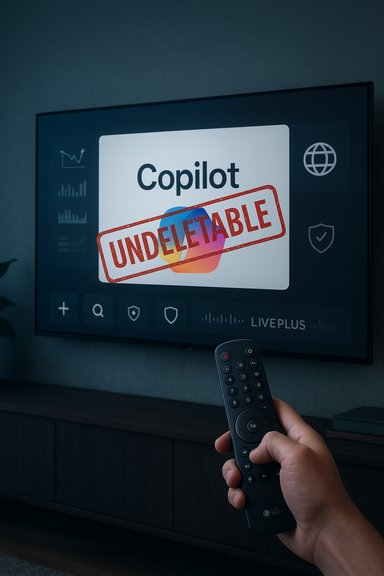
LG smart TVs have started receiving a webOS update that pins Microsoft’s Copilot to the home screen — and for many owners the shortcut arrived as effectively non‑removable, touching off one of the clearest consumer backlash moments of the “AI everywhere” era.
LG and Microsoft announced a partnership to bring Microsoft Copilot to big‑screen TVs as part of an “AI TV” push first publicized at trade shows earlier in the year. The public pitch framed Copilot as a helpful, conversational assistant for content discovery, spoiler‑free recaps, and voice‑first navigation on webOS. That strategic alignment made Copilot on TVs inevitable; the controversy centers on how it was delivered to already‑sold devices.
In mid‑December, a routine firmware‑over‑the‑air (FOTA) update added a Copilot tile to many LG home screens. A large number of owners reported that the tile could be hidden but not deleted through the TV’s normal Edit/App Manager tools, and in multiple documented cases a factory reset restored the tile — a pattern that strongly suggests system‑level or firmware‑baked provisioning rather than a normal user‑installable app. That behavior was widely circulated in forums, with one Reddit thread alone attracting tens of thousands of upvotes and thousands of comments. LG has since said the Copilot entry is a browser‑based shortcut and has promised a future webOS update that will let owners delete the tile — although the company gave no firm timeline at the time of reporting.
The core failure here is procedural: LG shipped a convenience feature in a way that felt like an imposition to owners of hardware they already purchased. The immediate fix — making the tile deletable and publishing clear privacy disclosures — is straightforward product work. The larger lesson is institutional: how updates are applied to connected products matters as much as what functionality they add.
Until vendors standardize consent‑first practices for non‑security updates and provide transparent telemetry details, smart‑device users are justified in treating such surprise additions with deep skepticism. For owners who value control and privacy, the safest path remains careful update management, strong network segmentation, or relying on external streaming hardware that gives them full uninstallability and clearer choice architecture.
LG’s Copilot rollout is both a technical and a product‑management cautionary tale: a reminder that when an assistant is delivered without clear user consent and without an obvious uninstall path, utility quickly turns into distrust.
Source: FlatpanelsHD LG forces Copilot AI app onto Smart TVs – no way to delete it
 Background / Overview
LG and Microsoft announced a partnership to bring Microsoft Copilot to big‑screen TVs as part of an “AI TV” push first publicized at trade shows earlier in the year. The public pitch framed Copilot as a helpful, conversational assistant for content discovery, spoiler‑free recaps, and voice‑first navigation on webOS. That strategic alignment made Copilot on TVs inevitable; the controversy centers on how it was delivered to already‑sold devices.In mid‑December, a routine firmware‑over‑the‑air (FOTA) update added a Copilot tile to many LG home screens. A large number of owners reported that the tile could be hidden but not deleted through the TV’s normal Edit/App Manager tools, and in multiple documented cases a factory reset restored the tile — a pattern that strongly suggests system‑level or firmware‑baked provisioning rather than a normal user‑installable app. That behavior was widely circulated in forums, with one Reddit thread alone attracting tens of thousands of upvotes and thousands of comments. LG has since said the Copilot entry is a browser‑based shortcut and has promised a future webOS update that will let owners delete the tile — although the company gave no firm timeline at the time of reporting.
What actually happened — the observable facts
- A webOS FOTA update applied to many LG models inserted a visible Copilot tile into the home ribbon.
- The tile typically launches a web‑based Copilot interface in the TV’s browser shell and accepts voice input from the remote in many implementations.
- When users open the Edit/App Manager, the usual uninstall affordance is missing for Copilot; the UI commonly offers only Hide or Disable.
- Several owners who performed a factory reset reported the tile reappearing, indicating the component is present in the system image or installed as a privileged package.
Timeline (concise)
- LG and Microsoft preview Copilot for TVs at CES and in product messaging.
- Routine webOS FOTA rollout begins; Copilot tile appears on many owners’ home screens.
- Reddit and forum posts documenting the tile’s undeletable behavior go viral.
- Press coverage amplifies the story; LG responds with a promise to allow deletion in a future update.
Technical anatomy — why the tile felt “undeletable”
Understanding why a new piece of software can feel permanent on a smart TV requires a quick primer on platform packaging:- User‑installable apps: Delivered through the platform store, sandboxed, and removable by consumers through the app manager.
- System / preinstalled apps: Bundled with firmware or marked as privileged packages; these are often hidden from uninstall controls because the vendor considers them integral to the platform.
Web shortcut vs native app
On many affected TVs the Copilot entry behaved like a browser shortcut (a tile that launches Copilot’s web UI inside the TV’s browser) rather than a deep native integration. That reduces deployment complexity for vendors but also explains why the item might not appear in the app‑uninstall workflow and why microphone activation and richer features still require explicit consent and sign‑in. LG has told media it is a shortcut — not a native app — which aligns with forensic observations of the behavior.Privacy, telemetry, and the Live Plus context
Smart TVs are already potent data collectors: Automatic Content Recognition (ACR), ad personalization toggles, voice‑enabled remotes, and cloud‑based recommendation services feed a broad telemetry surface. LG’s platform includes an ACR/personalization feature marketed under names such as Live Plus, which can identify what you’re watching to power targeted content and ads. Several owners noted the update also surfaced Live Plus‑style settings and that ad personalization flags were present in some menus after the update. The combination of a persistent Copilot tile plus ACR‑style capabilities increases the perceived risk profile for users:- Copilot queries could be recorded or routed through Microsoft cloud services if the user engages with the assistant.
- Microphone activation typically requires user consent on modern platforms, but the presence of an assistant tile in the UI increases the likelihood of microphone use and data collection events.
- Without granular, persistent vendor disclosures about what data flows to Microsoft (or to LG for analytics/ads), owners are left to guess how conversational data, on‑screen context, and device identifiers may be joined for profiling.
Vendor responses and corrections
LG’s public response acknowledged the backlash and said the Copilot tile is a browser shortcut that will be made deletable in an upcoming webOS update. The company stated microphone input will activate only after explicit user consent. LG did not provide a firm timeline for the deletion update at the time of initial reports. That response represents a partial climbdown: it admits the tile’s technical form (a shortcut) and concedes the UI must be fixed to meet user expectations about control. However, the lack of a specific release date for the fix leaves affected owners in limbo and does not yet answer deeper questions on telemetry defaults or why the update was applied without a clearer opt‑in path for installed devices.Strengths and potential benefits of Copilot on TVs
While the rollout delivery deserves scrutiny, the underlying feature has legitimate upsides:- Convenience: A well‑implemented assistant can speed content discovery, provide spoiler‑free recaps, and make on‑screen search more natural than remote‑typing.
- Accessibility: Voice‑driven controls and conversational guidance can help users with mobility or vision impairments.
- Platform advantage: For LG, a built‑in assistant that ties into curated TV features is a differentiator in a hyper‑competitive hardware market.
Risks, harms, and unresolved questions
- Erosion of device autonomy: Installing a persistent system tile on hardware already sold reduces user agency. Consumers reasonably expect to remove or opt out of post‑sale software additions.
- Opaque telemetry: Without clear, persistent disclosures, owners cannot reliably know whether conversational queries, microphone events, or on‑screen metadata are retained, how long they are stored, or which entities can access them. That opacity is particularly sensitive when smart TVs sit in private spaces.
- Regulatory exposure: In jurisdictions with strict consumer privacy and “negative option” rules, adding persistent services without explicit opt‑ins could attract regulatory attention or complaints. The issue also raises potential consumer‑protection questions around material changes to purchased products.
- Precedent for forced features: If OEMs normalize shipping partner services as undeletable system items, the long‑term market effect may be worse: less trust, more fragmentation in platform choices, and stronger incentives for consumers to avoid “smart” platforms entirely.
- Unverified claims and inflammatory language: Some outlets and community posts used phrases like “backroom deal” or suggested malicious intent in vendor decisions. Those characterizations are politically and rhetorically powerful but not proven by the published record; they should be treated cautiously unless corroborated by documentation or whistleblower evidence. FlatpanelsHD’s framing that Microsoft and LG “struck a backroom deal to force Copilot” is a charging phrase without independently verified proof in public disclosures and should therefore be labeled an allegation rather than an established fact.
Practical guidance for affected owners
If your LG TV picked up the Copilot tile and you want to regain control, these steps may help reduce exposure and nuisance:- Use the TV’s app Edit or App Manager to Hide or Disable the Copilot tile (this removes the visual clutter but may not uninstall the underlying component).
- Review and turn off Live Plus / ACR / ad personalization settings in system Privacy menus where available. That reduces the platform’s content recognition and cross‑profile ad targeting.
- Limit microphone access: disable voice recognition or require explicit consent where the OS exposes the toggle.
- If you require stronger isolation, place the TV on a guest VLAN with restricted outbound access or control DNS to block known telemetry endpoints (advanced). This can reduce third‑party tracking but also disables other smart features and updates.
- Consider using an external streaming device you control (Apple TV, Roku box, Android TV / Chromecast dongle) and limit the TV to HDMI input if preserving a “dumb” display experience is a priority.
Industry context — this is not an isolated trend
OEMs across ecosystems have increasingly used platform updates to add partner services, promotional tiles, and integrated AI experiences. Examples include past criticisms of advertising on TV screens and forced app tiles across competing platforms. Samsung, Roku, Amazon, and Google have all faced similar consumer complaints when platform changes altered the device experience post‑purchase. The Copilot episode is the latest, higher‑stakes variant because it involves a conversational assistant and microphone capability. From a platform economics perspective, manufacturers see value in bundling services that increase engagement and generate data‑driven monetization. From a consumer perspective, those same moves can read as sneaky — especially when they change device behavior after the sale and remove the expected uninstall paths.What vendors and regulators should do next
- Vendors must adopt consent‑first update policies for non‑security feature additions to already‑sold devices: announce the change, request an explicit opt‑in, and provide an easy uninstall or delete pathway.
- Product teams should ship privacy‑minimal defaults for new AI assistants: off by default for data sharing features, and on‑demand activation of microphone capabilities.
- Regulators and consumer advocates should clarify whether post‑sale software changes that materially alter device function require a customer consent mechanism or disclosure under consumer protection laws, especially where personal data processing is implicated.
Final assessment — balance of utility versus trust
The presence of Copilot on TVs is, in principle, a sensible extension of conversational AI to a major household surface. It can make large‑screen entertainment more interactive, accessible, and helpful. That potential does not excuse a rollout that undermines user agency.The core failure here is procedural: LG shipped a convenience feature in a way that felt like an imposition to owners of hardware they already purchased. The immediate fix — making the tile deletable and publishing clear privacy disclosures — is straightforward product work. The larger lesson is institutional: how updates are applied to connected products matters as much as what functionality they add.
Until vendors standardize consent‑first practices for non‑security updates and provide transparent telemetry details, smart‑device users are justified in treating such surprise additions with deep skepticism. For owners who value control and privacy, the safest path remains careful update management, strong network segmentation, or relying on external streaming hardware that gives them full uninstallability and clearer choice architecture.
LG’s Copilot rollout is both a technical and a product‑management cautionary tale: a reminder that when an assistant is delivered without clear user consent and without an obvious uninstall path, utility quickly turns into distrust.
Source: FlatpanelsHD LG forces Copilot AI app onto Smart TVs – no way to delete it
