

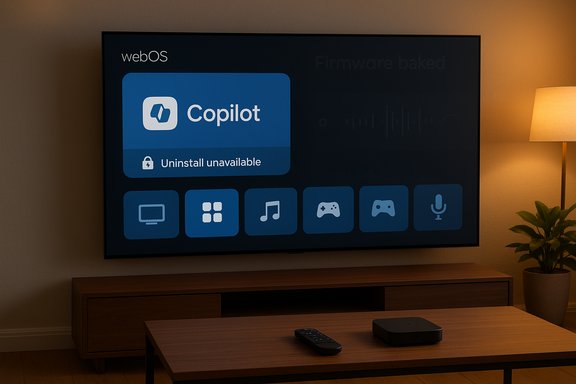
LG owners discovered a Microsoft Copilot tile on their TV home screens after a routine webOS firmware push — and for many the new AI entry point behaves like a system component that can be hidden but not removed, touching off a rapid backlash about device control, privacy, and how AI is being pushed into living-room hardware.
Smart televisions have ceased to be passive displays and are now full-fledged computing platforms that receive frequent firmware-over-the-air (FOTA) updates. In early 2025 major TV OEMs publicly signaled plans to surface Microsoft Copilot — a conversational AI assistant — on living-room screens, pitching it as a convenience for content discovery and on-screen contextual help. Samsung publicly staged a Copilot rollout for select 2025 models; LG likewise showcased Copilot in webOS demos and an “AI Remote” concept at trade shows.
The controversy began when owners reported that a recent webOS update inserted a Copilot tile or shortcut into the home ribbon of some LG TVs. Multiple community reports show the tile is often pinned near the top of the home screen and, crucially, does not present the usual uninstall affordance in the Edit/App Manager UI — owners can hide or disable it, but cannot delete it. Several users who performed a factory reset found the tile reappeared, strongly suggesting the component was delivered as a privileged system package or embedded in the firmware image rather than as a user-installed, removable app.
This is not just an annoyance: it raises core questions about ownership, consent, and telemetry on devices most people put in living rooms — spaces with multiple household members and heightened privacy expectations.
Past incidents in the smart-TV industry underline the stakes: regulators fined or settled with vendors after undisclosed data collection, and academic studies have repeatedly found wide-ranging tracking across channels and apps on TV platforms. In that context, a non-deletable assistant that’s always visible — and that could be tied to ACR or voice capture flows — fuels legitimate concerns about consent and data minimization.
Important caveat: claims that Copilot introduced brand-new classes of telemetry (for example, always-on ambient audio capture beyond existing webOS voice handling) were not confirmed by LG or Microsoft at the time of community reporting. Such claims should be handled cautiously and require vendor disclosures or independent network/firmware analysis to verify.
The practical difference: Samsung’s rollout appeared to be more clearly staged and communicated in supported models, while LG’s apparent quiet push via FOTA without a visible user opt-in or an easy uninstall route created surprise and frustration among owners.
If an OEM pushes a persistent AI assistant without transparent disclosures or without a clear opt-in for contextual personalization (ACR, voice-based features), that could attract complaint-driven investigations — particularly in privacy-sensitive regions. The prudent legal approach for vendors is to provide clear, accessible documentation about what was installed, how telemetry is handled, and how users can opt-out or remove the service.
Recommended steps, from least to most disruptive:
Users who value control and privacy are rightly upset: if a feature can be pushed silently and reappear after a factory reset, the device begins to feel less like an object they own and more like a service platform controlled by the manufacturer. The remedy is straightforward: better communication, privacy-minimal defaults, explicit opt-ins, and a supported removal or rollback path. Until vendors adopt those practices, useful AI will repeatedly collide with user expectations — and every surprise home-screen tile will be seen not as innovation but as another piece of bloatware forced into the living room.
Source: findarticles.com Microsoft Copilot Installed on LG Smart TVs, Removal Unclear
 Background
Smart televisions have ceased to be passive displays and are now full-fledged computing platforms that receive frequent firmware-over-the-air (FOTA) updates. In early 2025 major TV OEMs publicly signaled plans to surface Microsoft Copilot — a conversational AI assistant — on living-room screens, pitching it as a convenience for content discovery and on-screen contextual help. Samsung publicly staged a Copilot rollout for select 2025 models; LG likewise showcased Copilot in webOS demos and an “AI Remote” concept at trade shows.The controversy began when owners reported that a recent webOS update inserted a Copilot tile or shortcut into the home ribbon of some LG TVs. Multiple community reports show the tile is often pinned near the top of the home screen and, crucially, does not present the usual uninstall affordance in the Edit/App Manager UI — owners can hide or disable it, but cannot delete it. Several users who performed a factory reset found the tile reappeared, strongly suggesting the component was delivered as a privileged system package or embedded in the firmware image rather than as a user-installed, removable app.
This is not just an annoyance: it raises core questions about ownership, consent, and telemetry on devices most people put in living rooms — spaces with multiple household members and heightened privacy expectations.
What actually happened — the observable facts
- After a standard webOS FOTA update, a visible Copilot tile or shortcut appeared on the home ribbon of affected LG TVs.
- In many reported cases the TV’s Edit or App Manager workflow did not include an uninstall/delete option for Copilot; at best the UI offered hide or disable.
- Several owners reported that a factory reset restored the Copilot tile, consistent with a firmware-baked or privileged system install rather than a removable content-store app.
- Early attempts to remove or neutralize Copilot included hiding the tile, disabling related personalization settings (Live Plus/ACR), using router/DNS blocks, or taking the TV offline; none of these are elegant universal fixes.
Why packaging and delivery mechanics matter
System package vs. native app: the user-experience difference
A native, user-installable app can normally be removed through the UI. A privileged system package or a component baked into a firmware image is managed by the platform and may only expose limited UI actions (hide/disable), not uninstall. The difference is important because:- System packages persist across factory resets if included in the firmware image.
- System-level installs bypass the typical app sandboxing and management flows.
- A web wrapper or shortcut is easier for vendors to push widely but may reduce transparency around permissions and telemetry.
Why some vendors choose system installs
From an engineering and commercial perspective, installing a feature as a system component is attractive: it guarantees presence, simplifies sign-on and voice integration, and ensures the assistant is discoverable. From a business perspective, a persistent AI entry point drives engagement and home-screen advertising opportunities. These incentives are rational for OEMs and platform partners — but they collide with user expectations of post-purchase control and with privacy best practices if defaults and opt-outs are not handled transparently.Privacy and telemetry: what’s at stake
Smart TVs already collect significant signals through features like Automatic Content Recognition (ACR), sometimes marketed under names such as Live Plus. A conversational assistant that benefits from on-screen context or cross-device signals can increase the telemetry surface and deepen personalization in ways users may not expect.Past incidents in the smart-TV industry underline the stakes: regulators fined or settled with vendors after undisclosed data collection, and academic studies have repeatedly found wide-ranging tracking across channels and apps on TV platforms. In that context, a non-deletable assistant that’s always visible — and that could be tied to ACR or voice capture flows — fuels legitimate concerns about consent and data minimization.
Important caveat: claims that Copilot introduced brand-new classes of telemetry (for example, always-on ambient audio capture beyond existing webOS voice handling) were not confirmed by LG or Microsoft at the time of community reporting. Such claims should be handled cautiously and require vendor disclosures or independent network/firmware analysis to verify.
How LG’s execution compares with Samsung’s approach
Samsung rolled Copilot into its 2025 smart-TV lineup with a staged rollout and a product experience tied to its remote’s microphone button, positioning Copilot as a convenience feature for recaps and recommendations — and Samsung’s early messaging emphasized optional sign-in for personalization. LG’s public messaging earlier in the year likewise framed a broader webOS AI push and an “AI Remote” experience, but the observed field behavior — a pinned Copilot tile delivered by firmware and behaving like a system component or web shortcut — has felt more abrupt and less graceful to affected owners.The practical difference: Samsung’s rollout appeared to be more clearly staged and communicated in supported models, while LG’s apparent quiet push via FOTA without a visible user opt-in or an easy uninstall route created surprise and frustration among owners.
The legal and regulatory angle
Preinstalled, non-removable software with opaque opt-out mechanics is already on regulators’ radars. Consumer protection authorities in many jurisdictions scrutinize practices that could be considered unfair commercial practices or dark patterns. Privacy laws also require data minimization and clear user consent for new telemetry flows where applicable.If an OEM pushes a persistent AI assistant without transparent disclosures or without a clear opt-in for contextual personalization (ACR, voice-based features), that could attract complaint-driven investigations — particularly in privacy-sensitive regions. The prudent legal approach for vendors is to provide clear, accessible documentation about what was installed, how telemetry is handled, and how users can opt-out or remove the service.
Practical steps for affected LG TV owners today
For owners who discovered an unremovable Copilot tile, the available mitigations are imperfect but practical. They range from low-effort UI changes to more disruptive network or hardware workarounds.Recommended steps, from least to most disruptive:
- Check Home / Edit settings to see if the Copilot tile can be moved or hidden. Hiding removes daily visibility but doesn’t uninstall.
- Turn off On-Screen Content Recognition (Live Plus) and Interest-Based Advertising in Settings → General → Privacy (menu wording varies by model). This reduces ACR-driven signals.
- Avoid signing in to the TV with an account that ties into personalization (if offered). Without a sign-in, many personalization features are limited.
- Use network-level blocking (Pi-hole, router DNS/firewall rules) to block Copilot or Microsoft endpoints. This prevents cloud calls but requires technical knowledge and careful domain identification; it may also break legitimate features.
- Use an external streaming device (Apple TV, Chromecast with Google TV, Roku, Fire TV, Nvidia Shield) as the primary UI and keep the TV’s native smart features unused. This restores control over apps and avoids the vendor-supplied homescreen entirely.
- As a last resort, keep the TV offline. This disables streaming and updates but prevents the Copilot web app from functioning. Most owners find this too costly for daily use.
What LG and Microsoft should do next — a practical remediation checklist
These recommendations are pragmatic, consumer-focused, and aimed at restoring trust quickly:- Publish a clear technical bulletin that explains how Copilot was delivered (system package vs. firmware-baked), which firmware build(s) and models are affected, and why the delivery model was chosen. Transparency is the fastest path to reducing confusion.
- Provide a supported removal or rollback path for owners who want Copilot removed, or at least a documented process for advanced users to revert to a prior firmware image. A reversible path demonstrates respect for purchased hardware.
- Default to privacy-minimal settings for any assistant that can access microphones or ACR; require explicit, visible opt-in for contextual personalization. Persistent opt-outs must remain effective across updates.
- Ship clearer FOTA changelogs and pre-update notifications for functional changes that add visible services; give owners the chance to defer or decline non-essential feature updates.
- Publish a data-handling statement for Copilot on TVs that specifies what signals are collected, how long they are retained, and with whom data is shared. This reduces speculation and provides regulators and researchers with material for review.
Benefits and the case for Copilot on TVs — balanced view
Despite the controversy, the underlying idea has genuine merit when executed correctly. Conversational AI on large screens can:- Improve content discovery by aggregating search across multiple streaming services.
- Enhance accessibility by enabling voice-driven navigation and hands-free control.
- Provide contextual, real-time information about shows or actors without forcing users to switch devices.
- Create richer, cross-device experiences that tie a household’s ecosystem together.
Risks, trade-offs, and long-term implications
- Trust erosion: Repeated surprises in firmware updates can damage long-term brand trust and make users suspicious of routine updates.
- Regulatory exposure: Forced installs and opaque telemetry may draw attention from consumer protection and privacy regulators.
- Fragmented UX: If OEMs vary widely in how they deliver assistants — removable app vs. system package — consumer expectations for control will break down across the market.
- Market pushback: Privacy-conscious buyers may opt for simpler displays or external streamers, weakening the OEM’s ability to monetize platform features.
What independent verification remains necessary
Community reporting and repeated on-the-ground tests provide a strong empirical signal that some LG sets received a non-removable Copilot tile via FOTA. But the most consequential technical and privacy claims still need independent confirmation:- An official LG technical bulletin specifying affected firmware builds and the packaging model.
- A vendor statement describing any new telemetry introduced specifically by Copilot (audio capture, cross-device profiling, retention policies).
- Independent network captures or firmware analysis that confirm exactly which endpoints Copilot contacts and what data is transmitted (if any). Until such analyses appear, claims about additional telemetry should be treated as plausible but unverified.
How this episode fits into a broader trend
The Copilot-on-LG episode is illustrative of a wider industry tendency: manufacturers are racing to embed AI into commodity devices because AI features are a differentiator and monetization lever. That commercial pressure is colliding with longstanding consumer expectations of device autonomy. If vendors want AI to be widely accepted on the TV, they must make it clearly optional and privacy-preserving; otherwise, every FOTA push risks turning useful innovation into perceived bloatware.Conclusion
Integrating conversational AI into the living room is a defensible, even compelling evolution: it promises better discovery, accessibility, and cross-device continuity. The current controversy is not about the technology’s potential but about execution — a quiet firmware push that added a persistent Copilot tile to some LG webOS sets without an obvious uninstall pathway has turned a product feature into a trust problem.Users who value control and privacy are rightly upset: if a feature can be pushed silently and reappear after a factory reset, the device begins to feel less like an object they own and more like a service platform controlled by the manufacturer. The remedy is straightforward: better communication, privacy-minimal defaults, explicit opt-ins, and a supported removal or rollback path. Until vendors adopt those practices, useful AI will repeatedly collide with user expectations — and every surprise home-screen tile will be seen not as innovation but as another piece of bloatware forced into the living room.
Source: findarticles.com Microsoft Copilot Installed on LG Smart TVs, Removal Unclear
