

LG's quick about-face over a controversial Copilot tile suddenly appearing on many webOS televisions is the clearest sign yet that consumers still expect a say in what runs on devices they've already paid for — and that forcing AI onto screens without clear user control is a public-relations and privacy risk companies can't ignore.
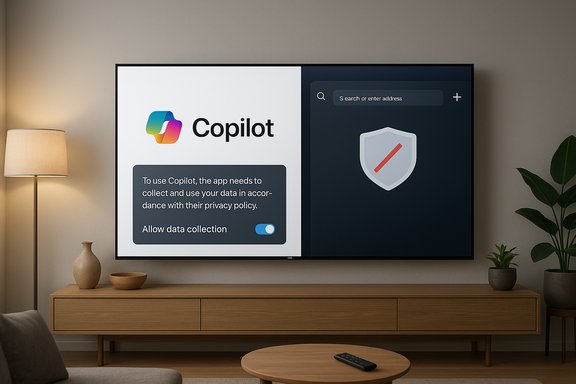
LG shipped a routine webOS update in mid-December that, for many owners, carried an unwelcome surprise: a new Copilot tile pinned to the TV home screen. The tile points to Microsoft’s Copilot AI and, in the versions widely reported, could not initially be removed by ordinary means — owners could hide it or move it, but not delete the package the update had placed on the system. That behavior set off a wave of complaints on Reddit and technology forums and pushed the vendor to respond publicly. Within days of the uproar, LG issued a clarifying statement saying the Copilot presence is implemented as a web shortcut that opens the Copilot web interface in the TV’s built‑in browser rather than a deep, native system app. LG also told outlets it “respects consumer choice” and intends to provide a means to remove the shortcut in a forthcoming update. That concession — a promise to add a removal option — is the core of the company’s response and the reason the story evolved from a consumer gripe into a case study about platform control and transparency.
LG’s public clarification — that the tile is a shortcut to a web-based Copilot experience and not an embedded native client — helps explain why the company could claim features like microphone input are only enabled with explicit consent. A web shortcut, when opened, launches the browser and then requests mic access; it does not necessarily require a persistent, system-level voice service. But the delivery mechanism (firmware update + pinned tile) is still what triggered the backlash.
In public forums, users framed the issue with familiar language: “forced features,” “bloatware,” and “loss of control.” The emotional punch comes from the contrast between the perceived permanence of the tile and the expectation that consumers control what runs on their devices.
LG’s statement that microphone access is gated by explicit permission addresses one of those concerns, but it doesn’t erase the perception problem: if users believe the AI feature was added without consent and can’t be removed, trust is damaged even if the technical reality is more nuanced.
Companies that triumph in the long run will be those that combine compelling AI experiences with clear, user-forward control: transparent opt-in, easy opt-out, and granular privacy settings. LG’s promise to let users remove the Copilot shortcut is a move in that direction, but it’s only credible if the implementation is fast, visible, and complete.
What matters going forward is not only that LG fixes this particular UX complaint, but that the company and its partners adopt more predictable, transparent rollout practices. That would include clearer update notes, optional installs for non-essential services, and straightforward mechanisms for revoking access to microphones or cameras.
In short, shipping AI on the home screen is not a problem — shipping AI without consent, removable controls, or clear communication is.
For consumers, the takeaway is practical: check update notes, exercise privacy controls, and demand removability. For vendors, the lesson is sharper: opt‑in beats push‑in. A proactive, transparent approach to AI deployments — one that privileges clear consent and reversible choices — is the best antidote to the cycles of outrage that accompany forced features.
If LG follows through with a prompt and well-documented removal option, this will likely end up as a brief pain with an easy fix. If the company delays or provides a half-measure, the incident will remain a cautionary example for how not to introduce AI to shared household devices.
Source: HotHardware LG Responds To Backlash Over Unremovable Copilot Icon On Smart TVs
 Background
LG shipped a routine webOS update in mid-December that, for many owners, carried an unwelcome surprise: a new Copilot tile pinned to the TV home screen. The tile points to Microsoft’s Copilot AI and, in the versions widely reported, could not initially be removed by ordinary means — owners could hide it or move it, but not delete the package the update had placed on the system. That behavior set off a wave of complaints on Reddit and technology forums and pushed the vendor to respond publicly. Within days of the uproar, LG issued a clarifying statement saying the Copilot presence is implemented as a web shortcut that opens the Copilot web interface in the TV’s built‑in browser rather than a deep, native system app. LG also told outlets it “respects consumer choice” and intends to provide a means to remove the shortcut in a forthcoming update. That concession — a promise to add a removal option — is the core of the company’s response and the reason the story evolved from a consumer gripe into a case study about platform control and transparency. What actually happened: technical anatomy of the Copilot tile
A system-level shortcut, not a removable app
Smart TV platforms like webOS manage software in layers. There are user-installable apps that appear in an app store and can typically be uninstalled, and there are system-level packages and shortcuts pushed by firmware or OEM services that are more tightly coupled to the device image. In the reported incidents, the Copilot tile behaved like the latter: installed or pinned by a firmware-level update so that ordinary app‑management tools did not offer a full uninstall. That explains why some users found the tile reappearing after resets or why hiding was the only available option.LG’s public clarification — that the tile is a shortcut to a web-based Copilot experience and not an embedded native client — helps explain why the company could claim features like microphone input are only enabled with explicit consent. A web shortcut, when opened, launches the browser and then requests mic access; it does not necessarily require a persistent, system-level voice service. But the delivery mechanism (firmware update + pinned tile) is still what triggered the backlash.
Why users perceived it as “unremovable”
From the end-user perspective, removal capability is binary: you expect to either delete software you don’t want, or at least be able to disable it. When a vendor ships something via firmware or as a privileged package, the device behaves like a managed appliance. That loss of sovereignty is especially sensitive on televisions because they are household devices often shared by multiple people; a forced tile for an AI assistant feels different than bloatware on a phone. Reported behavior — tile reappearing after resets, limited hide-only options — is consistent with an item installed at the firmware or system-image level rather than a user-installed app.The public reaction: privacy, agency, and optics
The Reddit firestorm
A Reddit post showing the tile and complaining about the lack of uninstall options rapidly climbed to tens of thousands of upvotes and thousands of comments, amplifying the story across mainstream tech media. That grassroots amplification is what turned a quiet firmware change into a reputational issue for LG. Online reaction focused on three related concerns: the lack of prior disclosure, the inability to remove the tile, and the potential for voice/microphone features to be used without robust consent.In public forums, users framed the issue with familiar language: “forced features,” “bloatware,” and “loss of control.” The emotional punch comes from the contrast between the perceived permanence of the tile and the expectation that consumers control what runs on their devices.
Privacy fears are predictable — and not entirely theoretical
Smart TVs have microphones, cameras, and always-on network links. That combination has long made them lightning rods for privacy concerns. Whether the Copilot tile is a web shortcut that only invokes the microphone after explicit permission or a native service that potentially listens without clear consent, the optics are the same: users are wary of any AI assistant that appears on their TVs without an obvious and reversible opt-in.LG’s statement that microphone access is gated by explicit permission addresses one of those concerns, but it doesn’t erase the perception problem: if users believe the AI feature was added without consent and can’t be removed, trust is damaged even if the technical reality is more nuanced.
Industry context: this is not an isolated event
A broader trend toward preloaded assistants
The Copilot-on-TV story fits a larger trend across the consumer electronics industry: major OEMs are baking AI assistants into screens as part of their “AI TV” roadmaps. Samsung integrated Microsoft Copilot into its 2025 TV and monitor lineups as a built-in assistant in Tizen, marketed as a way to get information, content recommendations, and interactive on-screen answers. TCL, Google TV partners, and other manufacturers have likewise pushed vendor or partner AI agents (including Google’s Gemini on select models) onto devices as a differentiator. These moves are often announced as convenience features but can collide with expectations of control when they arrive as mandatory or non-removable entries.Why vendors are doing this
There are rational business reasons for firms to ship AI features preinstalled:- AI assistants are a differentiator in marketing and product roadmaps.
- Partnerships with cloud providers (Microsoft, Google) provide a pathway for features without heavy on-device compute.
- Integrated assistants can extend a platform’s ecosystem and drive engagement with partner services.
The legal and regulatory angle
Privacy regulators and consumer-protection watchdogs have increasingly scrutinized smart-home devices, especially those that collect audio, camera, or behavioral data. A mandatory or hard-to-remove web shortcut that opens an AI assistant raises four regulatory flags:- Transparency: consumers must be informed about what was installed and why.
- Consent: microphone or camera activation must be clearly consented to and reversible.
- Data practices: where user queries are sent, how they’re stored, and whether they are tied to other identifiers must be disclosed.
- Device control: bundling non-removable software raises questions about unfair or deceptive practices in some jurisdictions.
Why LG’s response matters
LG’s public commitment to allow users to remove the Copilot shortcut is important for three reasons:- It acknowledges the user-experience failure: the company recognized that the way the feature was rolled out was poorly received and worthy of correction.
- It reduces technical risk: offering a removal path limits the potential attack surface and the perception that an always-present service could be exploited or misused.
- It preserves future flexibility: by treating Copilot as an optional feature rather than a locked-in system component, LG can continue integrating AI into its products while respecting consumer choice.
Technical and UX recommendations (what vendors should do next)
For LG and other OEMs
- Provide transparent release notes: firmware updates that add new services — even web shortcuts — should be documented in update notes and marked for optional acceptance.
- Add robust uninstall/disable paths: anything that appears on the home screen should be removable through the same UI that deletes apps.
- Clear mic consent flows: if a shortcut or app needs microphone access, the device should request permission in an explicit, discoverable manner and maintain a settings toggle that revokes access. A single dialog buried in settings is insufficient.
- Separate system-level services from optional content: if a feature is optional, it should be delivered as an optional, uninstallable package from a content store rather than baked into firmware.
- Provide an accessible rollback: if a notable portion of users report negative experiences after an update, offer a way to revert or opt out pending remediation.
For platform partners (Microsoft, Google, others)
- Be explicit about data handling: partners should insist that OEM partners surface clear privacy and data-processing notices before enabling AI features on consumer devices.
- Offer “guest” or local-only modes: for use cases where users need the assistant but don’t want cloud-backed personalization or history, provide a local-limited mode.
- Respect platform governance: large cloud partners should require OEMs to follow best practices for consent and removability if their assistant is being rolled out at scale.
What consumers can do right now
- Check your TV’s home screen options: most TVs let you hide or move tiles; that’s not the same as uninstalling, but it reduces visibility.
- Review microphone and privacy settings: on webOS and other platforms, look for voice or mic access controls and turn off permissions you don’t want.
- Delay non-essential firmware updates: if you’re highly privacy-sensitive, avoid immediate installation of optional updates until details are public — but weigh this against security patches that protect the device.
- Contact support: if a tile reappears after reset or behaves like a system package, file feedback with LG so the company can quantify the scope and prioritize a remediation.
- Use network controls: advanced users can use router-level filtering or guest network segmentation to limit a TV’s internet access if they want to neutralize remote features entirely (at the expense of smart functionality).
The reputational cost: more than a UI gripe
This episode is instructive because it’s not merely about a single tile. It’s symptomatic of a larger tension in consumer tech: manufacturers want to bake intelligence into devices as a visible product differentiator, while many consumers expect control over their purchased hardware. When the balance tips toward automatic, non-optional features — especially those with potential privacy implications — trust erodes.Companies that triumph in the long run will be those that combine compelling AI experiences with clear, user-forward control: transparent opt-in, easy opt-out, and granular privacy settings. LG’s promise to let users remove the Copilot shortcut is a move in that direction, but it’s only credible if the implementation is fast, visible, and complete.
Broader implications for the smart-home ecosystem
- Platform expectations are shifting: consumers increasingly treat TVs as long-term, durable devices. A misstep in software relationship management can degrade brand loyalty over multiple years of device ownership.
- Partnerships are double-edged: teaming with a market leader like Microsoft or Google provides technical muscle and features, but it also places the OEM under scrutiny for how partner software is integrated and surface‑mounted.
- Regulatory scrutiny will follow behavior: repeated patterns of pushing non-removable services could invite more formal attention from regulators and consumer groups.
- The debate about “managed devices” vs. privately-owned appliances will intensify: especially in households with multiple users and privacy-aware adults.
Verdict: a solvable problem with important lessons
Technically, the Copilot tile incident is solvable: the feature is a web shortcut rather than a baked-in voice daemon, and LG has already pledged to add a removal option. But the episode exposes a fragile area of product management where decisions about update delivery, UI placement, and defaults matter as much as the underlying technology.What matters going forward is not only that LG fixes this particular UX complaint, but that the company and its partners adopt more predictable, transparent rollout practices. That would include clearer update notes, optional installs for non-essential services, and straightforward mechanisms for revoking access to microphones or cameras.
In short, shipping AI on the home screen is not a problem — shipping AI without consent, removable controls, or clear communication is.
Closing analysis: the business calculus and the consumer compact
OEMs have incentives to make their products “smarter” by default. Partnerships with cloud AI providers accelerate feature timelines and create talking points for marketing. But each of those trade-offs carries a cost. The Copilot tile kerfuffle shows how quickly that cost can be paid when implementation disregards user agency.For consumers, the takeaway is practical: check update notes, exercise privacy controls, and demand removability. For vendors, the lesson is sharper: opt‑in beats push‑in. A proactive, transparent approach to AI deployments — one that privileges clear consent and reversible choices — is the best antidote to the cycles of outrage that accompany forced features.
If LG follows through with a prompt and well-documented removal option, this will likely end up as a brief pain with an easy fix. If the company delays or provides a half-measure, the incident will remain a cautionary example for how not to introduce AI to shared household devices.
Source: HotHardware LG Responds To Backlash Over Unremovable Copilot Icon On Smart TVs
