

LG’s rapid retreat on the Copilot shortcut marks a notable consumer win — and a revealing case study in how modern smart‑TV platforms manage updates, privacy and user agency when AI features are pushed to already‑sold devices.
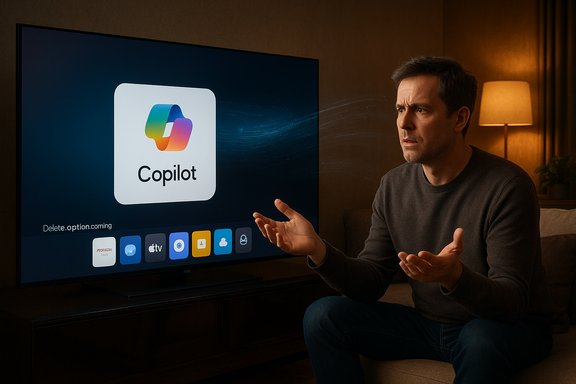
LG and Microsoft positioned conversational AI as a cornerstone of this product cycle’s “AI TV” vision: large displays that do more than show content, instead offering conversational search, show recaps and voice‑driven navigation. LG’s marketing has emphasized the role of its Alpha AI family of processors to drive real‑time upscaling, scene analysis and ambient brightness control as part of a broader value proposition for higher‑end webOS models. What changed in mid‑December was not the idea of putting Copilot on TVs — it was the delivery mechanism. A routine webOS over‑the‑air (FOTA) update added a Microsoft Copilot tile to many LG TV home screens, and users reported that the tile could be hidden but not deleted through the normal app‑management UI. The initial community outcry — a high‑visibility Reddit post that accumulated tens of thousands of votes — brought the issue to mainstream tech press and forced LG into a public clarification. LG has since told reporters it will add an explicit delete option for the Copilot shortcut in a future webOS update, while clarifying that the tile functions as a browser‑based shortcut rather than a native, always‑running local agent. That statement calmed some immediate angst, but it left unanswered questions about packaging choices, telemetry and the timeline for the promised fix.
Key consumer expectations that were disrupted:
Two possible outcomes are plausible:
For owners unsettled by the presence of Copilot today, practical mitigations exist, but the durable fix requires LG to follow through with a cross‑model, well‑documented deletion implementation and a public privacy statement that explains the service’s telemetry and consent mechanics. Without those steps, even a useful assistant risks becoming a long‑term source of consumer distrust rather than a living‑room convenience.
Source: iPhone in Canada LG Backtracks Microsoft Copilot Inclusion, Will Soon Let Users Delete App on Smart TVs | iPhone in Canada
 Background
LG and Microsoft positioned conversational AI as a cornerstone of this product cycle’s “AI TV” vision: large displays that do more than show content, instead offering conversational search, show recaps and voice‑driven navigation. LG’s marketing has emphasized the role of its Alpha AI family of processors to drive real‑time upscaling, scene analysis and ambient brightness control as part of a broader value proposition for higher‑end webOS models. What changed in mid‑December was not the idea of putting Copilot on TVs — it was the delivery mechanism. A routine webOS over‑the‑air (FOTA) update added a Microsoft Copilot tile to many LG TV home screens, and users reported that the tile could be hidden but not deleted through the normal app‑management UI. The initial community outcry — a high‑visibility Reddit post that accumulated tens of thousands of votes — brought the issue to mainstream tech press and forced LG into a public clarification. LG has since told reporters it will add an explicit delete option for the Copilot shortcut in a future webOS update, while clarifying that the tile functions as a browser‑based shortcut rather than a native, always‑running local agent. That statement calmed some immediate angst, but it left unanswered questions about packaging choices, telemetry and the timeline for the promised fix. What actually happened: sequence and symptoms
Timeline — concise
- LG and Microsoft announced or showcased Copilot integrations for some 2025 TV models and roadmaps.
- In mid‑December, a webOS FOTA update rolled out to many LG sets.
- After reboot, users found a Copilot tile pinned to the home ribbon or app row.
- When owners attempted to manage apps via webOS, Copilot often showed only hide or disable options, not delete.
- In multiple reported cases a factory reset restored the tile, implying the component was present in the firmware image or installed as a privileged system package.
- The resulting user backlash prompted LG to commit to adding a deletion feature.
How users discovered it
The issue reached viral scale after a Reddit thread in r/mildlyinfuriating displayed a screenshot and the caption “My LG TV’s new software update installed Microsoft Copilot, which cannot be deleted,” generating tens of thousands of upvotes and thousands of comments. Enthusiast sites, mainstream tech outlets and platform forums replicated the pattern across multiple models, which made the behavior reproducible enough to form a clear picture of the installation model.Technical anatomy: why the tile felt “undeletable”
The visible symptom — no uninstall affordance and reappearance after factory reset — is a classic indicator of either a system/privileged package or a firmware‑baked asset.- System/privileged package: OEMs can mark software as a protected system component to prevent casual removal. This is common for apps vendors deem integral to the platform.
- Firmware‑baked asset: If the launcher tile is included in the FOTA system image, a factory reset will restore it because the default image contains the tile. In such cases the UI may only permit hiding, not removal.
Why the delivery method matters: ownership, updates and trust
Smart TVs are now networked platforms that receive frequent software updates. From a product perspective, preinstalling or pinning shortcuts can increase adoption metrics for new services — but it also shifts the balance of control away from the buyer after purchase.Key consumer expectations that were disrupted:
- Agency: Device owners expect to choose which services live on their home screens. A forced, persistent tile feels like a change to the device’s contract without consent.
- Predictability: Firmware updates changing user‑facing features should be clearly communicated and reversible. Silent installs that cannot be removed violate that expectation.
- Privacy and consent: Even if Copilot is a web shortcut, enabling it invites the question: what triggers audio capture, what telemetry is collected, and how is that data processed and stored? The technical packaging does not resolve telemetry concerns if the feature can be invoked from a privileged surface.
Privacy and security implications
Microphone access and voice activation
LG emphasized that microphone features require explicit activation; launching the Copilot tile does not by itself make the TV an always‑listening device. That is an important distinction: the practical risk profile differs considerably between a passive browser bookmark and an embedded, persistent assistant. Still, per‑use consent does not erase the policy and telemetry questions that follow: who receives audio, where is it stored, and how long is it retained?Automatic content recognition (ACR) and personalization
Reports from several outlets noted that the update surfaced or enabled LG’s Live Plus or similar content‑recognition settings in affected sets. Live Plus‑style systems can analyze on‑screen content for recommendations and ad personalization. If such systems are default‑enabled, they heighten concerns about profiling inside shared, private spaces like living rooms. Those concerns are amplified when an assistant and ACR are present on the same device. Where ACR and assistant telemetry intersect, the surface for profiling broadens. Some reports noted the Live Plus toggle appearing after the update; however, the exact global scope and default status vary across models and regions and should be considered a plausible but partially region‑dependent claim.Telemetry, updates, and auditability
System‑level addons complicate audits: privileged packages are less transparent, not listed in standard app stores and may be excluded from routine user‑visible changelogs. Regulators and privacy advocates often push for clear telemetry disclosures for any service that collects or transmits household data. LG’s promise to allow deletion is a pragmatic response, but it must be paired with a detailed telemetry statement and changelog to restore trust.Consumer reaction and the economics of OLED buyers
Owners of premium displays — especially larger OLED models — are a vocal and influential segment. High per‑unit prices and the expectation of a pristine, uncluttered experience make these customers less tolerant of perceived bloatware or opaque additions.- Users reacted with social media outrage, forum petitions and defensive mitigations (disconnecting sets, isolating TVs on guest networks, or favoring external streamers).
- The incident undermines a key loyalty vector: long lifecycles for expensive displays and predictable, non‑intrusive ownership experiences. When a vendor installs post‑sale services without obvious opt‑outs, it erodes that trust and could influence future buying decisions.
LG and Microsoft: partnership context and technical promises
LG’s AI TV narrative is broader than Copilot alone. The company has publicized the Alpha AI processor and a suite of features:- AI Super Upscaling to 4K for lower‑resolution sources.
- AI Brightness Control that adjusts screens based on ambient light sensors.
- AI Object Enhancer and director‑style color remastering for scene‑by‑scene optimization.
Strengths of LG’s approach — and why they matter
- Visionary integration: Bringing conversational AI to living‑room screens is a logical extension of multi‑device AI continuity; done well, it can improve discoverability, accessibility and convenience for families.
- Hardware innovation: LG’s Alpha AI processors offer tangible, on‑device visual benefits — real‑time upscaling and ambient brightness control are differentiators that deliver measurable user value.
- Ecosystem alignment: Partnering with Microsoft leverages a widely recognized assistant platform and cloud infrastructure, enabling feature parity across devices and faster rollout than bespoke, vendor‑built LLMs.
Risks and unresolved problems
- Post‑sale control erosion: Installing system‑level features without a clear uninstall path risks alienating buyers and inviting regulatory scrutiny.
- Privacy ambiguity: Even if Copilot is a web link, default settings and the interaction with ACR or ad personalization can create opaque data flows.
- Reputational damage: The optics of forced installation — however well‑intentioned — can inflict long‑term trust costs that outstrip short‑term adoption metrics.
- Fragmented rollout & support complexity: Differences by model, region and firmware version can create inconsistent experiences and a large customer‑support burden.
How LG should follow through (practical checklist)
LG’s announced fix must be more than cosmetic. Recommended concrete steps:- Publish a clear, date‑bound rollout plan for the delete option and which models/firmware builds will receive it.
- Provide a simple, documented uninstall or remove workflow in webOS that applies across models and regions.
- Publish a plain‑language telemetry and privacy statement specifically for Copilot on webOS, including:
- Data types collected (audio, queries, usage metrics).
- Retention periods and third‑party sharing.
- How to fully opt out and disable related ACR/ad personalization features.
- Release a public changelog for the webOS update that included Copilot and any other user‑facing changes.
- Offer a rollback or guided remediation for users who do not want post‑sale service additions (for example, an explicit “minimal privacy” update package).
Short‑term mitigations for affected owners
For owners who want immediate control before LG’s promised deletion arrives, practical steps include:- Hide the Copilot tile using the webOS launcher’s edit options (temporary).
- Disable or opt out of ad personalization and any Live Plus/ACR features in Settings.
- Avoid signing into accounts tied to recommendation or personalization services.
- Put the TV on a guest VLAN or isolated network with restricted outbound rules to limit telemetry, or use DNS filtering to block known telemetry endpoints.
- Use an external streamer (Roku, Apple TV, Fire TV, Chromecast) and rely on the TV as a display only.
Regulatory and industry implications
This incident is symptomatic of a larger industry trend: vendors increasingly monetize and differentiate hardware through cloud services and AI features delivered post‑sale. That trend raises regulatory interest in consumer choice and transparency.- Expect consumer‑protection inquiries where forced software installations occur without opt‑in.
- Privacy regulators will focus on combined ACR and assistant deployments because of the expanded profiling surface.
- Industry bodies and standards organizations may consider guidelines for permissible post‑sale modifications and mandatory opt‑out affordances.
What this means for the future of “AI TV”
Conversational assistants on TVs are a compelling, logical evolution of the smart home. They promise richer search, enhanced accessibility and new discovery workflows optimized for large displays. But the Copilot tile episode shows the difference between a platform feature and a platform imposition.Two possible outcomes are plausible:
- Vendors adopt consent and control patterns: optional installs, visible changelogs, per‑feature telemetry controls and clear uninstall paths. This path preserves trust and enables widespread adoption.
- Vendors prioritize engagement metrics and preinstall experiences: persistent tiles, default‑on personalization and opaque telemetry. That path risks sustained consumer resistance, sales impact in premium segments and regulatory pushback.
Conclusion
LG’s commitment to let users delete the Copilot shortcut is the right immediate move and acknowledges the core problem: how a feature is delivered matters as much as what the feature does. The incident is a timely reminder for manufacturers and platform partners that post‑sale software changes are effectively contract modifications with customers — and must be handled with explicit consent, transparent telemetry, and durable uninstall mechanisms.For owners unsettled by the presence of Copilot today, practical mitigations exist, but the durable fix requires LG to follow through with a cross‑model, well‑documented deletion implementation and a public privacy statement that explains the service’s telemetry and consent mechanics. Without those steps, even a useful assistant risks becoming a long‑term source of consumer distrust rather than a living‑room convenience.
Source: iPhone in Canada LG Backtracks Microsoft Copilot Inclusion, Will Soon Let Users Delete App on Smart TVs | iPhone in Canada
