

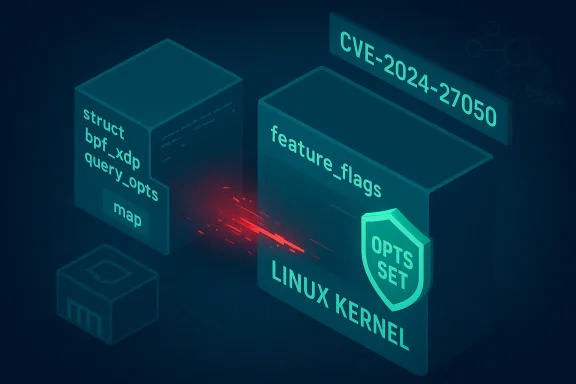
The Linux kernel’s libbpf received a targeted, upstream fix for a subtle but consequential ABI/stack-corruption bug: when the fields feature_flags and xdp_zc_max_segs were added to struct bpf_xdp_query_opts, the library wrote to those fields unconditionally instead of using the OPTS_SET() macro that guards optional fields. That unchecked write can corrupt the stack of programs compiled against an older libbpf layout and, in practice, can be triggered by a local actor to cause crashes or other availability loss. (cvefeed.io)
The extended Berkeley Packet Filter (eBPF) ecosystem consists of a kernel verification and execution engine and a companion userspace library, libbpf, which helps user programs load, configure, and query eBPF/XDP assets. One of libbpf’s convenience APIs is bpf_xdp_query(), which returns information about an XDP program attached to a network interface into a caller-supplied options structure,
When optional fields are added to a struct that may be used across different compile-time versions, the safe pattern is:
The sequence is:
Practically, the fix was applied in the kernel tree and included in the distribution updates and point releases identified by vendors; for example, Debian’s tracker and other vendor advisories list the issue as fixed in kernel snapshots based on the 6.7.12‑1 and related stable updates. Distributors packaged the kernel and tools updates so users can receive the patch through normal system updates. (cvefeed.io)
Source: MSRC Security Update Guide - Microsoft Security Response Center
 Background / Overview
The extended Berkeley Packet Filter (eBPF) ecosystem consists of a kernel verification and execution engine and a companion userspace library, libbpf, which helps user programs load, configure, and query eBPF/XDP assets. One of libbpf’s convenience APIs is bpf_xdp_query(), which returns information about an XDP program attached to a network interface into a caller-supplied options structure, struct bpf_xdp_query_opts. That structure has grown over time to carry more metadata (e.g., program IDs, attach mode, feature bits, and XDP zero-copy limits), and libbpf’s helper macros—OPTS_HAS() and OPTS_SET()—are used to make reads/writes forward- and backward-compatible as fields are added.When optional fields are added to a struct that may be used across different compile-time versions, the safe pattern is:
- check whether the caller’s struct includes the field (size-based test via OPTS_HAS), and
- only write the field if OPTS_HAS indicates the caller supplied space, or use OPTS_SET() which combines the size check and write.
What exactly went wrong: the technical root cause
At the heart of the bug is an ABI mismatch on a userspace API: a library (libbpf) that at runtime writes into a caller-supplied struct assumed the struct is large enough for newly added members. That assumption is valid only when both the application binary and libbpf headers/runtime are in sync.The sequence is:
- libbpf adds new fields to
struct bpf_xdp_query_opts(for example,feature_flags, laterxdp_zc_max_segs). - Older applications (or statically compiled tools) were compiled against previous versions of the header, so their stack-allocated
optsbuffer is smaller. - At runtime, a newer libbpf implementation in the system writes directly into the
opts->feature_flagsoropts->xdp_zc_max_segsfields without verifying the caller'soptsbuffer size. - The unconditional write therefore writes past the bounds of the caller’s struct on the stack—producing stack corruption, memory safety failures, and potential crashes. (cvefeed.io)
Why the OPTS_ macros matter (brief primer)
libbpf uses a pair of conventions/macros widely adopted for option structs whose layout may evolve:- OPTS_HAS(opts, field) — checks whether the passed-in
optspointer actually provides room forfield, typically implemented by comparingopts->sz(size) to the offset+size of the field. - OPTS_SET(opts, field, value) — sets the field only if OPTS_HAS would succeed; some implementations also update the reported size.
Impact analysis: who’s at risk, and how bad is it?
- Attack vector: Local. The vulnerability requires local code execution (the attacker must be able to run the affected process or otherwise induce bpf_xdp_query() calls in the context of an application linked to libbpf). Vulnerability trackers and distribution advisories consistently mark the attack vector as local. (cvefeed.io)
- Privileges required: Low in many real-world setups—some tools and utilities call into libbpf without elevated privileges depending on system configuration. However, in default hardened environments eBPF operations are restricted; real-world exploitation prerequisites vary by distribution and system policy.
- Primary impact: Availability (DoS). Stack corruption can lead to application crashes or kernel instability, depending on where the write occurs. Vulnerability databases categorize the primary impact as availability (A:H) and give the issue a medium CVSS score (~5.5). (cvefeed.io)
- Exploitability: There’s no public proof-of-concept (POC) widely reported at disclosure time; the vulnerability is primarily a correctness/compatibility bug, not a logical bypass. Still, the potential for reliable DoS through a crafted local call sequence is non‑trivial.
- Collateral considerations:
- Systems that permit many untrusted local users (shared hosting, multi-tenant workloads, CI runners) raise the operational risk.
- Containers: if the container runtime exposes the necessary interfaces and libbpf in the container or host is mismatched, containers could be used as a vector.
- Cloud/managed environments where users run user-space code but cannot update kernel-level libraries themselves require coordinated vendor updates and mitigations.
What the upstream fix does
The upstream change is minimal but precise: the libbpf code that populatedfeature_flags and xdp_zc_max_segs in bpf_xdp_query() was changed from unconditional assignments to guarded writes using OPTS_SET(). That prevents writes when the caller’s opts struct lacks the new fields.Practically, the fix was applied in the kernel tree and included in the distribution updates and point releases identified by vendors; for example, Debian’s tracker and other vendor advisories list the issue as fixed in kernel snapshots based on the 6.7.12‑1 and related stable updates. Distributors packaged the kernel and tools updates so users can receive the patch through normal system updates. (cvefeed.io)
Verification and cross-references
Multiple independent trackers and vendor notices confirm the vulnerability description, the fix approach (OPTS_SET guard), and the recommended mitigation (install the patched kernel/libbpf packages):- cvefeed.io and OpenCVE summarize the defect as an out-of-bounds write in libbpf's bpf_xdp_query(), and note the OPTS_SET remedy. (cvefeed.io)
- Distribution trackers such as Debian’s security tracker list the issue (CVE‑2024‑27050) and the fixed package versions that incorporate the upstream change. The Debian tracking page indicates fixed kernel package versions (e.g., linux 6.7.12‑1 in unstable and associated security backports).
- Secondary advisories and vulnerability feeds (Feedly, Vulert, OpenEuler advisories) independently summarize the same functional root cause and patch actions, reinforcing confidence in the diagnosis and remediation path.
Detection: how to tell if you're vulnerable
There are three practical detection vectors:- Kernel / package inventory: check installed kernel and libbpf packages against the versions listed by your distribution’s security tracker (Debian, SUSE, Ubuntu, openEuler, etc.). The Debian tracker indicates specific fixed versions and which releases are affected. Systems running kernels prior to the fixed releases should be considered vulnerable until updated.
- Binary ABI mismatch checks: scan for instances where user-space binaries or tools were built against an older libbpf header but may call into a newer system-provided libbpf at runtime. This is more advanced but possible for operators who maintain their own tools or ship prebuilt agents.
- Dmesg / logs: look for unexplained crashes or stack-corruption indicators tied to processes that call into libbpf (e.g., bpf-related tools, observability agents, or network tooling). Kernel oopses or application crashes following bpf_xdp_query calls are a strong sign. Logging and crash-dump systems should be consulted.
Recommended remediation and mitigation steps
Immediate actions for administrators and distro maintainers:- Install vendor-supplied patches.
- Update the kernel and libbpf packages to the fixed versions supplied by your distribution. Distributors have folded the upstream corrective commits into their stable trees and security updates; applying those updates is the canonical fix. Debian’s tracker and other vendor advisories list the fixed package versions.
- Rebuild or repackage user-space programs that are distributed with or rely on a specific libbpf header ABI, if you ship precompiled agents. If you cannot ensure library/runtime parity, avoid mixing libbpf versions or distribute statically linked, tested binaries.
- Restrict local access where practical. Because the attack vector is local, reduce the number of untrusted users with the ability to run binaries that exercise libbpf APIs. Harden systems that permit multi-tenant execution (build runners, container hosts).
- Monitor and log. Enable close monitoring for kernel oopses and application crashes and collect audit trails for processes that invoke eBPF/XDP operations.
- Follow distro advisories. Subscribe to your vendor’s security mailing lists and advisories to receive coordinated updates and backport notifications for long-term stable releases.
- Limit local user capabilities, consider disabling untrusted eBPF usage (where your distro or policy allows), and apply compensating configuration controls (e.g., AppArmor/SELinux rules that constrain agents and tooling, seccomp filters to block unexpected libbpf paths).
- For container platforms, avoid exposing host libbpf facilities into containers and ensure container images do not bring mismatched libbpf versions in ways that could be abused.
Operational considerations and risk trade-offs
- The vulnerability is an availability risk rather than a remote code execution vector; still, stack corruption is a severe memory-safety failure and can be used to create denial-of-service conditions quickly and reproducibly. That makes it an operational priority in environments where uptime for networking and observability agents matters.
- Patching kernel packages can be disruptive in high-availability networks. Operators must weigh the immediate risk of DoS against planned maintenance windows. Where possible, coordinate staged rollouts to minimize blast radius: patch non-critical hosts first, validate, then roll the fix to production.
- Rebuilding tools and agents is advised when packaging policies mean users could run older compiled binaries against updated libbpf. The safest long-term posture is to ensure library and header ABIs remain consistent within distributed artifacts.
- eBPF/XDP adoption is growing; vulnerabilities in the eBPF toolchain or libbpf tend to affect many downstream projects (observability, networking, load-balancing stacks). Treat small libbpf fixes as high-impact across the ecosystem, since they can indirectly destabilize widely used agents. Recent months have shown a steady stream of BPF-related fixes and advisories in vendor trackers.
Practical advice for developers and packagers
- Use OPTS_HAS and OPTS_SET patterns consistently whenever you add fields to option structs that may be passed across library boundaries. This bug is an instructive example of how a single missing guard can allow runtime corruption.
- When shipping precompiled binaries that call into libbpf, document the required libbpf version and, where possible, bundle or statically link a known-good libbpf to ensure ABI compatibility.
- Implement runtime sanity checks where feasible: verify
opts->szbefore passing a stack buffer into library calls, and prefer heap-allocated or zeroed buffers whose size you control. - Add unit tests that simulate older caller struct sizes interacting with newer library code (i.e., regression tests that exercise ABI backward-compatibility).
- For packagers: if you backport patches into older stable kernels for customers, ensure that clients who run userland tooling built for different kernel-tree snapshots are tested together.
Final assessment: strengths of the fix, and remaining risks
Strengths:- The upstream fix is surgical and follows the intended library compatibility pattern: switching to OPTS_SET() is the canonical guard and keeps the library behavior safe for both old and new callers.
- Multiple vendors quickly incorporated the patch into their kernel updates, and trackers cross-reference the upstream commits and the fixed package versions—so practical remediation via normal updates is available. (cvefeed.io)
- The issue was identified and fixed without evidence of wide public exploitation at disclosure, suggesting limited immediate attacker use.
- The vulnerability highlights the perennial danger of ABI drift between user code and libraries—this class of bug can recur if strict compatibility practices are not followed.
- Systems that cannot be patched rapidly (air-gapped, vendor-managed appliances, or hosts with constrained maintenance windows) remain exposed to local DoS risk.
- Because the practical exploit requires local code execution or the ability to induce calls into bpf_xdp_query(), attackers who gain a foothold (e.g., via a separate low-privilege exploit) could chain this into a service disruption, elevating operational impact in multi-stage attacks.
Quick checklist for system administrators (actionable)
- Confirm whether your distribution lists CVE‑2024‑27050 as fixed for your installed kernel/libbpf packages. If not, plan updates.
- If you run custom or bundled agents that include libbpf headers or are statically linked, rebuild them against the updated libbpf runtime or ship the patched library with the agent.
- Restrict local execution privileges for untrusted users until patches are applied.
- Watch for increased numbers of network-agent crashes or kernel oops messages; collect and preserve crash dumps for post‑mortem.
- Coordinate rollouts to minimize friction: test on staging, then push to production as soon as practicable.
Conclusion
CVE‑2024‑27050 is a textbook example of how small compatibility oversights in systems code can have outsized operational consequences: adding fields to an options struct without the established OPTS_SET() guard produced out‑of‑bounds writes that can corrupt caller stacks and cause denial of service. The bug was fixed upstream by applying the proper OPTS_SET() checks, and distributors have authenticated that fix into their security updates; administrators should prioritize those updates, especially on hosts that permit untrusted local code or run network observability tooling that uses libbpf. The fix is straightforward to deploy, but the incident is a useful reminder that ABI discipline and careful versioning of eBPF-related tooling are essential as eBPF becomes more deeply embedded in modern networking and telemetry stacks. (cvefeed.io)Source: MSRC Security Update Guide - Microsoft Security Response Center
