

Lightbits Labs is expanding its enterprise Linux footprint with newly announced Ubuntu certification, positioning its NVMe over TCP-based software-defined block storage platform for organizations that want to standardize cloud-native infrastructure around Canonical’s widely deployed operating system. The move matters less as a simple compatibility checkbox than as a practical shift in how enterprises can assemble high-performance private cloud, Kubernetes, database, and virtualization environments without committing to proprietary storage fabrics or a fragmented Linux estate.
The announcement brings native Ubuntu support to the Lightbits storage platform, enabling the company’s disaggregated block storage software to run in environments built around Ubuntu Server. For IT teams already operating Ubuntu across Kubernetes clusters, OpenStack deployments, cloud instances, CI/CD systems, and data services, that support can remove a significant deployment inconsistency: the storage layer no longer has to be based on a separate preferred enterprise Linux distribution.
At the center of Lightbits’ value proposition is NVMe over TCP, also written as NVMe/TCP. This technology exposes remote NVMe flash storage across a standard Ethernet network while preserving a block-storage model that applications, databases, hypervisors, and container platforms understand well. The goal is to combine the performance characteristics associated with local NVMe drives with the operational flexibility of shared, centrally managed storage.
That combination is particularly relevant as infrastructure teams try to reconcile conflicting priorities. Applications want low latency and high IOPS. Platform teams want pooled capacity, rapid provisioning, resilient clusters, and predictable automation. Finance departments want to avoid expensive specialized networking where a capable Ethernet design can meet the requirement.
Lightbits argues that Ubuntu certification gives customers more freedom to meet all three goals. The claim is credible in principle, but the real-world value will depend on the exact Ubuntu releases certified, kernel combinations supported, network configuration requirements, and the operational maturity of each customer’s storage automation practices.
That creates a familiar enterprise problem. A company may use Ubuntu for application servers, container worker nodes, observability systems, developer tooling, and public-cloud instances, while requiring a different Linux family for storage servers because of vendor support policy. The result is an avoidable split in patch management, image creation, configuration management, skills, compliance processes, and incident response procedures.
With Lightbits now supporting Ubuntu for its storage platform, organizations have the opportunity to reduce that divide.
A storage platform that fits the standard operating system model can be easier to deploy repeatedly across development, test, staging, disaster recovery, and production environments.
The more significant element in the announcement is therefore the formalization of Ubuntu as a supported deployment target for Lightbits. Certified support should mean that the vendor has validated a defined platform combination rather than simply acknowledging that the underlying protocol works.
However, organizations should still request exact compatibility information before treating the certification as a blanket endorsement of every Ubuntu version and every kernel variant. The phrase “Ubuntu support” can conceal important boundaries involving:
Traditional enterprise shared storage often relies on purpose-built storage arrays and protocols such as Fibre Channel, iSCSI, or NFS. Those technologies remain widely used, but modern infrastructure is increasingly exploring disaggregated designs in which compute and storage are separated while software provides pooling, resiliency, provisioning, and data services.
NVMe over Fabrics extends the NVMe command set beyond a locally attached PCIe bus. NVMe/TCP is one transport option within that broader family. It carries NVMe commands over standard TCP/IP networking, allowing remote flash devices to be presented to hosts as block storage.
The potential advantages include:
That is an attractive proposition for database operators. A transactional database, search platform, message broker, or analytics engine may depend heavily on storage latency consistency, queue depth behavior, write durability, and sustained throughput. A well-designed NVMe/TCP deployment can offer a more direct and modern path than legacy stack combinations.
A remote I/O operation still traverses a network. Its performance depends on multiple interacting components:
The right conclusion is not that NVMe/TCP performance claims are overstated. Rather, enterprise buyers should treat them as an invitation to conduct workload-specific validation. Storage performance is always a systems outcome, not a single product attribute.
A Kubernetes storage platform must do more than expose capacity. It must integrate with orchestration workflows so that persistent volumes can be provisioned, attached, mounted, resized, protected, and recovered consistently. It must also behave predictably when nodes are restarted, pods move, storage paths fail, or application teams request more capacity through automated workflows.
Ubuntu is common across Kubernetes deployments, making Lightbits’ certified support strategically relevant. A company using Ubuntu worker nodes may now be able to align the storage cluster, client hosts, and orchestration processes under a shared operating system strategy.
That does not mean the storage layer becomes simple by default. Stateful Kubernetes is inherently more complicated than stateless application deployment. But consistency in the supported operating system can eliminate an entire category of friction.
In these environments, high-performance shared block storage is foundational. Virtual machine workloads, database tiers, developer environments, and platform services all compete for predictable storage performance. The storage platform must scale with tenant growth while preserving control over isolation and operations.
Ubuntu is heavily associated with OpenStack deployments, so a supported Lightbits path could appeal to organizations that want a more unified operating environment. The operational promise is straightforward: use the same general Linux family across the cloud control plane, application estate, and storage infrastructure, while relying on NVMe/TCP to deliver high-performance block access.
Yet the strongest candidate workloads are not necessarily those with the largest data sets. They are workloads where storage performance remains a visible application bottleneck and where separating capacity from compute creates genuine operational flexibility.
Lightbits’ Ubuntu support reinforces the broader message of software-defined infrastructure: standardize wherever practical. Use commodity x86 servers, mainstream Linux, NVMe drives, and Ethernet networking, then build higher-level services in software.
This approach can offer meaningful benefits:
The relevant comparison is not “standard Ethernet versus no cost.” It is “a well-engineered Ethernet storage fabric versus the alternatives needed to meet the same service-level target.”
Still, client simplicity does not remove the need for architectural discipline. Enterprises must account for:
For Ubuntu operators, this matters because kernel-level dependencies are among the most sensitive areas of infrastructure support. A proprietary driver can become a barrier to adopting a newer kernel, applying a security patch, moving to a new cloud image, or standardizing a container host build.
The benefit should not be exaggerated, however. Running enterprise storage is still specialized work. The existence of standard interfaces does not eliminate the need to understand queue behavior, failover, replication, storage protection, data placement, and workload isolation.
Native integration reduces friction. It does not make the operational responsibility disappear.
Before deployment, enterprises should establish a clear process for:
NVMe/TCP storage traffic moves across the network. That makes network design, segmentation, access control, and authentication essential. Treating a storage VLAN as inherently trustworthy is not enough for many modern security models.
A sound design should consider:
That includes:
For database workloads, even a short pause can trigger cascading issues. Connection pools may time out, cluster members may fail health checks, and automated recovery systems may make a localized storage problem more disruptive. Testing should therefore include application-level behavior, not just storage-level counters.
The announcement does not, by itself, establish a universal performance number, a guaranteed cost reduction, or a complete compatibility matrix. Those outcomes are dependent on the design.
A responsible evaluation should include realistic testing with production-like conditions:
This is especially important for organizations using:
Poor cabling, uneven switch configuration, buffer contention, firmware mismatches, insufficient bandwidth, or a lack of redundancy can undermine the entire value proposition. The storage platform may be software-defined, but the underlying network remains a physical system with very real limits.
That is strategically important because infrastructure choices are increasingly interconnected. A Linux distribution decision affects automation, security, support contracts, skills, cloud images, Kubernetes nodes, and hardware certification. Storage can no longer be treated as an isolated procurement category.
In that context, Lightbits can be evaluated as a storage service that supports broader platform goals:
A consistent operating system strategy can simplify workload portability at the infrastructure layer. Application teams may not need to care whether persistent storage is backed by local cloud volumes, a managed service, or a Lightbits cluster in a private environment, provided the provisioning, performance, and availability characteristics are well defined.
That promise should be viewed pragmatically. Portability is never absolute; storage semantics, latency profiles, backup processes, and cost models still vary. But reducing unnecessary operating system variation can make hybrid deployments easier to govern.
The appeal is clear: high-performance shared block storage over Ethernet, delivered through a modern NVMe/TCP architecture, with the potential to avoid proprietary client drivers and specialized storage networking. For organizations trying to pool flash capacity without surrendering low-latency performance, that is a compelling design direction.
The announcement’s greatest strength is not that it suddenly makes Ubuntu capable of NVMe/TCP. Ubuntu and the broader Linux ecosystem have supported the underlying technology for years. The real advance is the prospect of a formally supported, vendor-qualified deployment model for the entire Lightbits storage stack on Ubuntu.
That distinction matters for enterprises. It can simplify standardization, reduce operational fragmentation, and make it easier to bring high-performance block storage into automated Linux infrastructure.
The risks are equally familiar: performance depends on engineering quality, “near-local” latency depends on workload and network conditions, and certification must be matched to exact software, kernel, hardware, and upgrade combinations. Buyers should test their own applications, demand a detailed compatibility matrix, and validate failure scenarios before committing production data.
For the right organization, though, Ubuntu support makes Lightbits a more credible candidate in the growing market for disaggregated NVMe storage. It strengthens the case for an enterprise storage architecture built not around a specialized appliance or fabric, but around Linux, NVMe flash, Ethernet, and software-defined operations.
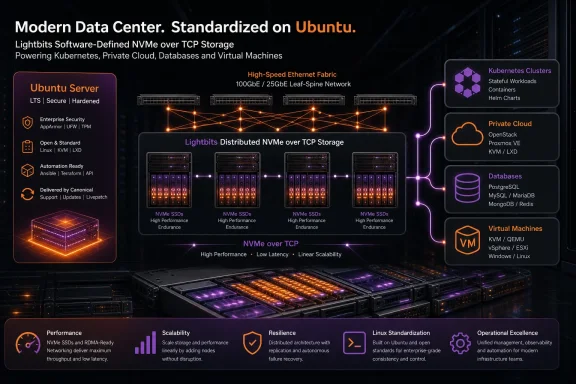 Overview
The announcement brings native Ubuntu support to the Lightbits storage platform, enabling the company’s disaggregated block storage software to run in environments built around Ubuntu Server. For IT teams already operating Ubuntu across Kubernetes clusters, OpenStack deployments, cloud instances, CI/CD systems, and data services, that support can remove a significant deployment inconsistency: the storage layer no longer has to be based on a separate preferred enterprise Linux distribution.At the center of Lightbits’ value proposition is NVMe over TCP, also written as NVMe/TCP. This technology exposes remote NVMe flash storage across a standard Ethernet network while preserving a block-storage model that applications, databases, hypervisors, and container platforms understand well. The goal is to combine the performance characteristics associated with local NVMe drives with the operational flexibility of shared, centrally managed storage.
That combination is particularly relevant as infrastructure teams try to reconcile conflicting priorities. Applications want low latency and high IOPS. Platform teams want pooled capacity, rapid provisioning, resilient clusters, and predictable automation. Finance departments want to avoid expensive specialized networking where a capable Ethernet design can meet the requirement.
Lightbits argues that Ubuntu certification gives customers more freedom to meet all three goals. The claim is credible in principle, but the real-world value will depend on the exact Ubuntu releases certified, kernel combinations supported, network configuration requirements, and the operational maturity of each customer’s storage automation practices.
Why Ubuntu Support Is More Than a Distribution Checkbox
Ubuntu has become deeply embedded in modern infrastructure, particularly where Kubernetes, cloud automation, open-source tooling, and developer-friendly deployment processes are central to the operating model. In many organizations, Ubuntu is not merely one Linux option among several. It is the standardized server platform for a broad range of workloads.That creates a familiar enterprise problem. A company may use Ubuntu for application servers, container worker nodes, observability systems, developer tooling, and public-cloud instances, while requiring a different Linux family for storage servers because of vendor support policy. The result is an avoidable split in patch management, image creation, configuration management, skills, compliance processes, and incident response procedures.
With Lightbits now supporting Ubuntu for its storage platform, organizations have the opportunity to reduce that divide.
Infrastructure standardization has tangible benefits
Standardizing around a smaller number of operating system builds can simplify daily operations in several ways:- Common automation pipelines for provisioning, updates, hardening, and compliance validation.
- Consistent package and repository management across application and storage systems.
- Shared Linux expertise rather than requiring teams to maintain separate operational runbooks for different distributions.
- Fewer golden images for virtual machines, bare-metal servers, and cloud instances.
- Simpler vulnerability remediation when security teams need to coordinate kernel, OpenSSL, SSH, and package updates across the estate.
- More predictable Kubernetes integration, especially where worker nodes and storage clients are already Ubuntu-based.
A storage platform that fits the standard operating system model can be easier to deploy repeatedly across development, test, staging, disaster recovery, and production environments.
Certification changes the support conversation
It is important to distinguish technical possibility from certified support. Linux systems have included NVMe/TCP support for years, and Ubuntu hosts have long been capable of acting as NVMe/TCP clients in appropriate configurations. That does not automatically mean a storage vendor has qualified its complete software stack for Ubuntu-based storage servers, management services, upgrade workflows, high-availability behavior, and support escalation.The more significant element in the announcement is therefore the formalization of Ubuntu as a supported deployment target for Lightbits. Certified support should mean that the vendor has validated a defined platform combination rather than simply acknowledging that the underlying protocol works.
However, organizations should still request exact compatibility information before treating the certification as a blanket endorsement of every Ubuntu version and every kernel variant. The phrase “Ubuntu support” can conceal important boundaries involving:
- Specific Ubuntu LTS releases.
- Supported kernel versions and hardware enablement stacks.
- CPU architectures.
- NIC firmware and driver combinations.
- NVMe SSD qualification lists.
- Kubernetes distributions and CSI driver versions.
- Upgrade paths between Lightbits software releases.
- Security features such as encryption, authentication, and multipath behavior.
The Technical Foundation: NVMe over TCP
To understand why this Ubuntu certification matters, it helps to separate the storage architecture from the operating system announcement.Traditional enterprise shared storage often relies on purpose-built storage arrays and protocols such as Fibre Channel, iSCSI, or NFS. Those technologies remain widely used, but modern infrastructure is increasingly exploring disaggregated designs in which compute and storage are separated while software provides pooling, resiliency, provisioning, and data services.
NVMe over Fabrics extends the NVMe command set beyond a locally attached PCIe bus. NVMe/TCP is one transport option within that broader family. It carries NVMe commands over standard TCP/IP networking, allowing remote flash devices to be presented to hosts as block storage.
Why TCP matters
TCP is not new, exotic, or limited to storage. It is the foundation of most data center networking. That familiarity gives NVMe/TCP a clear operational appeal: enterprises can build high-performance storage networks using Ethernet infrastructure and network operations practices they already understand.The potential advantages include:
- Broad Ethernet compatibility rather than a mandatory move to specialized fabrics.
- Familiar network monitoring and troubleshooting tools.
- Reduced dependence on proprietary host-side drivers.
- Flexible deployment across bare metal, virtual machines, and containerized environments.
- A standardized block interface for applications that do not want to be rewritten around object storage or distributed filesystems.
That is an attractive proposition for database operators. A transactional database, search platform, message broker, or analytics engine may depend heavily on storage latency consistency, queue depth behavior, write durability, and sustained throughput. A well-designed NVMe/TCP deployment can offer a more direct and modern path than legacy stack combinations.
“Near-local” performance requires careful interpretation
The most eye-catching claim in this category is the promise of near-local-flash performance with ultra-low latency. It is an achievable design objective in the right environment, but it should not be read as a guarantee that remote storage is indistinguishable from an NVMe SSD directly attached to the host.A remote I/O operation still traverses a network. Its performance depends on multiple interacting components:
- The latency and throughput characteristics of the NVMe SSDs.
- The CPU capacity available for storage processing and TCP handling.
- The network interface cards, switch buffers, firmware, and congestion behavior.
- The Ethernet speed and topology.
- The storage software’s data-placement and replication behavior.
- The host kernel, NVMe driver, and multipath configuration.
- The application’s I/O pattern, block size, queue depth, and durability requirements.
The right conclusion is not that NVMe/TCP performance claims are overstated. Rather, enterprise buyers should treat them as an invitation to conduct workload-specific validation. Storage performance is always a systems outcome, not a single product attribute.
What Lightbits Brings to Ubuntu Environments
Lightbits is positioning its platform as a software-defined, disaggregated block-storage layer for private clouds, virtualization environments, Kubernetes clusters, and demanding database workloads. Its Ubuntu support brings that design to organizations that have selected Ubuntu as their operating-system baseline.Block storage for cloud-native applications
Kubernetes has changed how many companies think about infrastructure, but it has not eliminated the need for durable block storage. Stateful workloads still require persistent volumes for databases, search indexes, queues, transactional logs, and application data.A Kubernetes storage platform must do more than expose capacity. It must integrate with orchestration workflows so that persistent volumes can be provisioned, attached, mounted, resized, protected, and recovered consistently. It must also behave predictably when nodes are restarted, pods move, storage paths fail, or application teams request more capacity through automated workflows.
Ubuntu is common across Kubernetes deployments, making Lightbits’ certified support strategically relevant. A company using Ubuntu worker nodes may now be able to align the storage cluster, client hosts, and orchestration processes under a shared operating system strategy.
That does not mean the storage layer becomes simple by default. Stateful Kubernetes is inherently more complicated than stateless application deployment. But consistency in the supported operating system can eliminate an entire category of friction.
Private cloud and OpenStack potential
The announcement also highlights private cloud and OpenStack environments. These remain important where organizations need cloud-like self-service and multi-tenant capabilities but must retain infrastructure in their own data centers for compliance, data residency, latency, sovereignty, or economics.In these environments, high-performance shared block storage is foundational. Virtual machine workloads, database tiers, developer environments, and platform services all compete for predictable storage performance. The storage platform must scale with tenant growth while preserving control over isolation and operations.
Ubuntu is heavily associated with OpenStack deployments, so a supported Lightbits path could appeal to organizations that want a more unified operating environment. The operational promise is straightforward: use the same general Linux family across the cloud control plane, application estate, and storage infrastructure, while relying on NVMe/TCP to deliver high-performance block access.
Database-heavy workloads
Lightbits specifically identifies massive databases and high-throughput workloads as target use cases. That focus is logical. Databases often demand the precise qualities that disaggregated NVMe storage seeks to provide:- High random-read and random-write IOPS.
- Consistent low latency.
- Reliable persistence semantics.
- Scalable capacity without continually rearchitecting compute nodes.
- Efficient replication and high availability.
- Fast provisioning for new instances, replicas, and environments.
Yet the strongest candidate workloads are not necessarily those with the largest data sets. They are workloads where storage performance remains a visible application bottleneck and where separating capacity from compute creates genuine operational flexibility.
The Appeal of Standard Ethernet Economics
One of the biggest reasons NVMe/TCP continues to attract attention is the possibility of using standard Ethernet networks rather than requiring a specialized storage fabric. In a data center already built around high-speed Ethernet, that can simplify the procurement and operating model.Avoiding unnecessary specialization
Specialized fabrics can offer excellent performance, but they also introduce trade-offs. They may require unique adapters, switches, cabling, operational expertise, testing procedures, and support relationships. For some organizations, that investment is justified. For others, particularly those building scalable private cloud infrastructure, it can be difficult to defend when Ethernet can provide sufficient performance.Lightbits’ Ubuntu support reinforces the broader message of software-defined infrastructure: standardize wherever practical. Use commodity x86 servers, mainstream Linux, NVMe drives, and Ethernet networking, then build higher-level services in software.
This approach can offer meaningful benefits:
- Procurement flexibility across multiple hardware vendors.
- Simpler capacity expansion using additional servers and drives.
- Reduced vendor lock-in relative to tightly integrated appliance models.
- Alignment with cloud operating practices.
- Potentially lower capital costs when specialized network hardware is unnecessary.
The relevant comparison is not “standard Ethernet versus no cost.” It is “a well-engineered Ethernet storage fabric versus the alternatives needed to meet the same service-level target.”
Cost efficiency depends on architecture discipline
The claim that Lightbits can scale without proprietary client-side drivers or specialized network infrastructure is one of the announcement’s most practical points. Native Linux support for NVMe/TCP reduces the need for a unique client driver ecosystem, which can ease upgrades and reduce compatibility concerns.Still, client simplicity does not remove the need for architectural discipline. Enterprises must account for:
- Redundant networking and multipathing.
- Storage-node failure domains.
- Switch redundancy and maintenance windows.
- Capacity reserves for rebuilds and replication.
- Flash endurance under write-heavy workloads.
- Monitoring of latency, bandwidth, errors, and saturation.
- Secure segmentation of storage traffic.
- Consistent host configuration across every client.
The Operational Strength: Fewer Moving Parts at the Client
A mature Linux NVMe stack is a notable advantage for this category of storage. When host operating systems provide the core NVMe/TCP capabilities, storage vendors can focus on the platform’s data services and management layer instead of requiring proprietary kernel modules everywhere.For Ubuntu operators, this matters because kernel-level dependencies are among the most sensitive areas of infrastructure support. A proprietary driver can become a barrier to adopting a newer kernel, applying a security patch, moving to a new cloud image, or standardizing a container host build.
Native stack integration is valuable
The Lightbits model can be especially appealing where teams want infrastructure components to behave like standard Linux building blocks. At the host level, the essential concepts are recognizable:- NVMe devices.
- TCP networking.
- Multipathing.
- Block devices.
- Filesystems or volume managers.
- Container storage interfaces.
- Automated service management.
The benefit should not be exaggerated, however. Running enterprise storage is still specialized work. The existence of standard interfaces does not eliminate the need to understand queue behavior, failover, replication, storage protection, data placement, and workload isolation.
Native integration reduces friction. It does not make the operational responsibility disappear.
Upgrades deserve close scrutiny
One area where Ubuntu certification may become particularly meaningful is lifecycle management. Ubuntu LTS environments are often selected for predictable support windows and disciplined patching. But storage clusters are less forgiving of casual upgrades than ordinary application servers.Before deployment, enterprises should establish a clear process for:
- Testing Ubuntu security updates against the certified Lightbits software version.
- Validating kernel changes, especially those affecting NVMe, networking, or multipath behavior.
- Rolling upgrades through storage nodes without interrupting application availability.
- Verifying client reconnection and path recovery under controlled failure conditions.
- Maintaining a supported firmware baseline for NICs, SSDs, and server platforms.
- Documenting rollback procedures that preserve data integrity.
Security and Resiliency Considerations
A high-performance disaggregated storage architecture has to address more than throughput and latency. It becomes part of the organization’s data protection and security boundary.NVMe/TCP storage traffic moves across the network. That makes network design, segmentation, access control, and authentication essential. Treating a storage VLAN as inherently trustworthy is not enough for many modern security models.
Storage network isolation remains essential
Organizations deploying Lightbits on Ubuntu should ensure that storage traffic is designed as a protected service plane. At a minimum, that typically means separating it from ordinary user traffic and carefully controlling which systems can access storage endpoints.A sound design should consider:
- Dedicated or logically isolated storage networks.
- Strict firewall and access-control rules.
- Authentication mechanisms appropriate to the deployment.
- Encrypted management channels.
- Credential and certificate lifecycle management.
- Monitoring for unauthorized connection attempts.
- Segmented administrative access to storage nodes.
- Auditable changes to configuration and access policy.
Failure behavior matters as much as benchmark behavior
Resiliency is another area where product architecture and deployment quality must work together. A storage platform may advertise redundancy and high availability, but organizations should explicitly test the failures they expect to survive.That includes:
- A storage node outage.
- A drive failure.
- A NIC failure.
- A cable or switch-port failure.
- A top-of-rack switch outage.
- Loss of a network path.
- A client host reboot.
- A rolling software update.
- A sudden workload spike during a rebuild.
- Partial control-plane disruption.
For database workloads, even a short pause can trigger cascading issues. Connection pools may time out, cluster members may fail health checks, and automated recovery systems may make a localized storage problem more disruptive. Testing should therefore include application-level behavior, not just storage-level counters.
What the Announcement Does Not Resolve
The Ubuntu certification is a meaningful expansion, but it does not answer every question a prospective customer should ask.The announcement does not, by itself, establish a universal performance number, a guaranteed cost reduction, or a complete compatibility matrix. Those outcomes are dependent on the design.
Performance claims require workload validation
“High performance” is a useful direction, not a deployment plan. A data warehouse, PostgreSQL cluster, AI inference pipeline, Kubernetes control-plane datastore, and virtual desktop environment create radically different I/O profiles.A responsible evaluation should include realistic testing with production-like conditions:
- Read/write mix.
- Block sizes.
- Queue depths.
- Concurrent tenants.
- Dataset sizes.
- Failover events.
- Backup and restore activity.
- Background rebuilds.
- Network contention.
- Application-level response time measurements.
Ubuntu versions and support scope must be confirmed
The announcement identifies Ubuntu support but does not establish, in its broad wording, every supported release and configuration. Enterprises should confirm whether their intended environment is included before beginning a production rollout.This is especially important for organizations using:
- Long-term support releases with custom kernel policies.
- Cloud-optimized Ubuntu images.
- Minimal installations.
- Hardware enablement kernels.
- ARM-based server platforms.
- Strict secure boot requirements.
- Air-gapped or regulated environments.
- Custom Kubernetes distributions.
- Nonstandard network interface configurations.
Standard Ethernet still needs high standards
NVMe/TCP’s ability to run over Ethernet is a strength, but it should not lead teams to underinvest in networking. Storage traffic can expose weaknesses that ordinary application networking tolerates.Poor cabling, uneven switch configuration, buffer contention, firmware mismatches, insufficient bandwidth, or a lack of redundancy can undermine the entire value proposition. The storage platform may be software-defined, but the underlying network remains a physical system with very real limits.
What This Means for Enterprise Linux Strategy
For enterprises that already use Ubuntu extensively, the Lightbits announcement creates a potentially cleaner path to high-performance disaggregated storage. It allows storage to become part of the same Linux standardization discussion as application hosting and cloud automation.That is strategically important because infrastructure choices are increasingly interconnected. A Linux distribution decision affects automation, security, support contracts, skills, cloud images, Kubernetes nodes, and hardware certification. Storage can no longer be treated as an isolated procurement category.
A stronger fit for platform engineering
The strongest use case for Ubuntu-certified Lightbits deployments may be organizations operating a platform engineering model. These companies tend to prefer reusable, API-driven infrastructure patterns over manually managed silos.In that context, Lightbits can be evaluated as a storage service that supports broader platform goals:
- Deliver persistent storage through automated workflows.
- Keep performance-sensitive workloads on a scalable block layer.
- Standardize systems administration around Ubuntu.
- Use Ethernet-based infrastructure rather than maintaining a distinct fabric.
- Support on-premises cloud patterns for Kubernetes and virtualization.
- Reduce the operational distance between storage and application teams.
A relevant option for hybrid infrastructure
The announcement is also relevant to hybrid environments. Many organizations use Ubuntu in public cloud instances and on-premises Kubernetes clusters, even when their storage strategy is primarily local to the data center.A consistent operating system strategy can simplify workload portability at the infrastructure layer. Application teams may not need to care whether persistent storage is backed by local cloud volumes, a managed service, or a Lightbits cluster in a private environment, provided the provisioning, performance, and availability characteristics are well defined.
That promise should be viewed pragmatically. Portability is never absolute; storage semantics, latency profiles, backup processes, and cost models still vary. But reducing unnecessary operating system variation can make hybrid deployments easier to govern.
The Bottom Line
Lightbits Labs’ Ubuntu certification is a practical expansion that should resonate with enterprises building Kubernetes, OpenStack, private cloud, virtualization, and database infrastructure around Ubuntu Server. It brings the company’s NVMe over TCP software-defined block storage approach into closer alignment with one of the most common Linux choices in cloud-native operations.The appeal is clear: high-performance shared block storage over Ethernet, delivered through a modern NVMe/TCP architecture, with the potential to avoid proprietary client drivers and specialized storage networking. For organizations trying to pool flash capacity without surrendering low-latency performance, that is a compelling design direction.
The announcement’s greatest strength is not that it suddenly makes Ubuntu capable of NVMe/TCP. Ubuntu and the broader Linux ecosystem have supported the underlying technology for years. The real advance is the prospect of a formally supported, vendor-qualified deployment model for the entire Lightbits storage stack on Ubuntu.
That distinction matters for enterprises. It can simplify standardization, reduce operational fragmentation, and make it easier to bring high-performance block storage into automated Linux infrastructure.
The risks are equally familiar: performance depends on engineering quality, “near-local” latency depends on workload and network conditions, and certification must be matched to exact software, kernel, hardware, and upgrade combinations. Buyers should test their own applications, demand a detailed compatibility matrix, and validate failure scenarios before committing production data.
For the right organization, though, Ubuntu support makes Lightbits a more credible candidate in the growing market for disaggregated NVMe storage. It strengthens the case for an enterprise storage architecture built not around a specialized appliance or fabric, but around Linux, NVMe flash, Ethernet, and software-defined operations.