

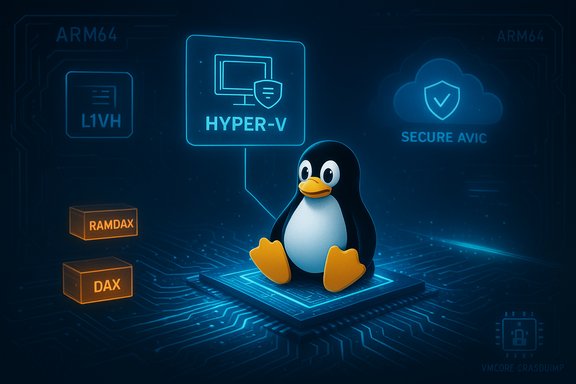
Microsoft’s Hyper‑V work for the Linux kernel landed a substantial set of features and cleanups in the Linux 6.19 cycle, expanding what Linux can do both as a guest on Hyper‑V and as a root partition for Microsoft’s hypervisor stack — and bringing confidential‑computing, crash collection, and new device models into closer parity with Azure’s infrastructure needs.
Background
Microsoft has been an active contributor to the Linux kernel for years, particularly in the virtualization and cloud stacks where Azure runs countless Linux workloads. That contribution set has steadily matured beyond basic integration (paravirtual drivers, VMBus, and timekeeping) toward deeper platform features: running Linux as the root partition for the Microsoft hypervisor, exposing kernel interfaces for Microsoft’s in‑house hypervisor (MSHV), and supporting modern confidential computing primitives used by cloud vendors.Linux 6.19 continues that evolution. The merge includes a wide sweep of Hyper‑V and MSHV work: a new L1VH mode that changes how Linux interfaces with the Azure host hypervisor, enhanced crash dump (vmcore) collection for MSHV, a new mshv_vtl driver that exposes virtual trust‑level functionality, support for Confidential VMBus, Secure AVIC support for guest interrupt handling, ARM64 support and cleanups for the MSHV code path, and numerous memory‑management and shutdown fixes. At the same time, Microsoft upstreamed a separate driver called RAMDAX to expose carved‑out RAM as NVDIMM/DAX devices — a capability that complements virtualized persistent memory use cases in cloud environments.
These changes are substantive: they are not cosmetic bugfixes but new ABI/driver additions and architecture code that change how Linux and Hyper‑V interoperate, particularly in confidential and nested virtualization scenarios.
What landed in Linux 6.19 — an overview
- L1VH mode: a new mode where Linux can “drive” the hypervisor used by the Azure Host directly, altering the way root‑partition interactions are implemented.
- MSHV crash dump support: kernel code to collect hypervisor crash data (vmcore) for MSHV, enabling better post‑mortem diagnostics on hypervisor failures.
- mshv_vtl driver: a new driver exposing Virtual Trust Level (VTL) features so Linux can host a more privileged secure kernel within a partition context.
- Confidential VMBus: support for confidential (encrypted/isolated) VMBus channels when running Linux guests on Hyper‑V, a cornerstone for confidential VM functionality.
- Secure AVIC: support in the Hyper‑V codepath for Secure AVIC semantics so Secure Encrypted Virtualization (SEV‑SNP)‑style protections can cooperate with Hyper‑V VM interrupt models.
- MSHV ARM64 improvements: added work for MSHV on aarch64, improving firmware boot, shutdown, and general MSHV behavior on ARM hosts.
- Memory management and region handling: improved guest memory region management, including support for movable and overlapping ranges better tracked by refcounts and locking.
- Shutdown and nested stability fixes: fixes that address shutdown failures in bare‑metal and nested configurations.
- RAMDAX driver merged: a Microsoft contribution to present RAM carve‑outs as DAX/NVDIMM devices for high‑speed persistent memory use on hosts and VMs.
Deep dive: key features explained
L1VH — what it is and why it matters
L1VH (the shorthand used in the code) is a mode intended to let Linux act as an active controller for the hypervisor that powers the Azure host. In practice this changes the way Linux can interact with hypervisor facilities and hypercalls when it is acting as a root partition — enabling more direct control paths and new hypercall semantics for high‑trust scenarios.- Why this is important: it provides a standardized kernel interface for cloud providers to use Linux at deeper levels in the virtualization stack, reducing the need for out‑of‑tree hacks.
- How it’s implemented: the kernel additions allocate vp (virtual processor) state pages and add new hypercall interfaces and trampolines — low‑level kernel code that mediates transitions between kernel and hypervisor contexts.
- Immediate effect: L1VH primarily affects systems where Linux is expected to be a first‑class partner with Microsoft’s hypervisor (for example, specialized Azure host builds) rather than standard end‑user VMs.
MSHV crash dump collection (hv_crash)
Collecting crash dumps from a hypervisor is critical for diagnosing blue‑screen equivalent failures. The new hv_crash code paths and supporting trampoline assembly let the kernel request and gather memory regions from the hypervisor into a vmcore capture.- Benefit: faster, more complete post‑mortem analysis for cloud operators when the hypervisor encounters a fatal error.
- Operational note: administrators and platform engineers will need to ensure vmcore tooling and storage policies are in place to collect and manage these larger crash artifacts.
mshv_vtl: Virtual Trust Levels in the kernel
The mshv_vtl driver exposes the ability to create and manage a Virtual Trust Level — essentially a more privileged execution context inside a partition that can act as a secure kernel for specialized workloads. This is similar in spirit to other vendor trust‑level constructs that isolate highly privileged services.- Intended use cases: secure in‑guest emulation, paravisors, or VMM helper modes that require isolation from standard guest code but do not run in firmware or host space.
- Interfaces: character device ioctl plumbing for creating VTLs, mapping address spaces, switching contexts, and funneling VMBus messages into a higher trust level.
- Implication: this creates a cleaner, supported pathway for in‑guest secure components to coexist with standard guest kernels, with better performance and isolation than earlier ad‑hoc approaches.
Confidential VMBus and Secure AVIC
Confidential VMBus introduces the ability for the VMBus control and message channel to operate in a confidential or encrypted mode, aligning Hyper‑V guest capabilities with confidential computing trends (e.g., SEV‑SNP, Intel TDX).Secure AVIC support enables a guest‑owned APIC backing page and associated fields so that a malicious or compromised hypervisor cannot trivially inject unexpected interrupts into a secure guest. This dovetails with hardware features from AMD (Secure AVIC) and fits the overall confidentiality model.
- Why this matters: confidential VMs require hardware‑anchored guarantees. Supporting matching channel and interrupt primitives in Hyper‑V guest drivers makes it feasible for confidential VMs to run under Hyper‑V with comparable semantics to KVM/SEV or TDX environments.
- Compatibility angle: the kernel code conditionally avoids older hv_apic paths when Secure AVIC is available, switching to the secure flow instead.
RAMDAX — carving RAM into DAX/NVDIMM devices
RAMDAX enables the kernel to treat specific RAM regions as persistent memory regions (NVDIMM) exposed to userspace via DAX. It supports dynamic layout of namespaces, label management, and up to hundreds of namespaces per region. Use cases include VM hosts exposing fast, byte‑addressable persistent memory to guests and specialized database or caching systems that want persistent memory semantics without dedicated NVDIMM hardware.- Why Microsoft upstreamed this: in cloud environments it’s common to allocate RAM for ephemeral persistent usage — RAMDAX formalizes this by providing a kernel driver to manage memmap carveouts consistently.
- Operational notes: this driver changes how memmap regions can be managed at runtime and offers devicetree/kernel‑cmdline integration; operators should understand namespace layout, backing device semantics (FSDAX/DEVDAX), and driver binding overrides.
Real‑world impact: who benefits and how
- Cloud operators (Azure and private clouds) get improved telemetry (crash dumps), richer platform primitives (L1VH, VTL), and confidential VM support parity that reduces friction implementing CoCo (confidential computing) offerings.
- Linux distributions and downstream kernels gain new upstreamed features that reduce the need for vendor‑specific kernel forks — but must also absorb and test larger Hyper‑V code changes.
- Security and compliance teams can map improved confidential VMBus and Secure AVIC support to regulatory or data‑sovereignty controls for workloads requiring hardware‑assisted isolation.
- Developers of virtualization stacks and VMMs can leverage mshv_vtl interfaces to implement paravisor models or userland VMMs that cooperate with Hyper‑V-specific trust levels.
- Operators running nested virtualization should see better shutdown semantics and fewer corner‑case failures in complex nested setups, improving reliability for advanced deployment topologies.
Strengths and notable positives
- Upstream, official support: Microsoft is shipping these features upstream rather than continuing to rely on out‑of‑tree patches. That means better long‑term maintainability, broader testing, and simpler lifecycle management for cloud customers and distributions.
- Confidential computing alignment: adding Confidential VMBus and Secure AVIC support demonstrates an industry move to standardize confidential VM primitives across hypervisors and hardware vendors.
- Stronger observability: MSHV crash dump collection gives platform engineers a real tool to diagnose hypervisor failures — an operational win for reliability engineering.
- Improved portability for cloud workloads: RAMDAX and memory region improvements make it easier to present persistent‑memory semantics to VMs in multiple environments, not just those with dedicated NVDIMM hardware.
- ARM64 attention: MSHV improvements on aarch64 are significant as cloud vendors expand ARM‑based host fleets — early parity reduces fragmentation across architectures.
Risks, unknowns, and caveats
- Increased attack surface: any new kernel interface, especially ones that manage hypercalls, trust levels, and memory mappings, inherently expands the attack surface. Features like mshv_vtl and L1VH provide powerful capabilities; if hardened and audited code paths are not exhaustive, they can become vectors for privilege escalation or misconfiguration.
- Vendor‑specific complexity: these changes are very Hyper‑V/MSHV centric. While useful for Azure and Microsoft‑aligned stacks, they increase distribution and kernel complexity for users who never touch Hyper‑V, and they can complicate testing matrices (x86 vs. aarch64, Kconfig permutations).
- Performance impact unknowns: the code adds new trapping, trampoline, and mapping behaviors; while the intent is improved efficiency and functionality, real‑world performance effects (latency, boot time on large vCPU counts, throughput under high interrupt churn) require thorough benchmarking across representative workloads.
- Compatibility and ABI stability: additions that expose userspace interfaces (ioctls, uapi headers) create a long‑term maintenance promise. Any future ABI changes must be done carefully to avoid breaking vendor tooling or operator scripts.
- Operational complexity for confidential VMs: running confidential VMs typically requires tooling, key management, and attestation services. Kernel support is a prerequisite but not sufficient; engineers must still integrate the full attestation and key lifecycle for secure deployments.
- Testing burden on distro maintainers: major Hyper‑V changes increase CI demands. Distros that ship kernels must test combinations of Hyper‑V, KVM, SEV/TDX, and other virtualization features across architectures.
Practical guidance and recommendations
- For cloud and platform teams:
- Build test plans that exercise the new MSHV crash flow, L1VH behaviors, and VTL creation paths in controlled environments before enabling in production.
- Validate backup and artifact retention policies to accommodate larger vmcore files produced by hypervisor crash captures.
- For administrators running Linux guests on Hyper‑V:
- Keep kernels updated but verify drivers and in‑guest tooling (e.g., vmtools or cloud agent equivalents) for compatibility with Confidential VMBus and Secure AVIC.
- Treat RAMDAX like any block/persistent memory change: plan for namespace layout and ensure applications are aware of DAX semantics and failure modes.
- For distribution maintainers and kernel packagers:
- Add Hyper‑V regression coverage to CI, especially for nested and large‑vCPU boot scenarios.
- Review Kconfig defaults for the Hyper‑V subsystem — ensure features intended only for Azure/Hyper‑V hosts are not unnecessarily enabled in user‑space kernels.
- For security teams:
- Subject mshv_vtl and L1VH interfaces to targeted code review and threat modeling.
- Integrate attestation and key‑management checks into deployment playbooks for confidential VMs; kernel support is only one piece of a secure chain.
- For developers building hypervisors or VMMs:
- Leverage the new mshv_vtl ioctl and device features to prototype paravisor or VTL‑based components, but design for graceful fallback when running on platforms that lack these features.
What remains to be proven
- Performance gains (or losses): the merge includes promises of better memory region management, better shutdown behavior, and enhanced interrupt models — but comprehensive benchmarking under real cloud workloads will ultimately validate whether these changes help or harm tail latency, throughput, or VM density.
- Maturity of confidential features: Confidential VMBus and Secure AVIC are technical enablers. Their security guarantees in production depend on correct firmware support, host configuration, and complete attestation stacks.
- Cross‑hypervisor interoperability: as KVM and Hyper‑V take different routes to confidentiality primitives, the community needs to watch for fragmentation; cross‑vendor interoperability and consistent semantics are still a work in progress.
Conclusion
The Hyper‑V and MSHV additions merged for Linux 6.19 are a meaningful step in bringing cloud‑grade virtualization features into the mainline kernel. By upstreaming L1VH controls, mshv_vtl, Confidential VMBus, Secure AVIC support, crash dump collection, and RAMDAX, Microsoft has both narrowed the gap between vendor‑specific functionality and the Linux mainline and provided clearer, supported paths for confidential and high‑trust virtualization use cases.The tradeoff is increased kernel complexity and a higher responsibility for testing and security review. For cloud operators and distributions that rely on Hyper‑V or aim to interoperate with Azure, these changes remove many of the previous hurdles that required out‑of‑tree patches. For the broader Linux ecosystem, the arrival of these features upstream means better long‑term support — provided the community follows through with rigorous testing, security analysis, and careful integration into production environments.
Operators and engineers should treat Linux 6.19’s Hyper‑V additions as an invitation to evaluate new capabilities in staging environments, align observability and incident‑response tooling to support hypervisor vmcore collection, and prepare policy and runtime controls before flipping these features into production workloads. The kernel is now ready; the next step is responsible, measured adoption.
Source: Phoronix Microsoft Has Many Hyper-V Virtualization Improvements For Linux 6.19 - Phoronix
