

Linux 7.2-rc1 was released on June 28, 2026, closing the two-week merge window for the next mainline Linux kernel and opening the release-candidate testing cycle with AMD GPU display work, AMD ISP4 support, Cache Aware Scheduling, USB4STREAM, driver updates, and core cleanup. Linus Torvalds called the state of the tree “reasonably normal,” which is kernel-maintainer shorthand for a release that is large, messy, hardware-heavy, and still boring in the way successful infrastructure work is supposed to be boring. The interesting part is not that Linux 7.2-rc1 arrived on schedule; it is that its most visible changes show how much modern operating-system progress now happens below the desktop layer, in display links, media pipelines, CPU topology, and driver hygiene. For WindowsForum readers, this is a reminder that the OS wars are no longer fought only in taskbars and app stores, but in whether the platform can keep pace with the hardware underneath it.
The first release candidate of a Linux kernel is not meant to be polished. It is the first public settling point after maintainers pour two weeks of subsystem work into Linus Torvalds’ tree, followed by weeks of regression hunting, bisection, testing, and increasingly cautious fixes. That makes rc1 less a product launch than a stress test of the project’s ability to metabolize change.
By Torvalds’ own framing, Linux 7.2-rc1 is broadly normal. The patch statistics are not hiding some architectural panic, and the usual categories are represented: drivers, architecture code, tooling, documentation, and core kernel updates. The caveat is familiar in modern Linux development: a large AMD GPU header drop makes the diff look bigger than the functional change might suggest.
That caveat matters because it says something about where the weight of the kernel now lives. A great deal of “Linux development” is no longer the romantic image of rewriting schedulers in a quiet room. It is the practical, sometimes tedious work of making new silicon visible to an open-source operating system before users notice the absence.
The release therefore lands with a paradox. It is normal because the process worked, but it is important because the normal process now carries changes that would once have been considered platform-defining. HDMI 2.1 transport work, camera ISP support, CPU-cache-aware scheduling, new USB streaming plumbing, NTFS fixes, and old API removal are not one feature. They are the operating system’s connective tissue being rewoven.
The Linux angle has been unusually thorny because display support is not just about whether the GPU can generate pixels. It depends on specifications, licensing, firmware behavior, monitor quirks, GPU driver infrastructure, and the permissions granted to open-source implementations. Linux graphics users have learned the hard way that “the port is on the card” and “the OS can use every mode reliably” are not the same claim.
That is why the AMDGPU HDMI 2.1 FRL work in Linux 7.2 is noteworthy even if it is described as initial. It signals forward movement on a long-running pain point for AMD Linux users who have seen DisplayPort serve as the safer high-bandwidth route while HDMI capabilities lagged behind expectations. It is not a guarantee that every HDMI 2.1 monitor, TV, dock, cable, and GPU combination will suddenly behave perfectly when Linux 7.2 goes stable.
Still, the direction is obvious. Linux is continuing to close the gap between what the hardware marketing box promises and what the open driver stack can actually deliver. For users who dual-boot Windows and Linux on gaming rigs, home-theater PCs, or creator workstations, that gap is often the difference between Linux as a daily-driver OS and Linux as an experiment launched only when convenient.
Windows has long benefited from vendor-supplied graphics stacks that prioritize consumer display compatibility early. Linux’s advantage is different: once support lands upstream, it becomes part of a shared, inspectable, distribution-wide base rather than a vendor package glued onto a single release. The downside is that upstreaming can be slow, politically constrained, and dependent on cooperation across companies that do not always share the same incentives.
For Windows users, the built-in webcam usually either works or is blamed on the OEM when it does not. For Linux users, laptop cameras have become a more complicated story as vendors move away from simple USB Video Class devices toward MIPI-connected camera stacks with proprietary tuning and platform-specific processing. The result is that a machine can run Linux beautifully and still fail at the very mundane task of joining a video call with its internal camera.
AMD ISP4 support is therefore more than a checkbox. It reflects Linux’s push into the parts of PC hardware that are less standardized, less glamorous, and more essential to everyday laptop use. A kernel can have a world-class filesystem, advanced scheduler, and elegant driver model, but if the camera does not work in a meeting, the user judges the system harshly and correctly.
This is where upstream support has a multiplier effect. Once the kernel has the relevant ISP driver infrastructure, distributions, desktop portals, camera libraries, and applications can build toward a more reliable experience. That does not mean every laptop suddenly becomes supported, because camera enablement also depends on sensors, firmware, ACPI descriptions, user-space stacks, and OEM cooperation.
But the arrival of AMD ISP4 in the merge window shows that Linux hardware support is moving deeper into the laptop bill of materials. The desktop Linux story used to be dominated by Wi-Fi, suspend, GPU acceleration, and touchpads. The next frontier is the invisible platform silicon that Windows users rarely have to learn by name.
This matters because modern CPUs have become less uniform. The old mental model of “a core is a core” is increasingly inadequate, whether the system is a many-core server, a chiplet-based desktop CPU, or a hybrid consumer processor. Moving a task to the wrong place can increase cache misses, force more data movement, and reduce the benefit of hardware that is otherwise extremely capable.
For Linux, scheduler changes are always delicate because the scheduler is everyone’s problem. A tweak that improves database throughput may hurt interactivity, while a decision that helps one CPU family may expose a regression on another. That is why kernel scheduling work tends to arrive cautiously and then spend multiple cycles being measured, contested, and revised.
The inclusion of Cache Aware Scheduling work in Linux 7.2 reflects a broader shift from headline clock speeds to locality and topology. Operating systems now win performance not merely by “using more cores,” but by using the right cores at the right time with the least waste. That is as true for a cloud host as it is for a power user’s desktop.
Windows has been traveling a parallel road, especially as Intel and AMD have complicated the CPU landscape with hybrid designs, chiplets, and increasingly specialized performance behavior. The interesting comparison is not whether Linux or Windows has the better scheduler in the abstract. It is that both platforms are being forced by hardware design to become more topology-aware, more telemetry-driven, and less reliant on assumptions that held during simpler multicore eras.
Streaming over USB4 is not just about raw throughput. It is about predictable data movement, latency expectations, device coordination, and the ability to handle specialized use cases without pretending they are ordinary bulk transfers. As PCs become thinner and external connectivity becomes more important, the OS-level plumbing around these ports becomes a practical differentiator.
Linux’s advantage here is its habit of exposing low-level infrastructure early and iterating in public. That can look chaotic from the outside, but it often means support for new device classes matures in the open before most users know the acronym. The catch, as always, is that early kernel support does not instantly equal a polished end-user experience.
For administrators and workstation users, USB4 matters because the cable increasingly carries the office. One connection may mean power, display, networking, storage, audio, input devices, and security policy. A kernel regression in that stack can turn a laptop from a portable workstation into an expensive slab with a battery.
That is why these seemingly obscure transport features deserve attention. The kernel is where the difference between “the dock mostly works” and “the dock is trusted infrastructure” gets decided. Windows users see that through OEM driver packages and firmware updates; Linux users see it through merge windows, subsystem maintainers, and release candidates.
That boundary matters more than ideology suggests. Plenty of users dual-boot. Plenty of technicians use Linux rescue media to inspect Windows systems. Plenty of external disks move between operating systems without the user caring which kernel last mounted them. Filesystem support is one of the quiet places where OS compatibility becomes either boring or disastrous.
The modern in-kernel NTFS driver was a significant step because it aimed to provide better native support than the older patchwork of alternatives and historical limitations. But filesystems are unforgiving, and improvements often arrive with edge cases. A bug in graphics may crash a desktop session; a bug in storage can damage trust in a way that takes years to repair.
That is why fixes so soon after introduction should not be read simply as embarrassment. They are part of the stabilization path for code that touches real user data. The right question is not whether the first release was perfect, but whether regressions are being found, fixed, and pushed through the normal upstream process.
For Windows users experimenting with Linux, NTFS support remains an area where caution is rational. The safest storage strategy is still to keep backups, avoid treating shared system partitions as casual scratch space, and understand that cross-OS write support carries risks. But the long-term trajectory is positive: Linux is taking Windows filesystem compatibility more seriously inside the kernel proper.
This is the least flashy kind of progress because it rarely produces a benchmark chart. Users do not reboot into a new kernel and say, “my legacy string-copying semantics feel safer today.” But the absence of a class of future mistakes is exactly what mature infrastructure projects should value.
The Linux kernel’s scale makes this work unusually hard. APIs persist because they are everywhere, because replacement needs vary by context, and because mechanical conversion can introduce its own bugs. A six-year cleanup effort says as much about governance and stamina as it does about code.
Security-minded Windows administrators should recognize the pattern. Microsoft has spent years pushing safer defaults, deprecating risky protocols, hardening memory handling, and trying to move developers away from patterns that were once normal. These changes are often unpopular because they break assumptions before they prevent incidents the public can see.
Linux’s
A general-purpose operating-system kernel in 2026 is not just CPU scheduling and memory management. It is GPU display tables, wireless drivers, storage controllers, sound codecs, power-management quirks, ARM board descriptions, virtualization hooks, security modules, filesystems, industrial buses, fan controllers, camera pipelines, and compatibility scaffolding for machines most users will never touch. Much of Linux’s line count is the price of being everywhere.
That does not mean size is harmless. More code can mean more attack surface, more maintenance burden, more abandoned corners, and more opportunities for regressions. Kernel developers know this, which is why the same release cycle that adds new drivers also deletes old ones, removes obsolete APIs, and continues long-running cleanup campaigns.
The better way to read the line count is as an index of ambition. Linux is trying to run on cloud servers, gaming handhelds, developer laptops, phones, routers, lab equipment, embedded controllers, workstations, and hardware that has not shipped yet. No small kernel can do all of that without pushing complexity somewhere else.
Windows solves this problem differently, with a tighter set of supported PC assumptions, a massive driver ecosystem, OEM certification programs, and layers of backward compatibility that live across kernel, user space, firmware, and vendor packages. Linux centralizes more of the hardware conversation in the upstream tree. Neither model is simple; both are attempts to keep the PC ecosystem from collapsing under its own variety.
That testing phase is one of Linux’s great strengths and one of its usability problems. The strength is that the release process is visible, distributed, and brutally empirical. If a regression appears, someone can often bisect it, point to a commit, argue on a mailing list, and get a fix moving before the stable release lands.
The usability problem is that ordinary users rarely understand where they are in that pipeline. A feature merged for Linux 7.2 may not appear in their distribution for months, may be backported selectively, may require firmware, may depend on Mesa or user-space support, or may be disabled by default until maintainers are comfortable. The kernel version is necessary context, not a complete product promise.
That distinction is especially important for hardware features like HDMI 2.1 FRL and ISP4. The kernel can provide essential support while the real user experience still depends on graphics stacks, compositors, camera frameworks, distribution policy, and firmware availability. Linux users who track mainline kernels will see the work first; mainstream distribution users will see it only when the wider stack catches up.
For WindowsForum readers, this is a useful contrast with Microsoft’s model. Windows typically packages hardware enablement behind driver updates, OEM images, Windows Update delivery, and vendor control panels. Linux exposes the sausage-making. That transparency can look messy, but it also lets the community see whether support is real, incomplete, blocked, or merely waiting for adjacent components.
That is uncomfortable for marketing departments. AMD wants to sell GPUs and APUs. Intel wants its platform technologies to become default assumptions. Microsoft wants Windows to feel like the natural home of PC hardware. Linux distributions want the same hardware to work without proprietary ceremony. Users simply want the monitor, dock, webcam, filesystem, and workload to behave.
The kernel sits below those narratives and turns them into engineering obligations. If HDMI 2.1 is part of the consumer display world, Linux eventually has to handle it. If laptop cameras depend on ISPs, Linux has to grow camera-pipeline support. If CPUs are no longer uniform blocks of identical cores and caches, the scheduler has to become smarter. If Windows filesystems remain part of the real storage landscape, Linux has to interoperate safely.
That is why “reasonably normal” is such a revealing description. The normal work of an operating-system kernel is now to absorb constant hardware specialization without losing reliability. Every release candidate is a negotiation between new capability and old stability.
The risk is that complexity becomes invisible until it breaks. Users notice the one display mode that will not appear, the one webcam that fails, the one dock that wakes unreliably, the one filesystem edge case that corrupts confidence. Kernel releases like 7.2-rc1 are where the industry tries to prevent those failures before they become anecdotes repeated for years.
The most concrete lesson is that Linux continues to narrow the gap in hardware enablement areas that once made Windows the obvious choice on new PCs. Graphics display capability, camera support, storage interoperability, and topology-aware performance are not niche concerns. They are daily-driver concerns, even when users do not know the subsystem names.
The second lesson is that Linux’s development model remains unusually honest about incompleteness. Initial HDMI 2.1 FRL support is not the same as universal HDMI 2.1 bliss. AMD ISP4 support is not the same as every webcam working. A release candidate is not a stable distribution kernel. The Linux ecosystem’s virtue is that it shows the work in public; its vice is that users must learn to read the difference between a patch landing and a problem being solved.
The third lesson is that Windows and Linux are converging on the same hard problems from different directions. Microsoft has the OEM channel, established driver relationships, and a controlled update story. Linux has upstream collaboration, public review, and a kernel tree that can eventually make support common across distributions. Both models are under pressure from hardware that changes faster than operating systems can comfortably abstract it.
For WindowsForum readers tracking practical impact, the release offers several grounded takeaways:
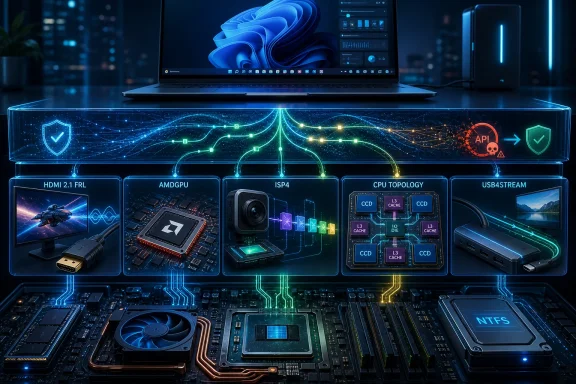 Linux 7.2 Looks Ordinary Because the Kernel Has Learned to Absorb Extraordinary Change
The first release candidate of a Linux kernel is not meant to be polished. It is the first public settling point after maintainers pour two weeks of subsystem work into Linus Torvalds’ tree, followed by weeks of regression hunting, bisection, testing, and increasingly cautious fixes. That makes rc1 less a product launch than a stress test of the project’s ability to metabolize change.By Torvalds’ own framing, Linux 7.2-rc1 is broadly normal. The patch statistics are not hiding some architectural panic, and the usual categories are represented: drivers, architecture code, tooling, documentation, and core kernel updates. The caveat is familiar in modern Linux development: a large AMD GPU header drop makes the diff look bigger than the functional change might suggest.
That caveat matters because it says something about where the weight of the kernel now lives. A great deal of “Linux development” is no longer the romantic image of rewriting schedulers in a quiet room. It is the practical, sometimes tedious work of making new silicon visible to an open-source operating system before users notice the absence.
The release therefore lands with a paradox. It is normal because the process worked, but it is important because the normal process now carries changes that would once have been considered platform-defining. HDMI 2.1 transport work, camera ISP support, CPU-cache-aware scheduling, new USB streaming plumbing, NTFS fixes, and old API removal are not one feature. They are the operating system’s connective tissue being rewoven.
AMDGPU’s HDMI 2.1 Work Is a Display Story With Platform Politics Underneath
The headline item for many desktop users will be the initial AMDGPU work around HDMI 2.1 Fixed Rate Link, commonly abbreviated FRL. HDMI 2.1 FRL is the transport mechanism behind higher-bandwidth display modes associated with modern televisions and monitors, including combinations of high resolution, high refresh rate, HDR, and reduced compression. In plain terms, this is part of what lets a PC drive the kind of display experience gamers and workstation users increasingly expect from current hardware.The Linux angle has been unusually thorny because display support is not just about whether the GPU can generate pixels. It depends on specifications, licensing, firmware behavior, monitor quirks, GPU driver infrastructure, and the permissions granted to open-source implementations. Linux graphics users have learned the hard way that “the port is on the card” and “the OS can use every mode reliably” are not the same claim.
That is why the AMDGPU HDMI 2.1 FRL work in Linux 7.2 is noteworthy even if it is described as initial. It signals forward movement on a long-running pain point for AMD Linux users who have seen DisplayPort serve as the safer high-bandwidth route while HDMI capabilities lagged behind expectations. It is not a guarantee that every HDMI 2.1 monitor, TV, dock, cable, and GPU combination will suddenly behave perfectly when Linux 7.2 goes stable.
Still, the direction is obvious. Linux is continuing to close the gap between what the hardware marketing box promises and what the open driver stack can actually deliver. For users who dual-boot Windows and Linux on gaming rigs, home-theater PCs, or creator workstations, that gap is often the difference between Linux as a daily-driver OS and Linux as an experiment launched only when convenient.
Windows has long benefited from vendor-supplied graphics stacks that prioritize consumer display compatibility early. Linux’s advantage is different: once support lands upstream, it becomes part of a shared, inspectable, distribution-wide base rather than a vendor package glued onto a single release. The downside is that upstreaming can be slow, politically constrained, and dependent on cooperation across companies that do not always share the same incentives.
AMD ISP4 Shows Linux Chasing the Laptop Experience Windows Users Take for Granted
The new AMD ISP4 driver points to another area where Linux has historically lagged behind Windows on consumer hardware: integrated camera pipelines. ISP stands for image signal processor, and on modern laptops it is not an optional luxury. It is the component that turns raw sensor data into usable video through processing stages that may include exposure, color correction, noise handling, and other camera-specific tuning.For Windows users, the built-in webcam usually either works or is blamed on the OEM when it does not. For Linux users, laptop cameras have become a more complicated story as vendors move away from simple USB Video Class devices toward MIPI-connected camera stacks with proprietary tuning and platform-specific processing. The result is that a machine can run Linux beautifully and still fail at the very mundane task of joining a video call with its internal camera.
AMD ISP4 support is therefore more than a checkbox. It reflects Linux’s push into the parts of PC hardware that are less standardized, less glamorous, and more essential to everyday laptop use. A kernel can have a world-class filesystem, advanced scheduler, and elegant driver model, but if the camera does not work in a meeting, the user judges the system harshly and correctly.
This is where upstream support has a multiplier effect. Once the kernel has the relevant ISP driver infrastructure, distributions, desktop portals, camera libraries, and applications can build toward a more reliable experience. That does not mean every laptop suddenly becomes supported, because camera enablement also depends on sensors, firmware, ACPI descriptions, user-space stacks, and OEM cooperation.
But the arrival of AMD ISP4 in the merge window shows that Linux hardware support is moving deeper into the laptop bill of materials. The desktop Linux story used to be dominated by Wi-Fi, suspend, GPU acceleration, and touchpads. The next frontier is the invisible platform silicon that Windows users rarely have to learn by name.
Cache Aware Scheduling Is the Kind of Performance Work Users Feel Before They Understand
Cache Aware Scheduling is one of those features that sounds dry until it makes a workload faster or a system more responsive. The basic idea is that a scheduler should understand more about the CPU cache topology when deciding where work runs. On modern processors, where cores, cache slices, chiplets, and memory paths can vary meaningfully inside the same socket, a naive placement decision can leave performance on the table.This matters because modern CPUs have become less uniform. The old mental model of “a core is a core” is increasingly inadequate, whether the system is a many-core server, a chiplet-based desktop CPU, or a hybrid consumer processor. Moving a task to the wrong place can increase cache misses, force more data movement, and reduce the benefit of hardware that is otherwise extremely capable.
For Linux, scheduler changes are always delicate because the scheduler is everyone’s problem. A tweak that improves database throughput may hurt interactivity, while a decision that helps one CPU family may expose a regression on another. That is why kernel scheduling work tends to arrive cautiously and then spend multiple cycles being measured, contested, and revised.
The inclusion of Cache Aware Scheduling work in Linux 7.2 reflects a broader shift from headline clock speeds to locality and topology. Operating systems now win performance not merely by “using more cores,” but by using the right cores at the right time with the least waste. That is as true for a cloud host as it is for a power user’s desktop.
Windows has been traveling a parallel road, especially as Intel and AMD have complicated the CPU landscape with hybrid designs, chiplets, and increasingly specialized performance behavior. The interesting comparison is not whether Linux or Windows has the better scheduler in the abstract. It is that both platforms are being forced by hardware design to become more topology-aware, more telemetry-driven, and less reliant on assumptions that held during simpler multicore eras.
USB4STREAM Hints at the Peripheral Future Arriving Through the Kernel First
Intel’s USB4STREAM work is another example of a feature whose name undersells its implications. USB4 and Thunderbolt-class connectivity are increasingly central to high-performance docks, external GPUs, capture devices, displays, storage, and professional peripheral chains. The more bandwidth and flexibility these links carry, the more the operating system has to manage them as serious fabric rather than fancy USB ports.Streaming over USB4 is not just about raw throughput. It is about predictable data movement, latency expectations, device coordination, and the ability to handle specialized use cases without pretending they are ordinary bulk transfers. As PCs become thinner and external connectivity becomes more important, the OS-level plumbing around these ports becomes a practical differentiator.
Linux’s advantage here is its habit of exposing low-level infrastructure early and iterating in public. That can look chaotic from the outside, but it often means support for new device classes matures in the open before most users know the acronym. The catch, as always, is that early kernel support does not instantly equal a polished end-user experience.
For administrators and workstation users, USB4 matters because the cable increasingly carries the office. One connection may mean power, display, networking, storage, audio, input devices, and security policy. A kernel regression in that stack can turn a laptop from a portable workstation into an expensive slab with a battery.
That is why these seemingly obscure transport features deserve attention. The kernel is where the difference between “the dock mostly works” and “the dock is trusted infrastructure” gets decided. Windows users see that through OEM driver packages and firmware updates; Linux users see it through merge windows, subsystem maintainers, and release candidates.
The NTFS Fixes Are a Reminder That Filesystems Are Compatibility Promises
Linux 7.2 also includes fixes for the newer NTFS driver introduced in the previous development line. For WindowsForum’s audience, NTFS is not an exotic filesystem; it is the default storage language of modern Windows installations and external drives. When Linux improves NTFS support, it is improving the boundary between the Windows and Linux worlds.That boundary matters more than ideology suggests. Plenty of users dual-boot. Plenty of technicians use Linux rescue media to inspect Windows systems. Plenty of external disks move between operating systems without the user caring which kernel last mounted them. Filesystem support is one of the quiet places where OS compatibility becomes either boring or disastrous.
The modern in-kernel NTFS driver was a significant step because it aimed to provide better native support than the older patchwork of alternatives and historical limitations. But filesystems are unforgiving, and improvements often arrive with edge cases. A bug in graphics may crash a desktop session; a bug in storage can damage trust in a way that takes years to repair.
That is why fixes so soon after introduction should not be read simply as embarrassment. They are part of the stabilization path for code that touches real user data. The right question is not whether the first release was perfect, but whether regressions are being found, fixed, and pushed through the normal upstream process.
For Windows users experimenting with Linux, NTFS support remains an area where caution is rational. The safest storage strategy is still to keep backups, avoid treating shared system partitions as casual scratch space, and understand that cross-OS write support carries risks. But the long-term trajectory is positive: Linux is taking Windows filesystem compatibility more seriously inside the kernel proper.
Killing strncpy Is Maintenance as Security Policy
The removal of thestrncpy API after years of work may sound like janitorial cleanup, but it belongs in the same conversation as security hardening. C string-handling APIs have caused enough bugs, truncations, and unsafe assumptions to fill a museum. When kernel developers spend years eliminating a problematic interface, they are not chasing aesthetic purity; they are reducing the number of traps available to future code.This is the least flashy kind of progress because it rarely produces a benchmark chart. Users do not reboot into a new kernel and say, “my legacy string-copying semantics feel safer today.” But the absence of a class of future mistakes is exactly what mature infrastructure projects should value.
The Linux kernel’s scale makes this work unusually hard. APIs persist because they are everywhere, because replacement needs vary by context, and because mechanical conversion can introduce its own bugs. A six-year cleanup effort says as much about governance and stamina as it does about code.
Security-minded Windows administrators should recognize the pattern. Microsoft has spent years pushing safer defaults, deprecating risky protocols, hardening memory handling, and trying to move developers away from patterns that were once normal. These changes are often unpopular because they break assumptions before they prevent incidents the public can see.
Linux’s
strncpy cleanup is the open-source version of the same institutional lesson. A secure platform is not made only by emergency patches after vulnerabilities are named. It is made by retiring the old footguns before the next exploit chain finds them.The 43-Million-Line Kernel Is Not Bloat So Much as a Hardware Atlas
Phoronix notes that Linux 7.2 is now beyond 43 million lines in the kernel tree. The easy reaction is to call that bloat. The more accurate reaction is to ask what kind of modern hardware ecosystem would be supportable without that mass.A general-purpose operating-system kernel in 2026 is not just CPU scheduling and memory management. It is GPU display tables, wireless drivers, storage controllers, sound codecs, power-management quirks, ARM board descriptions, virtualization hooks, security modules, filesystems, industrial buses, fan controllers, camera pipelines, and compatibility scaffolding for machines most users will never touch. Much of Linux’s line count is the price of being everywhere.
That does not mean size is harmless. More code can mean more attack surface, more maintenance burden, more abandoned corners, and more opportunities for regressions. Kernel developers know this, which is why the same release cycle that adds new drivers also deletes old ones, removes obsolete APIs, and continues long-running cleanup campaigns.
The better way to read the line count is as an index of ambition. Linux is trying to run on cloud servers, gaming handhelds, developer laptops, phones, routers, lab equipment, embedded controllers, workstations, and hardware that has not shipped yet. No small kernel can do all of that without pushing complexity somewhere else.
Windows solves this problem differently, with a tighter set of supported PC assumptions, a massive driver ecosystem, OEM certification programs, and layers of backward compatibility that live across kernel, user space, firmware, and vendor packages. Linux centralizes more of the hardware conversation in the upstream tree. Neither model is simple; both are attempts to keep the PC ecosystem from collapsing under its own variety.
Release Candidates Are Where Vendor Promises Meet Community Reality
The “rc1” suffix is important. Linux 7.2 is not done. It has entered the period where developers, distributions, testers, hardware vendors, and adventurous users find out which changes behave outside the machines that produced them.That testing phase is one of Linux’s great strengths and one of its usability problems. The strength is that the release process is visible, distributed, and brutally empirical. If a regression appears, someone can often bisect it, point to a commit, argue on a mailing list, and get a fix moving before the stable release lands.
The usability problem is that ordinary users rarely understand where they are in that pipeline. A feature merged for Linux 7.2 may not appear in their distribution for months, may be backported selectively, may require firmware, may depend on Mesa or user-space support, or may be disabled by default until maintainers are comfortable. The kernel version is necessary context, not a complete product promise.
That distinction is especially important for hardware features like HDMI 2.1 FRL and ISP4. The kernel can provide essential support while the real user experience still depends on graphics stacks, compositors, camera frameworks, distribution policy, and firmware availability. Linux users who track mainline kernels will see the work first; mainstream distribution users will see it only when the wider stack catches up.
For WindowsForum readers, this is a useful contrast with Microsoft’s model. Windows typically packages hardware enablement behind driver updates, OEM images, Windows Update delivery, and vendor control panels. Linux exposes the sausage-making. That transparency can look messy, but it also lets the community see whether support is real, incomplete, blocked, or merely waiting for adjacent components.
The Real Story Is the PC Becoming Too Complex for Any One Vendor Narrative
Linux 7.2-rc1 is easy to frame as another kernel milestone, but the deeper story is that the PC platform has outgrown simple vendor narratives. AMD’s GPU work, Intel’s USB4 plumbing, NTFS compatibility, camera ISP enablement, and scheduler topology work all land in the same release because modern computing is a web of dependencies. No single company owns the experience end to end.That is uncomfortable for marketing departments. AMD wants to sell GPUs and APUs. Intel wants its platform technologies to become default assumptions. Microsoft wants Windows to feel like the natural home of PC hardware. Linux distributions want the same hardware to work without proprietary ceremony. Users simply want the monitor, dock, webcam, filesystem, and workload to behave.
The kernel sits below those narratives and turns them into engineering obligations. If HDMI 2.1 is part of the consumer display world, Linux eventually has to handle it. If laptop cameras depend on ISPs, Linux has to grow camera-pipeline support. If CPUs are no longer uniform blocks of identical cores and caches, the scheduler has to become smarter. If Windows filesystems remain part of the real storage landscape, Linux has to interoperate safely.
That is why “reasonably normal” is such a revealing description. The normal work of an operating-system kernel is now to absorb constant hardware specialization without losing reliability. Every release candidate is a negotiation between new capability and old stability.
The risk is that complexity becomes invisible until it breaks. Users notice the one display mode that will not appear, the one webcam that fails, the one dock that wakes unreliably, the one filesystem edge case that corrupts confidence. Kernel releases like 7.2-rc1 are where the industry tries to prevent those failures before they become anecdotes repeated for years.
What This Kernel Cycle Tells Windows People About Linux’s Next Move
Linux 7.2-rc1 should not be read as a sudden desktop revolution. It is better understood as the steady arrival of platform plumbing that makes desktop revolutions possible later. The kernel is not where most users experience polish, but it is where many forms of polish become technically possible.The most concrete lesson is that Linux continues to narrow the gap in hardware enablement areas that once made Windows the obvious choice on new PCs. Graphics display capability, camera support, storage interoperability, and topology-aware performance are not niche concerns. They are daily-driver concerns, even when users do not know the subsystem names.
The second lesson is that Linux’s development model remains unusually honest about incompleteness. Initial HDMI 2.1 FRL support is not the same as universal HDMI 2.1 bliss. AMD ISP4 support is not the same as every webcam working. A release candidate is not a stable distribution kernel. The Linux ecosystem’s virtue is that it shows the work in public; its vice is that users must learn to read the difference between a patch landing and a problem being solved.
The third lesson is that Windows and Linux are converging on the same hard problems from different directions. Microsoft has the OEM channel, established driver relationships, and a controlled update story. Linux has upstream collaboration, public review, and a kernel tree that can eventually make support common across distributions. Both models are under pressure from hardware that changes faster than operating systems can comfortably abstract it.
The Fine Print Behind “Reasonably Normal” Is Where the Action Is
A short reading of Linux 7.2-rc1 says the merge window closed, the tree looks normal, and testing begins. A better reading says the kernel is absorbing another wave of PC platform complexity without losing its process discipline. That is not glamorous, but it is exactly the kind of engineering that determines whether an operating system feels modern two years from now.For WindowsForum readers tracking practical impact, the release offers several grounded takeaways:
- Linux 7.2-rc1 is a testing milestone, not the stable Linux 7.2 release that mainstream users should expect distributions to ship immediately.
- AMDGPU HDMI 2.1 FRL work is an important step for high-bandwidth display support, but real-world results will depend on hardware combinations, firmware, user-space graphics components, and follow-up fixes.
- AMD ISP4 support matters because modern laptop webcams increasingly rely on integrated image-processing hardware rather than simple legacy USB camera behavior.
- Cache Aware Scheduling reflects the growing need for operating systems to understand CPU topology, cache locality, and chiplet-era performance tradeoffs.
- NTFS fixes and the removal of
strncpyshow that compatibility and cleanup remain as important to kernel progress as new hardware features. - The scale of the Linux kernel is best understood as the cost of broad hardware ambition, not merely as evidence of uncontrolled growth.
References
- Primary source: Phoronix
Published: Sun, 28 Jun 2026 20:04:00 GMT
Linux 7.2-rc1 Released: "Things Look Reasonably Normal" While Landing AMDGPU HDMI 2.1 FRL, AMD ISP4 & CAS - Phoronix
As expected, Linux 7.2-rc1 was released a brief time ago to cap off the Linux 7.2 merge windowwww.phoronix.com