

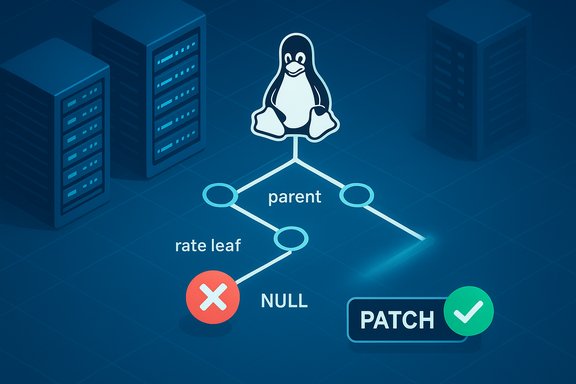
A recently disclosed Linux kernel vulnerability, tracked as CVE‑2025‑40251, stems from a small but consequential oversight in devlink’s rate node teardown logic: the function
devl_rate_nodes_destroy failed to clear the devlink_rate->parent pointer after decrementing the parent's reference count, leaving a dangling pointer that can trigger refcount warnings and kernel instability in drivers such as netdevsim and mlx5. Overview
The defect is narrow in scope but instructive: the devlink rate object cleanup path notified driver callbacks and decremented parent refcounts, but it did not set the internaldevlink_rate->parent field to NULL. That inconsistency left stale pointers inside devlink_rate structures after parent removal, producing observable refcount warnings and potential lifecycle confusion when devices or virtual functions are removed. The issue was documented and fixed upstream in a small kernel patch that explicitly clears the parent pointer as part of node destruction. This writeup summarizes the technical details, reproducer behavior, impact analysis, detection and mitigation guidance, and a critical appraisal of both the upstream fix and the operational risks that remain for mixed estates and vendor-provided kernels.Background
What is devlink and why do rate nodes matter?
Devlink is a kernel API layer used by high-end network drivers and switch offloads to expose device-level configuration and telemetry. One devlink feature is rate management—a hierarchical tree of rate nodes representing hardware TX schedulers and shaping/policer structures. The kernel tracks that tree per devlink object and relies on correct pointer and reference‑count management to maintain object lifecycles.When a parent-child relationship between rate nodes is removed, the kernel must both notify drivers (so hardware state can be updated) and update internal bookkeeping (clear parent pointers and adjust refcounts). Failing to do both leaves an internal inconsistency: driver callbacks may be executed and refcounts altered, but structures retain a stale parent pointer. That’s precisely the condition CVE‑2025‑40251 describes.
How the bug was discovered and reproduced
Public reports and the CVE metadata include concrete reproducer steps that exercise devlink rate parent removal withnetdevsim or an mlx5 device configured for cross-function rate trees. The reproducer typically:- Create a
netdevsimdevice (a virtual device for testing). - Add devlink rate nodes and set a parent via
devlink port function rate addanddevlink port function rate set ... parent. - Trigger device removal (for example,
echo 1 > /sys/bus/netdevsim/del_device). - Observe kernel messages such as “refcount_t: decrement hit 0; leaking memory” and stack traces rooted in
devl_rate_leaf_destroyor related devlink teardown functions.
Technical analysis
Root cause: inconsistent pointer cleanup
The functiondevl_rate_nodes_destroy is intended to “Unset parent for all rate objects.” In practice, prior to the upstream fix it:- Iterated rate nodes and called driver-specific callbacks such as
rate_leaf_parent_setorrate_node_parent_setto inform hardware drivers the parent relationship was being removed. - Decremented the parent's reference count so the parent's refcount bookkeeping reflected the removal.
- Did not set
devlink_rate->parentto NULL inside the devlink core object.
devlink_rate->parent pointing at the former parent object even though the parent’s refcount had been decremented and the driver had been told the parent relationship no longer existed. The stale pointer eventually produced a refcount warning and leaking memory diagnostic when the object lifecycle continued. The fix: explicit pointer nullification
Upstream maintainers applied a small, surgical change: after notifying the driver and adjusting parent refcounts, the core now explicitly setsdevlink_rate->parent = NULL for the node being destroyed. This brings the implementation in line with its documented behavior and with adjacent APIs (for example, devlink_nl_rate_parent_node_set) that already clear the parent pointer when detaching a node. The patch is minimal and low‑risk: it eliminates the dangling pointer without altering normal behavior for correctly ordered operations. Why this is not necessarily a remote exploitable bug
Available public analysis and the kernel logs indicate the immediate observable effect is refcount warnings and leaked refcounts that lead to WARNs and potentially unstable device removal flows. There is no authoritative public proof-of-concept showing remote code execution or local privilege escalation stemming directly from this bug.That said, kernel lifecycle bugs and dangling pointers can be part of a more complex exploitation chain in theory. Converting a refcount warning or inconsistent lifecycle into an arbitrary write or execute primitive generally requires additional conditions (allocator behavior, predictable reuse, or other bugs). No such chain is documented or published for this CVE at disclosure. Treat the primary risk as availability and stability rather than a confirmed RCE vector.
Affected systems and exposure model
- The vulnerability lives in the Linux kernel devlink rate management code‑path and therefore affects kernels that include that code (mainline and many distribution kernels).
- Practical exposure is highest for systems that instantiate devlink rate trees—networking appliances, SR‑IOV/VF configurations, and NICs that use devlink/MLX5 offloads. Test and development environments using
netdevsimcan reproduce the fault easily. - The attack vector is local/operational: device removal or reconfiguration operations that manipulate rate relationships are the trigger—this is not a straightforward unauthenticated remote network exploit.
- The principal impact is availability and operational correctness—unexpected WARNs, refcount errors, device removal problems or memory refcount saturation messages that impair driver unloading and can provoke instability.
Detection and hunting guidance
Operational detection focuses on kernel-level telemetry and driver logs rather than network signatures. Key signals to monitor:- Kernel logs (dmesg, journalctl -k) for messages such as:
- “refcount_t: decrement hit 0; leaking memory”
- Stack traces mentioning
devl_rate_leaf_destroy,devl_rate_nodes_destroy,devlink,netdevsimormlx5_core.
- Sudden failures or warnings during device removal, VF hotplug/unbind, or when manipulating devlink rate objects.
- Reproducible triggers if
netdevsimis available—running the documented reproducer steps will generate the same refcount trace shown in many public entries.
- Capture kernel logs immediately after the suspected event:
- journalctl -k -b --no-pager | grep -iE 'devl_rate|devlink|refcount|devl_rate_leaf_destroy'
- Identify modules and drivers involved:
- lsmod | egrep 'mlx5|netdevsim|devlink'
- Confirm the kernel contains the patched commit by inspecting package changelogs or upstream commit references included in distro advisories.
Remediation and mitigation
The definitive remediation is to run a kernel that contains the upstream patch which setsdevlink_rate->parent = NULL during devl_rate_nodes_destroy.Operational checklist:
- Verify whether your distribution/kernel package lists CVE‑2025‑40251 or references the upstream commit (for example, the stable commit id noted in upstream tracking). Distributors and trackers (Debian/OSV/NVD) have mapped the CVE and stable commits—check your distro advisory.
- Apply vendor-supplied kernel updates or upstream stable kernel packages that include the fix. Because this is a kernel change, reboot after updating into the patched kernel.
- For third‑party appliances, network boxes, or vendor images: contact your vendor to confirm a firmware or kernel update that includes the backport is available. Do not assume vendor images are patched just because the upstream kernel contains the change.
- If patching immediately is impossible:
- Avoid workflows that frequently remove or reload affected devices or that change rate parent relationships.
- Limit administrative access that can trigger devlink reconfiguration to trusted operators only.
- Where feasible, test whether disabling affected offload features or blacklisting specific modules is an acceptable temporary mitigation—but beware that blacklisting drivers such as mlx5 may remove critical functionality. Always test changes in a non‑production window.
Why the upstream fix is sensible — strengths and limitations
Strengths- The fix is small and precise: it implements the logical cleanup (pointer nullification) the API promised. Small fixes are easier to review, test, and backport with minimal regression risk.
- Aligns behavior across APIs: harmonizes
devl_rate_nodes_destroywithdevlink_nl_rate_parent_node_setwhich already cleared pointers, reducing future developer confusion. - Upstreaming a minimal behavioral correction makes downstream backports straightforward for distribution maintainers and vendors.
- Long tail of unpatched vendor images: embedded appliances, network devices, or vendor-provided kernels often lag upstream. These images may continue to exhibit the refcount symptom until vendor updates are issued—inventory and vendor engagement remain necessary.
- Potential for complex exploitation (theoretical): while no public PoC exists that elevates this specific dangling parent pointer into an RCE, object lifecycle defects are a recurring class that sometimes interacts with allocator behavior and other bugs to form an exploit chain. That potential is speculative and unproven here; however, the operational risk (stability and availability) is concrete and immediate. Mark any claims of escalation as unverified until authoritative PoC or exploit analysis appears.
Operational recommendations for mixed estates
Many Windows‑centric environments nevertheless host Linux components (VM appliances, WSL instances, routers, virtual network functions, management appliances). Treat any Linux kernel used in the estate with the same remediation discipline:- Inventory: map which internal services and appliances use devlink-capable hardware or drivers (mlx5, SR‑IOV, host NIC offloads).
- Prioritize: patch devices that provide networking infrastructure, VPN termination, or multi‑tenant services first—those are the places where a kernel refcount crash can cause the largest operational impact.
- Vendor confirmation: for vendor appliances (virtual or physical), request explicit confirmation that the vendor image includes the upstream patch or timetable for release.
- Test: stage kernel updates in pilot groups and validate device attach/detach, VF operations, and any devlink‑managed features before wide deployment.
- Monitoring: tune alerting to detect kernel refcount warnings so you get early notice of devices still exhibiting the old behavior.
Final assessment — what admins should take away
CVE‑2025‑40251 is a textbook example of how a tiny API inconsistency—failure to clear an internal pointer—can ripple into observable kernel instability. The bug’s tangible impact is a refcount warning and leaking-refcount messages that hamper device removal and driver unload sequences in netdevsim and mlx5 contexts. The upstream fix is minimal, corrects the documented behavior, and is straightforward to backport and deploy.Administrators should:
- Treat the issue as an availability and stability risk for systems that use devlink and advanced NIC offloads.
- Prioritize applying kernel updates from their distribution or vendor that contain the upstream commit; confirm the package changelog or advisory lists the CVE or commit reference.
- For environments that can’t patch immediately, avoid device reconfiguration workloads that change devlink rate parents and enforce stricter administrative controls to limit inadvertent triggers.
CVE‑2025‑40251 is small in code size but significant in operational terms: a short, defensive change eliminates an avoidable dangling pointer and restores predictable devlink lifecycle semantics. Apply the kernel update, confirm vendor images are patched, and tune monitoring to turn a subtle pointer bug into a routine maintenance item rather than an operational incident.
Source: MSRC Security Update Guide - Microsoft Security Response Center
