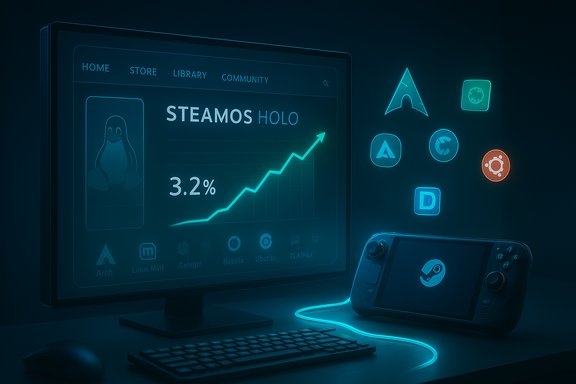
Linux gaming has quietly crossed a new milestone: for the second month in a row the Steam Hardware & Software Survey shows Linux users climbing to a record share of the platform, reaching 3.2% of all Steam users in November 2025 — a modest fraction of the total, but a clear and sustained uptrend that matters for developers, hardware vendors, and anyone tracking the state of PC gaming.
The Steam Hardware & Software Survey is Valve’s monthly snapshot of the client population — a voluntary, anonymized sample that has become an industry bellwether for platform trends, input devices, GPU share, and OS splits. November’s snapshot shows Windows still overwhelmingly dominant, but the incremental growth for Linux is noteworthy because it follows a similar jump in October and because the composition of Linux installs is changing in ways that reflect Valve-driven ecosystem shifts and wider user reactions to Microsoft’s platform policies.
There are three broad forces driving the change:
The direct effect is visible in the survey: Valve’s SteamOS Holo is now the most-used Linux variant among Steam users, making up around a quarter of the Linux cohort. That’s a statement about product influence: when Valve ships a device and maintains the stack that powers it, a measurable portion of the community adopts that stack on desktop and laptop PCs as well.
The timing of the Linux gains in Steam’s October and November surveys aligns with the EOL date, suggesting the EOL event amplified interest in trying Linux. However, it would be wrong to ascribe all growth to Windows 10’s EOL: the technical improvements to Linux gaming were already in motion and the Steam Deck’s continued sales performance has been steadily normalizing Linux workflows for players.
This month’s numbers — 3.2% Linux share on Steam and SteamOS Holo representing roughly a quarter of that slice — are verifiable trends, not a passing novelty. They deserve attention from publishers, platform engineers, and hardware partners because the implications for testing, packaging, and customer support affect the entire PC gaming stack.
Source: Računalniške novice Linux sets new record on Steam - Computer News
 Background
The Steam Hardware & Software Survey is Valve’s monthly snapshot of the client population — a voluntary, anonymized sample that has become an industry bellwether for platform trends, input devices, GPU share, and OS splits. November’s snapshot shows Windows still overwhelmingly dominant, but the incremental growth for Linux is noteworthy because it follows a similar jump in October and because the composition of Linux installs is changing in ways that reflect Valve-driven ecosystem shifts and wider user reactions to Microsoft’s platform policies. Key November snapshot figures at a glance
- Linux on Steam (November 2025): 3.20% — a new record for Steam’s monthly survey and the second consecutive month of growth.
- Windows overall (November 2025): ~94.79%, with Windows 11 and Windows 10 making up the bulk of that share.
- SteamOS Holo is now the single most common Linux distribution on Steam, accounting for about 26.4% of Steam’s Linux installs. Other distributions such as Arch, Linux Mint, CachyOS, Bazzite, and Ubuntu are visible in single-digit shares.
- Microsoft’s formal end of support for Windows 10 occurred on October 14, 2025, a calendar event that coincides with the uptick in Linux installs reported by the survey.
Why this matters: a short explanation
Three percent of Steam might seem small relative to Windows’ dominance, but Steam is a massive platform. Even fractional percentage moves translate to millions of users and measurable buying power. More importantly, the composition of that Linux slice matters: Valve’s SteamOS Holo presence and the rise of gaming-focused distros shift how games will be tested, packaged, and supported going forward.There are three broad forces driving the change:
- Valve’s ecosystem work (Steam Deck, Proton, SteamOS) made Linux gaming practical for mainstream users.
- Packaging and distribution improvements (Flatpak, gaming-oriented distros like Bazzite) lowered the setup barrier.
- Platform decisions and timelines (Windows 10 end-of-life) created a concrete migration event that nudged some users to explore Linux as an alternative.
Valve’s role and SteamOS Holo’s dominance
Valve’s investments in Linux for gaming are the single biggest structural factor here. The Steam Deck proved that a large portion of Steam’s catalog could be made to run on Linux hardware with acceptable performance and compatibility, and Valve’s Proton compatibility layer — essentially a curated and enhanced Wine build — is the engineering foundation that lets Windows-only titles run on Linux with minimal friction.The direct effect is visible in the survey: Valve’s SteamOS Holo is now the most-used Linux variant among Steam users, making up around a quarter of the Linux cohort. That’s a statement about product influence: when Valve ships a device and maintains the stack that powers it, a measurable portion of the community adopts that stack on desktop and laptop PCs as well.
What SteamOS Holo adoption means
- A common runtime and baseline (SteamOS + Proton) reduces the QA surface for developers testing Linux behavior, because a large segment of Linux gamers are running similar stacks.
- Native SteamOS adoption makes feature testing for Valve’s platform features (like controller integration, performance profile APIs, and Steam Input) more meaningful for non-handheld PCs.
- It creates a stronger business case for publishers to enable Proton/SteamOS compatibility flags or to release native Linux builds because the reachable Linux audience is concentrated rather than scattered across dozens of small, unique installations.
The distro mix and what it tells us
The Linux installs reported by Valve’s survey are no longer just a miscellany of desktop Linux setups. The distribution breakdown shows a clear leader (SteamOS Holo), followed by Arch, Linux Mint, CachyOS, Bazzite, Ubuntu, and identifiable Flatpak runtime entries. Bazzite, a newer gaming-focused Linux distribution often recommended as a SteamOS alternative for custom gaming PCs, showed a noticeable month-to-month jump in the survey. Flatpak-distributed Steam clients are also visible and growing — a signal that simplified packaging and sandboxing are resonating with users who want the easiest path to play. This mix matters because:- Arch-style, rolling distributions attract enthusiasts who will tinker and push fixes, helping the ecosystem to stabilize quickly.
- Gaming-first distros like Bazzite provide out-of-the-box profiles that match the expectations of gamers used to Windows: GPU drivers, performance settings, and easy install routes to Steam and Proton.
- Flatpak and other containerized packaging reduce the installation friction for Steam, making Linux a pragmatic choice for users who otherwise dread package-management differences between distros.
Why Windows 10 end-of-life probably nudged some users to Linux
Microsoft’s formal end of support for Windows 10 on October 14, 2025 created a decision point for many users: upgrade to Windows 11, buy new hardware, pay for temporary extended support, or try an alternative OS. For a subset of users whose machines either failed Microsoft’s Windows 11 requirements or who disliked Windows 11’s direction, Linux became a viable, attractive alternative — especially as the gaming experience on Linux has matured.The timing of the Linux gains in Steam’s October and November surveys aligns with the EOL date, suggesting the EOL event amplified interest in trying Linux. However, it would be wrong to ascribe all growth to Windows 10’s EOL: the technical improvements to Linux gaming were already in motion and the Steam Deck’s continued sales performance has been steadily normalizing Linux workflows for players.
Technical enablers: Proton, Steam Deck, drivers, and packaging
Linux gaming growth is not a coincidence; it rests on cumulative improvements in several technical layers:- Proton compatibility layer — Valve’s Proton has improved dramatically in recent years, integrating upstream Wine advances, DXVK/D9VK translation layers, and performance-focused patches that make many AAA titles run well on Linux. Proton’s continuous releases and Valve’s internal testing for Steam Deck games accelerate compatibility fixes.
- Steam Deck validation and the compatibility program — Valve’s game compatibility program and the Deck Verified tiers give consumers and developers a clearer roadmap for what works on Linux-based SteamOS. That confidence reduces buyer friction.
- Driver maturity, particularly for AMD GPUs — AMD’s open driver strategy and strong Linux support has made GPUs perform reliably across many distributions, narrowing an earlier gap between Linux and Windows for many titles.
- Packaging advances — Flatpak and similar runtimes make installing a working Steam client trivial and reduce dependency hell, which historically discouraged everyday users from trying Linux.
Strengths: what Linux’s growth brings to the PC gaming ecosystem
- More competition and user choice. A small but growing Linux install base provides users with a genuine alternative to Windows when migrating or refreshing hardware. It also creates pressure on Microsoft and OEMs to make Windows transitions smoother or cheaper.
- Reduced platform lock-in for players. Proton lets users keep large parts of the Windows-only library accessible without giving up Steam’s ecosystem. That expands consumer agency.
- A concentrated Linux market for developers. With SteamOS as a prominent share of Linux installs, developer testing and certification can be targeted. That makes it feasible to support Linux economically.
- Open-source innovations feeding back into the stack. Improvements to Wine, Vulkan translation layers, and GPU drivers benefit not only Linux users but the broader cross-platform tooling ecosystem.
- Lower friction installs via Flatpak and gaming distros. Easier installation and preconfigured gaming distros shorten the time from curiosity to playing.
Risks and limitations — the reality behind the headlines
The rise is meaningful but not revolutionary. Linux remains a small slice of the overall market, and several persistent challenges could slow or cap adoption unless addressed.1) Anti-cheat and multiplayer compatibility
Anti-cheat systems are the single biggest blocker for full parity with Windows on multiplayer titles. Historically, kernel-level anti-cheat systems (Easy Anti-Cheat, BattlEye) prevented many multiplayer games from being playable under Proton. Over the last few years these vendors and Valve have worked on compatibility options that let Proton users be supported, but in practice anti-cheat support varies; some vendors have enabled support, others have had stability problems with certain builds, and publishers must opt into the new configurations. The practical result is that many recent multiplayer titles either run with caveats or remain blocked. This is now well documented across community and press reporting and is still a live, developer-facing problem.2) Market share inertia and developer economics
At ~3.2%, Linux is still small. For many large publishers, the cost to QA, support, and maintain a native Linux build — on top of Windows and console targets — remains hard to justify. Proton reduces some of that friction, but publishers still worry about support costs for edge cases, anti-cheat, and platform-specific bugs. The industry’s economics will determine whether Linux grows through better Proton support or via native ports from major studios.3) Hardware and driver fragmentation
While drivers have improved dramatically, Linux hardware compatibility still varies. Laptop manufacturers often ship Windows-oriented hardware with little Linux testing, and some devices (Wi‑Fi cards, advanced power-management features, vendor-specific GPUs) can require manual configuration. This increases support requests and can discourage casual users unless distributors produce polished, pre-tested install images for common gaming hardware.4) Distribution and packaging fragmentation
Linux’s diversity is a strength but also a complexity. Differences between distros, package managers, library versions, and compositor behaviors mean QA matrices can balloon if publishers decide to test across multiple targets. The concentration of SteamOS helps, but for a truly mainstream experience the industry needs more standardization around runtimes and driver stacks or better ways to abstract differences. Flatpak/Flatpak runtimes and containerization are steps in that direction.5) Survey limitations and interpretation caution
Valve’s Hardware & Software Survey is a useful sample but not a flawless census. It’s voluntary and reflects the client base that runs the survey; therefore, month-to-month shifts can contain sampling noise. Two consecutive months of growth reduce the odds of a fluke, but long-term trends require more data. Treat the percentages as indicators, not definitive market-share accounting.What the rise means for developers and publishers
Developers should treat the Linux uptick as a strategic signal rather than an immediate demand to produce Linux ports for every title. Practical steps:- Prioritize Proton compatibility testing. Running Windows builds under Proton and fixing the high-impact blockers is often cheaper and faster than native ports. Use Valve’s tools and community resources like ProtonDB to triage issues.
- Work with anti-cheat vendors early. If your game uses EAC or BattlEye, engage the vendor to enable Proton-friendly support paths and test those builds across hardware. That step removes the largest friction for multiplayer players.
- Adopt cross-platform middleware and open standards. Favor Vulkan and cross-platform libraries when practical — they reduce platform-specific bridges and future-proof builds.
- Consider Flatpak packaging or a SteamOS QA target. For developers offering Linux builds, shipping a Flatpak or including SteamOS compatibility testing reduces the number of user support cases.
Practical advice for players considering a switch from Windows
- Back up your data and create recovery media before changing operating systems.
- Try a gaming-focused distro in a live USB or on a secondary drive first; Bazzite and similar distros offer preconfigured environments aimed at gamers.
- Install Steam via Flatpak if you want the easiest cross-distro route to a working client. Flatpak isolates dependencies and often reduces install friction.
- Check ProtonDB and Steam’s compatibility tags for your most-played games before migrating. For multiplayer titles, verify anti-cheat support specifically.
- If you rely on proprietary Windows-only apps (e.g., some launchers, specific voice middleware, or vendor utilities), test those workflows or keep a Windows installation available for those edge cases.
The near-term outlook: realistic scenarios
- If Valve maintains Steam Deck momentum and continues to polish Proton, Linux’s share could keep creeping upward as more curious Windows 10 holdouts and privacy/security-minded users try Linux as an alternative. The concentration of users on SteamOS makes developer support more tractable.
- Anti-cheat remains the primary friction for broad multiplayer parity. Progress here is both technical and commercial — vendors must maintain stable Proton-compatible builds and publishers must enable them. Success on anti-cheat unlocks a much larger slice of the Windows catalog for Linux users.
- Windows’ dominance is unlikely to evaporate quickly. But sustained Linux growth across multiple months reduces developer indifference and increases the economic case for dedicated Linux QA and build targets.
Conclusion
November’s Steam survey is not a revolution, but a signal: Linux gaming is growing in a sustained, measurable way, driven by Valve’s SteamOS and Proton investments, packaging improvements like Flatpak, and real-world events such as Windows 10’s end of support. For gamers the change means more real alternatives; for developers it shifts the cost-benefit calculus toward Proton-first QA and targeted native support. For vendors and platform maintainers, the challenge is to close the remaining gaps — anti-cheat stability, hardware testing, and packaging standardization — so that the next few percentage points of growth convert into reliable, long-term market presence.This month’s numbers — 3.2% Linux share on Steam and SteamOS Holo representing roughly a quarter of that slice — are verifiable trends, not a passing novelty. They deserve attention from publishers, platform engineers, and hardware partners because the implications for testing, packaging, and customer support affect the entire PC gaming stack.
Source: Računalniške novice Linux sets new record on Steam - Computer News