

A small, surgical change to the Linux iwlwifi driver — preserving an error code during DVM-mode startup — closed a subtle but consequential bug tracked as CVE-2025-38656 that could lead to a kernel-level use‑after‑free and denial‑of‑service when debugfs is exercised; operators should treat the patch as a priority for multi‑tenant, cloud and vendor‑embedded systems because the vulnerability converts a compact error‑handling mistake into a host stability risk.
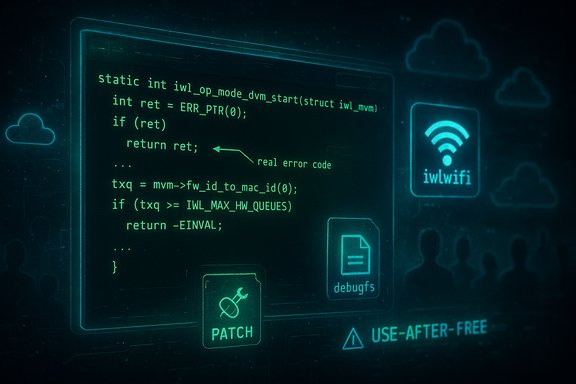
This CVE centers on the function that starts DVM (Driver‑Virtual‑Machine) operation mode — iwl_op_mode_dvm_start — and specifically on how it handled failures returned from a helper that sets up deferred work. When that helper failed, the calling code returned an incorrect value (ERR_PTR(0), effectively a NULL pointer) rather than preserving the specific error code; that malformed return can create a use‑after‑free scenario involving debugfs, with the potential to crash the host. Multiple public advisories and vendor trackers describe the fix and risk model.
The kernel maintainers addressed the problem by ensuring the original error code is preserved and returned correctly by iwl_op_mode_dvm_start, removing the NULL-return path and eliminating the confused caller-state that could trigger the UAF. The upstream change is small and defensive by design.
Source: MSRC Security Update Guide - Microsoft Security Response Center
 Background
What is iwlwifi and why this matters
The iwlwifi driver is Intel’s in‑tree Linux kernel driver for many Intel Wireless Wi‑Fi chipsets. It implements device initialization, firmware loading, runtime configuration, and debugging interfaces (including debugfs hooks used for firmware diagnostics). Because the driver runs in kernel space, even tiny logic errors that mishandle pointers or error returns can become system‑level problems — most commonly a kernel oops, panic, or other instability that affects availability.This CVE centers on the function that starts DVM (Driver‑Virtual‑Machine) operation mode — iwl_op_mode_dvm_start — and specifically on how it handled failures returned from a helper that sets up deferred work. When that helper failed, the calling code returned an incorrect value (ERR_PTR(0), effectively a NULL pointer) rather than preserving the specific error code; that malformed return can create a use‑after‑free scenario involving debugfs, with the potential to crash the host. Multiple public advisories and vendor trackers describe the fix and risk model.
Technical overview
The bug in plain terms
At a high level, the bug is an error‑handling defect: when iwl_setup_deferred_work fails during DVM startup, its error return was lost and replaced by a NULL-style pointer (ERR_PTR(0). The caller later treats the returned pointer as if it were a valid error pointer or object; under certain flows involving debugfs, that misinterpretation can allow access to freed data — a use‑after‑free (UAF) in kernel space. UAFs in the kernel typically produce immediate crashes or undefined behavior and are therefore primarily an availability risk in practice.The kernel maintainers addressed the problem by ensuring the original error code is preserved and returned correctly by iwl_op_mode_dvm_start, removing the NULL-return path and eliminating the confused caller-state that could trigger the UAF. The upstream change is small and defensive by design.
Why ERR_PTR vs NULL matters here
Kernel conventions often encode error codes into pointers using ERR_PTR/PTR_ERR/IS_ERR helpers. That allows functions that normally return pointers to also propagate error codes. When a routine mistakenly returns ERR_PTR(0) (which produces a NULL pointer) rather than ERR_PTR(err) for a non‑zero error value, the caller loses the ability to distinguish a real NULL (no object) from a genuine error pointer. That ambiguity can lead calling code to perform operations on an object that does not exist, or to skip critical cleanup — the exact conditions that produce a use‑after‑free or double‑free in kernel code paths that also touch debugfs nodes. The upstream patch preserves the real error pointer value so callers follow the correct error branches.Impact and exposure
Attack vector and severity
Public vulnerability repositories uniformly model the attack vector as local with low complexity and low privileges required (an unprivileged local user or process can in many setups trigger the susceptible driver paths). The most commonly published CVSS v3 base score is 5.5 (Medium) with the primary impact listed as Availability. Some vendor pages show score variance — one tracker reported a higher numeric score in a particular scoring interpretation — but the consensus remains: this is a local DoS / stability issue rather than a direct path to remote code execution.What systems are affected
Any Linux build that includes the in‑tree iwlwifi driver and the vulnerable upstream commit range prior to the stable fix is potentially affected. That includes many distribution kernels, vendor‑branded kernels, cloud images that include Linux guest kernels or custom kernels, and embedded or appliance images that compile iwlwifi into their kernel. Because distributions and vendors backport fixes into their own package timelines, the exact exposure depends on which kernel revision your environment runs. Public advisories (Ubuntu, SUSE, Amazon Linux, others) have mapped the CVE to kernel commits and are packaging fixes according to their release and backport policies.Long‑tail risk: OEM and marketplace images
The practical danger is the long tail: vendor‑forked kernels, appliance firmware, or marketplace images may lag upstream fixes and remain vulnerable long after mainline distributions have published patches. Cloud marketplace images, independent vendor kernels, and embedded devices are common sources of unpatched hosts in enterprise estates. Microsoft’s attestation processes and advisories can help pin down which Microsoft‑managed images are affected, but per‑artifact verification is still required (the presence of iwlwifi in a particular image or product should be confirmed by checking the image’s kernel build or SBOM).Verification and cross‑checks
Multiple independent sources define and document the vulnerability in the same technical terms, which increases confidence in the characterization:- The NVD entry and the canonical CVE summary describe the error‑code preservation bug and the potential debugfs‑related use‑after‑free.
- Distribution advisories (for example Ubuntu’s security notice) publish the same technical note and list kernel package status for supported releases.
- Vendor trackers such as SUSE and Amazon’s ALAS list the CVE, provide their prioritization and CVSS modeling, and flag platform‑specific impacted kernels.
Detection: what to look for in your environment
Because the bug manifests at kernel level and is not a network‑facing exploit, detection involves kernel logs and runtime behavior rather than IDS signatures.- Kernel oops/panic traces in dmesg or journalctl — particularly stack traces referencing iwlwifi symbols or the DVM startup path.
- Unexpected debugfs errors or stabilized debugfs nodes that disappear or reference freed objects after a DVM startup attempt.
- Reproducible recreation in test images: run the kernel path that triggers iwl_op_mode_dvm_start and observe for WARN_ON, KASAN alerts (if enabled), or immediate oops.
- Inventory checks to find candidates for remediation: verify whether iwlwifi is present/loaded. Use modinfo iwlwifi and lsmod | grep iwlwifi; inspect /boot/config-$(uname -r) for CONFIG_IWLWIFI where available.
Mitigation and remediation guidance
Immediate recommended actions (operational playbook)
- Inventory: Identify Linux hosts with iwlwifi present. Commands to run on representative hosts:
- lsmod | grep iwlwifi
- modinfo iwlwifi
- uname -r and zgrep CONFIG_IWLWIFI /boot/config-$(uname -r) (when available).
- Map packages: Cross‑reference your kernel package and its changelog to vendor advisories to determine whether the patch has been backported into your distribution’s kernel. Look for packages that explicitly reference CVE‑2025‑38656 or the upstream stable commit IDs.
- Patch and reboot: Apply vendor/distribution kernel updates that include the upstream fix and reboot into the updated kernel. This is the definitive remediation; there is no reliable runtime workaround that fully eliminates the UAF risk.
- For long‑tail devices (embedded appliances, vendor kernels): Contact the vendor or image publisher to get a timeline for patched kernel images. If an immediate patch is not available, consider isolating the device, restricting which local users can access debugfs, or mitigating the ability to exercise the DVM startup path.
Patching nuance and verification
- Do not assume a kernel version number alone proves a host is fixed; distribution maintainers sometimes backport patches without changing the top‑level kernel version number. Inspect the kernel package changelog or vendor advisory for the commit ID or CVE tag to confirm the fix is present.
- If you build kernels from source, merge the upstream stable commit that corrects the ERR_PTR handling and rebuild/test. Use git log --grep to find the commit in your kernel tree.
Risk assessment and prioritization
Which hosts to patch first
- High priority: multi‑tenant and cloud hosts, VMs running untrusted workloads, CI runners and build machines, and infrastructure that exposes debugfs or where unprivileged processes may trigger kernel subsystem initialization. These environments allow a local attacker or untrusted tenant to trigger kernel code paths and cause denial of service across tenants.
- Medium priority: single‑tenant desktops or specialist appliances where local access is already tightly controlled. The operational risk is lower but not negligible.
- Low priority: air‑gapped systems with strict physical access controls, although vendors still recommend patching as part of routine maintenance.
Why this small fix matters
The patch is compact and low‑risk from a regression perspective, but the operational impact of leaving it unpatched can be high. Kernel NULLs, UAFs and other pointer mismanagement issues are notorious because a single kernel oops can take down an entire host and, in virtualized environments, impact other tenants. The cost/benefit calculus is therefore heavily in favor of rapid application of the stable kernel update.Developer takeaways — how this happened and how to prevent similar bugs
- Preserve error semantics. When a function uses ERR_PTR/PTR_ERR conventions, ensure non‑zero error codes are encoded correctly and never normalized to ERR_PTR(0). Lossy error normalization creates ambiguous return values that can break caller assumptions.
- Defend debugfs and deferred work paths. Deferred work and debugfs are both asynchronous and lifecycle‑sensitive; code that mixes object lifetimes with debugfs node creation must explicitly manage ownership and teardown to avoid UAFs.
- Use compiler/static analysis and runtime sanitizers. Tools like sparse, KASAN and static analyzers help detect mismatches in error handling and dangling pointer possibilities during development and CI. Many kernel drivers that were fixed in recent CVE waves were identified with a mix of static/dynamic tooling.
Caveats, conflicting scores, and unverifiable claims
- Score divergence: different trackers sometimes publish different CVSS numbers. SUSE’s advisory shows a different numeric score matrix than other trackers — this is normal, and numeric differences reflect vendor‑specific context assumptions and scoring choices rather than technical disagreement about the underlying flaw. Use your environment’s exposure model to prioritize remediation rather than relying only on a numeric score.
- Time‑sensitive attestation: claims that specific vendor images (for example, a particular Microsoft product beyond Azure Linux) include or exclude iwlwifi at this moment are time‑sensitive and require per‑artifact verification. Microsoft’s public attestation process and advisories help but do not replace direct inventory of kernel builds and SBOMs. Treat any product‑level inclusion/exclusion claims as provisional unless you confirm the kernel build or vendor advisory for that artifact.
- No public remote exploit evidence: as of published advisories, there is no authoritative proof‑of‑concept showing reliable remote exploitation to achieve RCE or privilege escalation purely from this defect. The dominant, demonstrable impact is availability (host crash / kernel oops) triggered by local activity. However, do not equate absence of public PoC with lack of urgency — DoS-on-demand is operationally valuable to attackers and is trivial to weaponize where local access exists.
Practical checklist for patching teams
- Inventory: find kernels with iwlwifi (lsmod | grep iwlwifi; modinfo iwlwifi).
- Map: consult your distro/vendor advisories for CVE‑2025‑38656 and check package changelogs for the fix commit ID.
- Test: apply the updated kernel in a staging window and reproduce normal wireless initialization flows and debugfs interactions. Watch dmesg/journalctl for iwlwifi traces and KASAN warnings (if enabled).
- Deploy: plan a staged rollout favoring cloud and multi‑tenant hosts first, then edge and desktop fleets.
- Verify: after reboot, confirm the new kernel is active (uname -r), and that iwlwifi initialization no longer produces the pre‑patch oops or debugfs instability.
- Document: note images or vendor kernels that cannot be patched immediately and implement isolation or access restrictions until a vendor fix arrives.
Conclusion
CVE‑2025‑38656 is a compact but consequential example of how an error‑handling slip in kernel code can escalate into an availability problem with wide operational impact. The fix itself is small and defensive — preserving an error pointer rather than returning NULL — but the remediation path requires careful patch management across distributions, cloud images, and vendor kernels. For most organizations the practical priority is clear: inventory affected kernels, apply the vendor or distribution kernel updates that include the upstream commits, and reboot into the fixed kernel; where vendor images cannot be patched immediately, isolate and restrict access to limit the ability of local users or tenants to exercise the vulnerable path. Multiple independent trackers and distribution advisories corroborate the technical characterization and remediation approach, and operators should treat this as a stability‑first remediation task.Source: MSRC Security Update Guide - Microsoft Security Response Center
