

A recently disclosed Linux-kernel vulnerability, tracked as CVE-2024-46730, affects the AMD DRM display subsystem (drivers/gpu/drm/amdgpu — the drm/amd/display code path) and can cause a deterministic denial-of-service by using a negative array index (tg_inst == -1) when the driver assumes at least one timing generator is present. The flaw — identified by static analysis and fixed upstream with a small defensive check — maps to an availability-first impact model: a local attacker or untrusted process that can exercise DRM device paths (/dev/dri/*) may reliably provoke a kernel oops or driver failure that can crash the display stack or the host. The underlying fix is surgical and low-risk, but the operational work for organizations is non-trivial: inventory kernels, confirm vendor package updates, and coordinate patch-and-reboot windows for affected hosts.
Ensuring robust patch management, careful inventory of kernel builds, and strict control over device-node access are the practical, decisive controls for neutralizing this class of kernel defects. The code-level fix was straightforward; the operational challenge is getting every affected host into a patched, rebooted state.
Source: MSRC Security Update Guide - Microsoft Security Response Center
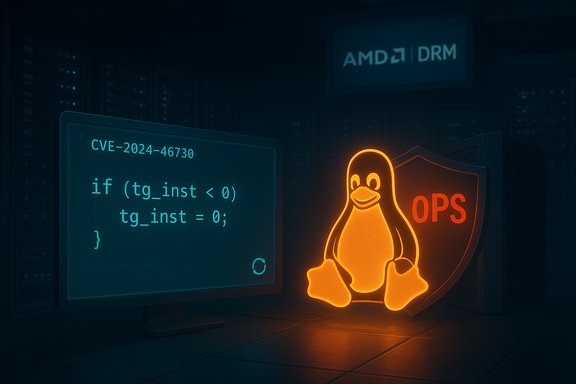 Background / Overview
What broke and why it matters
The bug is an indexing/validation error inside the AMD display driver: when the driver’s internal count of timing generators (timing_generator_count) is zero, code that computes a timing-generator instance index (tg_inst) can yield a negative value (–1). That negative value is later used as an array index without an explicit guard, creating one or more overruns reported by static analysis (Coverity). An out‑of‑bounds index used in kernel-space driver code is dangerous because it can cause immediate kernel faults (NULL dereferences, oops), trigger driver resets or panics, and consequently produce a full loss of availability for affected systems. The issue was triaged as a medium-severity local vulnerability with a primary impact on availability. This class of defect is familiar in graphics drivers: array-bounds mistakes or unchecked indices show up only on certain hardware topologies, specific runtime conditions (hot-plug, MST, or other edge cases), or when particular device counts are zero or otherwise unexpected. Historically the Linux kernel maintainers prefer small defensive patches in such cases — add a guard, short-circuit the path, or assert expected conditions — because the fix is straightforward to backport and minimizes regression risk. The upstream correction for CVE-2024-46730 follows that pattern.Who is affected
- Systems running Linux kernels that include the upstream drm/amd/display code prior to the remedial commit are potentially affected.
- Devices with AMD GPUs where the amdgpu driver is loaded can exercise the relevant code paths; exposure is highest where untrusted local users or container workloads can access DRM device nodes (/dev/dri/*).
- Multi-tenant hosts, CI runners, virtual desktop infrastructure, and shared workstations where GPU devices may be accessible to non-privileged processes should treat this as higher priority.
Vendors and distributions have mapped the fix into stable kernel series and published package advisories; whether a particular host is affected depends on the exact kernel version and whether the vendor backported the upstream commit into the distro package.
The technical anatomy: tg_inst, timing_generator_count, and the crash primitive
Where the code went wrong
At a conceptual level the bug is simple: a helper routine expects to compute an index identifying a timing generator instance. That routine does not check whether the count of available timing generators is zero before returning a value; in a zero-count case it returns –1. Later code uses that return value as an index into an array without verifying it is non-negative, producing an out-of-bounds read or write (OVERRUN). Two such overruns were flagged by Coverity and fixed in the upstream tree. This is an indexing validation failure (CWE class: improper bounds checks / integer sign misuse).Why this causes total loss of availability
When kernel-space code performs an invalid memory access, the kernel’s memory protection and execution model mean the result is not safe process termination but a kernel oops, reset, or panic. In display-driver code, offending operations are performed in privileged context while the kernel programs hardware registers or accesses driver-managed structures; any error at that level can crash the driver or kernel and often forces a reboot to fully recover. For multi-user or multi-tenant systems, that translates to a complete denial of service until the host is patched and rebooted. Multiple vendor trackers classify the vulnerability as having a high availability impact even though confidentiality and integrity impacts are not reported.Timeline and coordination: disclosure, fixes, and vendor advisories
Discovery and upstream fix
The issue was flagged by static analysis (Coverity) and fixed with a small defensive change in the kernel’s AMD DRM display code: ensure that timing_generator_count is checked and that tg_inst cannot be negative before using it to index arrays. The upstream patch is intentionally minimal, designed to eliminate the crash primitive without refactoring broader display sequencing logic. That patch was merged into the kernel’s upstream trees and propagated into stable branches that vendors and distributions track.Vendor and distribution response
Major Linux distributions and vendor security feeds incorporated the fix and published advisories mapping package versions that contain the remedial commit. Amazon’s ALAS feed, Debian trackers, Ubuntu security notices, and other vulnerability databases list CVE-2024-46730 and indicate the affected kernel ranges or fixed package versions. Distribution mappings differ because of backporting choices and release lifecycles — always check the specific advisory for your distro and package. For example, Amazon lists this CVE in its tracker and reports a CVSS v3 base score of 5.5 with a local attack vector. Ubuntu and Debian security entries list fixed package names and kernel image upgrades for affected channels.Operational impact and risk assessment
Realistic exploitability
- Attack vector: local only. An attacker must run code on the host or induce a process that interacts with the graphics stack (video playback, compositor, container with /dev/dri access).
- Privileges required: low in many desktop configurations (unprivileged users can reach DRM interfaces indirectly via compositors or GPU-accelerated apps); higher on hardened servers that restrict /dev/dri.
- Complexity: low. The crash is deterministic under the right conditions when tg_inst becomes –1 and is used unchecked.
Because exploitation is local and hardware-dependent, broad internet worms are unlikely; however, targeted attacks against shared infrastructure, CI hosts, or untrusted-VM hosts that expose GPU devices are realistic and worrisome for availability. Vendor aggregators have scored the base impact as “Medium” with high availability consequences; organizations should prioritize systems where GPU access is exposed to untrusted code.
Potential secondary impacts
Although the immediate impact is denial-of-service, kernel memory corruption primitives are sometimes combined with other flaws to achieve privilege escalation or information disclosure. No public, reliable proof-of-concept for privilege escalation tied to CVE-2024-46730 has been documented at disclosure time, but defenders should not assume impossibility: kernel corruption is a dangerous starting point. Treat availability-first CVEs in privileged drivers as high priority in shared or multi-tenant environments.Detection, triage, and forensics
What to look for in logs and telemetry
- Kernel oops traces referencing the amdgpu module, DRM display sequence functions, or file names in drivers/gpu/drm/amdgpu (stack traces that include display/sequencer function names).
- Repeated pageflip timeouts, amdgpu watchdog/reset messages, or driver panics documented in dmesg or journalctl -k.
- Sudden compositor crashes, black screens, or display freezes correlated with GPU workloads or with containers/VMs that have GPU access.
If any of these signals appear, preserve kernel logs (dmesg output, serial console logs, and journal entries) immediately for post-mortem and cross-reference them against upstream patch IDs and vendor advisory traces.
Quick triage checklist
- Confirm whether the amdgpu module is loaded: lsmod | grep amdgpu.
- Check for DRM device nodes and permissions: ls -l /dev/dri/*.
- Gather kernel logs: journalctl -k --no-pager and dmesg | tail -n 200.
- Identify which process triggered the ioctl or modeset (call traces often include the userland process name, e.g., Xwayland, GNOME Shell, MPV).
- Map running kernel versions to distribution advisories to see if the installed package includes the remedial upstream commit.
Remediation and mitigation guidance
Definitive fix: install patched kernels
The only complete remediation is to install a kernel package that contains the upstream fix and reboot into the patched kernel. Vendors have published patched kernel images in their security advisories; in many cases backports are available for long-term support (LTS) kernels. Check your distribution’s security tracker or vendor feed for the exact package name and version that resolves CVE-2024-46730 and schedule reboot windows accordingly.Interim mitigations if you cannot patch immediately
- Restrict access to /dev/dri device nodes by adjusting udev rules and group membership. Bind /dev/dri/* to a trusted group and ensure untrusted users and container runtime accounts are not members.
- Avoid exposing GPU devices to untrusted containers or CI jobs: remove device passthroughs (e.g., remove --device=/dev/dri) unless absolutely required.
- Harden container runtimes: drop unnecessary capabilities, use seccomp and minimal privileges, and avoid granting host access that includes device nodes.
- Increase monitoring: add SIEM rules to alert on repeated amdgpu oops messages, pageflip timeouts, and related kernel traces.
These compensations reduce the attack surface and buy time for controlled patching and reboots. However, they are partial fixes; a reboot into a patched kernel is the only way to fully remove the vulnerability.
Patch verification
After installing vendor updates and rebooting:- Verify the running kernel version: uname -r.
- Confirm the kernel package changelog or distro advisory lists CVE-2024-46730 or the upstream commit ID.
- Re-run representative GPU workloads (in a test window) and monitor for prior oops traces or compositor crashes to confirm the fix is effective. For custom kernels, inspect the tree for the defensive check that ensures tg_inst cannot be –1 before use.
Prioritization guidance: who patches first
- Multi-tenant hosts, CI runners, VDI infrastructure, and cloud hosts that expose GPU devices to untrusted tenants — top priority.
- Developer workstations or build servers that permit unprivileged GPU access (e.g., developer desktops on open networks).
- Single-user desktop systems where only a trusted user can run GPU workloads — still important but can be scheduled with lower urgency.
- Embedded devices, appliances, and vendor kernels — these are the long tail and often take the longest to be patched; engage vendors proactively for backports and advisories.
Operators should balance business impact against exposure: a workstation in an isolated office is lower priority than a shared CI runner that runs arbitrary container workloads.
Why this fix was small and why that matters
The remediation for CVE-2024-46730 is intentionally small: add an explicit check for timing_generator_count (or ensure tg_inst is non-negative) before using it as an array index. Small, surgical fixes are preferred because they are easier to backport, review, and test — critical attributes when the patch must be deployed across many kernel series and vendor trees. The small size does not make the risk small; rather, it reduces the risk of regressions while restoring robustness. The real work for operators is not the patch itself but inventorying and applying it across distributed and often heterogenous environments.Strengths, weaknesses, and residual risks — critical analysis
Notable strengths
- The upstream maintainers implemented a minimal, low-risk fix that addresses the crash primitive directly; this aids rapid backporting and distribution packaging.
- Multiple vendors and distributions responded with advisories and fixed kernel packages, enabling straightforward remediation for mainstream deployments.
- The vulnerability is local-only, which reduces the immediate risk of automated remote exploitation chains and widespread wormable attacks.
Potential risks and caveats
- Hardware and vendor diversity: because the bug manifests only on certain hardware topologies or runtime conditions, some vendors may not have shipped the fix promptly in custom or embedded kernels, leaving a long tail of vulnerable devices.
- Operational friction: the fix requires a kernel reboot; in production environments that is often the real blocker, as patch windows and reboots must be coordinated to avoid service disruptions.
- Residual exploitability: while CVE-2024-46730 is availability-focused, kernel memory-corruption primitives sometimes can be escalated with additional bugs or misconfigurations. No public RCE PoCs were documented at disclosure, but defenders should assume worst-case potential until fully patched and verified.
Unverifiable or uncertain elements (flagged)
- Public exploit activity and weaponization status is always time-dependent. At the time of disclosure and in the subsequent vendor advisories there were no widely reported in-the-wild campaigns exploiting CVE-2024-46730 for privilege escalation. That statement should be considered accurate for the disclosure window but must be re-checked against threat-intel feeds if the organization operates in a high-risk environment. Treat claims of RCE without a published, peer-reviewed PoC as unverified.
Practical checklist for administrators (actionable playbook)
- Inventory:
- Run uname -r and record kernel versions across hosts.
- Detect amdgpu presence: lsmod | grep amdgpu.
- List device node permissions: ls -l /dev/dri/*.
- Map to vendor advisories:
- Consult your distribution’s security tracker for CVE-2024-46730 and identify the fixed package(s). Vendors provide exact package names and versions.
- Test and stage:
- Apply the patch to a staging host, reboot, and run representative GPU workloads for a validation window (24–72 hours as appropriate).
- Rollout:
- Schedule phased patch-and-reboot windows for production hosts, starting with multi-tenant/CI hosts.
- Interim controls:
- Immediately restrict /dev/dri access where feasible, and prevent device passthrough to untrusted containers.
- Monitoring:
- Add SIEM alerts for amdgpu oops, repeated pageflip timeouts, or audio/video compositor crashes.
- Vendor coordination:
- For embedded devices and vendor appliances, open support tickets and request backport timelines if patched kernel images are not yet available.
Bottom line
CVE-2024-46730 is a classic kernel driver robustness defect: a missing validation allowed tg_inst to be –1, producing out-of-bounds array accesses and a reliable denial-of-service primitive in the AMD DRM display code. The upstream fix is small and safe, and major distributions published updates; the operational burden is inventory and coordinated patch-and-reboot windows. Organizations that expose GPU devices to untrusted code — CI hosts, multi-tenant infrastructure, and containers with device passthrough — should treat this as a priority. Short-term mitigations (restrict /dev/dri, avoid device passthrough, monitor kernel logs) reduce exposure, but the only complete remediation is to install the vendor-supplied kernel update and reboot into the patched kernel.Ensuring robust patch management, careful inventory of kernel builds, and strict control over device-node access are the practical, decisive controls for neutralizing this class of kernel defects. The code-level fix was straightforward; the operational challenge is getting every affected host into a patched, rebooted state.
Source: MSRC Security Update Guide - Microsoft Security Response Center
