

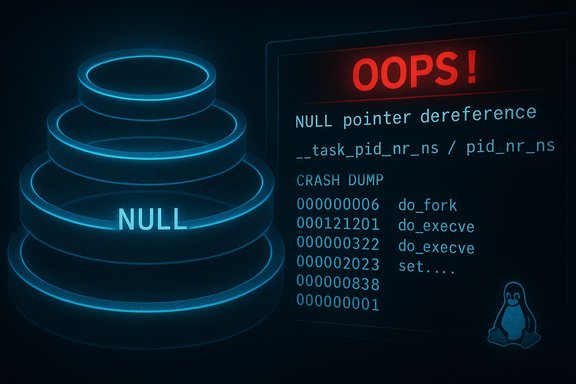
A kernel null‑pointer check that was missing in the Linux PID namespace handling has been fixed upstream after being cataloged as CVE‑2025‑40178 — the flaw can cause a kernel NULL pointer dereference in pid_nr_ns when task_active_pid_ns(current) returns NULL, producing an OOPS or panic and an immediate availability impact for affected systems.
The Linux kernel tracks process identifiers (PIDs) together with PID namespaces; kernel helpers such as __task_pid_nr_ns and pid_nr_ns expose and compare pid structures across namespace levels. In CVE‑2025‑40178, maintainers identified that a call to task_active_pid_ns(current) can return NULL in certain contexts, but the downstream logic in pid_nr_ns did not guard against that possibility before dereferencing ns->level. When the NULL case is hit the kernel can attempt to read from address 0x58 (or otherwise dereference a zero pointer), triggering a fatal kernel fault and potential panic. Public vulnerability summaries reproduce the failing call trace and illustrate the crash footprint seen in dmesg/journal output. This is a classic robustness/defensive‑coding fix: the remedy is to add an explicit NULL (or IS_ERR_OR_NULL) check around the ns pointer before using its fields, converting what would have been an uncontrolled OOPS into a recoverable error path. The upstream patch was applied into the kernel stable trees and then propagated through distributions and vendor kernels via normal backporting and packaging channels.
Why this approach is correct
High‑level runbook
For operations teams and Linux administrators:
Conclusion
A missing NULL judgment in pid_nr_ns produced a kernel panic vector captured as CVE‑2025‑40178. The remedy — adding an explicit check for a NULL PID namespace returned by task_active_pid_ns(current) — is already upstreamed and represented in vendor advisories. Administrators should treat the issue as an availability risk and follow the prioritized remediation plan: inventory potentially affected kernels, obtain vendor‑provided patched kernels (or backports), stage and test, then roll out with reboots and verification. Immediate compensating controls include limiting untrusted local access and enabling robust kernel OOPS/log collection to detect and respond to any in‑the‑wild hits while patches are deployed.
Source: MSRC Security Update Guide - Microsoft Security Response Center
 Background / Overview
The Linux kernel tracks process identifiers (PIDs) together with PID namespaces; kernel helpers such as __task_pid_nr_ns and pid_nr_ns expose and compare pid structures across namespace levels. In CVE‑2025‑40178, maintainers identified that a call to task_active_pid_ns(current) can return NULL in certain contexts, but the downstream logic in pid_nr_ns did not guard against that possibility before dereferencing ns->level. When the NULL case is hit the kernel can attempt to read from address 0x58 (or otherwise dereference a zero pointer), triggering a fatal kernel fault and potential panic. Public vulnerability summaries reproduce the failing call trace and illustrate the crash footprint seen in dmesg/journal output. This is a classic robustness/defensive‑coding fix: the remedy is to add an explicit NULL (or IS_ERR_OR_NULL) check around the ns pointer before using its fields, converting what would have been an uncontrolled OOPS into a recoverable error path. The upstream patch was applied into the kernel stable trees and then propagated through distributions and vendor kernels via normal backporting and packaging channels. Why this matters: technical anatomy in plain language
- Kernel code frequently exposes tiny assumptions that are safe for the common case but fragile in edge cases. In this instance the code assumed task_active_pid_ns(current) always returned a valid pointer. Under certain timing, task‑lifecycle, or namespace teardown operations that assumption is false.
- When kernel code dereferences a NULL pointer it does not just kill a process; it typically produces a kernel OOPS or panic. That makes even a one‑line missing check a serious operational problem in production and embedded systems.
- The observed failure mode is deterministic kernel panic traces showing __task_pid_nr_ns and pid_nr_ns call frames and a panic at a read from an address like 0x58 (address offsets vary by platform/arch). Public CVE descriptions and vendor trackers include representative call traces that match this symptom.
Affected systems and practical exposure
Who is likely affected
- Any Linux system running a kernel built from affected upstream commits that contained the vulnerable pid namespace code prior to the fix.
- Multi‑tenant hosts, virtual machine guests, container hosts, appliances, and embedded devices that expose PID‑related syscalls or that run workloads which can trigger unusual PID namespace transitions are higher‑risk.
- Vendor or OEM kernels (Android device kernels, appliance images, vendor‑forked kernel trees) that lag upstream are frequently the long‑tail risk — they may not receive the stable backport promptly.
Attack model and impact
- Vector: local. The vulnerability requires local code execution or a guest in a virtualized environment to exercise the specific kernel path that calls pid_nr_ns.
- Privilege: may be low or moderate depending on how /proc and PID namespace access is controlled in your environment; some user actions and standard system operations could accidentally hit the path.
- Impact: availability. The realistic outcome is a kernel OOPS or panic — immediate Denial‑of‑Service for the host or VM. There is no public, credible evidence that this specific NULL dereference yields direct remote code execution or data disclosure without additional, platform‑specific exploit chaining.
Severity and scoring
Different trackers have applied modestly varying CVSS values, but the common pattern ranks this as a medium‑severity, availability‑centric issue (local attack vector, low complexity, high availability impact). SUSE’s public tracker, for example, lists the issue as moderate and highlights the high availability impact typical of kernel NULL dereferences.What was changed upstream (technical summary)
Upstream maintainers implemented a guard in the pid_nr_ns call path to ensure the ns pointer returned by task_active_pid_ns(current) is valid before it is dereferenced. Concretely, the change adds an explicit check that handles the NULL case and avoids the comparison that accesses ns->level when ns is NULL.Why this approach is correct
- It follows the kernel’s defensive programming convention: treat return values from helpers as untrusted and validate them before use.
- It’s low risk: behavior for the normal, non‑NULL case is preserved while eliminating the edge‑case crash.
- It’s backportable: because the patch is small it can be merged into stable branches and vendor kernels with minimal regressions risk.
Detection, hunting and triage — concrete steps
When assessing your estate, be pragmatic: kernel OOPS/panic traces are noisy but unmistakable if you know what to look for.- Search kernel logs for the signature call frames or messages:
- journalctl -k | grep -E "__task_pid_nr_ns|pid_nr_ns|NULL pointer dereference|Unable to handle kernel NULL pointer dereference"
- dmesg | grep -E "__task_pid_nr_ns|pid_nr_ns"
- Look for the specific virtual address and abort messages sometimes shown in traces (examples in public advisories used 0x58 as the dereferenced offset) and the associated stack dump lines referencing __task_pid_nr_ns. These traces were included in published CVE entries and distributor trackers.
- Correlate any panic with recent namespace operations or workloads that stress process creation, exit, or namespace teardown (container lifecycle events, rapid fork/exit cycles, PID recycling stress tests).
- Collect forensic evidence before rebooting:
- Save /var/log/messages, journalctl output, and any serial console logs.
- Preserve vmcore or kdump output if your environment captures crash dumps — those contain the exact stack frames and register context needed to validate that the panic matches the CVE pattern.
- If you find matching traces, escalate to patching priority and treat the host as high‑impact until patched and tested.
Practical remediation and patching guidance
The only reliable remediation for kernel NULL dereference defects is to install a kernel that contains the upstream fix and reboot into it. Follow a prioritized and test‑driven rollout.High‑level runbook
- Inventory: identify all hosts, VMs, containers, and appliances running Linux kernels that might include the vulnerable pid code. Commands that help:
- uname -a
- rpm -qi kernel (or dpkg -l | grep linux-image)
- Check /proc/config.gz or /boot/config-$(uname -r) to see if relevant PID namespace helpers are compiled in.
- Vendor advisories: consult your distribution or vendor security tracker for the CVE number and fixed package versions. Debian, SUSE, and other trackers have already indexed CVE‑2025‑40178 and can point to fixed package releases or backports.
- Download and stage: obtain the updated kernel package for test systems, apply in a staging ring, and validate critical workloads. Reboot into the patched kernel and run stress tests that exercise namespace and process lifecycles.
- Rollout: phase the update into production in waves; use automated orchestration and canary hosts where possible.
- Verification: confirm the package changelog or kernel git history includes the upstream commit ID that implements the NULL check. If building kernels from source, ensure the patch is present in the git log (search commit message for the pid_nr_ns/ task_active_pid_ns fix).
- Emergency mitigation (if you cannot patch immediately):
- Limit local/guest access: reduce or control who can run untrusted code, particularly on multi‑tenant or CI hosts.
- Isolate hosts running untrusted workloads or containers that exercise namespace transitions.
- Harden detection: add kernel OOPS/panic alerts to monitoring and SIEM to expedite detection and troubleshooting.
- Preserve crash logs and enable kdump for forensic triage.
Risk analysis and operational recommendations
Strengths of the upstream response
- The fix is minimal and clearly targeted: a single defensive check is straightforward to audit and backport.
- Small patches of this kind carry low regression risk and are easy for distributions to integrate into stable trees.
- Public trackers and distributors (NVD, Debian, Tenable, SUSE, Wiz and others) converged on the same technical description and remediation approach, which increases confidence in the fix and the mapping to affected packages.
Residual and long‑tail risks
- Vendor lag: embedded devices, Android OEM kernels, and custom appliances may take months to receive the backport (or may never be patched). Those devices represent the usual long‑tail risk for kernel CVEs.
- Detection gaps: kernel OOPS traces can be lost if logs aren’t centralized or if hosts reboot quickly. Absent crash collection, you may never know a host hit this condition.
- Compositional exposures: this CVE is one of a class (missing NULL/IS_ERR checks) — organizations should assess whether similar defensive omissions exist in other in‑tree drivers or vendor modules used in their estate.
- Exploitability beyond DoS: currently there is no authoritative public evidence that CVE‑2025‑40178 can be escalated to privilege escalation or arbitrary code execution without additional, platform‑specific chaining. Treat such escalation as theoretical but not observed at present.
Prioritization guidance
- Patch multi‑tenant hosts, hypervisor hosts, and cloud VMs first (highest impact).
- Next, update CI runners, build servers, and developer workstations that might run untrusted builds or accept artifact uploads.
- Then update edge appliances and embedded devices as vendor patches become available — maintain tight inventory of vendor images and follow up with vendors for backport timelines.
- For any host that cannot be rebooted immediately, deploy detection and access mitigations and maintain strict local user controls.
Tactical playbook — commands and checks you can run today
- Identify running kernel and package:
- uname -a
- sudo cat /proc/version
- rpm -q --last kernel (RHEL/SUSE) or dpkg -l | grep linux-image (Debian/Ubuntu)
- Inspect logs for the crash signature:
- sudo journalctl -k | egrep "__task_pid_nr_ns|pid_nr_ns|Unable to handle kernel NULL pointer dereference"
- sudo dmesg | tail -n 200
- Confirm vendor package contains the fix:
- Check /usr/share/doc/<kernel-package>/changelog.Debian.gz or the vendor security advisory page for CVE‑2025‑40178.
- If building from source: git log --grep='pid_nr_ns' or git log --grep='task_active_pid_ns' in the kernel tree you use.
- Capture crash evidence:
- Ensure kdump is enabled and configure vmcore preservation.
- Save journalctl -k output to a central location for review.
- Short‑term compensations:
- Limit who can create namespaces or run untrusted containers.
- Remove unneeded capabilities and tighten container runtime defaults to avoid exposing namespace operations to untrusted code.
Verification and cross‑checking: what we relied on
The technical description and remediation mapping for CVE‑2025‑40178 have been confirmed by multiple independent trackers and vendor advisories. The National Vulnerability Database provides the canonical CVE entry and references the upstream kernel commits that implement the fix; Debian’s security tracker and vendor pages reflect parallel descriptions and package mappings; Tenable and other commercial vulnerability databases summarize exploitability and impact. SUSE’s tracker lists affected product states and provides a CVSS‑style assessment consistent with an availability‑focused defect. These independent sources align on the root cause (missing NULL check for task_active_pid_ns return) and the recommended remediation (install patched kernel/backport and reboot). One practical note: some commit pages on kernel.org may be blocked from direct scraping by automated fetchers, and vendor changelogs are the recommended authoritative verification channel for applied fixes. Where a direct kernel.org commit fetch was not available to this analysis toolchain, NVD and distributor trackers still reference the upstream commit IDs and provide the necessary mapping to vendor packages. Operators should use vendor changelogs as the final proof of remediation in live environments.Final assessment and recommendations
CVE‑2025‑40178 is a prototypical kernel robustness defect: a missing check on a helper’s return value that, when exercised, causes a NULL dereference and kernel panic. The vulnerability is not exotic — it is a programming omission — but in kernel space that omission is consequential because it causes host‑level availability failure.For operations teams and Linux administrators:
- Treat this CVE as a high‑priority patch on multi‑tenant and infrastructure hosts.
- Validate vendor package changelogs and apply fixed kernels promptly; test the new kernel in staging and validate behavior before broad rollout.
- If immediate patching is infeasible, apply strict access controls and monitoring for kernel OOPS traces, and make sure to preserve crash dumps for triage.
- Add routine checks for missing defensive checks in vendor/forked kernels where possible and encourage vendors to adopt an agile backporting cadence for such fixes.
Conclusion
A missing NULL judgment in pid_nr_ns produced a kernel panic vector captured as CVE‑2025‑40178. The remedy — adding an explicit check for a NULL PID namespace returned by task_active_pid_ns(current) — is already upstreamed and represented in vendor advisories. Administrators should treat the issue as an availability risk and follow the prioritized remediation plan: inventory potentially affected kernels, obtain vendor‑provided patched kernels (or backports), stage and test, then roll out with reboots and verification. Immediate compensating controls include limiting untrusted local access and enabling robust kernel OOPS/log collection to detect and respond to any in‑the‑wild hits while patches are deployed.
Source: MSRC Security Update Guide - Microsoft Security Response Center
