

Linux kernel maintainers have pushed a small but important hardening fix for CVE-2025-40217 — a validation shortcoming in the pidfs ioctl handling — closing a class of type‑confusion and buffer‑size risks by introducing stricter checks for extensible ioctls used by PID file descriptor helpers.
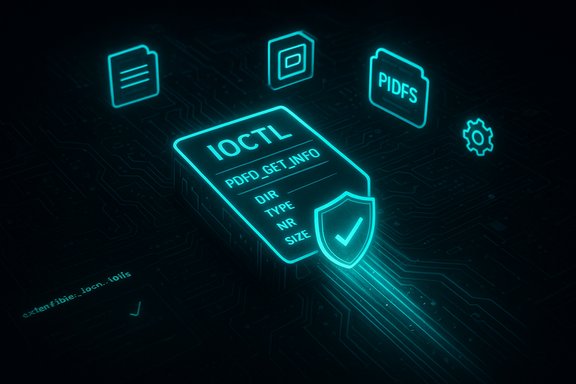
The Linux kernel exposes a range of ioctl interfaces that use a conventional, extensible layout: direction, type (magic), number, and buffer size encoded in the ioctl number. Subsystems that accept "extensible ioctls" must validate not only the ioctl type but also the direction, the exact request number and a minimum buffer size to avoid inadvertently accepting malformed or maliciously crafted ioctls.
The pidfs subsystem implements PID file descriptor helpers (for example,
Actionable summary:
Source: MSRC Security Update Guide - Microsoft Security Response Center
 Background
The Linux kernel exposes a range of ioctl interfaces that use a conventional, extensible layout: direction, type (magic), number, and buffer size encoded in the ioctl number. Subsystems that accept "extensible ioctls" must validate not only the ioctl type but also the direction, the exact request number and a minimum buffer size to avoid inadvertently accepting malformed or maliciously crafted ioctls.The pidfs subsystem implements PID file descriptor helpers (for example,
PIDFD_GET_INFO) and historically used a minimal validation rule that only compared the ioctl's TYPE field. That approach left room for subtle mismatches: callers could craft ioctls with the same TYPE but different number, direction, or undersized buffers and thereby cause the kernel to operate on the wrong user buffer or assumptions about read/write direction. The newly applied fix replaces the weak TYPE-only check with a comprehensive extensible_ioctl_valid helper that checks direction (_IOC_DIR), type (_IOC_TYPE), number (_IOC_NR) and minimum size (_IOC_SIZE). The upstream commit and stable‑tree backport are recorded in the kernel stable discussions and CVE trackers. What changed (technical summary)
The problem in plain terms
- Existing pidfs code validated ioctl requests by comparing only the _IOC_TYPE (the ioctl "magic").
- That left three other ioctl characteristics unverified: the direction (
_IOC_DIR), the ioctl number (_IOC_NR), and the encoded size (_IOC_SIZE). - As a consequence, an attacker (or buggy userspace) could present an ioctl that shared TYPE but differed in other fields. This can lead to:
- Type confusion (the kernel treating one structure as another),
- Incorrect copy_to_user/copy_from_user semantics (wrong direction or undersized buffer),
- Potential information leakage or memory corruption if kernel code copies or reads the wrong region.
The patch
The upstream change (commit 3c17001b21b9f168c957ced9384abe969019b609) introduces:- A small helper,
extensible_ioctl_valid(unsigned int cmd_a, unsigned int cmd_b, size_t min_size), added ininclude/linux/fs.h. - Replacement of the legacy TYPE-only comparison in
fs/pidfs.cwith a call to that helper, for example: - Old:
return (_IOC_TYPE(cmd) == _IOC_TYPE(PIDFD_GET_INFO); - New:
return extensible_ioctl_valid(cmd, PIDFD_GET_INFO, PIDFD_INFO_SIZE_VER0); - The helper returns false if any of
_IOC_DIR,_IOC_TYPE,_IOC_NRdiffer or if_IOC_SIZE(cmd_a) < min_size. The net effect: a malicious ioctl that only matches TYPE will no longer pass validation.
Why the change matters
The change is surgical and low-regression: it tightens defensive checks on a public kernel interface without altering the semantics of legitimate callers that conform to the expected ioctl layout. It also provides a reusable helper function for other subsystems to apply the same robust validation pattern. The commit was reviewed and accepted by multiple filesystem maintainers and queued into stable backports for affected kernel branches.How the community cataloged this issue
CVE-2025-40217 was published to public trackers on 4 December 2025 and is described succinctly as: "pidfs: validate extensible ioctls — Validate extensible ioctls stricter than we do now." Public CVE mirrors and vulnerability aggregators indexed the fix and point to the upstream commit(s) that implement the validation helper and replacement check. At the time of publication, mainstream trackers (OpenCVE, CVE Details, CVEFeed) show the CVE entry and link to the kernel commit; automated feeds also note that the change was applied to stable trees and recommended for backporting. Note: some scanning vendors initially reported high scanner severity for hosts that do not yet include the patched kernel; these signatures often flag an unpatched kernel tree rather than providing an exploitability score derived from public proof‑of‑concept code. Tenable/Nessus released a plugin marking unpatched systems as vulnerable (plugin references the CVE) — treat vendor scanner output as a prioritization input, not definitive proof of exploitation in the wild.Exploitability, impact and realistic risk
Attack surface and preconditions
- Vector: local (ioctl). The vulnerability is triggered by issuing a pidfs ioctl (for instance
PIDFD_GET_INFO) with specially crafted ioctl code fields. This requires a process able to call the ioctl on a pidfs file descriptor. - Privileges: local process access to invoke the pidfs ioctl (the exact privilege requirement depends on how the process obtains a pidfd or interacts with pidfs in your environment). This is not a remote network exploit on its own.
Potential outcomes
- The fix addresses validation gaps; without correct checks the kernel could:
- misinterpret a userspace buffer layout,
- perform a copy_to_user/copy_from_user with incorrect size or direction,
- thus cause information disclosure (reading kernel memory into userspace) or memory corruption (writing into user buffers incorrectly).
- In practice, the change is a defensive hardening step that reduces the chance of type confusion and buffer misuse. Public trackers characterize the CVE as a security hardening/validation fix rather than a straightforward remote code‑execution vector. No public proof-of-concept exploit was present at disclosure.
Severity and scoring (what to expect)
- At publication many trackers had not yet published a CVSS vector; some scanners initially flagged the issue aggressively. Operational severity depends heavily on the environment:
- Exposed multi‑tenant hosts, CI/build machines, container hosts, or systems that allow untrusted local code to interact with kernel ioctls are higher risk.
- Standalone desktop systems with strict local control are lower risk.
- The code change is small and defensive; the remediation is recommended as a high‑value, low‑regression patch.
Practical remediation and patching guidance
The authoritative remediation is to install a kernel that includes the upstream commit(s) referenced by the CVE and reboot into the patched kernel. Below is a prioritized runbook for system administrators and Linux distro maintainers.Quick checklist (high-level)
- Inventory hosts that might include the vulnerable pidfs implementation (kernels built with pidfs and with
PIDFD_GET_INFOsupport). - Confirm vendor/distribution advisories for your kernel packages and identify fixed package versions or patches that include commit 3c17001b21b9f168c957ced9384abe969019b609 (or the equivalent stable backport).
- Stage the updated kernel in a test/pilot ring. Validate functionality for process management tooling and any pidfd-using components.
- Roll out updates in waves and reboot hosts into the patched kernel.
- Monitor kernel logs and user-facing services after deployment for regressions.
Detailed steps
- Inventory and scope
- Run:
uname -rto collect running kernel versions. - Check your distro's kernel package changelog or security tracker for explicit mention of CVE-2025-40217 or for the upstream commit ID. If a vendor advisory references the commit or lists the CVE as fixed, that package version is your target.
- Map to patches
- For vendor packages (Debian, Ubuntu, RHEL, SUSE, Oracle Linux, etc., wait for or obtain the vendor-supplied package that includes the upstream stable patch. Where vendors have not yet published backports, consider building a kernel with the stable commit merged for emergency remediation in high-risk environments.
- Testing
- Stage the patched kernel in a pilot group that mirrors production workloads (especially anything that uses pidfds or custom management tooling). Test typical management operations, process inspection/monitoring tools, and any out-of-tree modules before wide rollout.
- Deploy and reboot
- Kernel fix requires a reboot for removal of the vulnerable code path. Coordinate reboots with stakeholders and use rolling updates for large fleets.
- Post‑deployment verification
- Verify kernel package versions and booted kernel:
uname -aand confirm package changelog mentions the fix. Monitor dmesg/journalctl for any unexpected warnings. - For embedded/OEM/vendor kernels
- Coordinate with the device OEM or vendor images. Vendor images often lag upstream; require direct vendor engagement for backports or replacement images. If vendor images remain unpatched, apply network segmentation, strict local privilege controls, and limit untrusted code execution on those devices.
Detection, hunting and mitigation if you can’t patch immediately
Detection/hunting signals
Because CVE-2025-40217 is a validation hardening fix (not a clear memory corruption exploit with public PoC), detection is best focused on:- Unexpected kernel OOPS or error traces around pidfs or ioctl handling (search
dmesgandjournalctl -k). - Unusual behavior or crashes in utilities that call PIDFD_GET_INFO or other pidfd-related ioctls.
- Telemetry from EDR/host monitoring showing many failed ioctl calls, unexpected syscalls, or repeated attempts to call pidfs ioctls from unprivileged processes.
Compensating controls
If you must delay patching, consider:- Restricting which users or containers can open pidfds or perform the relevant ioctls (e.g., capability or policy-based restrictions).
- Applying stricter LSM policies (SELinux, AppArmor) to prevent untrusted processes from invoking the pidfs interfaces.
- Isolating high-risk workloads (CI runners, multi-tenant services) behind stronger sandboxing or dedicated hosts that can be patched faster.
Why this sort of hardening matters: context and precedent
The pidfs fix follows a familiar security pattern: converting implicit assumptions (we only need to check ioctl TYPE) into explicit validation of all ioctl components. Similar fixes across the kernel have reduced type‑confusion, undersize-copy and direction mismatch vulnerabilities in diverse subsystems. Kernel maintainers prefer small, surgical fixes that are easy to backport and that preserve ABI semantics for compliant callers — a pattern visible across recent stable backports and advisory notes. Treat these validation hardenings as high-value fixes: they reduce the attack surface for attackers who often rely on surprising the kernel’s assumptions about userspace-provided values.Risk analysis: strengths and residual weaknesses
Strengths of the upstream response
- The fix is minimal and low-risk: changing one check and adding a small helper to centralize validation is unlikely to cause regressions while substantially improving correctness.
- The change is reusable: the introduced
extensible_ioctl_validhelper provides a consistent validation primitive that other subsystems can adopt. - Maintainer review: the change was reviewed by multiple filesystem and security-minded maintainers and queued for stable backports, demonstrating the kernel project's normal review discipline for defensive fixes.
Residual risks and caveats
- Local vector still matters: this fix mitigates a specific validation gap but does not prevent every class of kernel ioctl misuse. Systems that allow untrusted local code to exercise privileged ioctls remain a higher overall risk.
- Vendor/OEM lag: embedded devices, vendor kernels, and appliances may not receive timely backports. These images often remain exposed for weeks or months after upstream fixes land. Segmentation and vendor coordination are essential controls in those environments.
- No public PoC does not mean no exploit: absence of public exploitation at disclosure is common; motivated attackers can develop private PoCs, especially when a type‑confusion or buffer-size primitive exists. Track your telemetry for suspicious local ioctl activity.
Recommended timeline for operations teams
- Within 24 hours: Inventory hosts and tag high-exposure systems (CI/build hosts, multi‑tenant servers, developer rigs that run untrusted workloads).
- Within 72 hours: Identify vendor/distro patch availability and create a priority list for patch rollout.
- Within 7 days: Deploy patched packages to pilot hosts, validate workloads and critical tooling.
- Within 14–30 days: Roll out to the rest of the fleet, focusing on high-value and multi-tenant hosts first; maintain compensating controls for devices that cannot be patched.
Final assessment and takeaways
CVE-2025-40217 is a compact, defensive hardening that addresses a real validation omission in pidfs ioctl handling. The fix — implemented as a small helper and a one-line replacement — is an excellent example of how focused defensive code improves kernel trust boundaries without introducing functional regression. Kernel maintainers have backported the patch to stable trees and public CVE trackers reference the upstream commits. Organizations should treat this as a routine but important kernel security update: verify vendor packages that include the commit, stage and apply patched kernels, and prioritize hosts where untrusted local code executes.Actionable summary:
- Confirm vendor/distro advisories and identify fixed kernel package versions that reference the upstream commit.
- Patch and reboot impacted systems as soon as operationally possible.
- For devices that cannot be patched immediately, apply isolation and stricter local access controls while you track vendor backports.
Source: MSRC Security Update Guide - Microsoft Security Response Center
