

The Linux kernel received a focused fix for a small but consequential memory‑handling bug in the ALSA firewire-motu driver that could let the driver write more bytes to userspace than requested during DSP event handling — tracked as CVE-2025-68347 and remedied upstream by clamping copy length with min_t to never copy more than the user supplied buffer requests.
ALSA’s firewire-motu driver implements support for certain FireWire/IEEE‑1394 audio interfaces produced by MOTU and similar vendors. The driver exposes a hwdep (hardware dependent) character interface that userspace utilities and applications can read to receive DSP event records reported by the device. These event records begin with a fixed-size header (8 bytes) followed by payload data.
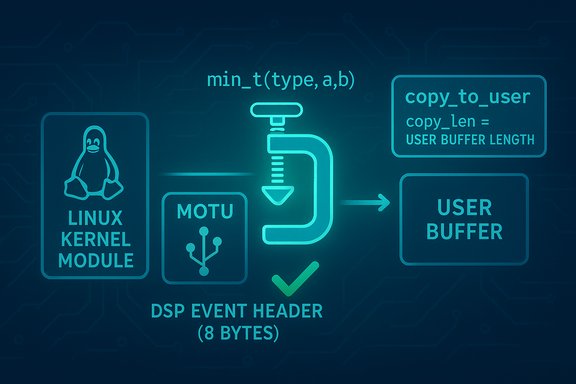
A fault in the driver’s hwdep_read path allowed the code to attempt to copy more bytes to a user buffer than the caller had requested when the user provided a buffer smaller than the expected header size. The upstream remedy clamps the copy operation using the kernel min_t helper so that copy_to_user never receives a length larger than the userspace buffer size. This change is small, surgical and was landed into the stable kernel trees. The practical effect is primarily an availability/reliability issue (a potential kernel oops or corruption) rather than a clearly demonstrated remote code‑execution vector; exploitation requires local or local‑adjacent ability to exercise the hwdep read path (for example, opening the hwdep device node and issuing a read with a small buffer). The community has treated the fix as correctness‑oriented and low‑risk to backport.
When userspace passed a buffer smaller than the 8‑byte header, the driver’s copy logic failed to properly clamp the number of bytes copied to the size requested by userspace. In other words, code paths computed or assumed a copy length based on the event layout rather than the actual buffer length requested by the caller, and then invoked copy_to_user with that computed size — which can exceed the requested size and cause out‑of‑bounds writes into userspace memory or trigger kernel‑side faults while copying. The public CVE record explains the same sequence and the remedy applied.
In practice the patched code looks like this (illustrative, paraphrased):
Source: MSRC Security Update Guide - Microsoft Security Response Center
 Background / Overview
ALSA’s firewire-motu driver implements support for certain FireWire/IEEE‑1394 audio interfaces produced by MOTU and similar vendors. The driver exposes a hwdep (hardware dependent) character interface that userspace utilities and applications can read to receive DSP event records reported by the device. These event records begin with a fixed-size header (8 bytes) followed by payload data.A fault in the driver’s hwdep_read path allowed the code to attempt to copy more bytes to a user buffer than the caller had requested when the user provided a buffer smaller than the expected header size. The upstream remedy clamps the copy operation using the kernel min_t helper so that copy_to_user never receives a length larger than the userspace buffer size. This change is small, surgical and was landed into the stable kernel trees. The practical effect is primarily an availability/reliability issue (a potential kernel oops or corruption) rather than a clearly demonstrated remote code‑execution vector; exploitation requires local or local‑adjacent ability to exercise the hwdep read path (for example, opening the hwdep device node and issuing a read with a small buffer). The community has treated the fix as correctness‑oriented and low‑risk to backport.
Why this matters to system operators and developers
- Kernel space memory safety matters. Any code that copies kernel memory into a user buffer must respect the bounds implied by the caller’s buffer size; a mismatch can result in unexpected writes, kernel oopses or subtle memory corruption that affects stability.
- Low‑barrier local triggers exist. In many deployments a local user or a guest VM with device passthrough may be able to open ALSA hwdep nodes and provoke read paths. While FireWire devices are uncommon on modern servers, the attack surface includes emulated devices and passthrough scenarios.
- Long tail for embedded and vendor kernels. Device vendors and embedded OS vendors often ship kernel forks and can lag upstream patches. The upstream fix does not automatically propagate into every vendor kernel tree. This creates the classic long‑tail exposure scenario.
Technical deep dive: what went wrong and how it was fixed
The vulnerable pattern (plain terms)
The hwdep_read implementation in the firewire-motu ALSA driver processes device‑reported DSP events which include a header (8 bytes) and then optional event payload. The code attempted to copy the event data into a userspace buffer provided by the read caller.When userspace passed a buffer smaller than the 8‑byte header, the driver’s copy logic failed to properly clamp the number of bytes copied to the size requested by userspace. In other words, code paths computed or assumed a copy length based on the event layout rather than the actual buffer length requested by the caller, and then invoked copy_to_user with that computed size — which can exceed the requested size and cause out‑of‑bounds writes into userspace memory or trigger kernel‑side faults while copying. The public CVE record explains the same sequence and the remedy applied.
The fix: clamping with min_t
The upstream change is intentionally minimal: before invoking the copy_to_user operation, the kernel code computes the maximum number of bytes to copy as the minimum of the device‑event remaining bytes and the user‑supplied buffer length. The kernel helper macro min_t(type, a, b) (which evaluates to the lesser of a and b while ensuring proper type promotion) is used to perform the clamp safely and portably.In practice the patched code looks like this (illustrative, paraphrased):
- compute copy_len = min_t(size_t, event_remain, user_buf_len);
- rc = copy_to_user(user_buf, event_ptr, copy_len);
Why the change is low risk and easy to backport
The fix alters only the copy length computation; it does not change higher‑level protocol handling, return codes, or state machines. That makes it well suited to stable branch backports because it preserves prior semantics for correctly sized reads and only tightens behavior when callers provide undersized buffers. This surgical nature is why kernel maintainers accepted the patch into stable trees quickly.Affected systems, scope, and exploitability
Who’s in scope
- Any Linux host whose kernel includes the ALSA firewire-motu driver (built‑in or as a loadable module) and that either has FireWire hardware, permits device pass‑through, or exposes the ALSA hwdep interface to untrusted users is in scope.
- Distribution kernels built from upstream branches that contained the vulnerable revision prior to the stable commit are affected until a vendor/maintainer backport is applied. Debian and other distro trackers list affected package versions and fixed package revisions.
- Embedded OEMs and vendor kernel forks that copy in older ALSA driver code are high‑risk long‑tail populations; many such devices do not receive prompt upstream backports.
Attack complexity and prerequisites
- The vector is classified as local or local‑adjacent. A remote, unauthenticated network actor cannot trivially trigger hwdep_read unless other host mechanisms forward or emulate FireWire device enumeration over the network.
- Attack prerequisites typically include: local process ability to open and read the ALSA hwdep device, or a guest VM where a malicious host or co‑tenant can present an emulated FireWire device descriptor or use passthrough to present device events. Virtualization scenarios with device passthrough increase exposure.
- Exploiting this flaw to achieve remote code execution is not demonstrated publicly. The immediate, realistic impact is denial of service or kernel instability; conversion of such a primitive into an arbitrary‑code execution chain usually requires additional memory‑corruption primitives, precise heap grooming and other supporting conditions. Treat privilege escalation claims as speculative until an independent, reproducible PoC shows otherwise.
Severity and scoring
- Many public trackers present the issue as an overflow / out‑of‑bounds write risk with availability impact; some vendors may attach a moderate severity rating but this can vary by vendor’s scoring. At disclosure time canonical feeds list the problem but some numerical scores remained unassigned or vendor-specific. Administrators should weigh severity using their asset context: audio hosts and multi‑tenant systems are more sensitive.
Detection, hunting and triage guidance
Rapid triage and detection fall into three practical categories: inventory, evidence collection, and runtime monitoring.1) Inventory — quickly find potentially vulnerable kernels
- Check whether the driver exists: lsmod | grep motu or grep -i CONFIG_SND_FIREWIRE /boot/config-$(uname -r) (driver names and config flags vary across trees).
- Confirm the running kernel version: uname -r and compare with distribution security advisories or package changelogs that map to the upstream stable commit. Debian and other distro trackers publish fixed package versions.
2) Evidence collection — gather kernel logs and process context
- Search dmesg or journalctl -k for new kernel oops traces referencing FireWire, ALSA, hwdep or motu identifiers. Preserve vmcore or kexec/kdump dumps for forensic analysis if available.
- Capture an strace or audit of processes interacting with /dev/snd/hw* device nodes to find suspicious patterns where undersized reads are performed.
3) Runtime monitoring — operational detectors
- Alert on kernel oopses that contain frames pointing at motu, hwdep_read or ALSA stack frames.
- In virtualized environments correlate guest oopses with host attach/passthrough events to find cross‑artifact triggers. Community writeups on ALSA driver fixes recommend centralizing kernel telemetry for these cases.
Mitigation and remediation playbook
Definitive remediation (recommended)
- Install a kernel package that contains the upstream stable commit that applied the min_t clamp and reboot into it. Because this is a kernel‑space fix, a reboot is required to complete remediation. Distribution trackers and OSV entries reference the stable commits and package mappings for common distros.
Short‑term mitigations if immediate patching is impossible
- Restrict device attachments. Block untrusted FireWire interfaces and disable passthrough in virtualization platforms for untrusted guests.
- Blacklisting (if driver is modular and system can tolerate disabling it): add the driver/module name to /etc/modprobe.d/blacklist.conf to prevent it from loading until a patched kernel is deployed. Note: this removes functionality for legitimate devices.
- Restrict access to hwdep device nodes. Enforce stricter udev permissions so only trusted users can open ALSA hwdep nodes. This reduces local attack surface at the cost of limiting some audio tooling.
Where the fix landed and vendor status
- Upstream kernel commits implementing the clamp have been merged into stable branches; vulnerability records and aggregator entries list the kernel stable commit references. Public trackers (OSV, OpenCVE, and distro trackers) include those references.
- Distribution trackers (Debian security tracker and distribution advisories) list affected package versions and map to patched package releases; operators should consult their distro’s security advisory pages for exact package identifiers and deployment instructions.
- For vendor‑supplied kernels (embedded vendors, OEMs), check vendor support portals. Many vendors maintain distinct backport and release policies; some may treat particular kernel bug classes as “won’t fix” for older kernels — operators must validate vendor timelines and plan compensations accordingly.
Practical checklist for administrators (prioritized)
- Inventory: identify hosts running kernels that include the firewire-motu driver. Use module checks and kernel config inspection.
- Verify: check your distribution’s security advisory and package changelog to map to a fixed package version.
- Patch: apply official kernel updates from your vendor/distributor that include the stable commit, or rebuild your custom kernel including the upstream patch.
- Reboot: schedule reboots as needed to bring systems onto the patched kernel.
- Mitigate: if patching cannot be immediate, restrict device attachment, disable passthrough, or blacklist the module until you can install the fix.
- Monitor: centralize kernel logs and alert on new ALSA/FireWire oops traces. Preserve crash dumps for forensic follow up.
Developer guidance and long‑term lessons
- Validate externally supplied lengths. Drivers must always clamp copy sizes and validate lengths obtained from hardware or userspace before copying or indexing.
- Use type‑safe helpers (min_t, max_t, size_t promotion) to avoid mixed‑width arithmetic pitfalls that can lead to overflow or truncation.
- Add negative tests and fuzz‑driven checks for device‑parsing code. Several ALSA and device driver bugs in recent years were discovered through fuzzing frameworks that generate malformed descriptors; integrating fuzzing into driver CI reduces regression risk.
- Prefer surgical fixes for correctness issues; maintainers will accept minimal, semantics‑preserving changes to enable broad backporting to stable branches.
Risks and residual concerns
- Vendor lag remains the single largest operational risk: devices and appliances built on vendor kernel forks often receive fixes late or not at all. Organizations running long‑lived embedded or industrial images should prioritize vendor follow‑ups.
- Detection is inherently reactive: this class of bug typically manifests as kernel oopses, and such events can be misattributed to flaky hardware or driver quirks. Centralized kernel telemetry and alerting are critical to avoid slow triage cycles.
- While the upstream fix closes the immediate overflow, converting such a primitive into a full escalation chain would require additional exploitable conditions; treat claims of escalations as speculative until validated by reproducible proof of concept.
Conclusion
CVE‑2025‑68347 is a compact, real‑world example of how a missing bounds clamp in a kernel driver can create an availability risk. The fix is small and straightforward — applying min_t to clamp the copy size before copy_to_user — and has been committed to stable kernel branches. Administrators should verify whether their kernels include the patched commits via distribution advisories, apply vendor updates, and reboot as required. For environments where immediate patching is not feasible, temporary mitigations (blocking device attachments, disabling passthrough, or blacklisting the module) reduce exposure but do not substitute for a proper kernel update. Operationally, this CVE reinforces three enduring lessons: validate all external numeric fields before use, prefer minimal defensive fixes that are easy to backport, and centralize kernel telemetry to detect and triage memory‑handling regressions quickly.Source: MSRC Security Update Guide - Microsoft Security Response Center
