

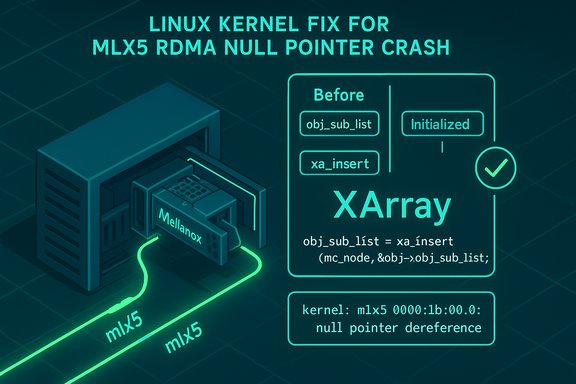
The Linux kernel received a targeted fix for a null‑pointer crash in the Mellanox/NVIDIA mlx5 RDMA driver: the obj_event structure’s list head now gets initialized before it’s inserted into the XArray, preventing a poisonous pointer dereference that could cause kernel oopses on affected hosts.
RDMA (Remote Direct Memory Access) drivers such as mlx5 (used for Mellanox / NVIDIA ConnectX adapters and BlueField SmartNICs) live in a delicate space of concurrency, interrupt handling, and device event queues. Small lifecycle or initialization omissions in kernel driver code can produce NULL dereferences, use‑after‑free, or other memory hazards that manifest as kernel WARNs, oopses, or complete panics. The recently published CVE‑2025‑38387 is an example of this class of reliability / availability defect: a list_head inside an event object was not initialized before the object was inserted into an XArray, which allowed a racing consumer to load the inserted object and encounter an uninitialized (poisonous) pointer. The defect and its practical crash trace were captured and published in standard vulnerability trackers. This article explains exactly what went wrong, why it matters to WindowsForum readers and mixed estates (Azure, WSL, cloud images, on‑prem servers), how well vendors have addressed it, and what administrators should do now to detect, mitigate, and verify remediation.
Key signals to hunt for:
Recommended prioritized actions:
Note on MSRC: the direct MSRC web page for CVE‑2025‑38387 may not be easily machine‑readable without JavaScript, and users may see “page not found” or an inaccessible view at times; consult vendor advisories and distribution CVE pages for concrete patch information and package names. (An attempt to open the MSRC CVE page returned a JavaScript‑rendered page requiring a browser environment. Practical WindowsForum guidance for mixed estates:
Source: MSRC Security Update Guide - Microsoft Security Response Center
 Background / Overview
RDMA (Remote Direct Memory Access) drivers such as mlx5 (used for Mellanox / NVIDIA ConnectX adapters and BlueField SmartNICs) live in a delicate space of concurrency, interrupt handling, and device event queues. Small lifecycle or initialization omissions in kernel driver code can produce NULL dereferences, use‑after‑free, or other memory hazards that manifest as kernel WARNs, oopses, or complete panics. The recently published CVE‑2025‑38387 is an example of this class of reliability / availability defect: a list_head inside an event object was not initialized before the object was inserted into an XArray, which allowed a racing consumer to load the inserted object and encounter an uninitialized (poisonous) pointer. The defect and its practical crash trace were captured and published in standard vulnerability trackers. This article explains exactly what went wrong, why it matters to WindowsForum readers and mixed estates (Azure, WSL, cloud images, on‑prem servers), how well vendors have addressed it, and what administrators should do now to detect, mitigate, and verify remediation.Technical anatomy: what the bug is and why it crashes
The bug in plain terms
At the source: a driver constructs an event object (obj_event) and inserts it into an XArray (xa_insert). Because the code inserted the object before initializing the object’s internal list head (obj_sub_list), another thread or interrupt handler could load the newly inserted pointer from the XArray and walk the list head expecting valid initialized fields. If the list_head remained uninitialized, the code that touched it could dereference a garbage pointer and trigger a kernel NULL pointer dereference or other memory access fault. The public crash trace accompanying the advisory shows such an oops originating from mlx5/related frames. Why initialization order matters: list heads and other small embedded structures are not inherently safe to access unless they are properly initialized before concurrent consumers can observe the parent object. In kernel code that uses lockless lookup containers (like XArray) or not‑fully serialized insertion + notification flows, the canonical pattern is to fully initialize an object and its internal pointers before publishing the pointer into a shared container. The fix in this CVE is precisely to restore that invariant: initialize obj_event->obj_sub_list before performing the xa_insert. Multiple vendor advisories and open vulnerability databases summarize the same root cause.Evidence from the crash trace
The publicly reported log excerpt shows a kernel oops: “Unable to handle kernel NULL pointer dereference at virtual address …” and a call trace that includes mlx5 event handling frames such as dispatch_event_fd and devx_event_notifier. The crash report context indicates execution on BlueField‑class hardware with mlx5 core and mlx5_ib modules present — precisely the environments that exercise this code path (SmartNICs, ConnectX NICs, and RDMA‑enabled hosts). This evidentiary trace is what tie the defect to a runtime null dereference and helps vendors target the minimal fix.Impact and exploitability: availability first
What the vulnerability does (impact classification)
CVE‑2025‑38387 is primarily an availability problem: the immediate observable symptom is a kernel crash or oops that can take down a VM, node, or appliance. There is no authoritative public proof that this particular init‑order bug leads to remote code execution or privilege escalation. Vendors and trackers classify the issue as medium severity in many cases because exploitation requires local access to RDMA event paths or the ability to trigger device/driver events — a narrower attack surface than a purely remote network service. That said, a kernel oops on an infrastructure host is operationally severe for multi‑tenant environments.Practical attacker model
- Local or tenant‑adjacent: an attacker needs the capability to run workloads that touch RDMA device control paths, trigger event notifications, or exercise SmartNIC event handling. In cloud contexts this could be a tenant with misconfigured passthrough RDMA or a container/VM that can drive device control operations.
- Hardware and configuration dependent: systems without mlx5 hardware or without RDMA features enabled are not meaningfully exposed. Desktop hosts with no ConnectX/BlueField hardware are low priority.
- Realistic impact: a crashed host, hung service, or disrupted VM migration; in multi‑tenant hypervisors or NFV workloads, this is significant.
Who is affected — and who has published fixes
Multiple independent vulnerability trackers have ingested the upstream kernel fix and listed downstream advisories and distribution backports. Key sources include NVD, OSV, Debian, Ubuntu, Oracle Linux and vendor trackers; each confirms the same description and links the fix to mlx5 RDMA code paths. Affected environments (prioritization):- High priority: hosts that run Mellanox/NVIDIA ConnectX / BlueField NICs with kernel modules loaded (mlx5_core, mlx5_ib, mlx5_core.sf, mlx5_core.sf.*), especially in multi‑tenant or NFV/cloud hypervisor roles.
- Medium priority: RDMA testbeds, HPC nodes, storage clusters, and appliances that use in‑kernel RDMA stacks.
- Low priority: systems without RDMA hardware or without the mlx5 driver loaded; such systems are typically not exposed.
- Ubuntu has a CVE page listing CVE‑2025‑38387 with a Medium priority classification and vendor package mappings.
- Oracle Linux, Debian, and other downstream trackers list advisories mapping fixed kernel packages or backports for their supported kernel series.
- OSV and NVD show integration and stable‑commit references; downstream vendors (SUSE, RHEL, Amazon Linux, Debian) have backported fixes at varying timelines.
The upstream fix and why it’s low‑risk
Upstream kernel maintainers applied a surgical change: ensure obj_event->obj_sub_list is initialized prior to insertion into the XArray. This is a minimal, defensive change that reestablishes the canonical initialization‑then‑publish ordering pattern and is straightforward to backport to long‑term stable kernels. Minimal fixes of this kind are low risk: they do not alter algorithmic behavior, they don’t change device protocols, and their test surface is small — therefore vendors can confidently backport into stable releases. Multiple downstream advisories reference upstream commit IDs and indicate that vendors have pushed backports into their kernel packages. Why this pattern is correct: any object published into a shared container must be in a fully initialized, observable state. Failure to do so creates a race window where consumers see a partially constructed object. The upstream change restores that invariant, removing the race window.Detection, triage and forensics
If you operate systems that could be affected, watch kernel logs and traces closely — the bug produces a very recognizable signal.Key signals to hunt for:
- Kernel oops or NULL pointer dereference traces that include mlx5 or mlx5_ib frames such as dispatch_event_fd and devx_event_notifier. The crash trace in advisories is explicit and reproducible on affected hardware.
- Journalctl / dmesg lines containing “mlx5_core” or mlx5 call traces combined with OOPS/BUG/WARN events. Aggregating kernel logs to a centralized log store will preserve transient traces; WARNs can be lost on reboot.
- Module presence checks (quick triage commands):
lsmod | egrep 'mlx5|mlx5_core|mlx5_ib'lspci | grep -i mlxorlspci | grep -i Mellanox- confirm kernel package / version with
uname -rand cross‑reference vendor advisories for fixed package names.
- Inventory all hosts with mlx5 hardware or loaded mlx5 modules.
- Search kernel logs for the specific mlx5 oops/warn patterns. Collect vmcore/dmesg if you replicate the issue.
- Map running kernel versions to vendor advisories and plan backport/upgrade windows. Use vendor package changelogs to verify the fix was included.
Mitigation and remediation: what to do now
The only fully reliable remediation is to run a vendor‑supplied kernel that contains the upstream fix and to reboot into that kernel. Secondary mitigations exist but have operational tradeoffs.Recommended prioritized actions:
- Apply vendor kernel updates for affected distributions (Ubuntu, RHEL, Debian, Oracle Linux, SUSE, Amazon Linux, etc. as soon as they are available for your kernel series; reboot into the patched kernel. Confirm changelogs reference CVE‑2025‑38387 or upstream commit IDs.
- For Azure customers: verify whether Microsoft’s Azure Linux images (Azure‑maintained kernels) have published attestations or fixes for the CVE. Treat vendor attestations as authoritative for the specific product family they cover — but confirm artifact‑level checks yourself for any other Microsoft images you run.
- If you cannot patch immediately: restrict or isolate RDMA functionality and limit who can run devlink/rdma/ibverbs operations; avoid reconfiguration workflows that exercise event or representor flows; schedule maintenance windows for a full patch rollout. Beware that blacklisting mlx5 will remove RDMA capability and may not be acceptable in production.
Microsoft, Azure, WSL and the attestation problem
Microsoft’s public CVE/VEX practice maps upstream open‑source components into specific Microsoft product families (for example, Azure Linux). Microsoft has published machine‑readable CSAF/VEX attestations for Azure Linux and may expand those attestations as more inventory work completes. That means: when Microsoft’s CVE page lists Azure Linux as the Microsoft product containing a particular upstream kernel component, Azure Linux customers should treat that attestation as authoritative for Azure Linux images. However, absence of an attestation for other Microsoft products (WSL, Windows images, marketplace appliances) is not proof those artifacts are unaffected; it only means Microsoft’s inventory for those SKUs is incomplete or the mapping hasn’t been published yet. Administrators must perform artifact‑level verification (check kernel configs, loaded modules, and package provenance) rather than assuming “not listed → safe.”Note on MSRC: the direct MSRC web page for CVE‑2025‑38387 may not be easily machine‑readable without JavaScript, and users may see “page not found” or an inaccessible view at times; consult vendor advisories and distribution CVE pages for concrete patch information and package names. (An attempt to open the MSRC CVE page returned a JavaScript‑rendered page requiring a browser environment. Practical WindowsForum guidance for mixed estates:
- WSL2 uses a Microsoft‑maintained Linux kernel fork. Whether a given WSL deployment is affected depends on the WSL kernel configuration and whether mlx5-related modules are compiled in or shipped in the modules VHD. Don’t assume WSL is safe — inspect
uname -r, the kernel config file in the WSL image, or the published WSL kernel sources for the patched commit. - Azure Marketplace images are published by many parties; Microsoft’s Azure Linux attestation only covers Microsoft’s own Azure Linux SKUs. For third‑party images, consult the marketplace publisher and verify the kernel package in the VM.
Detection playbook for SOCs and platform engineers
Add telemetry rules and hunt queries targeted at kernel logs and infrastructure telemetry:- Alert rule examples:
- kernel OOPS / NULL dereference traces that include “mlx5_core”, “mlx5_ib”, “dispatch_event_fd”, “devx_event_notifier”.
- repeated device crash or module reload events on hosts that show Mellanox PCI hardware.
- Asset discovery:
- scan your estate for Mellanox/NVIDIA devices:
lspci | grep -i mellano xandlsmod | egrep 'mlx5|mlx5_core|mlx5_ib'. - mark nodes with RDMA hardware as high‑priority for patching.
- Preserve evidence:
- retain vmcore / crash dumps, as kernel WARNs and oopses are transient and may be lost on reboot. If you can reproduce the crash in a lab, preserve the entire kernel log and vmcore for post‑mortem.
- Validate remediation:
- after backport/upgrade, run targeted devlink / RDMA event sequences in a test window and confirm no reappearance of the crash trace.
Risks, residual concerns and practical tradeoffs
Notable strengths of the response:- The upstream fix is minimal and well‑scoped, which reduces regression risk and makes vendor backporting straightforward. Multiple distributors have already incorporated backports into their kernels.
- Vendor backport lag: appliance vendors, custom kernels, and marketplace images may lag the upstream or distribution backports. Those artifacts require direct vendor confirmation.
- Multi‑tenant exposures: even though the vulnerability requires local access to RDMA event paths, cloud hosts that expose RDMA or device control plane APIs to tenants increase the attack surface significantly. Prioritize hypervisors, gateways, and NFV hosts.
Quick operational checklist (actionable steps)
- Inventory: find all hosts with Mellanox/NVIDIA RDMA hardware or with
mlx5modules loaded. - Prioritize: mark hypervisors, multi‑tenant hosts, NFV appliances, and storage clusters as high priority.
- Patch: apply vendor/distribution kernel updates that explicitly reference CVE‑2025‑38387 or the upstream commit; reboot into the patched kernel.
- Validate: run test workloads and watch kernel logs for recurrence; collect vmcore if you hit issues.
- Contain: if patching is delayed, restrict access to RDMA control interfaces and avoid risky devlink/representor reconfiguration in production until patched.
Conclusion
CVE‑2025‑38387 is a focused, low‑risk‑to‑regression upstream fix that addresses an initialization ordering bug in the mlx5 RDMA driver — a class of issue that reliably causes kernel oopses and availability problems in RDMA‑enabled environments. The fix is straightforward and already reflected in NVD/OSV and multiple vendor advisories; administrators who run Mellanox/NVIDIA hardware or RDMA workloads must inventory affected nodes, apply vendor kernel updates and validate remediation, and treat Microsoft’s product attestations as helpful but not exhaustive — confirm artifact‑level status for WSL, marketplace images, and custom kernels. Vigilant log monitoring, conservative patching, and controlled reboots remain the best defenses against this availability risk.Source: MSRC Security Update Guide - Microsoft Security Response Center
