

The Linux kernel received a defensive patch in April 2024 closing a dangerous input‑validation gap in the in‑kernel SMB server (ksmbd) that let a malicious userspace component return malformed IPC replies, potentially causing kernel memory corruption and service‑stopping crashes.
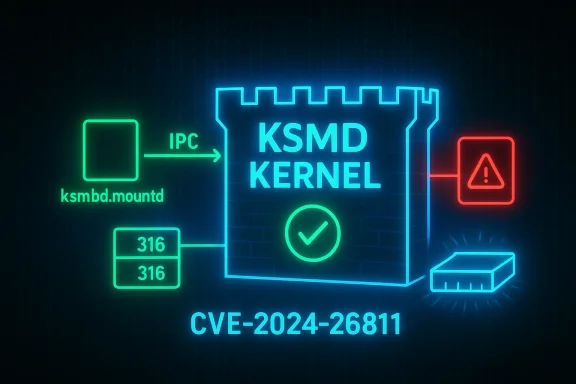
ksmbd is the Linux kernel’s in‑kernel implementation of the SMB/CIFS server protocol. Designed to improve performance and reduce context switches compared with a solely userspace SMB server, ksmbd implements the SMB protocol inside the kernel while delegating some control and policy functions to a small userspace helper suite (commonly packaged as ksmbd‑tools). Those userspace helpers — in particular a component named ksmbd.mountd — respond to kernel requests over a dedicated IPC channel.
The vulnerability tracked as CVE‑2024‑26811 stems from the kernel side trusting the payload length supplied by userspace when processing IPC replies. If a compromised or deliberately malicious ksmbd.mountd returns a crafted reply whose payload length doesn't match the actual data or the kernel's expectations, the kernel could overread or overwrite its buffers — a classic memory‑corruption vector that can produce reliability failures (kernel panics / OOPS) or worse in carefully weaponized scenarios.
This was addressed upstream by adding explicit payload size validation for the IPC reply paths that contained copyable payloads. The change enforces expected size bounds before allocating, copying, or otherwise processing incoming reply payloads.
The vulnerability arises when the kernel insisted on using the payload size reported by the userspace reply without validating that size against what the kernel expected for that command. Put simply:
Example scenario:
Because kernel memory safety is brittle, it is prudent to treat memory‑corruption bugs as potentially exploitable for privilege gain until proven otherwise. That means conservative remediation priorities: patch quickly and mitigate exposure.
For defenders, the right priorities are clear: identify whether ksmbd is present and in use; apply vendor kernel patches as soon as they are available; and harden supply‑chain and package verification processes to reduce the chance that trusted helper binaries can be swapped out. In places where in‑kernel SMB is unnecessary, removing the functionality entirely is a low‑cost, high‑benefit mitigation.
This vulnerability reinforces a perennial truth in systems engineering: performance optimizations that push complex parsing into privileged layers must be accompanied by defensive programming and rigorous provenance controls for the small userspace pieces that exercise those privileged interfaces.
Source: MSRC Security Update Guide - Microsoft Security Response Center
 Background / Overview
ksmbd is the Linux kernel’s in‑kernel implementation of the SMB/CIFS server protocol. Designed to improve performance and reduce context switches compared with a solely userspace SMB server, ksmbd implements the SMB protocol inside the kernel while delegating some control and policy functions to a small userspace helper suite (commonly packaged as ksmbd‑tools). Those userspace helpers — in particular a component named ksmbd.mountd — respond to kernel requests over a dedicated IPC channel.The vulnerability tracked as CVE‑2024‑26811 stems from the kernel side trusting the payload length supplied by userspace when processing IPC replies. If a compromised or deliberately malicious ksmbd.mountd returns a crafted reply whose payload length doesn't match the actual data or the kernel's expectations, the kernel could overread or overwrite its buffers — a classic memory‑corruption vector that can produce reliability failures (kernel panics / OOPS) or worse in carefully weaponized scenarios.
This was addressed upstream by adding explicit payload size validation for the IPC reply paths that contained copyable payloads. The change enforces expected size bounds before allocating, copying, or otherwise processing incoming reply payloads.
Why this matters: threat model and impact
- Attack vector: local, requires installing or replacing ksmbd‑tools (or otherwise controlling ksmbd.mountd) on the target system. The vulnerability is not a direct remote network attack against the kernel; it is a local userspace → kernel trust failure.
- Potential impact: memory overrun or slab out‑of‑bounds conditions in kernel space, which can lead to:
- Immediate denial of service through kernel panic or OOPS (high availability impact).
- Under some circumstances, memory corruption that could be escalated toward privilege escalation or arbitrary code execution — though such exploitation requires precise control and system‑specific conditions.
- Realistic worst case: a trojanized package (supply‑chain or local compromise) replaces ksmbd.mountd or supplies malicious ksmbd‑tools to a host that runs the kernel’s ksmbd subsystem. That malicious userspace can craft IPC replies that the kernel previously accepted unchecked, causing crashes or memory corruption in the kernel domain.
- Scope: the kernel-side fix targets the ksmbd IPC reply paths that carry payloads — the patch validated three reply types with payloads in the affected code paths.
Technical breakdown: what went wrong
ksmbd architecture and IPC
ksmbd runs as kernel code implementing SMB server operations. To perform certain tasks — mounting, session negotiation, configuration — it exchanges messages with a userspace daemon, commonly called ksmbd.mountd, over an internal IPC layer (generic netlink or another kernel messaging system). Those messages follow a typed format: command identifier, header, and an optional payload. The kernel asks; userspace replies.The vulnerability arises when the kernel insisted on using the payload size reported by the userspace reply without validating that size against what the kernel expected for that command. Put simply:
- Kernel: "Send me X bytes of payload for command Y."
- Userspace: returns a message claiming it contains N bytes of payload.
- Kernel (pre‑patch): allocates or copies using N without checking whether N is within valid limits or matches the expected structure for command Y.
- Malicious/userspace bug: craft N so that memcpy/copy_from_user or buffer handling overruns or reads beyond intended memory, producing slab corruption, overreads, or writes.
The defensive fix
Upstream maintainers added explicit validation logic to verify that the returned payload length for a reply message is within the expected bounds for that command. The fixes include:- Determining the expected payload size (or maximum acceptable size) for each IPC reply type that carries a payload.
- Checking reply->len against that expected/minimum and maximum values before allocating or copying data.
- Returning an error and dropping the reply when the size is out of bounds, rather than processing it.
Affected systems and severity
- Who is affected: Linux kernels with the ksmbd subsystem prior to the upstream fixes merged in April 2024. In practice, whether a particular distribution or host is vulnerable depends on:
- Whether the kernel build includes ksmbd (not all kernels enable it by default).
- Whether the host ships/installs ksmbd‑tools and runs ksmbd.mountd.
- Attack complexity: low for causing denial of service (local), higher for privilege escalation (requires much more nuanced conditions).
- Exploit status: at the time of disclosure and upstream patching there were no public, reliable, widely‑used exploits publicly reported. The primary real‑world risk is local compromise or trojanized packages that supply malicious userspace helpers.
- Severity classification: assessed as a medium risk for widespread exploitation of arbitrary code execution, but high impact for availability because kernel memory corruption can crash systems or cause persistent instability when triggered.
Responsible remediation: patching and mitigation steps
If you manage Linux hosts or embedded devices, follow this ordered plan:- Assess exposure first
- Check whether your kernel supports/loads ksmbd:
- Run: lsmod | grep ksmbd (or check kernel config: CONFIG_KSMBD).
- Identify whether ksmbd.mountd (or ksmbd‑tools) are installed and running.
- Confirm installed kernel versions (uname -r) and distribution kernel release; compare to distribution advisories.
- Apply vendor patches
- Install the kernel updates that include the ksmbd payload‑validation fixes from your Linux distribution vendor or from the upstream stable kernel offering you track.
- If you run a distribution kernel that backports fixes, use your package manager to upgrade to the security‑patched kernel package rather than building from upstream unless you manage custom kernels.
- If immediate patching is not possible — temporary mitigations
- Disable or remove ksmbd/ksmbd.mountd if you do not need in‑kernel SMB:
- Stop the ksmbd.mountd service, uninstall ksmbd‑tools from hosts that do not require it.
- Use user‑space Samba instead of the in‑kernel server on hosts that require SMB services but cannot be patched promptly.
- Harden package installation and supply chain controls:
- Enforce package signature verification.
- Run only signed images in container orchestrations and block untrusted images.
- Reduce the local attack surface:
- Limit who can install packages (principle of least privilege).
- Use host integrity tools (rpm -V, debsums) to detect trojanized binaries.
- Monitor and detect
- Watch kernel logs (dmesg, /var/log/kern.log) for suspicious OOPS messages or error lines referring to ksmbd IPC processing or invalid reply lengths.
- Implement host monitoring alerts for sudden kernel panics, OOPS, or ksmbd service crashes.
- Audit package installations and recent changes to ksmbd‑tools; alert on unexpected replacements of the ksmbd.mountd binary.
- For high‑security environments
- Consider runtime controls that restrict behavior of ksmbd.mountd via AppArmor/SELinux policies or seccomp filters to limit what a compromised helper can do.
- For endpoints that must remain highly available, consider virtualization and kernel lockdown features that further isolate kernel attack surfaces.
Detection and forensics guidance
When investigating a suspected exploit or probing whether a system was targeted, look for:- Kernel OOPS or panic logs immediately following operations that invoke ksmbd functions. The error path for invalid IPC reply lengths typically logs an error when the kernel discovers the reply length mismatches expectations; such messages are a strong indicator.
- Unexpected changes to ksmbd‑tools or ksmbd.mountd binaries (file modification times, package upgrade history).
- Local package installation in unattended or unauthorized contexts, especially where users or processes without administrative justification installed packages.
- Unusual process behavior around ksmbd.mountd: elevated CPU usage, repeated restarts, or failure to start.
- Corruption symptoms such as memory allocation failures or slab allocator warnings may also correlate with abuse of this class of bug.
- The kernel logs and dmesg output.
- A copy of the ksmbd.mountd binary for analysis.
- The installed package metadata and full package repository state to help trace supply‑chain compromise.
Why in‑kernel servers increase the stakes
Moving protocol logic into the kernel can bring performance benefits, but it also changes the security calculus:- Bigger blast radius: bugs in kernel code operate at the highest privilege level. An unchecked userspace→kernel trust boundary that would otherwise compromise only a userspace process becomes a vector against the entire OS.
- Harder instrumentation: kernel memory corruptions are more difficult to contain, debug, and remediate than userland crashes.
- Dependency on secure userspace helpers: in‑kernel services still rely on tiny userspace components for configuration and control. If those helpers are compromised — via supply chain, package manager, or local privilege abuse — the kernel must robustly validate their inputs.
Operational recommendations (quick checklist)
- 1.) Identify: Does this host run ksmbd? If not, deprioritize. If yes, proceed.
- 2.) Patch: Apply the vendor kernel update that includes the ksmbd IPC payload validation fixes.
- 3.) Remove/Disable: If you don’t need in‑kernel SMB, uninstall ksmbd‑tools and stop ksmbd.mountd.
- 4.) Harden package installs: enforce signed package policies and scanned container images.
- 5.) Monitor: add dmesg/kernel log alerts for ksmbd errors and unexpected kernel OOPS.
- 6.) Audit: review recent package changes for ksmbd‑tools and verify binary integrity.
- 7.) Plan: ensure your incident playbook covers local supply‑chain compromise scenarios.
Risk analysis and attacker scenarios
Likely, low-cost misuse: Denial of Service
The simplest attack is to intentionally craft abnormal IPC replies to produce kernel panic or OOPS. Because causing reliability failures in kernel space is comparatively easy when memory boundaries are violated, this is a realistic near‑term threat when an attacker can control ksmbd.mountd.Example scenario:
- An attacker with limited write access (or who persuades an admin to install a malicious package) installs a trojan ksmbd.mountd.
- The attacker crafts specially sized reply payloads to trigger slab corruption or an immediate OOPS.
- Outcome: the host becomes unavailable for file shares or could reboot; in clustered storage contexts, this could ripple into service outages.
Harder, higher payoff: privilege escalation
Memory corruption in kernel space can sometimes be leveraged to escalate privileges. Achieving this requires highly controlled memory manipulation and deep knowledge of the targeted kernel build, loaded modules, and memory layout. It's a plausible but more difficult route than causing DoS.Because kernel memory safety is brittle, it is prudent to treat memory‑corruption bugs as potentially exploitable for privilege gain until proven otherwise. That means conservative remediation priorities: patch quickly and mitigate exposure.
Supply‑chain angle: a real concern
CVE‑2024‑26811 demonstrates how a small, trusted userspace helper can become a weapon if it is trojanized. The real-world threat scenario most organizations should fear is not an external remote exploit overnight, but a supply‑chain compromise or misconfiguration that replaces ksmbd‑tools with malicious binaries. Defending the package pipeline and image provenance is therefore as important as patching the kernel.Developer and vendor perspectives
- Kernel maintainers reasonably chose to harden the ksmbd reply paths with explicit length checks — a classic, necessary improvement in defensive coding.
- Distributions that ship ksmbd need to ensure both the kernel fix and secure distribution of ksmbd‑tools; a kernel patch without verifying userspace integrity does not eliminate the supply‑chain risk.
- In high‑assurance environments, operators may choose to avoid in‑kernel SMB entirely, opting for user‑space Samba or dedicated file servers that keep complex protocol parsing out of the kernel.
Lessons for system designers and administrators
- Never trust userspace input at kernel boundaries. That rule is old but still relevant; CVE‑2024‑26811 is a reminder.
- Small helper tools (mountd, control daemons, etc.) are attractive targets for adversaries. Their integrity must be protected.
- Performance gains from in‑kernel services carry security tradeoffs; carefully evaluate whether those tradeoffs fit your threat model.
- Combine short‑term emergency patches with long‑term supply‑chain hygiene: signing, verification, reproducible builds, and strict image policies.
What we still don’t know (and what to watch for)
- Whether any in‑the‑wild exploitation chains have ever used this specific bug to do more than cause denial of service is not proven public knowledge. Treat memory‑corruption bugs as potentially escalatable, but do not assume privilege escalation is trivial without a proof‑of‑concept.
- Distribution backporting: different vendors may have applied the upstream fix in varying kernel branches and package releases. Confirm your vendor advisory for the exact patched package or kernel version.
- Kernel configs differ: many distributions do not enable ksmbd by default. Inventory your estate before rushing to patch every machine — prioritize hosts that run ksmbd or provide SMB services.
Final assessment
CVE‑2024‑26811 is a meaningful memory‑safety hardening that closes a predictable trust failure in the ksmbd userspace → kernel interaction. Its immediate and clear impact is availability — an attacker controlling or replacing ksmbd.mountd can crash or destabilize hosts. The privilege‑escalation risk is harder to exploit but cannot be dismissed.For defenders, the right priorities are clear: identify whether ksmbd is present and in use; apply vendor kernel patches as soon as they are available; and harden supply‑chain and package verification processes to reduce the chance that trusted helper binaries can be swapped out. In places where in‑kernel SMB is unnecessary, removing the functionality entirely is a low‑cost, high‑benefit mitigation.
This vulnerability reinforces a perennial truth in systems engineering: performance optimizations that push complex parsing into privileged layers must be accompanied by defensive programming and rigorous provenance controls for the small userspace pieces that exercise those privileged interfaces.
Source: MSRC Security Update Guide - Microsoft Security Response Center
