

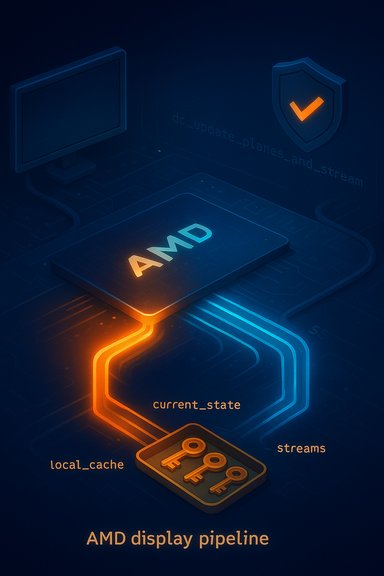
A small but important defensive patch landed in the Linux kernel in mid‑December 2025 that fixes a crash in the AMD DRM display stack: CVE‑2025‑68196 addresses a race where the display code could reference dc->current_state while calling into dc_update_planes_and_stream during link training (LT) automation, a sequence that could clobber current_state and lead to a kernel crash — the fix caches the relevant stream pointers and iterates over that cached list instead of relying on the mutable current_state.
Display pipeline initialization and reconfiguration in modern GPUs is a multi‑stage process that includes a step called link training (LT), where the GPU and monitor sink negotiate physical lane configuration, voltage swing and pre‑emphasis, and the clocking domain for the physical interface (for example DisplayPort). The AMD DRM driver (amdgpu) implements that logic inside the drm/amd/display portion of the kernel, which maintains a central dc->current_state structure describing active streams and planes. Under normal operation this state is stable while the driver programs hardware; however, several code paths in the display stack can allocate, swap or free display state as part of an update, leaving transient windows where code that assumes current_state is still valid can dereference freed pointers or read stale values — a classic kernel‑space use‑after‑assumption scenario.
Why this matters: a NULL dereference or a use‑after‑free in kernel display code is not a benign process crash. It can produce an oops, driver reset, compositor failure, or a host‑wide reboot in multi‑tenant systems. That’s why even small, localized fixes in display sequencing are treated as security fixes: they remove deterministic crash primitives that can be used as denial‑of‑service (DoS) vectors on shared infrastructure.
Who to worry about most:
Source: MSRC Security Update Guide - Microsoft Security Response Center
 Background
Display pipeline initialization and reconfiguration in modern GPUs is a multi‑stage process that includes a step called link training (LT), where the GPU and monitor sink negotiate physical lane configuration, voltage swing and pre‑emphasis, and the clocking domain for the physical interface (for example DisplayPort). The AMD DRM driver (amdgpu) implements that logic inside the drm/amd/display portion of the kernel, which maintains a central dc->current_state structure describing active streams and planes. Under normal operation this state is stable while the driver programs hardware; however, several code paths in the display stack can allocate, swap or free display state as part of an update, leaving transient windows where code that assumes current_state is still valid can dereference freed pointers or read stale values — a classic kernel‑space use‑after‑assumption scenario.Why this matters: a NULL dereference or a use‑after‑free in kernel display code is not a benign process crash. It can produce an oops, driver reset, compositor failure, or a host‑wide reboot in multi‑tenant systems. That’s why even small, localized fixes in display sequencing are treated as security fixes: they remove deterministic crash primitives that can be used as denial‑of‑service (DoS) vectors on shared infrastructure.
What went wrong: the technical root cause
At a high level the bug fixed by CVE‑2025‑68196 occurred when the LT automation routine walked the set of streams present in dc->current_state and then called dc_update_planes_and_stream on each matching stream. That helper — which can allocate a new dc_state and replace dc->current_state as part of its update work — could clobber the current_state pointer mid‑loop. After the update, subsequent iterations of the loop that still indexed into the old state would dereference invalid pointers, producing crashes. The defensive approach in the patch is straightforward: identify which streams target the link in question, cache their stream pointers into a small local array, and then call into the update logic using those cached pointers so the loop is not tied to a possibly swapped current_state. Key technical details:- The problematic pattern relied on iterating state->streams[] while calling a helper that might replace state under the hood.
- The fix introduces a short pre‑scan that collects pointers to streams whose stream->link equals the link being processed and stores them in a local array sized by MAX_PIPES, then iterates that array when invoking dc_update_planes_and_stream.
- The change is intentionally minimal and defensive, which reduces regression risk and makes backporting to stable kernel trees straightforward.
Where the fix landed and how it was coordinated
The patch was reviewed and merged into the stable kernel trees; the stable mailing list entry documents the upstream commit and the rationale (WHY/HOW) for the change. The commit was authored and reviewed by upstream maintainers responsible for the amdgpu/DC code and then picked into autosel/stable updates for the 6.17 series and other relevant branches. Public CVE trackers (CVE feed pages and aggregated vulnerability sites) recorded CVE‑2025‑68196 with references to the kernel commits. Two independent public touchpoints documenting the fix:- The kernel stable commit and commit message explaining the WHY/HOW of the change.
- CVE aggregator pages that list CVE‑2025‑68196 and point to the kernel.org commit references.
Affected systems, scope and likely impact
Affected component: the Linux kernel DRM AMD display subsystem (drivers/gpu/drm/amd/display). The bug specifically targeted code paths exercised by LT automation and display stream updates that can cause the driver to swap the current DC state.Who to worry about most:
- Multi‑tenant hosts and CI runners that expose GPUs to untrusted workloads (via /dev/dri, GPU passthrough, or container device mounts) — an unprivileged tenant can often exercise display APIs indirectly.
- Developer workstations and desktops with AMD GPUs where untrusted local processes can trigger modesets.
- Embedded devices and OEM kernels that lag upstream patching — these are the classic long‑tail risk because vendors often delay backports.
- Local only. There is no indication the flaw is remotely exploitable without already having local code execution or the ability to induce the display stack to execute the vulnerable path. The exploitability is therefore limited to contexts where an attacker can run code on the host or where untrusted workloads are granted access to GPU devices.
- Primary impact is availability (denial‑of‑service) — a kernel oops, driver hang, repeated pageflip timeouts, or the need for a host reboot are the likely consequences. There is no authoritative, public proof that this particular CVE enables privilege escalation or information disclosure by itself.
- At the time of public tracking, the CVE entries initially carried no canonical CVSS metric in some aggregators, while other trackers classify similar DRM/AMD display issues as Medium with base scores around 5.5 driven by Local / Low complexity / Availability impact. EPSS and exploitation estimates for these hardware‑dependent local crashes tend to be very low, but the operational value for attackers targeting shared infrastructure can be significant. Treat the numeric severity as a guide — the practical operational severity is higher in multi‑tenant and VDI contexts.
How the patch prevents the crash (code‑level explanation)
The repair is concise and conservative:- Before: the code iterated dc->current_state->streams and inside that same loop invoked dc_update_planes_and_stream which could allocate and swap in a new dc_state, invalidating the pointer being iterated.
- After: the code first scans the streams in the current_state and collects pointers to the streams that target the given link into a local array (bounded by MAX_PIPES). Then, with this cached list, the code calls dc_update_planes_and_stream for each cached pointer. Because the helper operates on the cached stream pointers rather than indexing back into a possibly mutated current_state, there’s no possibility of dereferencing a freed/moved state.
Detection — how to tell if the bug has been hit
If a host is vulnerable and a workload triggers the path, common operational indicators include:- Kernel messages in dmesg or journalctl with amdgpu or drm symbols, including oops traces rooted in drivers/gpu/drm/amd or calls into dc_update_planes_and_stream. Preserve the full stack trace.
- Repeated “Pageflip timed out!” messages, watchdog/reset traces from the amdgpu driver, or compositor crashes that coincide with display hot‑plug, docking, or fullscreen video.
- A single display freezing in a multi‑monitor setup while other displays remain responsive, followed by driver resets or session termination.
- Capture persistent logs: journalctl -k and dmesg output, serial console logs if available.
- Preserve the kernel oops stack trace (don’t reboot before collecting it unless necessary).
- Record the running kernel version (uname -r) and the amdgpu module status (lsmod | grep amdgpu).
Remediation and mitigations — what to do now
Definitive fix:- Install vendor/distribution kernel updates that include the upstream commit(s) addressing CVE‑2025‑68196 and reboot into the patched kernel. Kernel changes require a reboot — there is no hot patch that entirely eliminates the risk at runtime. Verify the package changelog references the kernel commit ID or the CVE entry before assuming hosts are protected.
- Restrict access to DRM device nodes: change udev rules or group membership so that only trusted users/groups can open /dev/dri/*; remove device exposure from untrusted containers or CI runners. This reduces the attack surface by preventing unprivileged processes from exercising DRM ioctls.
- Avoid hot‑plugging suspect monitors, uncertified docking stations, MST hubs, or adapters that are known to produce link training failures until hosts are patched. The bug depends on LT automation and link conditions; using known‑good cables and certified adapters reduces the accidental trigger rate.
- If running containers that need GPUs, run them with the minimum privileges and avoid binding /dev/dri into untrusted containers; prefer controlled GPU resource managers and explicit authorization for GPU access.
- Reboot into the patched kernel.
- Reproduce representative display operations in a staging environment for 24–72 hours (hot‑plug, MST chains, docking, fullscreen media).
- Monitor dmesg/journalctl for recurrence of prior oops, pageflip timeouts, or display watchdog messages.
Practical rollout guidance for administrators
- Inventory: enumerate hosts that load the amdgpu module and where /dev/dri is accessible.
- uname -r across your fleet to map kernels in use.
- lsmod | grep amdgpu to check module load status.
- ls -l /dev/dri/* to inspect device nodes and permissions.
- Prioritize: patch multi‑tenant hosts, VDI servers, CI runners, and developer fleets that run untrusted workloads first.
- Patch: obtain and deploy vendor kernel updates that explicitly reference the upstream commit or CVE entry; reboot hosts.
- Test: run representative display and workload tests in a staging ring before broad production rollout to catch any regressions. Display driver changes are legitimately sensitive to hardware topology and require validation.
Risk analysis and broader implications
Strengths of the upstream response:- The upstream patch is small, well‑explained, and defensive — exactly the kind of surgical change that is low‑risk to backport to stable kernels. Kernel maintainers prioritized correctness and minimized surface area for regressions.
- Backport/packaging lag: not all distributions or vendor kernels will have applied the patch simultaneously. Embedded and OEM kernels are particularly likely to lag, so inventorying and validating package changelogs is essential.
- Regression risk: while the change is minimal, any modification to clocking, sequencing, or state handling in the display driver needs hardware validation — operators should test on representative hardware stacks (docks, hubs, MST chains).
- Chaining potential: although CVE‑2025‑68196 is an availability bug, deterministic kernel primitives can be combined with other vulnerabilities in complex exploit chains; do not treat DoS CVEs as universally harmless. Mark any claims of privilege escalation without evidence as unverified.
Why the missing MSRC page matters (and what to do when vendor pages return 404)
If you tried to open the Microsoft Security Response Center (MSRC) page for CVE‑2025‑68196 and received “page not found,” that can happen for several reasons:- The vendor may not have ingested this particular CVE into their product mapping yet, or MSRC’s URL schema may differ from the public CVE identifier.
- The CVE could be newly published and the MSRC index not yet updated.
Because the underlying fix and authoritative details exist in the Linux kernel tree (git.kernel.org) and multiple independent CVE aggregators, rely on the kernel commit and your distribution’s security advisory rather than a single vendor page when verifying whether a host is fixed. Always confirm package changelogs for the vendor kernel image in your environment.
Conclusion — operational takeaways for WindowsForum readers
- CVE‑2025‑68196 is a narrowly scoped but meaningful fix: a defensive change to the AMD DRM display code that removes a deterministic crash primitive by caching stream pointers before LT automation updates.
- The primary impact is availability (local denial‑of‑service), and the CVE is exploitable only with local access or where untrusted workloads can drive the DRM stack; there is no public evidence this change enables remote compromise or privilege escalation by itself.
- Immediate action for administrators: inventory GPU‑exposed hosts, apply vendor kernel updates that reference the fix, reboot into patched kernels, and test display recomposition scenarios with representative hardware. If urgent patching is impossible, restrict /dev/dri access and avoid risky hot‑plug/hub scenarios.
- Finally, don’t rely on a single vendor page to confirm protection: verify the presence of the upstream commit in your kernel package changelogs or the distribution’s security advisory and preserve kernel logs if you need to triage a suspected crash.
Source: MSRC Security Update Guide - Microsoft Security Response Center
