

The Linux kernel has received a small but important corrective patch addressing CVE-2025-40262 — a memory-corruption bug in the IMX SCU key driver (imx_sc_key) that could corrupt kernel memory during module unload by passing the address of a stack variable instead of the intended pointer. The upstream fix replaces an erroneous call that passed &priv with the correct argument priv, preventing the unload-time callback from operating on a stack address and removing a practical source of memory corruption.
Appendix: Quick commands and checks
Source: MSRC Security Update Guide - Microsoft Security Response Center
 Background
What component is affected
The bug lives in the IMX System Controller Unit (SCU) key driver — the kernel module commonly built as imx_sc_key and used on NXP i.MX-based SoCs to handle system controller key inputs. The driver is compiled as drivers/input/keyboard/imx_sc_key.c in mainline kernels and appears in kernels supporting i.MX SCU platforms. The configuration symbol is CONFIG_KEYBOARD_IMX_SC_KEY, and the module name is imx_sc_key.Nature of the flaw
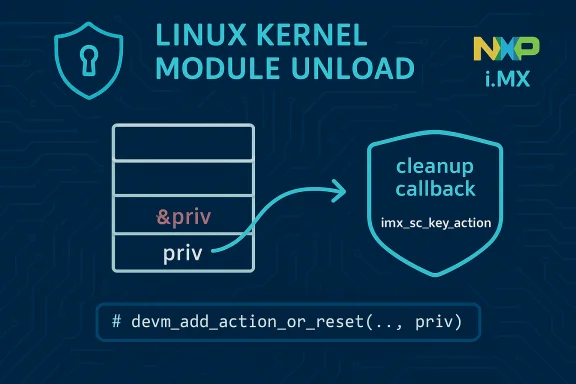
The problem is a classic pointer misuse introduced in cleanup registration: the probe routine used devm_add_action_or_reset to register an unload/cleanup callback but passed the address of a local stack variable (&priv) instead of the pointer value (priv) that lives beyond the probe frame. That means the cleanup callback could later dereference a pointer into the stack frame that no longer exists — a direct recipe for memory corruption during module unload. The upstream patch is a one-line fix: change the third argument to devm_add_action_or_reset from &priv to priv.How this class of bug typically manifests
When kernel code registers a callback or data pointer and accidentally passes the address of a stack-local object, the callback receives a pointer that becomes invalid once the stack frame is unwound. When the callback runs later (for example, during module unload), it may read or write through that stale pointer and corrupt kernel memory. In kernel space, memory corruption often leads to kernel oopses, WARNs, or crashes — effects that primarily impact availability rather than confidentiality or privilege elevation in most cases. Similar defensive fixes across the kernel convert pointer mistakes or uninitialized handling into explicit checks or properly managed heap- or module-scoped objects to avoid such transient faults.What the upstream patch changed
The technical delta (short)
The committed patch replaces:- error = devm_add_action_or_reset(&pdev->dev, imx_sc_key_action, &priv);
with: - error = devm_add_action_or_reset(&pdev->dev, imx_sc_key_action, priv);
Why that change matters
- Passing priv ensures the cleanup callback receives a valid pointer to the driver state (or the allocated resource) rather than a transient stack address.
- Removing the stack address prevents the callback from dereferencing or modifying memory that no longer belongs to the driver context — eliminating the unload-time memory-corruption window.
- The change is minimal and surgical, consistent with kernel maintenance practice: small, easy-to-review fixes are favored for stable backports because they reduce regression risk.
Impact and affected population
Affected builds
Public trackers and upstream commit references list the issue and the fix in the Linux kernel stable trees; vulnerability aggregators record CVE-2025-40262 against the Linux kernel. The practical exposure is the set of kernels that include the vulnerable commit(s) in drivers/input/keyboard/imx_sc_key.c and that have the imx_sc_key module enabled. Embedded Linux images and vendor-supplied kernels for NXP i.MX SoCs are the primary population of concern because they commonly include this driver.Real-world attack model and prerequisites
- Attack vector: local. The bug is triggered by module unload or the devm-managed action running at device remove/unbind; an attacker must be able to trigger or influence that lifecycle on the target host.
- Privileges required: often low in some setups. On development or test hosts where modules are loaded/unloaded, a less-privileged local user or a misconfigured container could cause module lifecycle operations. On production embedded devices the practical exploitation scenario is rare without local access or vendor image modifications.
- Primary impact: availability through kernel memory corruption (oops/panic) during driver unload. There is no public evidence that this particular pointer mistake enables direct remote code execution or privilege escalation on its own. Aggregators classify the issue as a memory-corruption defect to be fixed for stability.
Severity and exploitability nuance
Although memory corruption in kernel mode can be a high-value primitive, not every corruption yields a reliable escalation or RCE path. For this CVE, published accounts and the upstream patch narrative frame it primarily as an unload-time memory-corruption bug leading to potential oopses. Until proof-of-concept exploit code appears demonstrating a practical escalation, the most credible operational risk is denial-of-service or instability, especially on fleets where legitimate unload cycles happen frequently (development CI, dynamic module testbeds, or devices with hot plugin/unplug flows).Detection, triage, and verification steps
How to check whether a host is affected
- Identify whether the running kernel includes the imx_sc_key driver:
- lsmod | grep imx_sc_key
- zgrep IMX_SC_KEY /proc/config.gz (or inspect kernel config)
- Check your kernel package changelog or distribution security tracker for backports referencing CVE-2025-40262 or the stable commit IDs published by the kernel project.
- If you build kernels in-house, search the tree used to produce your kernel for the vulnerable line in drivers/input/keyboard/imx_sc_key.c or for the upstream fix commit. The definitive check is presence/absence of the single-line change around devm_add_action_or_reset.
Kernel log indicators
Look for oops traces or WARNs originating from input/keyboard driver routines at module remove/unload time. Sample signals include:- Kernel oops backtraces that mention imx_sc_key_action or functions in drivers/input/keyboard/imx_sc_key.c.
- Repeated crashes or instability occurring when device drivers are probed/removed (for example, during module reload cycles).
Collect full dmesg or journalctl -k output for post-mortem analysis if you suspect the bug.
Example verification workflow (quick)
- On a test host, load the imx_sc_key module (modprobe imx_sc_key) if configured as a module.
- Trigger the remove/unbind path (modprobe -r imx_sc_key or perform the device remove you expect in production).
- Observe kernel logs (journalctl -k or dmesg) for oopses. If present prior to the patch and absent after applying the fix, you have validated the remediation.
Remediation and mitigation
Definitive fix
Install kernel packages from your distribution or vendor that explicitly include the upstream stable commit that fixes imx_sc_key (the change to remove &priv). Boot the patched kernel so that the corrected code is active. Upstream commit references and stable-tree merges are already tracked by NVD and other vulnerability databases.Interim mitigations (when patching is delayed)
- Prevent unnecessary module load/unload cycles on production hosts.
- For systems where imx_sc_key is unnecessary, consider blacklisting or compiling the driver out (CONFIG_KEYBOARD_IMX_SC_KEY=n) — but only after verifying that no legitimate hardware depends on it; on embedded appliances this may not be feasible.
- Limit access to hosts and management interfaces to reduce the chance that a local non-privileged actor can trigger module lifecycle operations.
These are tactical workarounds only — the correct long-term action is to apply the kernel patch and reboot into the updated kernel.
Vendor-specific notes
Embedded OEMs and device manufacturers that ship vendor kernels (Android, router, appliance firmware) must backport the one-line fix into their kernel trees and regenerate firmware images. Because vendors often maintain forked kernel trees and longer release cycles, there is often a long tail of exposed embedded devices even after upstream merges appear. Prioritize requests to vendors that supply i.MX-based devices in your fleet.Operational guidance for sysadmins and device vendors
- Inventory: locate devices that run i.MX SoC kernels and that include the imx_sc_key module. Use configuration-management data to find likely candidates.
- Prioritize: test and patch development/test hosts and CI systems first if they are dynamic or allow module reloads. Then target embedded fleets where vendor images can be upgraded.
- Test: stage the patched kernel in a pilot ring, exercise typical device attach/remove workflows, and monitor kernel telemetry for regressions.
- Communicate: advise device vendors that the upstream patch is tiny and safe to backport; encourage fast firmware updates for long-tail devices.
- Logging: enable collection of kernel logs (dmesg/journal) centrally to spot patterns of oopses correlated with device remove events.
- Discover hosts with imx_sc_key present.
- Cross-check kernel package changelogs for commit IDs or CVE-2025-40262 references.
- Stage patched kernel on a pilot host; exercise module load/unload cycles.
- If pilot passes, schedule maintenance windows for broader rollout.
- Verify each host boots to the patched kernel and confirm absence of unload-time oopses.
Why small patches like this matter
This CVE underscores a recurring reality in kernel development: tiny pointer mistakes yield outsized risk. A single ampersand in the wrong place converted safe cleanup registration into a potential crash primitive. The kernel community's practice of issuing minimal, surgical fixes and backports is effective: it reduces the regression surface and helps vendors accept patches into stable branches quickly. The operational impact, however, depends heavily on device class and lifecycle: development testbeds and modular systems are more exposed than static production appliances, but the embedded long tail remains an important risk vector because firmware updates are often slow. Similar kernel fixes in the past — defensive checks, NULL guards, or minor pointer corrections — have been small in code size but large in operational effect.Verification and cross-references
Multiple independent sources corroborate the issue and the fix:- The kernel mailing list patch archive (patch email and diff) includes the exact one-line change and a short rationale explaining the &priv mistake; this is the primary technical artifact showing what changed.
- The National Vulnerability Database has a CVE-2025-40262 entry summarizing the vulnerability text and referencing kernel.org stable commits.
- Vulnerability trackers (CVE Details, OpenCVE, and other aggregators) list the CVE, the description, and the referenced kernel.org commits; they provide secondary corroboration for affected versions, timelines, and public visibility.
Practical developer notes (for kernel maintainers and integrators)
- When registering cleanup actions that receive a pointer argument, ensure that the object being referenced is long-lived for the lifetime of the callback: either allocate it with devm_* APIs or pass module/device-managed pointers rather than stack addresses.
- Prefer devm-managed resources or heap-allocated structures for state that must survive beyond the scope of the probe function.
- Minimal code reviews focused on pointer ownership semantics can catch many of these errors. Automated static checks or targeted code scans for devm_add_action_or_reset usage patterns can surface suspicious &addresses passed into devm callbacks.
Conclusion
CVE-2025-40262 is a compact but representative kernel robustness bug: an accidental ampersand caused the devm_add_action_or_reset cleanup registration to receive a stack address rather than the intended driver state pointer, opening a path to unload-time memory corruption. The upstream fix is a single-line correction that removes the ampersand and makes the driver’s cleanup registration correct; this change has been merged into stable kernel streams and tracked by vulnerability databases. Administrators and device vendors with i.MX-based systems should verify whether their kernels include the fix, prioritize patching or backporting in environments that permit module unloads or that rely on dynamic driver lifecycles, and treat lingering embedded images as a remediation priority due to typical vendor-image lag. The practical risk today is primarily availability-related, but the orthodox response is timely patching: reboot into a patched kernel to eliminate the risk and restore predictable cleanup behavior.Appendix: Quick commands and checks
- Check for module presence:
- lsmod | grep imx_sc_key
- Check kernel config for build options:
- zgrep CONFIG_KEYBOARD_IMX_SC_KEY /proc/config.gz
- Search for the problematic line (if you have the kernel source used to build your image):
- grep -n \"devm_add_action_or_reset(.*imx_sc_key_action\" -R drivers/input/keyboard
- Kernel logs:
- journalctl -k | grep -i imx_sc_key
- Verify vendor/distro advisories and kernel changelogs for mentions of CVE-2025-40262 or the upstream commit IDs before declaring systems remediated.
Source: MSRC Security Update Guide - Microsoft Security Response Center
