

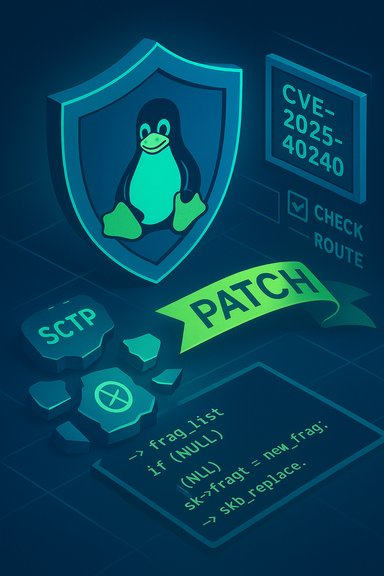
The Linux kernel has been updated to fix CVE-2025-40240, a small but important defensive bug in the SCTP receive path that could trigger a kernel NULL-pointer dereference when a chunk’s data buffer is missing; the upstream patch reorders checks and uses the chunk header instead of dereferencing a possibly NULL skb pointer, eliminating an availability-impacting crash vector.
SCTP (Stream Control Transmission Protocol) is a transport-layer protocol used by certain telecom stacks, signaling systems, and middlebox software where ordered and unordered message semantics matter. The Linux kernel implements SCTP in net/sctp; that code path manipulates skbs (socket buffers) and chunk structures representing incoming SCTP packets and their fragments.
In CVE-2025-40240 the kernel code reached into chunk->skb in a conditional block where, under a corner case, chunk->skb can be NULL while chunk->head_skb is set. The defect manifested when the code attempted to increment a statistic or access device fields via chunk->skb without first confirming that pointer is valid; the upstream fix changes the check and moves it to the point just before chunk->skb is replaced from skb_shinfo(...->frag_list, avoiding the dereference entirely. This is a classic kernel robustness fix: the code path had a missing/null-safety check in a rarely-hit fragmentation/cover-letter flow, and maintainers corrected the ordering and pointer usage rather than changing SCTP semantics. The patch was proposed, discussed on the kernel lists, and merged into the stable trees referenced by the public CVE metadata.
Windows administrators should pay attention because Linux is present across mixed estates: virtual machines, containers, WSL2, network appliances, and cloud images. A Linux kernel oops in any of those components can disrupt services that Windows teams rely on for orchestration, monitoring, or hybrid workloads. Treat Linux kernel CVEs like other infrastructure CVEs: inventory, patch, and validate.
Source: MSRC Security Update Guide - Microsoft Security Response Center
 Background
SCTP (Stream Control Transmission Protocol) is a transport-layer protocol used by certain telecom stacks, signaling systems, and middlebox software where ordered and unordered message semantics matter. The Linux kernel implements SCTP in net/sctp; that code path manipulates skbs (socket buffers) and chunk structures representing incoming SCTP packets and their fragments.In CVE-2025-40240 the kernel code reached into chunk->skb in a conditional block where, under a corner case, chunk->skb can be NULL while chunk->head_skb is set. The defect manifested when the code attempted to increment a statistic or access device fields via chunk->skb without first confirming that pointer is valid; the upstream fix changes the check and moves it to the point just before chunk->skb is replaced from skb_shinfo(...->frag_list, avoiding the dereference entirely. This is a classic kernel robustness fix: the code path had a missing/null-safety check in a rarely-hit fragmentation/cover-letter flow, and maintainers corrected the ordering and pointer usage rather than changing SCTP semantics. The patch was proposed, discussed on the kernel lists, and merged into the stable trees referenced by the public CVE metadata.
What the vulnerability actually is
The technical fault, in plain language
- Kernel code processes incoming SCTP chunks; each chunk may carry an skb (the main skb) and/or a head_skb when fragments or cover-letters are involved.
- Under certain fragmentation/GSO combinations the code path made an assumption that chunk->skb was non-NULL when it was not guaranteed to be so; that assumption led to a dereference of chunk->skb at a time it could be NULL.
- Dereferencing a NULL pointer in kernel space typically produces an oops (a logged kernel fault) or, on some platforms/configurations, a panic—an immediate availability loss for the host.
Where the fix was applied
The upstream change reorders the check and uses the chunk header or frag_list test earlier and only replaces chunk->skb after verifying it is safe to do so. The edit is intentionally small (a few lines) and constrained to the inqueue handling function, making it easy to backport to stable kernels used by distributions and vendors. Mailing-list discussion and the patch notes clarify the fix and the rationale.Scope and affected systems
Which systems are vulnerable
Any Linux kernel build that contains the vulnerable SCTP code path prior to the stable commit that implements the fix is potentially affected. That includes:- Mainline and stable kernel trees that predate the merged patch.
- Distribution kernels (Debian, Ubuntu, Red Hat, SUSE, etc. that have not yet received the stable backport.
- Vendor or embedded kernels and forks (network appliances, telecom boxes, Android vendors that include SCTP code) that lag upstream and have not incorporated the fix.
Attack vector and practical exploitability
- The issue is not documented as remotely exploitable in the public CVE metadata; the practical outcome is an availability problem (kernel crash/oops) rather than remote code execution. Local access or the ability to exercise the vulnerable SCTP code path is required to trigger the condition.
- In mixed environments, this can still be operationally significant: virtual machines, containers, WSL2 instances, and network appliances all run Linux kernels and may be impacted until their kernels are patched. Windows administrators who operate mixed estates or who host Linux guests/containers should treat the issue as relevant to their Linux elements.
Why this matters: availability, not data theft
Kernel NULL-pointer dereferences are typically availability issues. A single kernel oops can:- Crash or hang a host, requiring a reboot.
- Disrupt services (networking, storage, telemetry) and intermediate monitoring systems.
- Create windows for an attacker who already has local access to escalate denial-of-service goals or complicate incident response.
Upstream response and patch quality
The upstream fix
The upstream patch is deliberately small and defensive: it reorders checks, uses the chunk header when appropriate, and does the frag_list test only at the exact point where chunk->skb would be replaced. The change avoids touching speculative state and preserves normal fast paths. The maintainers accepted the patch, and it has been propagated into the kernel stable trees for backporting. The small footprint reduces regression risk and accelerates downstream adoption.Strengths of the fix
- Surgical: minimal lines changed, low behavioral impact when inputs are correct.
- Backportable: small diffs are easy for distribution maintainers to apply to stable kernels.
- Correctness-first: converts an uncontrolled crash into a controlled error path, which is the right defensive approach for kernel code.
Potential concerns
- Vendor lag: embedded vendors and OEM kernels often lag upstream; patched upstream code does not automatically mean every device is patched promptly.
- Coverage: because SCTP is less common than TCP/UDP on typical desktops, some admin teams may overlook the risk and delay patching.
- Visibility: kernel oops evidence can be transient (lost on reboot) and hard to correlate to the root cause if systems are not logging or if reboot is automatic.
Practical remediation guidance (for sysadmins and enthusiasts)
Apply kernel updates that include the upstream stable commit. Because this is a kernel-level fix, remediation requires a kernel package update and a reboot.- Inventory: identify hosts that could include the affected code.
- Identify Linux VMs, containers (host kernel vs. containerized kernels), WSL2 instances, and network appliances that run Linux kernels.
- For Linux hosts, run: uname -r to capture the running kernel version.
- Check module/status:
- Check whether the SCTP module is present or built-in: lsmod | grep sctp or modinfo sctp.
- If SCTP is built into the kernel, the only remediation is a kernel update and reboot.
- Update:
- Apply vendor/distribution kernel security updates that reference the stable patch or CVE entry in their advisory.
- For source-built kernels, merge the stable commit(s) from the upstream tree and rebuild.
- Reboot:
- Schedule and perform reboots to boot into the patched kernel. Kernel fixes are not effective until the updated kernel is running.
- Validate:
- After patching, exercise representative SCTP workloads (if available) or run your post-patch QA to ensure no regressions and that no oops traces return in dmesg/journalctl.
Short-term mitigations when patching is delayed
If you cannot immediately apply a kernel update, consider short-term mitigations that reduce exposure or make the vulnerable code path harder to reach. These are compensating controls, not replacements for patching.- Blacklist or unload the SCTP kernel module on hosts that do not need SCTP:
- To unload (if built as a module): sudo rmmod sctp
- To blacklist: add a file under /etc/modprobe.d/ (for example: echo "blacklist sctp" | sudo tee /etc/modprobe.d/blacklist-sctp.conf)
- Caveat: Unloading or blacklisting will break legitimate SCTP-dependent applications and services.
- Block SCTP at the network edge or host firewall for hosts that must remain unpatched and do not require SCTP:
- Example iptables rule: sudo iptables -A INPUT -p sctp -j DROP
- Example nftables: nft add rule inet filter input ip protocol sctp drop
- Caveat: Firewalling is effective only for network-exposed flows; it does not prevent local users or processes from triggering local code paths.
- Restrict untrusted local execution:
- Harden container policies, limit unprivileged access to raw sockets, or tighten capability sets to reduce the chance a low-privileged user can exercise the vulnerable path.
- For appliances and vendor devices, contact the vendor for patched firmware/kernel images or for a vendor-supplied mitigation path.
Detection and hunting
Look for kernel oops signatures and SCTP-related traces in logs.- Kernel logs: journalctl -k or dmesg | grep -i -E 'sctp|NULL pointer|oops'
- Reboot correlation: check for unexpected reboots or crashes correlated with SCTP stack usage.
- SIEM hunts: add rules that flag kernel oops messages containing SCTP symbols or that match “NULL pointer dereference” with network stack frames.
- If you capture vmcore or kdump data from an oops, preserve it for forensic analysis and for vendor/distributor triage.
Operational risk assessment and prioritization
- High priority: multi-tenant hosts, cloud VMs, networking appliances, and systems that allow untrusted local code execution or have vendor-supplied kernels that are slow to receive updates.
- Medium priority: single-tenant desktops on which SCTP is not used and where local accounts are tightly controlled.
- Low priority: systems that do not run Linux kernels or that have vendor images confirmed to include the stable fix.
Wider context and cross-platform implications
This CVE is another example of the many small defensive fixes the Linux kernel receives regularly. The pattern is familiar: a rare corner-case path lacked a safety check and maintainers fixed it upstream with a minimal, well-scoped patch. That pattern reduces regression risk and eases downstream backports, but it does not eliminate the usual distribution/vendor lag for embedded or custom kernels.Windows administrators should pay attention because Linux is present across mixed estates: virtual machines, containers, WSL2, network appliances, and cloud images. A Linux kernel oops in any of those components can disrupt services that Windows teams rely on for orchestration, monitoring, or hybrid workloads. Treat Linux kernel CVEs like other infrastructure CVEs: inventory, patch, and validate.
Critical analysis — strengths, weaknesses, and residual risks
Strengths
- The upstream response was fast and conservative: a surgical fix that preserves normal behavior and is easy to backport.
- The nature of the fix (pointer-check reordering and using available header data) is low risk for regressions.
- Public tracking entries and kernel-list discussion provide a clear audit trail of the defect, the diagnostic, and the fix.
Weaknesses / Residual risks
- Vendor and embedded images may lag significantly; devices with long lifecycle firmware can remain exposed long after upstream merges the fix.
- Detection is difficult if logs are not centralized; kernel oopses are often transient and can be obscured by automatic reboots.
- While this particular CVE is an availability issue, local DoS primitives can be weaponized in targeted attacks against multi-tenant hosts—so the operational impact can be large even without remote exploitation.
Unverifiable or uncertain claims (flagged)
- Public trackers at time of disclosure do not show an in-the-wild exploit or PoC for remote exploitation; that absence reduces immediate risk but is not a guarantee against future PoCs. Treat claims of exploitation as unverified until a credible PoC or incident report is published.
Step-by-step checklist (quick reference)
- Inventory Linux hosts and appliances; list kernel versions (uname -r).
- Search for SCTP presence: lsmod | grep sctp; modinfo sctp.
- Consult your distribution/vendor security advisories for the CVE and expected fixed package versions.
- Apply kernel updates that include the stable patch; schedule reboots.
- Validate by reviewing dmesg and service health; confirm no new SCTP oops traces.
- If you cannot patch immediately, consider module blacklisting or firewalling SCTP; plan remediation windows.
Conclusion
CVE-2025-40240 is a defensive, upstream-fixed Linux kernel issue in the SCTP receive path that could cause a kernel NULL-pointer dereference when a chunk’s data buffer is missing. The upstream patch is small and low-risk, and distributions and vendors should backport it promptly. The vulnerability’s principal impact is availability (kernel oops/DoS), not remote code execution, but operational exposure in mixed and embedded estates means Windows-centric administrators and security teams should still treat it as actionable: inventory affected systems, apply vendor kernel updates, and use short-term mitigations where needed until every device and guest is patched.Source: MSRC Security Update Guide - Microsoft Security Response Center
