

A subtle change in the Linux kernel networking stack — switching get_netdev_for_sock to use __sk_dst_get and dst_dev_rcu — was published as CVE-2025-40149 and patches were merged upstream to remove a potential use‑after‑free (UAF) when callers accessed a transient device pointer outside an RCU read‑side context.
The Linux networking stack represents routing and per‑destination device bindings through dst (destination) objects. Callers frequently need the device pointer stored in a dst to perform transmit or lookup operations; historically that device pointer was read directly via dst->dev or via helpers that returned device references. When such reads occur outside the protection of RCU read‑side locking or without an appropriate reference/count increment, concurrent lifecycle events (hotplug, driver unload, device replacement) can leave the pointer stale and vulnerable to use‑after‑free conditions. CVE‑2025‑40149 is a defensive hardening in the TLS helper path that prevents precisely that class of race by using safer accessor functions. The immediate trigger for this CVE is the function get_netdev_for_sock, which is called from kernel paths executed during setsockopt. Because setsockopt runs in a context that is not guaranteed to be under RCU read‑side protection, code that dereferences sk_dst_get(sk)->dev without taking an RCU‑safe snapshot or incrementing the device reference risks observing a freed device object. The upstream fix switches to __sk_dst_get and then uses dst_dev_rcu to access the device under RCU semantics, removing the window where a UAF could occur.
Quick checklist for operators:
Conclusion
A modest code hardening in the Linux kernel eliminated a risky dereference that could lead to use‑after‑free conditions in TLS/socket option handling. The technical fix is minimal and aligns with correct RCU usage patterns, but the effective security outcome depends on timely propagation of the patch through distribution packages and vendor firmware. Administrators should treat CVE‑2025‑40149 as actionable: inventory, patch, reboot, and monitor — and demand vendor timelines for any devices where you cannot apply an upstream or distribution patch.
Source: MSRC Security Update Guide - Microsoft Security Response Center
 Background
The Linux networking stack represents routing and per‑destination device bindings through dst (destination) objects. Callers frequently need the device pointer stored in a dst to perform transmit or lookup operations; historically that device pointer was read directly via dst->dev or via helpers that returned device references. When such reads occur outside the protection of RCU read‑side locking or without an appropriate reference/count increment, concurrent lifecycle events (hotplug, driver unload, device replacement) can leave the pointer stale and vulnerable to use‑after‑free conditions. CVE‑2025‑40149 is a defensive hardening in the TLS helper path that prevents precisely that class of race by using safer accessor functions. The immediate trigger for this CVE is the function get_netdev_for_sock, which is called from kernel paths executed during setsockopt. Because setsockopt runs in a context that is not guaranteed to be under RCU read‑side protection, code that dereferences sk_dst_get(sk)->dev without taking an RCU‑safe snapshot or incrementing the device reference risks observing a freed device object. The upstream fix switches to __sk_dst_get and then uses dst_dev_rcu to access the device under RCU semantics, removing the window where a UAF could occur. What changed (overview)
- The insecure pattern: calling sk_dst_get(sk)->dev directly inside get_netdev_for_sock, trusting that the dst->dev pointer remains valid in a non‑RCU context.
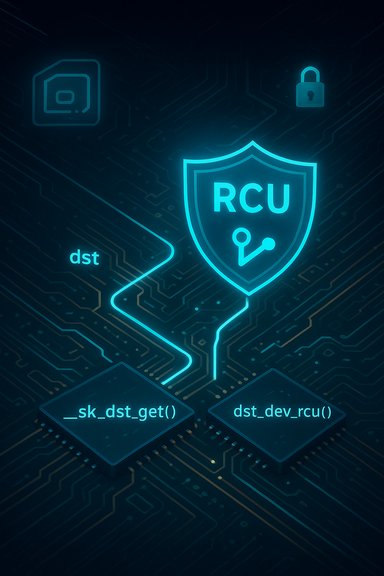
- The fix: use __sk_dst_get to obtain the dst safely and use dst_dev_rcu to retrieve the device pointer inside an RCU‑protected sequence; this ensures proper lifetime semantics for the returned device pointer and triggers lockdep checks on RCU‑aware kernels.
Technical anatomy
Why the original code was risky
The kernel exposes multiple helpers for reading destination and device pointers; some are intended for contexts already under RCU protection and some are safe for non‑RCU contexts because they acquire references or perform other lifetime checks. When code that executes outside RCU (for example, during setsockopt handlers) uses an accessor that returns a raw pointer without ensuring the referenced object’s lifetime, a concurrent device removal or module unload path can free that object while the caller still uses it — resulting in a use‑after‑free. In kernel space, a UAF can cause immediate crashes (oops/panic) and in some allocator configurations can be escalated into memory corruption or potential exploit primitives.The safe accessors: __sk_dst_get and dst_dev_rcu
- __sk_dst_get: obtains the dst for a socket in a way that is suitable when the caller will subsequently use an RCU‑aware device accessor. It provides the expected internal semantics to coordinate with dst‑lifetime helpers.
- dst_dev_rcu: reads dst->dev under RCU read‑side protection and returns an RCU‑stable device pointer. On kernels built with lockdep, it helps enforce correct lock ordering and prevents accidental dereferences of freed device pointers.
Why get_netdev_for_sock mattered
The routine get_netdev_for_sock surfaces in TLS and socket option handling paths; it is invoked as part of setsockopt control flows, which are synchronous operations originating from user space. Because such code is not executed under RCU read protections by default, the previous direct access used here created a small but real window for a UAF if device lifecycles were concurrent with setsockopt execution. Fixing this exact call site eliminates that specific race without changing the external behavior of the socket API.Impact and exploitability
Who is affected
Practically any system running a kernel version that contains the vulnerable code path may be in scope. That includes desktop, server and cloud kernels compiled with the relevant net/tls and device support enabled. Embedded and vendor‑forked kernels are particularly problematic because backports and patches can be delayed in two ways: vendors may not track upstream stable branches closely, and OEM images may bundle older kernel trees into device firmware. Public distribution trackers have already mapped the issue to multiple branches and packages.Severity and exploitation likelihood
Vendor trackers and distributors differ slightly in their severity framing. Some vendor advisories classify the issue as Important or Moderate and assign typical local‑vector CVSS semantics (local attacker, high complexity to exploit, low required privileges in some scenarios). For example, Amazon’s ALAS page surfaced a CVSSv3 value of 7.0 in their internal mapping (reflecting a high‑impact local exploit scenario), while SUSE’s tracker and others use a more conservative moderate rating with a CVSSv3 base around 6.3. Public CVE aggregators list the defect as an upstream kernel hardening fix. This disparity is not uncommon: distribution maintainers weigh practical exploitability against reachable attack surfaces for their user base when assigning severity. From an attacker model perspective, the vector is primarily local: an attacker needs the ability to run code or otherwise cause setsockopt operations that race with device teardown. In cloud or multi‑tenant environments this can be amplified — unprivileged guests or co‑located containers that can influence networking state or create heavy, crafted control flows could trigger the problem. At the time of disclosure there are no authoritative reports that this CVE was used for remote, unauthenticated exploitation in the wild. That absence of evidence does not imply impossibility; it simply means defenders should treat this as a serious availability/integrity risk deserving patching but not necessarily as an urgent, remotely exploitable emergency.Affected versions and vendor mappings
Multiple public trackers list the kernel commits and provide distribution mappings. Debian’s tracker shows vulnerable packaged kernels in several releases but marks unstable/forKy/sid as receiving the fixed 6.17.x builds; other distributions are tracking stable upstream commits for backports. SUSE, Red Hat/Bugzilla pages, and other distro trackers similarly list the CVE and indicate that fixes were merged into the upstream stable trees and are being backported per vendor cadence. Amazon’s ALAS entries list which Amazon Linux packages are pending fixes and which aren’t affected. In short: the fix is upstream; the operational work is to ensure your distribution’s kernel package includes the stable commit or to apply kernels built from the patched trees. If you compile kernels from source, the upstream commit identifiers referenced in public CVE metadata point to the exact change; operators managing source builds should merge the stable commit referenced by the CVE entries. If you rely on distribution packages, consult your distro’s security tracker or patch advisory to map the CVE to the package version that carries the backport.Detection, telemetry and hunting
Kernel UAFs and transient device races typically manifest as kernel oopses or panic traces referencing networking functions and device pointers. Practical signals to hunt for include:- Kernel oops/panic stack traces mentioning get_netdev_for_sock, tls helpers, or device pointer dereferences.
- Repeated crashes or oopses correlated with interface hotplug, driver reload, or module unload events.
- Correlation of crash timestamps with orchestrator actions (container start/stop, VM migration) that might change device lifecycles.
- Forensic artifacts: kdump/vmcore captures, persistent dmesg logs, and stack traces that show which function dereferenced a freed device.
- Centralize kernel logs (journalctl -k, dmesg) and search for the affected function names and "NULL pointer deref" or "use-after-free" related text.
- For hosts that auto‑reboot on panic, ensure crashdump capture is enabled and automated to persist vmcore for post‑mortem analysis.
- Use configuration management inventories to map kernel package versions to running hosts so you can rapidly identify which machines need remediation.
Remediation and operational playbook
Applying the upstream fix is straightforward in concept but requires careful operational steps in practice. The broad playbook:- Inventory your estate for kernel versions and package builds. Use uname -r and package changelogs to map running kernels to upstream commit IDs or distribution CVE mappings.
- Identify high‑priority hosts: multi‑tenant servers, cloud host nodes, hypervisors, network gateways, and appliances that run vendor kernels. Prioritize remediation where the blast radius of a kernel oops is greatest.
- Acquire fixed kernels: apply your distribution’s security package that includes the backport, or build kernels from upstream stable trees containing the patched commit IDs. Confirm the package changelog includes the upstream commit or explicit CVE mapping.
- Stage: roll out to a pilot cohort that mirrors production NIC hardware and typical workloads. Test critical network paths and setsockopt‑related workflows.
- Deploy in controlled waves and reboot hosts into the patched kernel. Monitor kernel logs for 7–14 days post‑deployment for recurrence.
- Vendor escalation: for appliances or embedded devices where vendor images are the only supported path, open support cases and require timelines for patched images. If vendors cannot or will not supply updates, implement compensating controls (isolate the device, limit network exposure) or plan replacement for critical assets.
- Restrict local users/processes from performing device unbinds or driver unloads.
- Isolate affected hosts from untrusted networks.
- Disable unnecessary network features that interact with the vulnerable code path, if feasible (but beware operational impact).
- Increase monitoring of kernel logs and crashdump capture to reduce detection latency.
Critical analysis — strengths and remaining risks
Strengths of the fix
- Surgical and low‑risk: The upstream change is narrowly scoped to the dangerous accessor pattern. That makes it easy to audit, backport, and test — which shortens the time from fix to deployed patch.
- Correct synchronization model: Moving to RCU‑aware accessors aligns the code with established kernel lifetime semantics and lockdep checks, improving long‑term maintainability.
- Upstream consensus and distribution tracking: Multiple trackers and vendors have logged the CVE and associated commits, enabling operators to map fixes to package versions. That coordinated visibility reduces ambiguity for administrators.
Remaining risks and caveats
- Vendor lag in the long tail: Embedded devices, OEM kernels, and third‑party appliances commonly lag upstream and can remain vulnerable for extended periods. These are often the hardest assets to remediate.
- Detection challenges: Kernel oopses can be noisy, and hosts that auto‑reboot may obscure the trace. Organizations without centralized kernel crash telemetry risk missing early signals.
- Exploitability nuance: While the immediate risk is a local UAF leading to stability issues, in some allocator/architecture contexts a UAF can be convertible into more powerful primitives. Public trackers have not confirmed in‑the‑wild remote exploitation of this specific CVE at disclosure time — claims otherwise should be treated cautiously unless backed by a PoC or vendor confirmation. Flag that as unverified where appropriate.
Recommendations for Windows‑centric teams that run Linux artifacts
Many Windows shops run mixed environments — build servers, container hosts, CI runners, network appliances, or test VMs that include Linux kernels. For Windows engineers and security teams:- Include kernel packages and virtual host images in your software inventory and patch governance just as you would Windows updates. Don’t assume Linux artifacts are covered elsewhere.
- Prioritize hypervisor hosts, CI runners and VMs that host untrusted workloads; a single kernel oops there can disrupt many downstream Windows build or test flows.
- For Windows‑centric monitoring stacks, ensure kernel crash logs from Linux hosts are funneled into your central SIEM and incident response playbooks. This reduces time to detection and aligns remediation across OS boundaries.
- When vendors supply Linux‑based appliances (VPN gateways, load balancers, management appliances), demand explicit CVE→build mappings from the vendor and timelines for patched firmware — vendor mapping remains the single most effective lever for dealing with long‑tail devices.
Closing analysis and practical checklist
CVE‑2025‑40149 is a textbook example of a small kernel synchronization fix that closes a real availability and integrity risk without altering higher‑level behavior. The change — shifting get_netdev_for_sock to use __sk_dst_get and dst_dev_rcu — is straightforward and low risk, but the operational challenge lies in propagating the patch across distribution packages, vendor kernels, and embedded devices.Quick checklist for operators:
- Inventory kernels and map to vendor/distro CVE pages.
- Prioritize patching for multi‑tenant/cloud host, hypervisors, and appliances.
- Stage and test kernel packages, then deploy with monitored rollouts and reboots.
- Enable and centralize kernel crashdump capture for analysis.
- Escalate to vendors for unpatchable appliances and implement compensating isolation controls.
Conclusion
A modest code hardening in the Linux kernel eliminated a risky dereference that could lead to use‑after‑free conditions in TLS/socket option handling. The technical fix is minimal and aligns with correct RCU usage patterns, but the effective security outcome depends on timely propagation of the patch through distribution packages and vendor firmware. Administrators should treat CVE‑2025‑40149 as actionable: inventory, patch, reboot, and monitor — and demand vendor timelines for any devices where you cannot apply an upstream or distribution patch.
Source: MSRC Security Update Guide - Microsoft Security Response Center
