

A subtle race-condition fix in the Linux kernel’s md (multiple device/RAID) subsystem — tracked as CVE-2024-26758 — has been published to address a scenario where the md daemon can hang because the recovery thread unregistering logic incorrectly ignores suspended arrays, creating a reliable local denial-of-service condition if triggered.
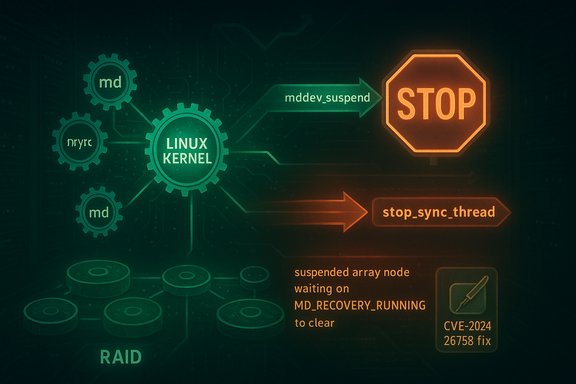
The Linux device-mapper RAID stack (commonly referred to as md) manages software RAID arrays and houses logic for background synchronization and recovery via a dedicated sync thread. In normal operations, this sync_thread is registered and unregistered in coordination with changes to the array state (start, stop, suspend, resume). A recent change upstream — commit f52f5c71f3d4, titled “md: fix stopping sync thread” — altered stopping semantics in a way that exposed a race between array suspension and sync thread teardown. The specific vulnerability is summarized succinctly in public advisories: the code path md_check_recovery returns early when an array is flagged as suspended, but that early return can prevent the normal unregister flow (clear of MD_RECOVERY_RUNNING) after a concurrent stop, leaving the array in a state where waiters never complete — in short, a hang. The defect was assigned CVE-2024-26758 and published in April 2024.
Conclusion
CVE-2024-26758 underscores the importance of careful thread lifecycle coordination in kernel subsystems and the real-world impact that a short-circuiting early return can have on availability. The fix is available in upstream and distribution kernels; administrators should install the relevant security updates and reboot as soon as operationally feasible to remove a reliable local denial-of-service primitive from their environments.
Source: MSRC Security Update Guide - Microsoft Security Response Center
 Background
The Linux device-mapper RAID stack (commonly referred to as md) manages software RAID arrays and houses logic for background synchronization and recovery via a dedicated sync thread. In normal operations, this sync_thread is registered and unregistered in coordination with changes to the array state (start, stop, suspend, resume). A recent change upstream — commit f52f5c71f3d4, titled “md: fix stopping sync thread” — altered stopping semantics in a way that exposed a race between array suspension and sync thread teardown. The specific vulnerability is summarized succinctly in public advisories: the code path md_check_recovery returns early when an array is flagged as suspended, but that early return can prevent the normal unregister flow (clear of MD_RECOVERY_RUNNING) after a concurrent stop, leaving the array in a state where waiters never complete — in short, a hang. The defect was assigned CVE-2024-26758 and published in April 2024. What exactly went wrong? Technical anatomy
The race and the hang
The problematic sequence is reproducible with the following high-level steps as documented by public advisories:- Suspend the array (raid_postsuspend → mddev_suspend).
- Stop the array (raid_dtr → md_stop → __md_stop_writes → stop_sync_thread), which sets MD_RECOVERY_INTR and wakes the sync thread, then waits for MD_RECOVERY_RUNNING to be cleared.
- The sync thread finishes its work and sets MD_RECOVERY_DONE, waking the daemon thread.
- The daemon thread runs md_check_recovery; because the array is suspended, md_check_recovery contains an early
if (mddev->suspended) return;which causes the code responsible for clearing MD_RECOVERY_RUNNING to be skipped. - The waiter in step 2 (waiting for MD_RECOVERY_RUNNING to clear) never completes — the system hangs waiting on an event that will never be cleared.
Why the code change exposed the problem
An upstream change intended to improve stopping semantics removed some assumptions about how and when sync threads were halted. That fix (the f52f5… commit) altered the interaction between suspend and stop flows; however, it also created a mismatch in the recovery-check path where the suspended flag prevented the daemon from completing the expected unregister sequence. The resultant behavior is not purely a one-off: automated kernel tests (the test shell/integrity-caching.sh referenced in advisories) can reproduce the hang reliably when the timing aligns.Scope and severity
- Affected component: the upstream Linux kernel md (multiple-device/RAID) subsystem — code paths that handle suspend/stop and recovery thread management.
- Attack vector: local — a local user or process (or a container/guest with the ability to trigger md operations) can provoke the sequence. Several distributors mark the vector as local with low complexity to trigger.
- Impact: availability (hangs / denial of service for the host or the md-managed device). Advisories uniformly classify the practical impact as an operational DoS rather than confidentiality or integrity loss.
- CVSS v3.1 (as listed by several trackers): 5.5 (Medium) with vector AV:L/AC:L/PR:L/A:N/C:N/I:N/A:H — consistent with a locally-triggered availability issue.
Who should care (affected populations)
- Enterprises and service providers that run Linux servers with software RAID (mdadm-managed arrays) or that programmatically manage arrays as part of orchestration workflows.
- Virtualization and cloud hosts where guests or containerized workloads may influence device management operations indirectly. The local attack model makes multi-tenant hosts comparatively higher priority to patch.
- Embedded and vendor kernels: appliance vendors, OEM kernel forks, and long-life embedded devices that track upstream kernels manually. These vendors often represent the longest tail for remediation; if they do not pick up the upstream fix, devices may remain susceptible.
Upstream response and fix
Maintainers addressed the issue by changing md_check_recovery to ignore the suspended flag in the code path where it matters for unregistering the sync thread — effectively ensuring the cleanup/unregister logic runs even if the array is currently marked suspended. This restores the expected coordination between stop and suspend flows so that MD_RECOVERY_RUNNING can be cleared and waiters resume. The canonical description of the fix and affected commit ranges is referenced in upstream advisories and distribution security trackers. Several distributors and vulnerability trackers have mapped the upstream commit to their package updates and security advisories (Debian, SUSE, Oracle/Red Hat family advisories). Distribution security pages list affected package versions and fixed versions mapping to the stable kernel releases that include the remediation. Administrators should consult their distribution’s kernel changelog/security advisory to identify the precise patched package for their platform.Repro steps (high level) — for lab validation only
The public advisories include the exact scenario used to confirm the hang; a condensed lab checklist follows for administrators who need to validate the fix in a controlled environment:- Prepare a test host with the vulnerable kernel build (do not run this on production systems).
- Create an md array and start the sync thread (typical mdadm operations).
- Execute the suspend flow (raid_postsuspend / mddev_suspend).
- Execute the stop flow while the array is suspended (raid_dtr / md_stop / __md_stop_writes / stop_sync_thread). The stop path sets MD_RECOVERY_INTR and waits on MD_RECOVERY_RUNNING.
- Observe whether the waiter completes; on vulnerable kernels, the wait will block due to md_check_recovery returning early and preventing MD_RECOVERY_RUNNING from being cleared.
Mitigation and remediation guidance
Immediate actions (short-term)
- If you operate systems that run md-managed arrays and cannot immediately apply a kernel update, reduce exposure by limiting untrusted local access to hosts that can manipulate md devices and by restricting which users can run mdadm operations or perform hotplug that affects RAID arrays.
- For virtualization hosts, avoid exposing device management to untrusted guest workloads until the fix is applied.
- Increase monitoring for hung md operations and for kernel logs that show waits or thread wakeups failing to clear MD_RECOVERY_RUNNING.
Definitive remediation
- Install a kernel update from your distribution that includes the upstream fix (the stable kernel tree commits that address md_check_recovery behavior). Distribution advisories (Debian, SUSE, Oracle/Red Hat derivatives, Ubuntu) have mapped fixed package versions — check your vendor’s security advisory and install the listed kernel package.
- Reboot into the patched kernel (kernel fixes require a reboot or vendor-supplied livepatch if available).
- Validate post-patch that the test sequence no longer blocks in lab conditions and that production services that previously demonstrated hangs are not encountering the same symptoms. Use dmesg/journalctl to inspect for any residual thread coordination warnings.
For vendor/OEM kernels and embedded images
- Contact your vendor for patched firmware/kernel images or documented backports. Vendor-supplied kernels often lag upstream; insist on vendor confirmation that their builds include the md_check_recovery change and provide an expected timeline for a patched release.
Practical risk assessment and operational priorities
- Prioritization should be based on exposure and service criticality: hosts that run production storage arrays, hosts that manage many tenants, and automation tooling that programmatically stops/starts arrays are high priority to patch quickly. Systems that do not use md/RAID or that do not allow untrusted local operations can be lower priority.
- The vulnerability class (logic/race leading to hang) is an operational availability risk. While it does not directly permit code execution or data corruption under the public descriptions, a deterministic DoS primitive is valuable to attackers aiming to disrupt services and therefore merits rapid remediation on shared infrastructure.
- The fix is small and surgical in nature — kernel maintainers preferred a localized correction to restore expected teardown behavior rather than a broad redesign. This approach reduces regression risk and makes the fix suitable for backporting into stable distribution kernels. The kernel community frequently applies such focused corrections for correctness and robustness issues.
What administrators should do now — actionable checklist
- Inventory: identify hosts running md-managed arrays (search for mdadm processes, /proc/mdstat, or loaded md modules).
- Map: check each host’s kernel version against your distribution’s CVE advisory and fixed kernel package numbers. Use vendor security trackers (Debian, SUSE, Oracle/Red Hat, Ubuntu) to map the patched kernel versions.
- Patch: schedule kernel updates and reboots prioritizing production RAID hosts and multi-tenant machines.
- Validate: reproduce the suspend/stop sequence in a controlled lab to confirm the fix; monitor dmesg for recovery flag transitions and thread wakeups.
- Vendor engagement: for embedded/OEM devices, obtain vendor assurance that patched kernels are available or that a backport will be provided.
Wider context: why small kernel fixes matter
Kernel subsystems like md implement subtle cross-thread coordination primitives. Small changes — particularly around thread termination and state flags — can produce unintended interleavings when code paths evolve independently (for suspend vs. stop, in this case). The Linux kernel development model emphasizes surgical fixes to minimize regressions; that conservatism speeds distribution backports but sometimes requires follow-ups when unexpected interactions surface. The md_check_recovery correction follows that paradigm: a minor change to guarantee that cleanup actions occur even when arrays are suspended, thereby restoring a stable, predictable teardown contract.Caveats and unverifiable claims
- Public advisories describe the hang scenario and reference the upstream commit that made the original change; the exact timing windows that reproduce the hang can be environment-specific. Administrators should treat exploitability as local and context-dependent: the vulnerability requires the ability to invoke md suspend/stop flows in a particular order and timing. While advisories report reliable reproduction in test harnesses, there are no public reports of remote exploitation or a weaponized campaign as of the advisories’ publication dates.
- Mapping of every distribution and vendor package to fixed version numbers varies and changes over time. The distribution-specific package lists cited above are authoritative for those vendors, but operators must verify their particular package versions and vendor advisories before assuming remediation. If a vendor does not publish explicit mapping, treat the status as unverified until vendor confirmation is received.
Final analysis and recommendations
CVE-2024-26758 is a pragmatic example of how subtle state-machine changes in kernel code can create deterministic and reliable availability problems in production systems. The vulnerability does not indicate a memory-corruption primitive or direct privilege escalation, but the predictable hang it enables is operationally significant — particularly on multi-tenant and storage-critical hosts.- For security and operations teams: prioritize kernel updates for hosts that run md-managed arrays, especially shared or multi-tenant infrastructure. Validate fixes in a staging environment before rolling to production.
- For vendors and appliance makers: ensure backports are shipped for long-tail devices and confirm that device images include the upstream md_check_recovery correction.
- For defenders and incident responders: monitor kernel logs for stuck waiters and for repeated md stop operations that do not complete; capture dmesg and oops traces promptly, and correlate with any RAID-management automation jobs to find likely reproductions.
Conclusion
CVE-2024-26758 underscores the importance of careful thread lifecycle coordination in kernel subsystems and the real-world impact that a short-circuiting early return can have on availability. The fix is available in upstream and distribution kernels; administrators should install the relevant security updates and reboot as soon as operationally feasible to remove a reliable local denial-of-service primitive from their environments.
Source: MSRC Security Update Guide - Microsoft Security Response Center
