

A recently disclosed Linux kernel vulnerability in the Netfilter flowtable code can let malformed VLAN-tagged packets drive the kernel into reading uninitialized memory and, in some cases, crash networking stacks — a high‑priority fix that administrators must treat as operationally urgent.
Netfilter’s flowtable facility — the fastpath used by nftables to offload and accelerate packet forwarding — parses Layer‑2 encapsulations (notably VLAN and PPPoE) so it can match flows by their full tuple. A shortcoming in that parsing code meant the kernel sometimes assumed the VLAN header’s protocol field was readable without first ensuring the packet buffer held those bytes in the linear area. The result, flagged by Kernel Memory Sanitizer (KMSAN), was an uninitialized‑value access on the nf_flow_offload path. The defect was assigned CVE‑2024‑44983 and publicly disclosed on September 4, 2024.
This is not a logic error in userland; it is a kernel‑level bounds/validation bug in the flowtable datapath. The upstream kernel patch — authored by Pablo Neira Ayuso and merged into stable trees — explicitly adds validation to ensure there is “sufficient room to access the protocol field of the VLAN header” and to validate that protocol once before doing the flowtable lookup. The changelog and commit metadata are available in the kernel stable patch set.
Vendors that published advisories or mapped the CVE include major distributions and cloud OS vendors (Ubuntu, Amazon Linux / ALAS, Oracle Linux, Red Hat trackers, and many downstream repositories). These vendors have released patched kernel packages or backports; check your distro’s security advisory feed for the package updates specific to your installed kernel ABI.
If you manage network infrastructure, begin triage now: identify vulnerable kernels, schedule upgrades, and apply the temporary mitigations outlined above to reduce exposure until patched kernels are in place.
Source: MSRC Security Update Guide - Microsoft Security Response Center
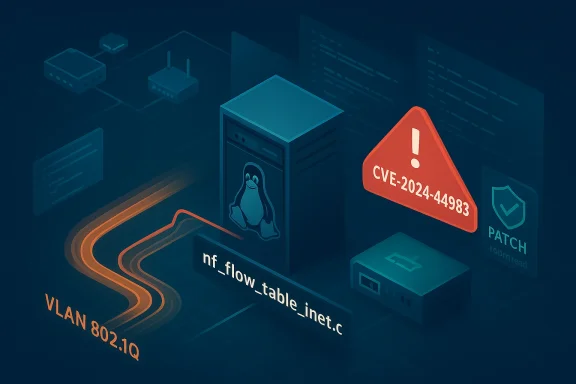 Background / Overview
Netfilter’s flowtable facility — the fastpath used by nftables to offload and accelerate packet forwarding — parses Layer‑2 encapsulations (notably VLAN and PPPoE) so it can match flows by their full tuple. A shortcoming in that parsing code meant the kernel sometimes assumed the VLAN header’s protocol field was readable without first ensuring the packet buffer held those bytes in the linear area. The result, flagged by Kernel Memory Sanitizer (KMSAN), was an uninitialized‑value access on the nf_flow_offload path. The defect was assigned CVE‑2024‑44983 and publicly disclosed on September 4, 2024.This is not a logic error in userland; it is a kernel‑level bounds/validation bug in the flowtable datapath. The upstream kernel patch — authored by Pablo Neira Ayuso and merged into stable trees — explicitly adds validation to ensure there is “sufficient room to access the protocol field of the VLAN header” and to validate that protocol once before doing the flowtable lookup. The changelog and commit metadata are available in the kernel stable patch set.
What exactly went wrong (technical deep dive)
Where in the code
The problematic code path is inside the netfilter flowtable inet handling — functions that handle offloading flows after the first packet has taken the full forwarding path. The critical functions implicated include nf_flow_offload_inet_hook and related helpers in net/netfilter/nf_flow_table_inet.c. KMSAN reported an uninitialized read during execution of that path, which led developers to audit how Ethernet and VLAN offsets were computed and validated.Root cause summary
- When processing ingress packets, the flowtable code extracts layer‑2 encapsulation information (ethertype, VLAN ID and protocol fields) and uses those values as keys in its lookup tuple.
- Under certain packet shapes (malformed or truncated VLAN tags, stacked VLANs, or unexpected skb layout), the code accessed the VLAN protocol field without guaranteeing those bytes were present or had been pulled into the linear skb buffer area.
- That race/bounds assumption produced an uninitialized memory read reported by sanitizers — a kernel memory safety defect that can trigger undefined behavior, kernel warnings, or a panic/crash depending on platform and conditions.
The fix
The patch makes two concrete changes:- Ensure there is sufficient room before reading the VLAN protocol field (a bounds check and skb pull/validation).
- Validate the protocol field one time before performing the flowtable lookup so that subsequent logic does not assume validity later on.
Upstream commit metadata shows the change was small and focused; it was merged and then backported into multiple stable branches.
Severity, exploitability, and practical impact
CVSS and classification
NVD lists CVE‑2024‑44983 with a CVSS v3.x score in the high range (around 7.1) and describes availability impact as the principal concern (kernel crashes / DoS). Distribution advisories and trackers broadly mark the issue as high/important for availability. Different vendors may present slightly different vectors (some list it as local/low‑privilege; others note attack surface is limited to network‑attached flows that reach netfilter), but the consistent consensus is that the defect is a memory‑safety validation bug with an availability impact.Can this be remotely triggered?
The vulnerability sits in packet parsing of VLAN/encapsulated traffic. In scenarios where an attacker can inject crafted VLAN‑tagged packets into the host’s ingress (for example, on a directly connected network, an untrusted LAN segment, or via routed/bridged configurations that expose the host to untrusted VLAN tags), the kernel can be driven down the nf_flow_offload path. Multiple trackers emphasize that local network access or an ability to send specially formed packets to the target is required; exploitation is thus network‑adjacent rather than purely remote. Different CVSS assessments (some vendor pages) classify the attack vector accordingly. Administrators should assume real‑world exploitation is plausible in exposed network environments and prioritize patching.What an attacker could achieve
- Repeatedly triggering the bug can cause kernel instability, panics, or a denial‑of‑service that disrupts networking on the host.
- There is no public evidence that this vulnerability directly yields arbitrary kernel code execution; however, uninitialized reads and memory‑safety issues can sometimes be chained with other bugs. The immediate and realistic threat is availability loss (DoS), which in network infrastructure contexts (routers, firewalls, NAT gateways) is a serious operational problem.
Who and what is affected
The flaw exists in upstream Linux kernel flowtable code and therefore affects kernel versions that include the vulnerable code path prior to the patch backports. Multiple vulnerability databases and distribution advisories enumerate affected ranges; aggregated trackers show the defect touches numerous kernel series that were active at the time of the fix. Representative affected ranges reported by aggregators include upstream series between the 5.13 line and various 6.x stable branches prior to their respective patched releases. Exact impacted versions vary by distribution and packaging; you must consult your vendor advisory to determine whether a given kernel package is vulnerable.Vendors that published advisories or mapped the CVE include major distributions and cloud OS vendors (Ubuntu, Amazon Linux / ALAS, Oracle Linux, Red Hat trackers, and many downstream repositories). These vendors have released patched kernel packages or backports; check your distro’s security advisory feed for the package updates specific to your installed kernel ABI.
Patching and mitigation guidance (operational playbook)
Apply the vendor kernel patch as the primary mitigation. The fix was merged upstream and backported; vendors released fixes in their kernel packages. The recommended steps are:- Inventory: Identify hosts running kernels with netfilter flowtable enabled or hosts that act as routers/bridges/firewalls. Focus first on internet‑facing routers, edge appliances, cloud VM images, and any system that accepts VLAN‑tagged ingress from untrusted networks.
- Identify package versions: Use your distribution’s tooling (apt, yum/dnf, zypper, rpm, dpkg) to query installed kernel packages and compare to your vendor advisory. If you run custom or embedded kernels, check your git history for the upstream commit (the patch is small and the commit id is available in stable trees) or apply vendor backports.
- Patch and reboot: Install the vendor’s patched kernel package and reboot systems that require the updated kernel. Coordinate reboots to minimize operational impact.
- Temporary mitigations (if you cannot patch immediately):
- Remove or disable flowtable rules in nftables that accept/perform flow offload: review
nft list rulesetand remove or disable anyflowtableactions, or temporarily refrain from adding new flowtable entries. - If feasible, filter or drop suspicious VLAN‑tagged packets at network edges: apply ACLs on switches or edge firewalls to block malformed VLAN frames from untrusted sources.
- Isolate vulnerable appliances from untrusted VLAN segments until patched.
- Monitoring and detection: Watch kernel logs (dmesg, journald) for sanitizer or BUG messages that mention KMSAN, “uninit‑value”, or nf_flow_offload_inet_hook — these are telltale signs that the code path was hit and triggered a sanitizer warning or kernel warning. Example grep:
dmesg | egrep -i 'KMSAN|uninit|nf_flow_offload_inet_hook|nf_flow_table'.
- Removing flowtable offload reduces attack surface but also removes the performance benefits of flowtable fastpath; evaluate the operational tradeoff.
- Edge filtering should be implemented carefully to avoid inadvertently breaking legitimate VLAN traffic; test ACLs in a staging environment if possible.
How to detect exploitation or attempts
- Kernel logs: The sanitizer trace that discovered the issue is informative. Look for kernel messages containing “BUG: KMSAN: uninit‑value” or references to nf_flow_offload_inet_hook. Such events indicate that a packet hit the vulnerable code path and triggered sanitizer instrumentation. If you see kernel panics correlated with receiving VLAN‑tagged packets, treat those as high‑priority indicators.
- Network telemetry: Monitor for unusual bursts of malformed VLAN frames or repeated abnormal VLAN tag manipulations originating from hosts on the same L2 segment. Use NetFlow/sFlow, IDS signatures, or packet captures on the ingress interface to look for repeated malformed 802.1Q frames.
- nftables and flowtable statistics: If you use nftables flowtables, inspect flowtable counters and offload statistics — unexpected behavior, elevated errors, or crashes correlated with flowtable hits warrant investigation.
- Vendor vulnerability scanners and CVE feeds: Ensure your asset management tool is tracking CVE‑2024‑44983 and that kernel packages on hosts are mapped against vendor advisories. Many distribution security trackers (Ubuntu, ALAS, Oracle Errata) have already published mappings and fixed package names.
Risk assessment — who should prioritize this
Prioritize patching for:- Network appliances and gateways running Linux (including software routers, virtual routers, firewalls, NAT gateways).
- Cloud VM images that accept VLAN‑tagged traffic or act as bridges between untrusted networks.
- Embedded network devices and appliances that include a Linux kernel and are on untrusted or semi‑trusted L2 segments.
- Desktop systems and servers that do not perform bridging or do not accept VLAN‑tagged packets from untrusted sources. Those systems are less likely to see the vulnerable code path triggered unless intentionally exposed or misconfigured.
Vendor and distribution response — where to look for the patch
Major distributors and kernel packagers have mapped the CVE into their advisories and released patched kernel packages or backports. Representative sources include:- NVD and upstream kernel notes for the technical description and CVSS reference.
- Distribution advisories (Ubuntu, Amazon Linux / ALAS, Oracle Linux, Rocky/Red Hat errata) listing patched kernels and package advisories. These advisories provide the exact package versions you need to install for your distro.
- Upstream kernel commit: the small, focused patch in net/netfilter (commit metadata shows commit id and author) — useful for integrators building custom kernels or vendors who backport fixes.
Practical recommendations (quick checklist)
- Immediate: Inventory systems that handle VLAN/bridged traffic and confirm whether your kernel package contains the upstream patch or vendor backport.
- Short term: If patching is not possible immediately, remove/disable flowtable rules or filter VLAN tags at network edges to reduce exposure.
- Medium term: Schedule kernel upgrades and coordinated reboots for infrastructure hosts. Test upgrades in a staging environment where possible.
- Long term: Add flowtable and low‑level kernel network parsing functions to your vulnerability monitoring scope; consider hardened kernel builds and enable sanitizer testing in development pipelines where appropriate.
Why this matters to WindowsForum readers
Even though this is an upstream Linux kernel problem, its operational effect is squarely in the domain of network reliability and security — areas that Windows administrators increasingly share with Linux in hybrid datacenters and cloud deployments. Many Windows services depend on Linux‑based network appliances (virtual routers, NAT gateways, and container hosts). A denial‑of‑service against a Linux networking node can cascade into Windows service outages. Treat CVE‑2024‑44983 as a cross‑platform operational risk: coordinate patching with network and Linux teams, validate firewall and switch filters, and ensure service‑level continuity plans anticipate kernel‑level outages.Final assessment and caveats
CVE‑2024‑44983 is a classical kernel packet‑parsing validation bug: small in code change but large in potential operational impact for network infrastructure. The upstream patch is small and has been merged and backported; the correct mitigation is to install vendor‑supplied kernel updates as soon as practicable. While there is no public proof‑of‑concept showing remote unauthenticated exploitation for arbitrary code execution, the availability impact (kernel crash/DoS) is real and credible. Treat systems that process VLAN‑tagged ingress as high priority for remediation.If you manage network infrastructure, begin triage now: identify vulnerable kernels, schedule upgrades, and apply the temporary mitigations outlined above to reduce exposure until patched kernels are in place.
Source: MSRC Security Update Guide - Microsoft Security Response Center
