

When Linus Torvalds wrote to the comp.os.minix newsgroup on August 25, 1991, describing “a (free) operating system (just a hobby…for 386(486) AT clones),” he set in motion not just a technical project but a social experiment that proved one of the most durable ways to build software: distributed, meritocratic collaboration at internet scale. The Register’s recent conversation with Torvalds and several early contributors is a timely reminder that Linux’s ascension from a one-man kernel to a global infrastructure backbone was as much about social engineering, trust, and incentives as it was about device drivers and task switching. This feature unpacks that transition, verifies the critical claims about Linux’s birth and early growth, and assesses the technical and governance choices that still shape the Linux kernel and the wider open-source ecosystem today.
In late August 1991 Linus Torvalds posted a short message to the MINIX community announcing a personal project: a Unix-like kernel he was building for Intel 386 hardware. Within weeks the nascent sources were uploaded to the Finnish research network’s FTP server (FUNET) and the project — reluctantly and serendipitously — acquired the name Linux. Early snapshots such as version 0.01 and the first broadly-usable 0.02 release (October 5, 1991) were tiny by modern standards — only a few thousand to tens of thousands of lines of code — but they were released under terms and in an environment that encouraged testing, patching, and redistribution.
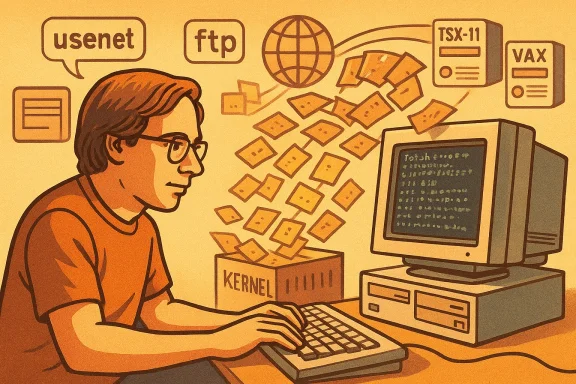
Two structural pivots accelerated Linux’s move from hobby to commons. First, the community around Usenet and FTP made it trivial for geographically-dispersed developers to obtain the code, test it, and send back fixes; that social flow converted occasional testers into persistent contributors. Second, the re-licensing of the kernel under the GNU General Public License in early 1992 clarified legal terms and enabled distributions that combined the Linux kernel with GNU userland tools — turning a kernel into an installable operating system for ordinary users. Those two pivots — connectivity + permissive, reciprocal licensing — explain why a student project could become a global platform.
That invitation mattered because the community of Unix hackers then online had both the skills and the communal ethos to respond. Within months, the kernel could run Bash and GCC; within a year, a small but effective peer group was making meaningful contributions. The early workflow — email and Usenet patch submission, FTP mirrors, and hand-applied patches — was fragile but fast enough for the scale of contributors at the time.
Installation in the very early days was artisanal. Torvalds reportedly installed Linux onto friends’ machines in person because his development environment was itself a growing tree layered on Minix. Those first installations were formative: they proved Linux could run on real hardware and that users could boot and test the kernel outside the author’s machine. Small, physical demonstrations like that often have outsized influence in nascent projects.
The effect was immediate:
Two implications flowed from that change:
It’s important to flag which early anecdotes are corroborated across multiple independent records and which are single-source recollections. Dates, naming origin, and the timeline of releases are well-attested across interviews, archived Usenet posts, and historical retrospectives. More intimate, human details (who sent checks to whom, or the exact mechanics of a fundraising effort) may be less exhaustively documented and should be treated as plausible community lore unless corroborated by archival receipts or multiple independent first-person accounts.
For IT professionals, system architects, and open-source practitioners, the practical lesson is simple: building durable software ecosystems is a social problem as much as a technical one. If you want your project to scale beyond a single author, invest early in mechanisms that make participation easy, make incentives clear, and make governance sustainable. Linux’s history shows those investments pay off in longevity, diversity, and utility — and that a project founded as “just a hobby” can, with the right mix of openness and stewardship, change how the world computes.
Source: theregister.com Linus Torvalds tells The Reg how Linux evolved from solo act
 Background / Overview
In late August 1991 Linus Torvalds posted a short message to the MINIX community announcing a personal project: a Unix-like kernel he was building for Intel 386 hardware. Within weeks the nascent sources were uploaded to the Finnish research network’s FTP server (FUNET) and the project — reluctantly and serendipitously — acquired the name Linux. Early snapshots such as version 0.01 and the first broadly-usable 0.02 release (October 5, 1991) were tiny by modern standards — only a few thousand to tens of thousands of lines of code — but they were released under terms and in an environment that encouraged testing, patching, and redistribution.Two structural pivots accelerated Linux’s move from hobby to commons. First, the community around Usenet and FTP made it trivial for geographically-dispersed developers to obtain the code, test it, and send back fixes; that social flow converted occasional testers into persistent contributors. Second, the re-licensing of the kernel under the GNU General Public License in early 1992 clarified legal terms and enabled distributions that combined the Linux kernel with GNU userland tools — turning a kernel into an installable operating system for ordinary users. Those two pivots — connectivity + permissive, reciprocal licensing — explain why a student project could become a global platform.
How Linux went from one person’s tree to many hands
The technical seed: building on Minix, cross-compilation, and the first snapshots
Torvalds developed the earliest Linux code on a personal 386 running Minix, using Minix tools to cross-compile and test. Early public snapshots were raw: they required technical competence to build and run, and often depended on a preexisting Minix environment. But the moment Torvalds posted and uploaded the sources, he effectively invited others to play with the code: download, compile, file bugs, and send patches.That invitation mattered because the community of Unix hackers then online had both the skills and the communal ethos to respond. Within months, the kernel could run Bash and GCC; within a year, a small but effective peer group was making meaningful contributions. The early workflow — email and Usenet patch submission, FTP mirrors, and hand-applied patches — was fragile but fast enough for the scale of contributors at the time.
Mirrors, bandwidth, and scaling distribution
In the pre-broadband era, geographic proximity to a mirror mattered. Volunteers like Theodore “Ted” Ts’o created mirrors (notably the tsx-11.mit.edu mirror in North America), which drastically reduced download times for users outside Europe and enabled more contributors to work on the code. Mirrors were not just convenience: they were capacity. A handful of mirror operators multiplied global participation and made Linux a truly transatlantic project.Social mechanics: email patches, Usenet threads, and a commons model
Early Linux development relied on a patch economy: individuals compiled the kernel, found faults, and submitted fixes. Torvalds’ stance was crucial: he accepted outside changes and, importantly, encouraged them. The kernel became a commons that anyone could extend. That attitude transformed Linux from a one-person trunk into an emergent, collaborative tree.- Patches were small, targeted, and exchanged over open channels.
- Early maintainers and contributors earned reputational capital that translated into influence.
- Technical merit (quality of contribution) became the primary currency for project status.
Naming, installation, and the first user installs
Linus had an ambivalent relationship with the project’s eventual name: he preferred “Freax” as a working moniker, but the FUNET FTP administrator chose “linux” when he created the public directory. That serendipitous rename stuck — and it mattered. Branding may seem trivial to engineers, but the name Linux was easy to say and easy to share; it helped the project gain traction beyond technical circles.Installation in the very early days was artisanal. Torvalds reportedly installed Linux onto friends’ machines in person because his development environment was itself a growing tree layered on Minix. Those first installations were formative: they proved Linux could run on real hardware and that users could boot and test the kernel outside the author’s machine. Small, physical demonstrations like that often have outsized influence in nascent projects.
Key early contributors and the creation of infrastructure
Several early contributors played outsized roles in turning Linux into a community project:- Ted Ts’o: Established one of the first North American mirrors and contributed critical kernel code (early memory allocator implementations and later filesystem-related work). By making the code available at scale in North America, mirrors like his lowered the barrier for stateside development.
- Dirk Hohndel and other early European contributors: Brought expertise and patches; gradually formalized maintenance practices.
- H. Peter Anvin and others: Contributed both code and community logistics. Anecdotes about community-funded hardware upgrades for Linus illustrate how early contributors transformed goodwill into tangible project resources and trust.
Licensing and the birth of distributions
Relicensing the kernel under the GNU GPL in 1992 was not a mere legal tweak; it was the moment Linux became an enabling component for a broader free-software ecosystem. The GPL’s reciprocity assured contributors that improvements would remain free, and crucially it enabled distributors to package the kernel with GNU userland tools to make full operating systems — the first Linux distributions — that ordinary users could install.The effect was immediate:
- The kernel could be legally redistributed by third parties.
- Distros assembled prebuilt system images that removed technical hurdles to entry.
- A much larger user base — not just hackers comfortable compiling kernels — could adopt Linux, which in turn created more users-turned-contributors.
From hacker to manager: Torvalds’ shifting role
One of the most striking evolutions in Linux’s story is Torvalds’ transition from principal coder to project steward. In the early years, Linus directly implemented and rewrote patches; later he evolved into the project’s arbiter: merging, refusing, and setting direction. That is a natural progression when single-author projects scale into global communities.Two implications flowed from that change:
- Process over feature: As the team grew, process — code-review protocols, the role of maintainers, and the kernel’s tree structure — became more important than individual coding style.
- Scalability limits: The anecdotal early behavior of reimplementing others’ patches “his way” was not sustainable; the community demanded and then adopted clearer review norms and delegation to subsystem maintainers.
Structural trade-offs baked into early design choices
Many of Linux’s long-lived properties stem from early technical decisions:- Monolithic kernel architecture: The kernel’s design favored performance and direct hardware control over microkernel-style isolation. That choice simplified early development and helped Linux perform well on servers and workstations, but it also meant that driver quality and privilege boundaries were crucial long-term concerns.
- Driver model and loadable modules: Early support for loadable modules sped hardware support but also multiplied attack surface and maintenance complexity.
- POSIX-like APIs and GNU toolchain integration: Aligning with POSIX and enabling GCC/Bash early on made Linux immediately useful for developers familiar with Unix environments.
Strengths of the early model that still matter
- Meritocratic contribution: Technical quality, not formal authority, often determines influence. This attracts skilled developers and sustains high-quality patches.
- Open channels of collaboration: Mailing lists, transparent patch review, and public trees create auditability and rapid feedback loops.
- Permissive communal licensing: The GPL aligned legal incentives with the project’s social incentives, allowing communities and businesses to co-evolve.
- Global, decentralized infrastructure: Early mirrors and volunteer nodes distributed load and democratized access to the codebase.
Risks and fragilities that emerged
No system is without trade-offs. Linux’s early growth created a few enduring risks:- Bus factor and institutional knowledge: Reliance on a small number of key maintainers for critical subsystems creates vulnerability. The project has taken steps (formal contingency plans and expanded maintainer rosters) to mitigate this, but the risk persists.
- Fragmentation vs. coherence: While forks are a feature of open-source freedom, divergence across distributions, custom kernels, and vendor patches can fragment testing and security responses.
- Corporate influence: As companies contribute employees and resources, corporate priorities can sometimes crowd out community needs. Balancing corporate investment with community autonomy is an ongoing governance challenge.
- Security surface area: The kernel’s privileged role makes any vulnerability significant; managing disclosure, patch coordination, and timely updates across a massive installed base is complex.
The role of storytelling, trust, and the anecdotal record
A detail that illustrates early community trust-building — recounted in recent interviews — is the grassroots fundraising that reportedly helped Linus upgrade his development hardware to a 486DX/2. Whether or not every aspect of that story is fully documented in independent sources, the anecdote’s value is illustrative: contributors converted goodwill into concrete capacity, and that conversion materially improved the project’s momentum.It’s important to flag which early anecdotes are corroborated across multiple independent records and which are single-source recollections. Dates, naming origin, and the timeline of releases are well-attested across interviews, archived Usenet posts, and historical retrospectives. More intimate, human details (who sent checks to whom, or the exact mechanics of a fundraising effort) may be less exhaustively documented and should be treated as plausible community lore unless corroborated by archival receipts or multiple independent first-person accounts.
What the early years teach modern open-source projects
There are enduring lessons in Linux’s evolution that apply to any modern collaborative software effort:- Build open, low-friction channels for sharing work (mirrors, repos, CI).
- Use licensing to align incentives and reduce legal uncertainty for contributors.
- Foster reputation systems and delegation to avoid single-person bottlenecks.
- Encourage transparency of governance and decision-making to preserve trust.
- Invest in infrastructure early — mirrors, CI, binary distribution — because accessibility equals participation.
Where the story goes from here: modern governance, continuity, and sustainability
Decades after that 1991 Usenet post, the Linux kernel has two parallel pressures: it must remain technically cutting-edge to serve hyperscalers and embedded-device makers, and it must defend continuity of stewardship as contributors age and corporate dynamics shift. The project has matured governance features — subsystem maintainers, formalized release trees, and community processes — but it still confronts modern problems the early developers could not have anticipated:- How do you replace a figurehead or long-time maintainer without fracturing trust?
- How do you scale security response coordination across an ecosystem of distributions and vendors?
- How do you fund long-term maintenance for low-glamour but critical subsystems?
Conclusion: why the Linux origin story remains relevant
The Register’s interview is more than nostalgia; it’s a reminder that technology history is a mixture of engineering, personality, and social architecture. Linux did not win because of a single brilliant design; it won because the design was open, the social channels were permissive, and early contributors could translate goodwill into code, mirrors, and even hardware. Those early choices — the decision to accept outside patches, the practical use of FTP and Usenet, the GPL relicensing — created a flywheel that turned a hobby kernel into a platform that now powers everything from household routers to global cloud services.For IT professionals, system architects, and open-source practitioners, the practical lesson is simple: building durable software ecosystems is a social problem as much as a technical one. If you want your project to scale beyond a single author, invest early in mechanisms that make participation easy, make incentives clear, and make governance sustainable. Linux’s history shows those investments pay off in longevity, diversity, and utility — and that a project founded as “just a hobby” can, with the right mix of openness and stewardship, change how the world computes.
Source: theregister.com Linus Torvalds tells The Reg how Linux evolved from solo act
