

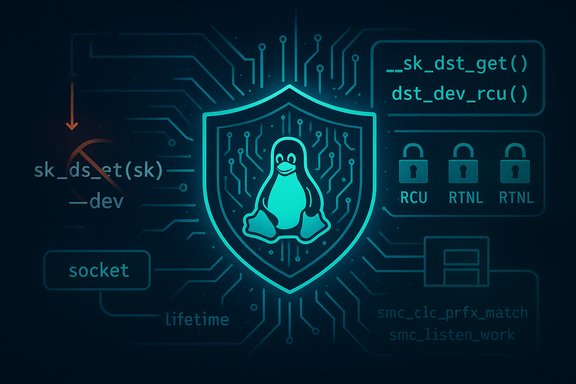
The Linux kernel team fixed a subtle but potentially disruptive use‑after‑free (UAF) in the SMC networking code by changing how a socket’s destination device is obtained inside smc_clc_prfx_match: callers now use the RCU‑aware accessors __sk_dst_get and dst_dev_rcu instead of a direct sk_dst_get(sk)->dev read, closing a race that could dereference freed device objects when smc_clc_prfx_match runs outside of RCU or RTNL protection.
SMC (Shared Memory Communications) implements a sockets‑over‑RDMA style datapath in Linux that lets TCP connections switch to RDMA or other shared‑memory transports for high throughput and low latency. The kernel exposes this functionality through the smc socket family and associated helpers; those code paths interact closely with generic kernel networking primitives such as dst (destination) objects and netdevice pointers. The recently recorded vulnerability, CVE‑2025‑40168, arises because the function smc_clc_prfx_match — called from smc_listen_work — previously read the device pointer using sk_dst_get(sk)->dev in a context that is neither under RCU read‑side protection nor the RTNL (rtnetlink) lock. That direct read can observe a device pointer that is concurrently freed, producing a UAF. The fix replaces that pattern with __sk_dst_get and dst_dev_rcu, which cooperate with RCU/lockdep semantics to ensure the device pointer read is safe even when the caller isn’t already in an RCU or RTNL protected region. Why this matters right now: RCU vs. ad‑hoc reads are a recurring class of kernel synchronization issues. A tiny change — switching to an RCU‑aware accessor and reordering checks — prevents ephemeral pointer races that otherwise show up as kernel oopses, panics, crashes, or unpredictable driver behavior under concurrency. Upstream maintainers merged the minimal changes to the stable trees so vendors and distributions can backport them into released kernel packages.
Source: MSRC Security Update Guide - Microsoft Security Response Center
 Background / Overview
SMC (Shared Memory Communications) implements a sockets‑over‑RDMA style datapath in Linux that lets TCP connections switch to RDMA or other shared‑memory transports for high throughput and low latency. The kernel exposes this functionality through the smc socket family and associated helpers; those code paths interact closely with generic kernel networking primitives such as dst (destination) objects and netdevice pointers. The recently recorded vulnerability, CVE‑2025‑40168, arises because the function smc_clc_prfx_match — called from smc_listen_work — previously read the device pointer using sk_dst_get(sk)->dev in a context that is neither under RCU read‑side protection nor the RTNL (rtnetlink) lock. That direct read can observe a device pointer that is concurrently freed, producing a UAF. The fix replaces that pattern with __sk_dst_get and dst_dev_rcu, which cooperate with RCU/lockdep semantics to ensure the device pointer read is safe even when the caller isn’t already in an RCU or RTNL protected region. Why this matters right now: RCU vs. ad‑hoc reads are a recurring class of kernel synchronization issues. A tiny change — switching to an RCU‑aware accessor and reordering checks — prevents ephemeral pointer races that otherwise show up as kernel oopses, panics, crashes, or unpredictable driver behavior under concurrency. Upstream maintainers merged the minimal changes to the stable trees so vendors and distributions can backport them into released kernel packages.Technical anatomy: what specifically changed
The vulnerable pattern
- Code path: smc_clc_prfx_match — used by SMC listen logic to match prefix information in CLC (Connection Local Control) handling.
- Caller context: smc_listen_work, which may execute without RCU read‑side protection and likewise without holding RTNL.
- Dangerous read: sk_dst_get(sk)->dev — this accesses the dst‑backed device pointer directly. If a concurrent device unbind or reconfiguration frees or replaces the net_device referenced by dst->dev, the reading code can observe a freed pointer, then dereference it — classic use‑after‑free.
The safe pattern introduced
- __sk_dst_get: a lower‑level accessor that returns the underlying dst pointer in a way appropriate for callers that will immediately take further protection or use RCU helpers.
- dst_dev_rcu: an RCU‑aware helper that reads dst->dev inside an RCU read‑side window and emits lockdep‑aware checks on kernels built with lock dependency verification. Using dst_dev_rcu ensures the returned device pointer remains valid for the caller’s read‑side lifetime and helps kernel developers catch mismatched locking during testing.
Cross‑checked verification
Key claims about the vulnerability and the fix have been cross‑verified with multiple independent sources:- The NVD entry for CVE‑2025‑40168 describes the exact change — switching smc_clc_prfx_match to use __sk_dst_get and dst_dev_rcu because the call site is not under RCU nor RTNL. The NVD record lists the issue as resolved with stable kernel commits.
- Distribution and tracker data (for example Debian’s security tracker) map the CVE to kernel package versions and show which branches remain vulnerable vs. which are fixed, giving operators practical package‑level mappings.
- Commercial scanners and vulnerability databases (Tenable / Amazon Linux advisories) capture the same summary and provide severity scoring (medium), CVSS vectors and EPSS guidance, confirming the vulnerability classification used across the ecosystem.
- Upstream kernel maintenance practice and prior similar fixes show that replacing dst_dev or direct dst->dev reads with RCU‑aware helpers is the standard remediation pattern for these races; several writeups and stable‑patch notes illustrate the same migration motif.
Impact assessment: who is affected and how severe is it?
- Attack vector and prerequisites: Local — an attacker or untrusted process on the same host (for example, a container tenant or an unprivileged user able to manipulate socket activity or device lifecycles) is the most realistic trigger model. The vulnerability requires manipulating local networking activity or device lifecycle events (hotplug, driver unload, reconfiguration) to create the race conditions. Public trackers classify the attack vector as Local, with high attack complexity in some scoring, and low privileges required.
- Primary impact: Availability and integrity — a UAF in kernel networking code typically leads to kernel oopses, panics, or undefined behavior that can crash or destabilize the host. Distribution advisories and canonical write‑ups treat this class of bug primarily as an availability problem with a consequential integrity risk if corruption occurs. There are no authoritative public reports of remote, unauthenticated exploitation to RCE at disclosure.
- CVSS / scoring: several trackers assign medium severity; one common formulation yields a CVSS v3 base score in the mid‑5 to low‑6 range (e.g., 5.5–6.3 depending on distributor scoring). EPSS and exploitation likelihood are low at the time of disclosure, but the operational impact (kernel crash on multi‑tenant hosts or appliances) makes patching prudent.
- Affected kernels and distributions: any Linux kernel build that includes the vulnerable commit(s) in the smc code path is in scope. Distribution trackers list the package versions affected and the fixed revisions; for example, Debian’s tracker shows which branches and package versions are vulnerable and which have fixes, enabling operators to map CVE → package. Embedded vendors and OEM kernels — which often lag upstream — represent the longest tail of exposure.
Exploitation model and practical risk
Turning a UAF like this into a reliable arbitrary code execution primitive is nontrivial and platform dependent: it depends on allocator layout, timing, and additional bugs. In practice, observed risk is:- For single‑tenant desktops and controlled servers: moderate risk. An attacker typically needs local privileges or the ability to run code on the host to reliably trigger the race.
- For multi‑tenant hosts, cloud hypervisors, CI runners, shared build servers, containers or VNFs: high operational risk. A local DoS primitive that can crash the kernel is particularly damaging in these environments because one host crash can disrupt many tenants or automated orchestration systems.
Detection, telemetry and triage guidance
Quick triage checklist for administrators:- Identify candidate hosts:
- Check running kernel version: uname -r
- Inspect whether the kernel was built from a tree that could include smc fixes: review package changelogs or kernel source used to build the kernel.
- On builds from source, search for the kernel commit IDs or the specific helper usage: grep -R "smc_clc_prfx_match" /usr/src/linux-headers-$(uname -r) or grep for dst_dev_rcu/__sk_dst_get in the net/smc source tree.
- Log signals to look for:
- Kernel oopses or panic traces that mention smc symbols, smc_listen_work, or stack frames with smc_clc_prfx_match.
- Repeated crashes correlated with device hotplug events, RDMA (RoCE) configuration changes, or high SMC socket churn.
- Tracebacks including NULL pointer dereferences, use‑after‑free diagnostics, or lockdep warnings in tests.
- Capture forensic evidence quickly:
- If an OOPS occurs, capture full kernel logs (journalctl -k / dmesg) and secure any available vmcore/kdump output before automated reboots erase traces. Centralized kernel‑log collection and retention of crash dumps significantly shortens time‑to‑investigation.
Remediation and operational playbook
- Definitive fix: Install vendor/distribution kernel packages that include the upstream stable commits which implement the change to __sk_dst_get and dst_dev_rcu, then reboot hosts into the patched kernel. This is the only way to remove the vulnerable code path from kernel memory.
- Prioritize:
- High priority: multi‑tenant hosts, cloud hypervisors, containers that run untrusted code, network appliances and devices performing RDMA/SMC.
- Medium priority: single‑tenant servers and desktops where local code execution exposure is tightly controlled.
- Low priority: isolated test machines without RDMA or SMC usage (still patch eventually).
- Practical steps:
- Inventory: find hosts running kernels with net/smc enabled and verify package changelogs for inclusion of the stable commit IDs referenced by upstream trackers. Use your configuration management database to identify likely at‑risk systems.
- Acquire: obtain vendor kernel updates (or merge the stable commits if building custom kernels).
- Test: stage patches in a pilot group that reflects production NICs, RDMA fabrics, and SMC workloads.
- Deploy & validate: roll updates in waves; after reboot, exercise SMC/SMC‑R flows, RDMA link up/down, and device hotplug/driver unload flows while monitoring dmesg and crash telemetry for residual OOPSes.
- Monitor: add signature rules to parse kernel logs for smc symbol traces and repeat oops patterns.
- Short‑term mitigations (if immediate patching is impossible):
- Restrict unprivileged local capabilities: tighten RBAC, container runtime restrictions or seccomp filters to reduce the ability of untrusted processes to create or manipulate SMC sockets or trigger device lifecycle events.
- Isolate affected devices: keep SMC‑enabled hosts off untrusted networks or isolate RDMA fabrics to trusted management planes only.
- Vendor engagement: for embedded appliances and OEM images that cannot be rebuilt in house, work with vendors to obtain patched images; if the vendor cannot patch promptly, consider isolating or replacing the device.
Practical commands and checks administrators can run now
- Identify kernel and module state:
- uname -r
- lsmod | grep smc
- zgrep -i smc /var/log/ /var/log/kern.log (or journalctl -k)
- Search kernel source or headers for the fix (if you build kernels):
- grep -R "smc_clc_prfx_match" /usr/src/linux-headers-$(uname -r) || grep -R "__sk_dst_get" /usr/src/linux-headers-$(uname -r)
- Validate package changelog:
- apt changelog linux-image-$(uname -r) (Debian/Ubuntu)
- rpm -q --changelog kernel | grep -i 40168 (RHEL/SUSE variants)
Why the fix is small but important (analysis)
- Strength of the change: the patch is surgical — it replaces an unsafe read with RCU‑aware accessors and reorders checks. That low‑risk change reduces regression chances and is straightforward to backport into stable kernel branches. The upstream kernel community favors this style of minimal synchronization hardening precisely because it preserves behavior while removing hazardous corner cases.
- Operational value: a small change that prevents kernel oopses and panics is high‑leverage in production. Kernel crashes have outsized operational cost compared with their code size because they can ripple across orchestration systems, monitoring, and tenant recovery flows. This CVE is a textbook example where modest maintenance work yields a large operational benefit.
- Remaining concerns: the long tail of vendor‑distributed kernels and embedded devices. Many appliances ship vendor forks of the kernel and lag upstream patches; those devices may remain vulnerable for months or longer without vendor action. Operators must not assume a patch is present just because an upstream commit exists — confirm package changelogs or vendor advisories for your specific kernel builds.
Special considerations for mixed Windows/Linux environments
Many Windows‑centric organizations run Linux inside VMs, containers, WSL instances, or networking appliances that participate in hybrid workflows. A kernel crash in any of the Linux elements can disrupt services that integrate with Windows infrastructure (file shares, orchestration pipelines, monitoring collectors). Prioritize patching of Linux guests that host production services, CI runners, and management‑plane appliances even in predominantly Windows estates — the operational impact crosses OS boundaries.Recommended timeline and priorities
- Immediately: inventory and triage — identify SMC‑enabled hosts, RDMA fabrics, and devices that rely on SMC/SMC‑R.
- Within 72 hours: plan rollouts for high‑priority hosts (multi‑tenant, cloud, orchestration, management) and obtain vendor kernel updates or upstream stable commits for in‑house builds.
- Two‑week window: complete staged rollouts, reboots and validation testing.
- Ongoing: monitor vendor advisories for embedded devices and follow up with vendors that have long backport cycles.
Final assessment and conclusion
CVE‑2025‑40168 is a focused synchronization hardening in the Linux SMC stack: replacing a direct sk_dst_get(sk)->dev read with __sk_dst_get and dst_dev_rcu in smc_clc_prfx_match removes a TOCTOU / lifetime mismatch that could yield a use‑after‑free when the function runs outside RCU or RTNL. The change is minimal, low risk, and aligns with standard kernel maintenance patterns that prefer surgical synchronization fixes to larger rewrites. The operational impact is primarily availability‑focused: kernel oopses and crashes on hosts where RDMA/SMC code runs. Distributors and trackers classify the issue as medium severity and have begun mapping the fix into package releases; operators should verify their kernel packages, apply vendor kernel updates, and reboot hosts to eliminate the vulnerable code path. Because the vulnerability is local in nature but can produce host‑wide disruption, the pragmatic course is straightforward: treat the patch as low‑risk, high‑value — patch early in multi‑tenant and production environments, and ensure embedded/OEM devices that cannot be immediately updated are isolated until vendors provide firmware/kernel updates. Operational playbooks (inventory → acquire → test → deploy → monitor) and persistent kernel crash telemetry are the practical controls that shrink the risk window for this class of kernel hardening.Source: MSRC Security Update Guide - Microsoft Security Response Center
