

A subtle race in the Linux wireless stack — tracked as CVE-2025-21979 — can let a queued wiphy work item run after its owning wiphy object has already been freed, producing a classic use-after-free that reliably threatens system availability and, in worst cases, integrity; the Linux kernel community fixed the issue by ensuring pending wiphy work is canceled before the wiphy is freed, and major distributions have pushed corresponding kernel updates.
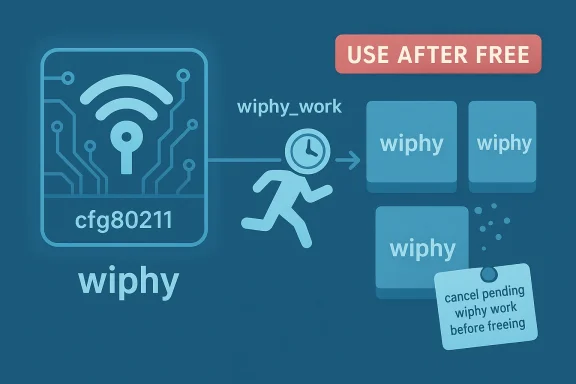
The Linux wireless configuration layer, cfg80211, exposes a high-level API for registering and managing wireless radios (wiphy objects) and their regulatory, interface, and event handling. A wiphy represents a wireless physical device and is backed by driver and cfg80211 state; asynchronous work items (workqueue entries) are commonly used inside the wireless stack to defer processing to non‑interrupt context. When the lifecycle of the wiphy is not carefully synchronized with queued work, a timing window appears: the work can be queued as soon as the wiphy is allocated, but the system (or a driver) may free the wiphy before that work runs. That precisely is the race CVE-2025-21979 addresses — a queued wiphy_work can execute against freed memory.
Security catalogs and vendor advisories assign this weakness a high severity rating (CVSS v3.1 base score commonly reported as 7.8), reflecting the fact that a local, low‑privilege actor can cause kernel memory to be referenced after free — reliably triggering kernel oops, panics, or persistent service failures. Several distributors reported the issue and the remediation timeline in April 2025; upstream stable kernel trees received small, targeted fixes to cancel pending work before freeing the wiphy.
This is a conservative, correctable change: it does not rearchitect the subsystem nor does it remove asynchronous processing — it simply enforces a required ordering between work completion and object teardown. The change was accepted into the stable kernel trees and backported by distributors.
Short term (minutes–hours)
For high‑value nodes where reboot windows are costly, prefer verified vendor livepatch packages where supported; several enterprise vendors and livepatch providers offered such remediation options for related kernel fixes in 2025 workflows.
Strengths of the response
Action priorities for defenders:
Acknowledgment: this report synthesizes upstream kernel commit summaries, vendor advisories and distribution trackers, and the uploaded technical notes available to WindowsForum contributors to provide an actionable, verifiable remediation path for CVE‑2025‑21979.
Source: MSRC Security Update Guide - Microsoft Security Response Center
 Background / Overview
The Linux wireless configuration layer, cfg80211, exposes a high-level API for registering and managing wireless radios (wiphy objects) and their regulatory, interface, and event handling. A wiphy represents a wireless physical device and is backed by driver and cfg80211 state; asynchronous work items (workqueue entries) are commonly used inside the wireless stack to defer processing to non‑interrupt context. When the lifecycle of the wiphy is not carefully synchronized with queued work, a timing window appears: the work can be queued as soon as the wiphy is allocated, but the system (or a driver) may free the wiphy before that work runs. That precisely is the race CVE-2025-21979 addresses — a queued wiphy_work can execute against freed memory.Security catalogs and vendor advisories assign this weakness a high severity rating (CVSS v3.1 base score commonly reported as 7.8), reflecting the fact that a local, low‑privilege actor can cause kernel memory to be referenced after free — reliably triggering kernel oops, panics, or persistent service failures. Several distributors reported the issue and the remediation timeline in April 2025; upstream stable kernel trees received small, targeted fixes to cancel pending work before freeing the wiphy.
What the bug actually is — a technical deep dive
The race, in plain terms
- When a wireless device (wiphy) is created, cfg80211 and some drivers may initialize and queue a worker (rdev::wiphy_work) to perform later tasks such as regulatory updates, channel-list adjustments, or other asynchronous housekeeping.
- If wiphy_free (the routine that tears down the wiphy) is invoked while that work item is still queued but not yet executed, the kernel may free the memory backing the wiphy.
- Later, when the work item runs, it dereferences pointers into the now‑freed wiphy structure — a textbook use‑after‑free that can crash the kernel or lead to unpredictable behavior.
Why use‑after‑free matters in the kernel
User‑space use‑after‑free bugs are serious; in kernel space they are more acute. A kernel use‑after‑free can:- Immediately cause a kernel oops or panic, resulting in total loss of availability for the host.
- In some hardware and allocator layouts, allow controlled memory corruption that may be leveraged for privilege escalation or data disclosure (though reliably achieving code execution is substantially more complex).
- Be reproducible from low‑privilege contexts when the operations that enqueue the work are available to non‑privileged processes or local attackers, making the risk operationally relevant in multi‑tenant or developer environments.
Where this bug shows up in the wild (scope & affected systems)
CVE-2025-21979 is a kernel-level defect in the cfg80211 subsystem and therefore can affect a very broad range of Linux builds — desktop, server, and embedded — but the practical blast radius depends on two operational conditions:- Whether the machine’s kernel includes the vulnerable cfg80211 code paths (most mainstream kernels did prior to the backports).
- Whether the affected wiphy and driver are loaded and used on that system (server-class VMs often don’t load wireless drivers by default; developer laptops, IoT/edge appliances, or systems with wireless hardware are at greater risk).
The remediation that landed — what changed in the code
The upstream patch is small and surgical: maintainers added code to cancel pending wiphy work synchronously before freeing the wiphy. In practical terms, that means inserting the appropriate work‑queue cancellation (for example, cancel_work_sync(&rdev->wiphy_work) or the equivalent safe housekeeping) at the point where the wiphy teardown happens, ensuring the system waits for any queued or running work to complete before reclaiming the memory.This is a conservative, correctable change: it does not rearchitect the subsystem nor does it remove asynchronous processing — it simply enforces a required ordering between work completion and object teardown. The change was accepted into the stable kernel trees and backported by distributors.
Practical impact and exploitation model
What an attacker can do
- Primary impact: Denial of Service (DoS). A local adversary (or an untrusted local process) that can cause the cfg80211 wiphy lifecycle transitions to occur can reliably trigger a kernel oops or crash, resulting in sustained or persistent loss of availability for the host or service. This matches the advisory language describing total loss of availability consequences.
- Secondary impact (theoretical): Information disclosure or elevation of privilege are not ruled out in principle because kernel memory corruption is a fundamental class that has historically been chained to escalate impact. Public telemetry did not show a widespread exploitation campaign tied to this CVE at disclosure, and proof‑of‑concept exploits have not been widely published; nevertheless, defenders should not assume the worst‑case cannot be engineered, particularly in controlled lab or tailored attacks.
Attacker prerequisites
- The vector is largely local: an attacker needs the ability to run code or otherwise interact with the relevant kernel paths on the target host. In some device contexts, an adjacent wireless presence could be relevant (if the driver or user‑space path can be triggered remotely via radio events), but most public analyses mark the vector as local/adjacent rather than unauthenticated remote.
Detection, hunting and triage
Detecting exploitation of this precise race cthe symptom is often an abrupt kernel oops or panic. Practical indicators and steps:- Inspect kernel logs (dmesg / journal) for oops traces and messages that mention cfg80211, wiphy, or worker functions associated with the wireless stack. Charge any unusual or repeated kernel oops as high‑priority incidents for immediateKASAN traces if sanitizer instrumentation is enabled in test builds; KASAN is what commonly uncovered these kinds of race conditions during development and testing.
- Inventory systems for loaded wireless modules: run module checks (for example, lsmod | grep cfg80211 or inspect /lib/modules/$(uname -r)/kernel/drivers/net/wireless) and identify hosts that load wireless drivers such as ath11k, iwlwifi, mac80211, etc. Prioritize remediation for hosts that actually use wireless devices.
- If you suspect active exploitation and need forensic evidence, capture kernel logs, enable persistent logging, and if possible arrange for safe collection of crash dumps before a forced reboot — but balance forensic needs against the operational requirement to restore availability.
- Identify hosts with wireless drivers loaded and mark them high-priority.
- Search logs for cfg80211/wiphy-related oops or KASAN messages.
- If patching will be delayed, apply temporary mitigations (see next section).
- Apply vendor kernel updates and validate remediation in staging before rolling into production. ([security-tracker.debian.org](CVE-2025-21979
Mitigations and recommended immediate actions
When a vendor-supplied kernel update is available, applying it is the correct and definitive remediation. For teams that cannot reboot immediately or must prioritize hosts, use a layered approach.Short term (minutes–hours)
- If wireless functionality is not required: disable wireless on affected hosts or blacklist the cfg80211/driver module (e.g., blacklist ath11k/iwlwifi in the initramfs or modprobe configuration) to eliminate the vulnerable code path. This is blunt but effective.
- Restrict local untrusted execution: reduce the ability of unprivileged users or tenants to interact with the kernel paths that create or tear down wiphys. In cloud or multi‑tenant environments, isolate images that include wireless drivers.
- Apply vendor kernel updates or backported stable fixes and reboot during an approved maintenance window. Confirm the updated kernel package installed on each node by checking the distribution's advisory mapping to package versions. Major distributions (Debian, Ubuntu, SUSE, RHEL derivatives) published advisories mapping the fix to specific kernel packages.
- For fleets built from vendor or marketplace images, rebuild or roll node pools with patched images to ensure immutable infrastructure remains protected.
- Integrate kernel CVE tracking into your image‑build and SCM pipelines so kernel updates are visible and routable into CI/CD processes.
- For embedded and IoT devices, demand a clear vendor update path (or supply chains that provide kernel livepatches) because these classes of hardware frequently remain vulnerable long after upstream fixes are published.
Patch verification and cross‑checking
Administrators should not assume a package name alone proves remediation. Verify one of the following on each host:- Confirm the kernel package version is at or beyond the vendor’s fixed release number (consult your distro's CVE advisory).
- Verify presence of the upstream commit in your kernel build by checking the shipped kernel changelog or vendor's patch notes; the upstream fix is small and intended to be visible in changelogs or stable patch commit lists. OSV, NVD, and multiple vendor trackers include references to the kernel commits associated with the fix.
For high‑value nodes where reboot windows are costly, prefer verified vendor livepatch packages where supported; several enterprise vendors and livepatch providers offered such remediation options for related kernel fixes in 2025 workflows.
Why the fix is sensible — and what residual risk remains
The corrective action — cancel pending work before freeing the associated object — is a well‑known lifetime‑management rule. It eliminates the exact reorder that produced the use‑after‑free without imposing radical design changes or measurable runtime overhead for typical workloads.Strengths of the response
- The fix is small, localized, and low‑risk to accept into stable kernels, which enabled rapid backporting by distributors.
- It addresses the root cause (unsafe ordering) rather than applying brittle heuristics.
- The real operational exposure is often the long tail — embedded devices, OEM kernels, and marketplace images that do not receive timely updates. Tin vulnerable for months or years unless vendors supply updates or operators proactively isolate them.
- Detection is inherently noisy: kernel oopses can be caused by many faults, so distinguishing accidental crashes from deliberate exploitation requires context and correlation.
- While DoS is the most immediate consequence, defenders should assume creative attackers will continue to probe whether memory corruptions can be escalated in their specific environment. Treat the CVE as a patch‑priority item, not an academic curiosity.
Operational playbook: step‑by‑step remediation for sysadmins
- Inventory
- Identify hosts that load wireless drivers (lsmod | grep cfg80211, inspect /lib/modules).
- Flag embedded appliances or developer images that include wireless modules even if they are not typically used.
- Triage
- Search logs for cfg80211/wiphy oops or KASAN slabs.
- Priorites or those in exposed roles (e.g., developer laptops, kiosks, edge appliances).
- Short‑term mitigation
- If wireless is not required, blacklist the driver or disable Bluetooth/wireless services.
- Isolate or sandbox untrusted local processes that may have access to device management APIs.
- Patching
- Apply vendor kernel updates that include the upstream cfg80211 fix.
- Where available, use livepatch products to apply the fix without immediate reboots; otherwise schedule reboots and redeploy with patched kernels.
- Verify
- Confirm package versions and check kernel changelogs for the specific fix.
- Validate on representative hardware that wireless functionality is intact and that the oopses no longer occur.
- Monitor & harden
- Add log detectors for repeated cfg80211/wiphy stack traces.
- For cloud images, ensure images and builders are updated so new instances are not provisioned with vulnerable kernels.
Final assessment and recommendations
CVE‑2025‑21979 is the kind of kernel race that is both conceptually simple and operationally dangerous: a queued work item referencing an object outlives the object. The upstream remedy — cancel pending work before freeing the wiphy — is correct, minimal, and already incorporated into stable kernels and vendor backports. Major distributions have published advisories and packages, and operators should treat the issue as a high‑priority kernel patch.Action priorities for defenders:
- Immediate: identify wireless‑enabled hosts and disable wireless where not required.
- Near term: deploy vendor kernel updates or livepatches and reboot per your maintenance policies.
- Long term: close supply‑chain gaps for embedded and marketplace images so vulnerable kernels are not propagated in your infrastructure.
Acknowledgment: this report synthesizes upstream kernel commit summaries, vendor advisories and distribution trackers, and the uploaded technical notes available to WindowsForum contributors to provide an actionable, verifiable remediation path for CVE‑2025‑21979.
Source: MSRC Security Update Guide - Microsoft Security Response Center
