

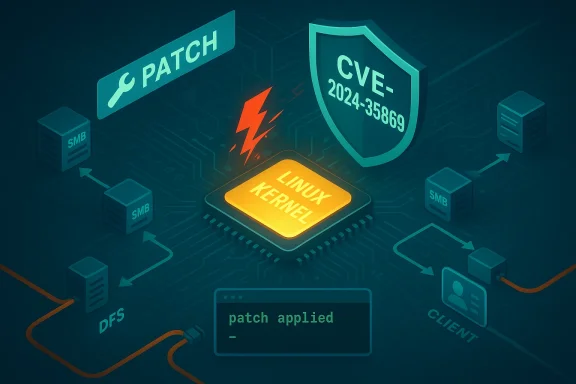
A use‑after‑free defect in the Linux kernel’s SMB client — tracked as CVE-2024-35869 — has been fixed upstream and back‑ported by major distributors after disclosure; the bug can cause reliable crashes and memory corruption when the client walks DFS referrals, mounts DFS targets, or performs DFS failover, and system administrators should treat this as a priority patching item for any Linux hosts that mount or access SMB/CIFS shares.
The vulnerability CVE-2024-35869 was assigned to a flaw in the Linux kernel's SMB client implementation. The underlying problem is a reference‑counting error: child connection objects that are derived from a parent session were not consistently refcounted, which opened a window for use‑after‑free (UAF) conditions when the kernel walked DFS referrals, mounted DFS targets, or performed DFS failover logic. Left unpatched, the bug can lead to kernel memory corruption and reproducible crashes; in practice the most immediate operational impact is denial of service (unplanned reboots, kernel panics, OOPS, or hung I/O). The issue was disclosed to maintainers in 2024 and fixes were committed into the kernel stable trees and rolled into downstream distribution kernel updates.
Why this matters: many enterprise and cloud environments still rely on SMB/CIFS for file shares, backups, or AD integrated storage. Linux systems acting as SMB clients — for example, on workstations, application servers, containers, or appliances that mount Windows shares or DFS namespaces — are exposed. Where DFS referrals or multi‑server DFS namespaces are in use, the vulnerable code path is exercised more readily, increasing the practical attack surface.
Reference counting is the kernel’s way of ensuring objects aren’t freed while somebody still needs them. If a code path drops a reference incorrectly or fails to take a reference for a short‑lived access window, another thread can free the object while it is still being used — and any subsequent dereference becomes a use‑after‑free.
Important operational notes:
Major distribution vendors produced kernel updates and security advisories to backport the fix:
Source: MSRC Security Update Guide - Microsoft Security Response Center
 Background / Overview
The vulnerability CVE-2024-35869 was assigned to a flaw in the Linux kernel's SMB client implementation. The underlying problem is a reference‑counting error: child connection objects that are derived from a parent session were not consistently refcounted, which opened a window for use‑after‑free (UAF) conditions when the kernel walked DFS referrals, mounted DFS targets, or performed DFS failover logic. Left unpatched, the bug can lead to kernel memory corruption and reproducible crashes; in practice the most immediate operational impact is denial of service (unplanned reboots, kernel panics, OOPS, or hung I/O). The issue was disclosed to maintainers in 2024 and fixes were committed into the kernel stable trees and rolled into downstream distribution kernel updates.Why this matters: many enterprise and cloud environments still rely on SMB/CIFS for file shares, backups, or AD integrated storage. Linux systems acting as SMB clients — for example, on workstations, application servers, containers, or appliances that mount Windows shares or DFS namespaces — are exposed. Where DFS referrals or multi‑server DFS namespaces are in use, the vulnerable code path is exercised more readily, increasing the practical attack surface.
What exactly is broken: a technical explanation
How SMB sessions, tcons and "children" relate
The SMB client in the Linux kernel manages connections to remote SMB servers using constructs often called sessions or tree connections (tcon). A single logical session may spawn one or more subordinate or "child" tcon objects when the client follows DFS referrals or mounts distributed namespaces that reference other servers.Reference counting is the kernel’s way of ensuring objects aren’t freed while somebody still needs them. If a code path drops a reference incorrectly or fails to take a reference for a short‑lived access window, another thread can free the object while it is still being used — and any subsequent dereference becomes a use‑after‑free.
The vulnerability root cause in plain terms
CVE-2024-35869 stems from a missing guarantee that every child tcon derived from a parent session is refcounted for the entire DFS mount lifetime when used across various DFS operations (walking referrals, mounting, failover). In certain schedules the parent session and its child tcons could be released concurrently; because some code paths assumed children remained valid, the kernel would later access freed memory. That access shows up as KASAN warnings, OOPSes, or panics depending on kernel configuration and timing.Realistic effects when triggered
- A kernel thread (kworker or similar) accessing a freed tcon may read or write corrupted memory, causing unpredictable behavior.
- On many kernels the immediate outcome is an OOPS or panic — a full loss of availability for services on that host until it reboots.
- In some configurations, especially with kernel sanitizers or hardened kernels, the bug will be detected and logged; on production kernels without sanitizers it can still crash or corrupt state.
- While the canonical impact is availability (DoS), any UAF in kernel space carries the theoretical risk of more severe memory corruption and, in pathological cases, local privilege escalation. Public analysis and vendor advisories that accompanied the patch emphasize the availability and memory integrity impacts rather than confirmed remote kernel‑level code execution in the wild.
Who and what is affected
- Any Linux host running a vulnerable kernel that uses the in‑kernel SMB/CIFS client (commonly mounted via cifs/fuse-smb or kernel cifs) and that either directly accesses DFS namespaces or handles DFS referrals is in scope.
- Not all systems use DFS. Hosts that exclusively connect to single, fixed SMB endpoints without referrals are less likely to trigger the problematic code paths — but are not categorically immune if the vendor or distro compiled in the same code paths.
- Major distributions issued vendor advisories and kernel updates after the upstream fix; administrators should treat vendor patch notices and kernel security errata as authoritative for their platform.
Severity, scoring and exploitation status
Security databases that tracked the report assigned a high base CVSS score (CVSSv3 around 8.4) because the flaw is kernel‑level, can cause significant confidentiality/integrity/availability impact in some contexts, and is relatively straightforward to trigger when the right DFS workflows are exercised.Important operational notes:
- The primary real‑world impact reported by vendors and community analysis is denial of availability (crashes, kernel panics, OOPS). That makes the bug especially relevant for infrastructure and storage servers where availability is critical.
- Public reporting and vendor advisories indicated the bug is a use‑after‑free (CWE‑416). UAFs in kernel space are treated with high urgency because the memory corruption boundary crosses privilege protections.
- As of the verification date of this article (February 18, 2026) there were no widely credible, publicized reports of mass exploitation campaigns actively weaponizing this CVE for remote kernel code execution. That said, the presence of a deterministic UAF in a widely used component means talented attackers with local access could weaponize it; defenders should not assume low risk simply because active exploitation has not been broadly reported.
Patches, vendor responses and distribution coverage
Upstream maintainers committed fixes into the kernel stable branches soon after the issue was triaged; the fix enforces refcount guarantees for children derived from parent sessions and removes the fragile list field that contributed to the problem.Major distribution vendors produced kernel updates and security advisories to backport the fix:
- Enterprise Linux vendors prioritized backports into supported LTS kernels and included kernel errata.
- Community distributions also delivered updated kernel packages for both rolling and LTS releases.
- Cloud providers and image maintainers integrated the corrected kernels into refreshed images.
Immediate actions for administrators — a prioritized checklist
If you manage Linux hosts that mount or consume SMB shares, follow this triage and remediation playbook immediately.- Inventory and triage
- Identify all Linux systems that use SMB/CIFS mounts or act as SMB clients in your environment.
- Prioritize systems that mount DFS namespaces or perform automatic DFS failover — these are highest risk.
- Record current kernel versions and applied kernel security errata.
- Apply vendor patches
- Pull the vendor‑supplied kernel security updates immediately into your testing pipeline.
- For production critical hosts, schedule out‑of‑band patch windows if necessary; be prepared to reboot after kernel updates.
- Where feasible, start with a small, representative pilot group to validate compatibility before broad rollout.
- Short‑term mitigations if you cannot immediately patch
- Unmount non‑essential CIFS/SMB mounts on hosts that do not require continuous access.
- Restrict access to SMB endpoints from untrusted networks using segmentation and firewall rules; reduce remote attack surface.
- Avoid interacting with untrusted DFS namespaces or UNC paths; disallow automatic referral traversal in application logic where possible.
- If a host is only intermittently a client, consider temporarily disabling the CIFS kernel module until a patch is applied.
- Monitoring and detection
- Watch kernel logs (dmesg and journalctl -k) for OOPS, KASAN warnings, or "use‑after‑free" style stack traces in SMB/CIFS subsystems.
- Instrument endpoint telemetry (EDR, syslog aggregation) for unexplained kernel panics, high rates of kworker crashes, or repeated automatic reboots coinciding with SMB operations.
- Create alerts on signs of memory corruption originating from CIFS/SMB subsystem messages.
- Post‑patch validation
- After applying kernel updates, validate that SMB mounts function normally and that there are no regression crashes under load tests that exercise DFS referrals and mount/failover workflows.
- Reconcile configuration drift in mount options or custom modules that might interact with CIFS behavior.
Detection and hunting recipes
Practical detection steps you can run now to hunt for possible exploitation or symptomatic crashes:- Inspect kernel ring buffer and persistent logs for relevant messages:
- journalctl -k | grep -i -E 'cifs|smb|KASAN|use-after-free|oops|panic'
- dmesg | grep -i cifs
- Look for crash signatures commonly seen when UAFs are triggered:
- KASAN: slab-use-after-free or KASAN: use-after-free references in KASAN‑enabled kernels
- OOPS stack traces that reference functions in the SMB client path (function names can vary by kernel version)
- On systems with EDR or host telemetry, search for sequences where SMB access is followed closely by kernel panic or reboot.
- For forensic analysis, preserve vmcore or kdump outputs if a kernel crash occurred; they can be replayed locally in a controlled lab to identify the offending code path.
Longer term mitigations and architectural considerations
This CVE is a reminder of how complex protocol implementations — especially ones that bridge OS boundaries like SMB, with DFS and referrals — produce brittle paths that are prone to subtle resource‑management errors.- Minimize attack surface: wherever possible, avoid unnecessary automatic mounts of network file systems from untrusted hosts. Favor application patterns that use authenticated, hardened object stores or protocol wrappers with smaller kernel attack surfaces.
- Consider running SMB client workloads inside well‑scoped containers or VMs that can be quickly redeployed if compromised; this reduces blast radius when kernel faults occur.
- Encourage vendors and maintainers to continue adopting memory‑safe idioms and to make sanitizer builds part of CI for networking subsystems. While sanitizers are not for production, CI builds that exercise KASAN, UBSAN, or similar can catch regressions before release.
- Maintain a fast and tested patch pipeline for kernel updates; the reality of kernel bugs is that credible fixes often exist upstream quickly, but operational constraints slow deployment — automation, staging, and validated hotpath testing reduce that lag.
What defenders should not assume
- Do not assume that because the bug primarily causes crashes it cannot be escalated into code execution. Kernel UAFs can in some cases be weaponized into local privilege escalation by sophisticated attackers.
- Do not assume Windows servers are the source of the problem — this is a Linux kernel client bug, so Windows hosts are not the vulnerable endpoint for this CVE unless they run Linux-based components that mount SMB shares.
- Do not rely on network firewalling alone. While network segmentation is effective to reduce risk exposure to malicious SMB servers, exploitation can occur via legitimate referrals or compromised internal hosts. Patch the endpoint.
Risk analysis: strengths and residual risks after patching
Notable strengths of the vendor response
- The fix was committed upstream and back‑ported to stable kernels, allowing distributors to ship patches quickly.
- Multiple distributors published advisories and CVE‑status entries, enabling teams to map affected kernels to vendor packages.
- The fix is surgical: improving reference counting and removing the fragile list pathway reduces future regression risk in that code path.
Residual or ongoing risks
- Rolling out kernel upgrades typically requires reboots and careful validation, which delays remediation for the most critical hosts.
- Environments that use diverse or vendor‑custom kernels (appliances, embedded systems, bespoke vendor kernels) may have the fix delayed or not available; these devices can remain vulnerable longer.
- If an attacker obtains a foothold in the internal network, the vulnerability could still be abused against Linux clients that mount internal SMB shares — meaning this bug plays well with lateral movement tactics.
- Kernel complexity means similar resource‑management errors can appear elsewhere; a single patch does not eliminate systemic risk.
Practical checklist for the next 72 hours (concise)
- Inventory: list all systems that mount SMB shares, label DFS usage.
- Patch: obtain and test vendor kernel security updates; schedule rapid deployment to production windows.
- Temporary mitigations: unmount nonessential CIFS mounts; restrict SMB access via segmentation and firewalling.
- Monitor: query kernel logs for OOPS/KASAN/SMB subsystem errors; raise pager on anomalies for production hosts.
- Validate: after patching, run DFS and referral workflows under test to confirm behavior.
Why CVE-2024-35869 matters beyond the immediate fix
CVE-2024-35869 highlights recurring themes in operating‑system security:- Protocol complexity increases attack surface. SMB is feature‑rich (authentication, referrals, DFS, opportunistic lock semantics) and implementing every case correctly at kernel speed is challenging.
- Resource management (refcounting, lifetime guarantees) remains one of the most error‑prone coding tasks in systems programming. Even experienced maintainers can miss narrow scheduling windows where invariants break.
- The ecosystem response — upstream kernel fixes, vendor advisories, and distribution patches — demonstrates the value of coordinated disclosure and active maintenance. But organizations still need the processes to consume and act on those updates.
Final recommendations
- Treat CVE-2024-35869 as a high-priority operational vulnerability for any Linux hosts that act as SMB clients or mount DFS namespaces. Prioritize patched kernels for those hosts.
- If immediate patching is impossible, adopt short‑term mitigations (unmount shares where practical, block SMB access from untrusted networks, avoid DFS referrals) and harden monitoring to detect symptomatic crashes.
- After remediation, validate systems under test and continue monitoring kernel logs for residual issues. Retrospective risk assessments should include whether network SMB usage is still appropriate or whether alternative file‑access patterns reduce future exposure.
- Continue to push vendors and upstream projects for rigorous CI sanitizer coverage and automated memory‑safety checks on complex protocol code paths.
Source: MSRC Security Update Guide - Microsoft Security Response Center
