

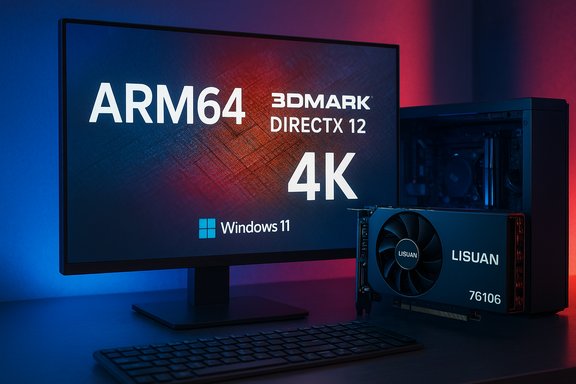
The first images and benchmark footage suggesting a discrete Chinese GPU running native 3D tests on an Arm-based Windows PC arrived like a burr of cold air through the GPU market: Lisuan’s 7G106 was shown executing 3DMark on a Windows 11 ARM machine, and multiple outlets picked up the implication that this may be the earliest public example of a discrete, gaming-focused dGPU shipping with an Arm‑aware 3D driver stack. This is notable on two fronts: it changes the technical conversation about what "Windows on Arm" can support, and it marks a potentially important milestone in China’s push toward independent GPU ecosystems.
Lisuan Technology — a recently visible Chinese GPU startup — unveiled the 7G100 family (consumer 7G106 and pro/AI 7G105) built on what the company calls the TrueGPU architecture and produced on TSMC’s N6 (6 nm) node. Key specifications circulating in early coverage include 12 GB GDDR6, a 192‑bit memory bus, a quoted peak of ~24 TFLOPS FP32, and support for modern APIs (DirectX 12, Vulkan 1.3, OpenGL 4.6, OpenCL 3.0). Early demos claimed playable 4K runs of Chinese AAA titles, and synthetic numbers reported in press previews place the 7G106 near or roughly comparable with NVIDIA’s GeForce RTX 4060 in some benchmarks. That bigger story — beyond raw arithmetic of cores and TFLOPS — is the driver and software stack: Lisuan’s demonstration reportedly used a driver compiled to work on an Arm‑based Windows system, allowing 3DMark’s DirectX test to run on native hardware instead of relying entirely on x86 emulation. If fully validated, that would make Lisuan one of the first discrete GPU vendors to ship or demo a Windows GPU driver with explicit Arm support for discrete cards rather than leaving Arm users to Windows’ in‑box limitations or to host‑specific workarounds. Several independent outlets have interpreted the footage and statements in this way.
Source: Tom's Hardware https://www.tomshardware.com/pc-com...g106-runs-3dmark-on-a-windows-11-arm-machine/
 Background / Overview
Lisuan Technology — a recently visible Chinese GPU startup — unveiled the 7G100 family (consumer 7G106 and pro/AI 7G105) built on what the company calls the TrueGPU architecture and produced on TSMC’s N6 (6 nm) node. Key specifications circulating in early coverage include 12 GB GDDR6, a 192‑bit memory bus, a quoted peak of ~24 TFLOPS FP32, and support for modern APIs (DirectX 12, Vulkan 1.3, OpenGL 4.6, OpenCL 3.0). Early demos claimed playable 4K runs of Chinese AAA titles, and synthetic numbers reported in press previews place the 7G106 near or roughly comparable with NVIDIA’s GeForce RTX 4060 in some benchmarks. That bigger story — beyond raw arithmetic of cores and TFLOPS — is the driver and software stack: Lisuan’s demonstration reportedly used a driver compiled to work on an Arm‑based Windows system, allowing 3DMark’s DirectX test to run on native hardware instead of relying entirely on x86 emulation. If fully validated, that would make Lisuan one of the first discrete GPU vendors to ship or demo a Windows GPU driver with explicit Arm support for discrete cards rather than leaving Arm users to Windows’ in‑box limitations or to host‑specific workarounds. Several independent outlets have interpreted the footage and statements in this way. Why this matters: Windows on Arm and the missing piece
The software gap that long held Arm back
Windows on Arm has steadily improved compatibility in recent years, particularly via Microsoft’s Prism translation layer for x64 applications and OEM/SoC vendor work (Qualcomm’s Adreno drivers and a Snapdragon Control Panel, for example). Still, a shortcoming remained: many third‑party hardware vendors — including the major discrete GPU makers — did not provide native Arm64 drivers for their desktop GPUs on Windows, meaning full-featured, optimized drivers weren’t available to Arm systems. The result was that running high‑performance direct 3D workloads on Arm-based desktops required awkward workarounds, emulation, or simply accepting degraded feature sets. Microsoft documentation and industry coverage explain that hardware drivers must be compiled for ARM64 to unlock native acceleration; otherwise, compatibility depends on what the OS in‑box drivers happen to expose.A discrete GPU vendor shipping an Arm-capable 3D driver is consequential
If Lisuan’s demo truly represents a driver stack that directly targets Windows on Arm for a discrete dGPU, that’s consequential in two different ways. First, it means a third‑party driver model — shader compilation paths, DX12/Vulkan runtime bindings, and vendor control panel features — can be implemented for ARM64 on Windows in the dGPU space. Second, it offers hardware vendors an alternate route: instead of waiting on ecosystem giants to expand Arm support, smaller entrants can supply Arm‑aware drivers that may open new OEM pathways for Arm desktops and workstations in markets where Arm silicon is gaining traction. Multiple outlets have highlighted the possibility that Lisuan may be the first to take that step publicly.Verifying the technical claims — what’s corroborated and what remains provisional
The early coverage contains a mix of verifiable numbers, vendor claims, and demo footage. For a responsible read, each major claim must be cross‑checked.- Specification claims (TSMC N6, 12 GB GDDR6, 192-bit bus, 24 TFLOPS FP32) appear consistently in multiple writeups and press translations; Tom’s Hardware summarized those numbers in its early coverage. These figures are reported by several independent outlets and are credible as vendor‑announced specs, but they remain vendor claims until validated in independent, repeatable testing.
- Synthetic benchmark figures have been widely circulated: ~26,800 3DMark Fire Strike and ~111,290 Geekbench 6 OpenCL are the most commonly quoted numbers. Multiple news sites and benchmark aggregations repeated them after the initial demos. These are useful reference points, but they should be treated as pre‑sampling engineering results, not final retail metrics. Hardware labs commonly report different scores on retail boards because clocks, voltage bins, firmware and drivers change between engineering samples and final products.
- The 3DMark footage on an ARM system: video shared publicly (on Chinese platforms) shows Steel Nomad running on a Windows 11 ARM machine with the 7G106 installed and executing a DirectX‑based benchmark. Coverage by regional outlets confirms the existence of the clip but also notes the absence of comprehensive, published logs or full result exports. That leaves room for interpretation: the demo proves a driver path exists, but not the full end‑to‑end quality, feature parity, or performance envelope for a retail rollout.
- Claim that Lisuan is the first discrete GPU vendor to ship ARM‑aware 3D drivers: this is the headline interpretation of the demo, but it requires some nuance. Major vendors (NVIDIA, AMD, Intel) have historically focused driver support on x86/x64 Windows and on Arm in the embedded/SoC space (Jetson, Arm‑based servers) as separate product lines. There was no public evidence that any major discrete dGPU vendor had shipped a general Windows ARM64 driver for desktop dGPUs before this Lisuan footage — which is why observers labeled Lisuan’s evidence noteworthy. Nonetheless, “first” in public demos is different from industry‑standard availability; a broader market claim must wait for published driver packages, documentation, and vendor verification.
Deep technical read: drivers, APIs and what an ARM‑aware dGPU driver must solve
Supporting discrete GPUs on Windows Arm goes beyond recompiling a driver binary for ARM64. A full, production‑quality dGPU driver must address a complex set of interactions:- Kernel‑mode components and signed drivers: Windows requires properly signed kernel drivers (KMDF/WDF / DCH model) and vendor coordination with Microsoft/OEMs. The driver must integrate with Windows driver signing and secure boot/attestation chains on ARM platforms, which can differ across OEM images.
- DXGI, D3D12 and Vulkan runtimes: graphics vendors map user‑mode runtime calls into kernel HW scheduling and command submission. The Arm64 driver must ensure shader compiler backends, GPU ISA toolchains, and runtime wrappers work with Windows’ DLL boundary conditions and with emulated x64 apps when relevant. Native ARM64 drivers unlock the ability for native ARM64 applications to call into hardware encoders/decoders and low‑level MFTs (media foundation transforms); emulated x64 apps cannot load ARM64 MFTs or native platform encoders without an ARM build.
- Anti‑cheat and kernel interop: many competitive multiplayer games rely on kernel‑level anti‑cheat components that historically lagged in cross‑architecture support. Unless anti‑cheat vendors explicitly support Windows on Arm and the dGPU driver model cooperates, multiplayer titles can remain blocked or unstable even when a driver exists.
- Firmware, UEFI and platform services: the GPU must coexist with the Arm board’s UEFI/firmware and power management, addressing things like SR‑IOV (virtualization), MMIO ranges, and display enumeration quirks that differ by SoC vendor and Apple/Qualcomm/Mediatek/CPUs.
Strengths of the Lisuan 7G106 story
- Bold systems engineering: Lisuan’s apparent integration of an Arm‑targeted driver for a discrete GPU shows software-first engineering focus that many domestic entrants have lacked previously. Combining a vendor driver stack with modern APIs and a claimed 6 nm process node gives the company credibility beyond paper specs.
- A credible performance positioning: the consistent benchmarking numbers reported (3DMark Fire Strike, Geekbench OpenCL) place the 7G106 in a practical midrange spot, competitive with an RTX 4060 in some synthetic workloads, which is a realistic place to capture share against more expensive imports. Multiple independent writeups repeated similar numbers.
- Strategic national significance: a local GPU vendor shipping a capable dGPU that runs Windows on Arm natively is strategically relevant for markets where export controls or supply chain constraints increase the value of domestic suppliers. The 7G106’s virtualization features and professional 7G105 sibling also signal a product roadmap that goes beyond consumer gaming.
Risks, unknowns and what to watch closely
- Driver maturity and update cadence: a demo driver is not the same as a field‑hardened driver with long‑term update channels, compatibility lists, and robust QA across the ecosystem. Expect early regressions, missing features (e.g., vendor control panel feature parity), and per‑title tuning gaps. Multiple outlets caution that demos often use engineering firmware and early drivers that change substantially by retail launch.
- Benchmark context: reported synthetic scores and demoed framerates can be influenced by cherry‑picked builds, tuned thermal envelopes, and optimized OEM firmware on engineering units. Independent laboratory validation is necessary to normalize comparisons with mature products. Reported 3DMark and Geekbench numbers should be considered provisional until repeated in standardized testbeds.
- Ecosystem lock and anti‑cheat: gaming isn’t only shaders and rasterization. Without broad anti‑cheat support and publisher validation, many multiplayer titles or launcher ecosystems may still fail to function smoothly on Arm desktops. Microsoft’s Prism and vendor work have helped, but kernel components remain a brittle point.
- Compatibility and feature gaps: early coverage indicates limited or no DirectX Ray Tracing parity, and some reports note HDMI licensing avoidance (some vendor materials list DP only), which signals trade‑offs. Also, long‑term driver support for professional features (CUDA‑style ecosystems, machine learning libraries) is still unproven.
- Geopolitical and supply constraints: while TSMC N6 was cited as the process node, supply and geopolitical realities may complicate retail availability outside of targeted regions. Mass production timetables and availability will shape whether these GPUs remain regional curiosities or become globally competitive.
Practical implications for Windows on Arm users and PC builders
- What this could enable if Lisuan scales: OEMs interested in Arm desktops or workstation appliances could have an option for a discrete accelerator that ships with Arm‑native drivers, enabling more fully featured D3D/Vulkan experiences on Arm PCs. That might accelerate adoption where local supply chains or software strategies favor Arm.
- What to test if you see a sample or driver build:
- Validate signed driver packages and the driver install path (are KMDF/WDF and DCH components present?.
- Run a broad set of API tests (D3D12, Vulkan) and export 3DMark logs for reproducibility.
- Check media pipeline integration: can native ARM64 media apps use hardware encoders/decoders? (emulated x64 apps cannot load ARM64 hardware MFTs).
- Test multiplayer titles with current anti‑cheat builds and check for kernel mode interactions.
- Enterprise caveats: IT teams evaluating Arm workstations should treat this as an emergent option and require compatibility testing for vendor toolchains, virtualization features (vGPU/SR‑IOV) and software stacks before deploying. Vendor SLAs and long‑term driver commitments matter far more for enterprise adoption than a single demo.
Strategic market analysis and the competitive picture
- Short term (0–12 months): expect Lisuan to continue demonstrations, ship samples to partners (as reported), and iterate its drivers. The most likely early wins are regional OEMs and cloud/virtualization providers that need local suppliers and a high‑level of integration with Chinese software stacks. Multiple outlets report sample shipments slated in the near term.
- Mid term (12–24 months): real competitive pressure on established GPU firms requires not just plausible hardware but a broad developer ecosystem. This includes drivers, toolchains, shader compiler maturity, developer documentation, and long‑term support. If Lisuan can expand driver availability and attract engine and middleware partners, it could create meaningful competition — especially in domestic markets.
- Longer term: incumbent vendors (NVIDIA, AMD, Intel) possess massive ecosystems — driver QA cycles, dev‑rel programs, and global OEM relationships. For a new entrant to seriously challenge them beyond price and policy headwinds, it must execute on software compatibility and developer adoption. At present, Lisuan’s demo is interesting and strategically relevant, but the road to parity in all aspects remains long.
What should hardware and software professionals watch next?
- Driver releases and documentation: published driver packages for ARM64 and their changelogs will be the clearest evidence that Lisuan intends a broad ARM strategy.
- Independent lab validation: third‑party benchmark labs re‑testing retail or sample cards under controlled conditions will confirm or rebut the early numbers in a reproducible way.
- Anti‑cheat updates and game publisher support: announcements from major publishers or anti‑cheat vendors that Arm platforms are supported for competitive titles will change the adoption calculus for gamers.
- OEM announcements: if major PC builders announce Arm desktops or workstations using Lisuan cards, that will move the story from engineering demo to product ecosystem.
- Regional availability and mass production timelines: public confirmation of sampling volume, mass‑production dates and distribution channels will determine whether Lisuan remains a demo or becomes a commercial business.
Quick technical checklist for enthusiasts considering Windows on Arm plus discrete GPU
- Confirm the platform: ensure the system UEFI / board firmware supports third‑party dGPUs and that the Arm CPU/platform exposes a PCIe x16 slot with the required firmware mappings.
- Verify driver package: install only signed vendor drivers and keep rollback media available (DDU / Safe Mode), as early drivers can introduce regressions.
- Benchmark reproducibly: export 3DMark logs and cross‑check scores against multiple runs and against the same testbed on x86 to spot emulation or driver anomalies.
- Test real games beyond synthetic tests: run a portfolio of games, including multiplayer titles with anti‑cheat, to validate the full stack.
- Maintain fallback: for competitive or professional workflows, maintain an x86 fallback until software support and driver maturity are proven.
Conclusion
Lisuan’s 7G106 footage and benchmark claims are a notable inflection point in two overlapping narratives: the maturation of Chinese GPU vendors and the practical evolution of Windows on Arm. The demo — showing a discrete GPU running 3DMark on a Windows 11 ARM machine — demonstrates that a vendor can build an Arm64 driver path for a discrete dGPU and run mainstream 3D workloads. That’s an engineering and market signal that deserves attention. At the same time, the most important caveats remain: early demos use engineering samples and bespoke firmware; driver stability, long‑term update channels, anti‑cheat support, and broad OEM availability are unresolved. For enterprise teams and gamers considering Arm desktops, Lisuan’s work is promising but not yet a reason to change procurement policies. Observers should demand independent lab verification, published driver packages, and clear release timelines before treating the Lisuan demonstration as a watershed moment. The practical takeaway for the Windows on Arm ecosystem is this: the hardware world is diversifying, and drivers matter more than ever. Demonstrations like Lisuan’s change the conversation from “Can Arm even run a modern dGPU?” to “How quickly can software, anti‑cheat, tooling, and drivers catch up?” That shift is the real story — and the next six to twelve months will determine whether Lisuan’s demo evolves into a durable, competitive product or remains an important but isolated technical milestone.Source: Tom's Hardware https://www.tomshardware.com/pc-com...g106-runs-3dmark-on-a-windows-11-arm-machine/
