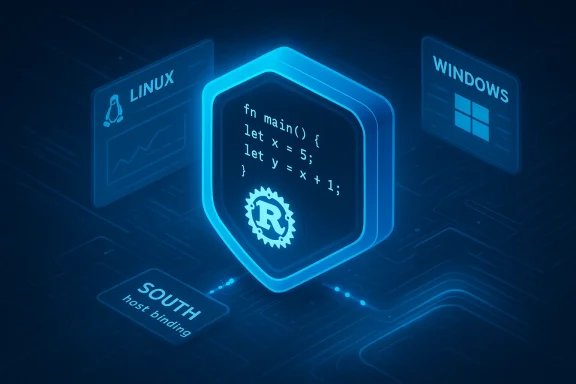
Microsoft’s engineers have quietly opened a new front in OS-level security with LiteBox, a Rust‑based “library OS” designed to shrink the exposed surface between running code and the host system so dramatically that entire classes of kernel‑exposed attack vectors become far harder to exploit. Announced and published to GitHub in early February 2026, LiteBox is not a consumer product you install — it’s a developer‑facing sandboxing runtime intended to be embedded into applications, runtimes, or platform components to supply a minimal, auditable execution environment that only exposes what the workload actually needs.
LiteBox arrives at a time when cloud operators, platform teams, and OS maintainers are rethinking trusted computing bases (TCBs). Modern kernels and system stacks are large and complex; when paired with third‑party libraries, ephemeral workloads, and multi‑tenant clouds, the inevitable result is a broad attack surface. LiteBox takes a blunt but elegant approach: reduce interfaces, reduce exposure, and move as much security‑critical functionality as possible outside the guest kernel — or out of reach entirely.
The project is openly hosted by Microsoft on GitHub under the MIT license. Its README describes LiteBox as a “security‑focused library OS” and lists multiple example scenarios: running unmodified Linux programs on Windows, sandboxing Linux applications on Linux, running programs on AMD SEV‑SNP hardware, hosting OP‑TEE trusted applications, and operating within Linux Virtualization Based Security (LVBS) environments. The repository contains platform shims, runtime components, syscall rewriters, and runners for Linux and Windows userland, demonstrating the team’s intent to support a wide spectrum of host environments.
A few practical facts you should know up front:
LiteBox follows this model: instead of exposing broad, raw system calls to an application, it provides a tightly scoped set of interfaces — in Rust flavor — that implement only the semantics the workload needs. That change moves the security boundary: the host kernel or hypervisor becomes the stronger isolation layer underneath the library, and the library minimizes what code can do by default.
The MIT license further signals the project’s intent: Microsoft wants open collaboration. The permissive license lowers integration friction for cloud providers, platform teams, and independent researchers who want to experiment, audit, or extend the runtime.
When LiteBox runs in an LVBS‑enabled environment or inside hardware‑backed confidential VMs (like AMD’s SEV‑SNP), the security model has several strong properties:
Practically speaking, LiteBox is an experimental building block right now. It offers a promising path for high‑value, security‑sensitive deployments — particularly those that already control build artifacts and can invest in integration work. For production adoption, the project will need a period of stabilization, expanded tooling, real‑world benchmarks, and operational patterns that teams can follow.
For security engineers, cloud architects, and runtime developers, LiteBox is worth watching and experimenting with. Its core idea — shrink the surface, harden the base underneath, and prefer small, auditable components — is exactly the kind of architectural thinking the industry needs as workloads continue to move into multi‑tenant and increasingly hostile execution environments.
Source: Windows Central Litebox is Microsoft’s bold new security project
 Background
LiteBox arrives at a time when cloud operators, platform teams, and OS maintainers are rethinking trusted computing bases (TCBs). Modern kernels and system stacks are large and complex; when paired with third‑party libraries, ephemeral workloads, and multi‑tenant clouds, the inevitable result is a broad attack surface. LiteBox takes a blunt but elegant approach: reduce interfaces, reduce exposure, and move as much security‑critical functionality as possible outside the guest kernel — or out of reach entirely.The project is openly hosted by Microsoft on GitHub under the MIT license. Its README describes LiteBox as a “security‑focused library OS” and lists multiple example scenarios: running unmodified Linux programs on Windows, sandboxing Linux applications on Linux, running programs on AMD SEV‑SNP hardware, hosting OP‑TEE trusted applications, and operating within Linux Virtualization Based Security (LVBS) environments. The repository contains platform shims, runtime components, syscall rewriters, and runners for Linux and Windows userland, demonstrating the team’s intent to support a wide spectrum of host environments.
A few practical facts you should know up front:
- LiteBox is implemented primarily in Rust, with a small complement of C where necessary.
- The codebase is open and actively evolving; no stable releases were published as of February 10, 2026.
- The project is clearly targeted at developers and platform teams — it’s meant to be linked into runtimes or apps rather than installed by end users.
Overview: What a “Library OS” Means Here
The library OS model — replace syscalls with library calls
Traditional execution models use an application → syscall → kernel path. That kernel mediates access to files, devices, and network resources, but it also exposes a large API surface and executes in a high‑privilege context. A library OS embeds the operating system-like services as a library linked with the application. The application calls into a small, purpose‑built runtime (the library), which provides filesystem semantics, networking stacks, and other primitives inside the same address space.LiteBox follows this model: instead of exposing broad, raw system calls to an application, it provides a tightly scoped set of interfaces — in Rust flavor — that implement only the semantics the workload needs. That change moves the security boundary: the host kernel or hypervisor becomes the stronger isolation layer underneath the library, and the library minimizes what code can do by default.
North and South: two halves of a minimal surface
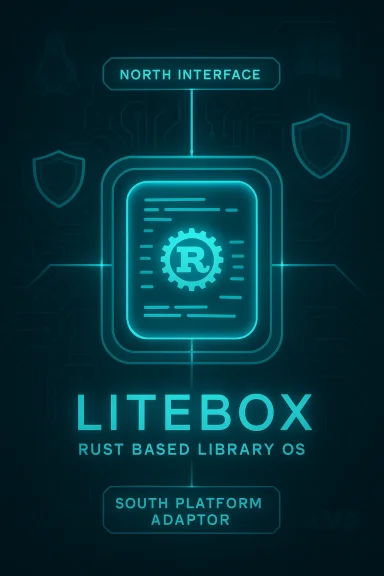
LiteBox’s architecture is modular and intentionally minimal. The project exposes two formal interface layers:- North interface: a Rust‑y, nix/rustix‑inspired API that applications and shims call into. The North interface resembles familiar POSIX semantics but is trimmed and Rust‑idiomatic, suited for linking directly into workloads that expect a UNIX‑style environment.
- South interface: the platform or host contract. A “Platform” implementation plugs into LiteBox’s South side and maps the minimal North primitives to host capabilities — whether that host is a Linux kernel, Windows userland, a hypervisor‑protected LVBS environment, or a confidential VM backed by SEV‑SNP.
Why Rust, and Why MIT?
Microsoft’s choice of Rust is not cosmetic. Rust’s ownership model and strong compile‑time memory safety guarantees eliminate whole categories of memory corruption bugs that historically drive privilege escalation and kernel compromise. For a project whose goal is to reduce TCB risk, implementing the runtime in Rust significantly raises the bar for remote and local exploitation.The MIT license further signals the project’s intent: Microsoft wants open collaboration. The permissive license lowers integration friction for cloud providers, platform teams, and independent researchers who want to experiment, audit, or extend the runtime.
Use Cases: Where LiteBox Intends to Help
LiteBox is deliberately positioned for targeted, high‑security workloads rather than general desktop substitution. Key scenarios include:- Running unmodified Linux programs on Windows: By providing a Linux‑style North interface backed by a Windows South implementation, LiteBox can let Linux binaries execute without a full Linux kernel or heavy VM, while still limiting interactions with the Windows host.
- Sandboxing Linux applications on Linux: LiteBox can constrain applications more strictly than containers by limiting kernel interactions at a more fundamental level.
- Confidential computing on SEV‑SNP: When combined with hardware memory encryption and integrity features, LiteBox can host workloads in confidential VMs where the hypervisor cannot inspect guest memory.
- OP‑TEE trusted applications: LiteBox can be used to host and isolate trusted execution environment (TEE) apps on Linux hosts.
- Integration with LVBS: LiteBox was developed in collaboration with the LVBS effort. LVBS moves certain kernel protection functions into the hypervisor or a hypervisor‑anchored component; LiteBox can run security‑critical services where the guest kernel cannot tamper with them.
How LiteBox Differs from Alternatives
LiteBox enters a crowded field of isolation technologies, but its combination of traits is distinct:- gVisor (Google): Interposes userland system calls and implements a userspace kernel. gVisor protects the host by mediating syscalls, but it still runs its isolation layer as a process interacting with the kernel. LiteBox embeds the OS services as a library linked into the app, avoiding syscall traps in many cases and enabling integration with confidential VM technologies.
- Firecracker (AWS) / microVMs: Create lightweight VMs with strong hardware‑level isolation. MicroVMs provide strong separation but still require a full virtualized kernel and device stack. LiteBox aims for lower overhead and smaller TCB by delivering only the interfaces needed as a library.
- Kata Containers / full VMs: These are VM‑backed runtime environments that trade density for security. LiteBox targets workloads where even a container or VM is overkill, or where the host kernel must be shielded from sensitive operations.
- WSL (Windows Subsystem for Linux): WSL runs a Linux userland on Windows but provides broader Linux kernel compatibility. LiteBox’s ambition is not full compatibility layer parity; rather, it aims to offer a constrained environment where only specific, auditable Linux semantics are available.
Security Benefits: What LiteBox Gains You
- Smaller attack surface: By design, LiteBox exposes a small set of APIs. Less interface equals fewer opportunities for attackers to reach functionality they shouldn’t.
- Memory safety from Rust: Most remote exploitation of userland and even kernel components stems from memory safety issues. Rust helps prevent those at compile time.
- Hypervisor and hardware anchors: When LiteBox runs in confidential or LVBS environments, the actual enforcement moves beneath the kernel, meaning kernel compromises do not necessarily expose secrets or privileged functionality.
- Auditability: The code’s relative size and the use of Rust should make audits faster and more effective than auditing a large kernel surface.
Risks and Limitations: The Other Side of the Coin
No single approach is a silver bullet. LiteBox reduces certain risks while introducing others that platform teams must evaluate:- The hypervisor becomes trusted: Moving enforcement into a hypervisor or confidential VM narrows the kernel TCB but increases dependency on the hypervisor and platform firmware. Any bugs or misconfigurations in that layer can still undermine isolation.
- API correctness and compatibility: Library OS semantics are inevitably imperfect compared to a mature kernel. Running “unmodified” Linux workloads may work for many binaries, but edge cases — kernel modules, specialized device drivers, or expectations about /proc and udev — may break or behave incorrectly.
- Syscall rewriting fragility: Public discussion of LiteBox’s syscall‑interception and rewriting techniques suggests the project can either rely on signal trapping (sigsys/sigtrap) or direct binary rewriting to replace syscall sequences with library calls. Binary rewriting can be efficient but fragile across compiler changes, differing ABIs, or JITed code.
- Networking and stack completeness: The repository shows use of lightweight network stacks (for example, smoltcp in some contexts). Those stacks are intentionally minimal and simpler to audit, but they may not match production performance or feature sets expected by typical server workloads.
- API churn and stability: The project is marked actively evolving. The README explicitly warns that APIs may change. That makes LiteBox unsuitable for production adoption in environments that require long‑term stable ABIs today.
- Operational complexity: Integrating a library OS into large existing codebases, runtimes, or container orchestrators will require careful engineering and operational discipline.
Deep Dive: Implementation Notes and Developer Experience
Project layout and components
The public repository shows several clear components:- *liteboxcommon**** libraries that implement shared logic across platforms.
- platform backends for Linux kernel userland, Windows userland, LVBS, and SEV‑SNP runners.
- shims and runners for translating binary expectations into North API calls.
- A syscall rewriter component used to patch binaries or intercept syscalls during runtime.
Linking model and developer ergonomics
Because LiteBox is a library OS, developers and runtime authors will need to:- Link application binaries or runtimes against LiteBox’s North interfaces — which can be achieved at compile time for Rust and C programs, or via binary rewriting for prebuilt artifacts.
- Choose a South platform that fits the deployment environment (Linux, Windows, LVBS, or hardware‑backed confidential VM).
- Adapt build and CI pipelines to produce or package workloads suitable for a constrained runtime.
Observability and debugging
Constrained runtimes often complicate observability. LiteBox is designed to be auditable and small, but teams must plan for:- Logging and metrics capture that do not leak secrets.
- Debugging strategies for reproducing errors outside the constrained environment.
- Tooling that understands the library OS model; traditional kernel traces will not represent the application’s view accurately.
Performance Considerations
LiteBox claims to reduce overhead by avoiding frequent context switches inherent in syscall trapping models. However, performance tradeoffs depend on deployment choices:- Binary rewriting of syscall instructions can remove syscall overhead entirely and yield near‑native performance for many operations — but the rewriting process can be brittle and may interact poorly with JITs, self‑modifying code, or nonstandard calling conventions.
- Signal‑based trapping reduces the complexity of rewriting but introduces latency on trapped syscalls.
- Internal stacks (e.g., smoltcp) prioritize auditability and minimal code size rather than high‑throughput networking; in I/O‑heavy server contexts, teams must validate whether those stacks meet throughput and latency requirements.
Integration with LVBS and Confidential Computing
LiteBox’s collaboration with LVBS is one of its most strategically interesting aspects. LVBS is an umbrella architecture for using virtualization features to back kernel protections: the hypervisor (or a privileged, small component) enforces integrity checks, cryptographic key handling, and other sensitive operations outside the guest kernel.When LiteBox runs in an LVBS‑enabled environment or inside hardware‑backed confidential VMs (like AMD’s SEV‑SNP), the security model has several strong properties:
- Sensitive assets and enforcement functions can live in the smaller, more auditable hypervisor/TBP (trusted building block) rather than the complex guest kernel.
- Even if the guest kernel is compromised, the hypervisor‑anchored components can retain control over key operations, limiting attackers’ ability to escalate or persist.
Adoption Path: Where LiteBox Is Likely to Land First
Expect experimental and niche adoption before broad production uptake. The likely early adopters include:- Cloud platform teams experimenting with offering confidential or strongly isolated runtime options to tenants.
- Security‑sensitive internal workloads, such as CI job execution or untrusted plugin execution, where the TCB must be kept minimal.
- Researchers and auditors who will scrutinize LiteBox’s small codebase to evaluate new isolation techniques.
- Runtime and language teams building sandboxed hosters for untrusted code (e.g., code execution as a service, notebook kernels, AI model sandboxing).
Practical Guidance for Developers and Operators
If you are evaluating LiteBox, here are pragmatic steps and guardrails:- Treat LiteBox as experimental today:
- Do not migrate production services without a stable release and a well‑tested integration path.
- Expect API churn and update your CI pipelines to tolerate upstream changes.
- Start small and measurable:
- Pick a narrow workload (e.g., a small CLI tool, a stateless worker) and prototype it within a LiteBox runner.
- Measure performance, failure modes, and operational observability.
- Validate the threat model:
- LiteBox focuses on reducing host interface exposure. If your primary threat vector is hypervisor compromise or supply chain issues in the hypervisor, LiteBox alone is insufficient.
- Pair LiteBox with hardened platform policies, signed images, and secure configuration of the underlying hypervisor.
- Remember integration complexity:
- Tooling for packaging, deployment, and debugging will be essential. Invest time in build pipelines that can produce artifacts compatible with LiteBox’s syscall handling.
- Audit and review:
- Use the MIT licensing and open source presence to engage third‑party auditors and the community to find and fix issues early.
Questions LiteBox Leaves Open
There are several areas where clarity will be earned only through time and community engagement:- How complete will the POSIX‑ish North interface become? Running complex Linux applications often depends on obscure kernel features or quirky filesystem semantics. The degree of fidelity will determine how broadly LiteBox can be applied.
- What is the long‑term performance story for networking and large I/O? Minimal network stacks are easy to audit, but production servers need throughput.
- How will cloud vendors adopt LVBS and expose LiteBox‑friendly primitives? Without cloud vendor buy‑in, confidential computing use cases will be limited.
- Operational best practices: How will teams handle upgrades, rollback, incident response, and forensics in library OS contexts where the runtime is part of the application binary?
Critical Analysis: Strengths, Weaknesses, and Strategic Fit
Strengths
- Principled minimalism: LiteBox’s single best characteristic is a discipline around offering only what the workload needs. That simplicity has outsized security benefits.
- Modern language choice: Rust brings compile‑time safety that materially reduces exploitable classes of bugs.
- Versatile host models: The North/South split and multiple runners make LiteBox adaptable to many environments.
- Open source and permissive licensing: MIT license and public development invite external audits and use in commercial solutions.
Weaknesses and Risks
- Immature and evolving: API churn and lack of stable releases create adoption friction for production environments.
- Operational and integration burden: Adopting a library OS requires changes to build, deploy, and debug toolchains, which can be costly.
- Trust pivot to the hypervisor: Security improves at one level but introduces or highlights trust requirements at another (the hypervisor/firmware).
- Compatibility limits: Full Linux compatibility is not the stated goal, which may disappoint teams expecting a drop‑in Linux runtime replacement.
Strategic fit
LiteBox is best framed as a tool for teams that must run untrusted or semi‑trusted code with extreme constraints on what that code can do. It is not a drop‑in replacement for existing containers or subsystem compatibility layers. For cloud providers and platform vendors pursuing confidential computing or hypervisor‑anchored kernel protections, LiteBox could become a valuable low‑TCB runtime option.Where This Could Lead: Long‑Term Implications
If LiteBox and LVBS gain traction, several ecosystem shifts could follow:- A new class of micro‑runtimes focused on auditability and small TCBs, used for specialized workloads in clouds and edge environments.
- Platform offerings that let tenants choose stronger isolation modes for specific workloads (e.g., a “LiteBox mode” in managed CI or serverless platforms).
- Shift in attacker economics: As the attack surface shrinks, attackers may be pushed toward supply chain or hypervisor compromises — altering defensive priorities across the stack.
- Cross‑pollination of OS design: Successful library OS patterns may influence how mainstream runtimes are constructed and how kernel responsibilities are decomposed.
Conclusion
LiteBox is an ambitious and well‑reasoned attempt to rethink isolation through the lens of interface minimalism and auditable runtime design. By combining Rust’s safety properties with a modular North/South architecture and integrating with LVBS and confidential computing technologies, LiteBox aims to give developers and platform teams a tool to dramatically reduce what a running workload can ask of the host.Practically speaking, LiteBox is an experimental building block right now. It offers a promising path for high‑value, security‑sensitive deployments — particularly those that already control build artifacts and can invest in integration work. For production adoption, the project will need a period of stabilization, expanded tooling, real‑world benchmarks, and operational patterns that teams can follow.
For security engineers, cloud architects, and runtime developers, LiteBox is worth watching and experimenting with. Its core idea — shrink the surface, harden the base underneath, and prefer small, auditable components — is exactly the kind of architectural thinking the industry needs as workloads continue to move into multi‑tenant and increasingly hostile execution environments.
Source: Windows Central Litebox is Microsoft’s bold new security project