

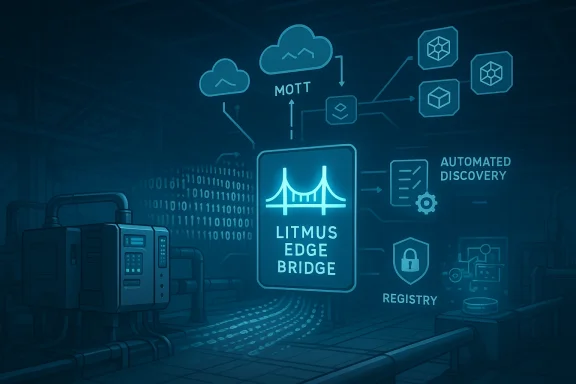
Industrial edge software provider Litmus has introduced a new bridge for Microsoft Azure IoT Operations, and the timing matters. The Litmus Edge Bridge for Microsoft Azure IoT Operations is designed to reduce one of industrial IT’s most stubborn bottlenecks: turning machine data from PLCs, sensors, and controllers into something cloud services can actually understand and use. Instead of sending untamed telemetry northbound and forcing every plant, line, or site to reinvent the same mapping work, the new connector promises automated discovery, schema-aware onboarding, and a more structured path into Microsoft’s industrial cloud stack.
For Microsoft, the move reinforces the company’s broader industrial edge strategy, where Azure IoT Operations, Akri services, Azure Device Registry, and Azure Arc are increasingly positioned as the plumbing for scalable OT-to-cloud integration. For Litmus, it is a play to stay relevant in a market that is shifting away from one-off connectivity projects and toward repeatable, governed, cloud-native industrial data operations. The result is less about a single product announcement and more about a growing industrial pattern: enterprises want faster onboarding, richer context, and less glue code between edge systems and analytics platforms.
Industrial data integration has always been harder than it looks from the outside. On the factory floor, data often lives in fragmented islands: PLC tags in one system, sensor streams in another, historian data in a third, and site-specific naming conventions everywhere. The labor required to normalize that mess has historically made industrial analytics feel slower, more expensive, and more brittle than the cloud-first world promised.
Microsoft’s answer has been to build an edge-to-cloud architecture that treats OT data as a managed asset rather than a raw firehose. In Azure IoT Operations, the asset and device concepts are not just physical machines but also configuration resources that define how connectors interact with those machines. Microsoft documents that these resources are stored as Kubernetes custom resources and synchronized with cloud services through Azure Device Registry, which is a critical clue about where the platform is headed: industrial connectivity is becoming declarative, cloud-managed, and policy-aware.
The Akri framework is central to that approach. Microsoft describes Akri services as enabling device discovery, onboarding, and monitoring at the edge, with connectors that can ingest telemetry, support command and control, and route data northbound through MQTT and other services. Microsoft also notes that Akri services are a commercial, Microsoft-managed version of the open-source CNCF Akri project, but with an API that differs from the upstream project. That matters because it shows Microsoft is not merely repackaging open source; it is shaping a managed industrial operating model around it.
Litmus has been moving in this direction for some time. ARC previously reported an integration between Litmus Edge and Azure IoT Operations, emphasizing industrial connectivity, real-time data access, and validation for native deployment on Azure Arc services. The latest Edge Bridge announcement looks like the next step in that relationship: not just integration, but automation around discovery, schema handling, and deployment lifecycle management.
The headline capability is automated discovery. Litmus Edge can identify a new PLC, sensor, or controller, and that asset can then appear inside Azure IoT Operations for onboarding in a single click. In practical terms, that reduces the friction that usually appears at the first mile of industrial digital transformation: device registration, endpoint configuration, tag mapping, and schema alignment. It is not glamorous work, but it is often the work that determines whether a pilot becomes a production deployment.
That distinction also affects deployment economics. If schema and metadata are carried forward automatically, each new site should require less custom work than the last. In theory, that makes edge rollouts more repeatable, which is a major advantage for enterprises operating across many plants, warehouses, or distributed assets. It is not a magic wand, but it is exactly the kind of leverage industrial IT has been chasing for years.
Key implications:
The Azure Device Registry is especially relevant here. Microsoft says it provides a unified registry that maps edge assets to Azure resources in the cloud and syncs those assets back to Kubernetes custom resources on the edge. In other words, Azure is trying to create a single source of truth for industrial assets that spans both the plant and the cloud. That is a serious architectural statement, and it is the kind of foundation on which automation like the Litmus bridge can matter.
It also changes the role of the edge. Rather than acting only as a buffer or transport layer, Azure IoT Operations is designed to help process data before it reaches cloud analytics platforms. The ARC report says the Litmus bridge supports filtering, enrichment, transformation, and routing before data reaches Microsoft Fabric or other cloud services. That is significant because where data gets shaped has major consequences for latency, governance, and workload cost.
Important architectural takeaways:
Akri’s value is in turning device discovery into a managed workflow. Microsoft explains that connectors can be dynamically deployed when the cluster detects matching devices, and that updates to secrets or configurations are handled by the operator. This is a substantial operational improvement over manual edge deployments, where every new device type often means another custom script, another interface definition, and another maintenance burden.
Microsoft’s own documentation reinforces the workflow: discover devices, create connector instances, sync assets into the device registry, and then route data into the MQTT broker and onward to cloud services. This is not just device visibility; it is a full lifecycle system for device and asset management. That matters because industrial software buyers increasingly want platforms that reduce operations overhead, not just ones that connect to more protocols.
What AKRI brings to the table:
This is why the bridge’s emphasis on schemas and metadata matters so much. By carrying device descriptions and asset definitions automatically into Azure IoT Operations, Litmus is trying to reduce the semantic gap between OT systems and cloud applications. In practical terms, that should make predictive maintenance, energy optimization, and OEE analytics easier to stand up with less site-by-site rework.
That is why the edge is becoming a processing layer rather than a simple gateway. If industrial data can be filtered, enriched, and transformed before it reaches Microsoft Fabric or other services, enterprises can reduce noise earlier and improve downstream consistency. It also allows organizations to make governance decisions closer to the source, which is far easier than trying to clean up messy data after it is already in the cloud.
Still, there is a caution here. The value of automation depends on how good the underlying discovery and modeling logic is. If the metadata is incomplete or the schema assumptions are wrong, the integration may accelerate bad data just as efficiently as good data. That is why the bridge is promising, but also why governance will matter more than the marketing suggests.
That matters because industrial cloud strategy is no longer only about ingestion. The winning vendor is likely to be the one that reduces deployment friction, preserves semantics, and gives customers a path from physical asset to analytics without a months-long services engagement. Microsoft is clearly trying to own that middle layer.
This also gives Microsoft a compelling story for IT and OT convergence. Azure Arc gives enterprise IT familiar control-plane concepts, while Akri services and Device Registry speak more directly to industrial device realities. If Microsoft can keep reducing the gap between those two worlds, it strengthens its case against vendors that only address one side of the equation.
Microsoft’s strategic advantages:
The company also benefits from the shift toward composable industrial architectures. If customers want to use Litmus Edge for discovery and local processing, then push managed assets into Azure for broader orchestration and analytics, Litmus becomes more embedded in the full workflow. That is a stronger position than being treated as a disposable connectivity layer.
At the same time, this is a relationship that has to be managed carefully. The closer Litmus gets to a hyperscaler’s stack, the more important it becomes to maintain differentiation. If the value is perceived as only being “the thing that makes Azure IoT Operations easier,” Litmus risks being absorbed into the platform narrative rather than owning one. That is the classic partner dilemma in industrial software.
Litmus-specific upside:
The bridge’s support for inline processing is equally important. Filtering, enriching, transforming, and routing data before it enters cloud analytics can lower bandwidth costs, improve performance, and protect downstream systems from noise. In industrial environments, where connectivity is often uneven and data volumes are high, processing closer to the edge is usually more sensible than hauling everything upstream.
That should matter to regulated industries. Energy, pharmaceuticals, food and beverage, and critical infrastructure operators do not just need data pipes; they need auditable systems with clear responsibility boundaries. A bridge that improves semantics and management can be just as important as one that improves speed.
Another concern is lock-in, even if the integration is technically elegant. Once industrial asset models, schemas, and deployment practices are expressed in a Microsoft-centric control plane, switching costs can rise quickly. That may be acceptable for some enterprises, but buyers should be aware that a smoother onboarding experience can also create deeper platform dependency over time.
Security is another area that deserves scrutiny. Any system that automatically discovers devices and creates management objects has to be extremely careful about trust boundaries, identity, and authorization. Microsoft’s broader platform emphasizes governance and secure access, but the more automation you introduce, the more important it becomes to verify that discovery does not become an attack surface.
Finally, there is the question of whether the market truly wants schema-aware, managed industrial data assets or whether many customers still prefer simpler, more direct telemetry movement. The likely answer is “both,” depending on maturity. Mature operations will appreciate the richer model; earlier-stage projects may still just want data flowing reliably before they worry about sophistication.
Potential concerns:
The biggest strengths are simplicity, structure, and ecosystem fit. That combination matters because industrial buyers increasingly want platforms that fit into the cloud tools they already trust, while still respecting the realities of OT networks and legacy devices. When a vendor can reduce integration effort and improve data quality at the same time, that is a meaningful competitive edge.
There is also a strategic concern around long-term control. Enterprises may welcome managed industrial data assets today and later discover that their model, lifecycle, and deployment processes are tightly coupled to one ecosystem. That does not make the approach wrong, but it does mean decision-makers should evaluate exit costs as carefully as they evaluate onboarding speed.
The broader market implication is that industrial software is moving toward declarative, cloud-managed operations. The days of treating the edge as a collection of custom scripts and isolated gateways are fading, especially for enterprises that want repeatable analytics, AI-ready datasets, and cross-site governance. Whether Litmus and Microsoft become a dominant pair or simply a strong reference architecture will depend on how well they turn this integration into measurable operational outcomes.
What to watch next:
Source: ARCweb.com Litmus Launches Edge Bridge for Microsoft Azure IoT Operations to Simplify Industrial Data Integration
For Microsoft, the move reinforces the company’s broader industrial edge strategy, where Azure IoT Operations, Akri services, Azure Device Registry, and Azure Arc are increasingly positioned as the plumbing for scalable OT-to-cloud integration. For Litmus, it is a play to stay relevant in a market that is shifting away from one-off connectivity projects and toward repeatable, governed, cloud-native industrial data operations. The result is less about a single product announcement and more about a growing industrial pattern: enterprises want faster onboarding, richer context, and less glue code between edge systems and analytics platforms.
 Background
Industrial data integration has always been harder than it looks from the outside. On the factory floor, data often lives in fragmented islands: PLC tags in one system, sensor streams in another, historian data in a third, and site-specific naming conventions everywhere. The labor required to normalize that mess has historically made industrial analytics feel slower, more expensive, and more brittle than the cloud-first world promised.Microsoft’s answer has been to build an edge-to-cloud architecture that treats OT data as a managed asset rather than a raw firehose. In Azure IoT Operations, the asset and device concepts are not just physical machines but also configuration resources that define how connectors interact with those machines. Microsoft documents that these resources are stored as Kubernetes custom resources and synchronized with cloud services through Azure Device Registry, which is a critical clue about where the platform is headed: industrial connectivity is becoming declarative, cloud-managed, and policy-aware.
The Akri framework is central to that approach. Microsoft describes Akri services as enabling device discovery, onboarding, and monitoring at the edge, with connectors that can ingest telemetry, support command and control, and route data northbound through MQTT and other services. Microsoft also notes that Akri services are a commercial, Microsoft-managed version of the open-source CNCF Akri project, but with an API that differs from the upstream project. That matters because it shows Microsoft is not merely repackaging open source; it is shaping a managed industrial operating model around it.
Litmus has been moving in this direction for some time. ARC previously reported an integration between Litmus Edge and Azure IoT Operations, emphasizing industrial connectivity, real-time data access, and validation for native deployment on Azure Arc services. The latest Edge Bridge announcement looks like the next step in that relationship: not just integration, but automation around discovery, schema handling, and deployment lifecycle management.
What Litmus Is Actually Launching
At the center of the announcement is a connector, but the word “connector” undersells what the product is trying to be. According to ARC’s reporting, the Litmus Edge Bridge links Litmus Edge with Azure IoT Operations so that devices, schemas, and metadata flow automatically from edge environments into Azure services. The promise is that industrial teams spend less time writing scripts and more time building actual use cases.The headline capability is automated discovery. Litmus Edge can identify a new PLC, sensor, or controller, and that asset can then appear inside Azure IoT Operations for onboarding in a single click. In practical terms, that reduces the friction that usually appears at the first mile of industrial digital transformation: device registration, endpoint configuration, tag mapping, and schema alignment. It is not glamorous work, but it is often the work that determines whether a pilot becomes a production deployment.
Why This Is More Than a Simple Integration
The shift from raw telemetry to structured, schema-aware data assets is the most consequential part of the launch. Traditional pipelines often treat industrial signals as generic measurements, leaving analytics teams to reconstruct context later. This bridge instead aims to preserve meaning earlier in the chain, which is critical if companies want dependable analytics, governed data products, or AI-ready industrial datasets.That distinction also affects deployment economics. If schema and metadata are carried forward automatically, each new site should require less custom work than the last. In theory, that makes edge rollouts more repeatable, which is a major advantage for enterprises operating across many plants, warehouses, or distributed assets. It is not a magic wand, but it is exactly the kind of leverage industrial IT has been chasing for years.
Key implications:
- Faster onboarding of OT assets.
- Less manual scripting and custom configuration.
- Better consistency across multi-site deployments.
- Stronger handoff from connectivity to analytics.
- Reduced risk of data-context drift over time.
How Azure IoT Operations Fits In
Microsoft’s Azure IoT Operations is not just another IoT ingestion layer. Microsoft positions it as an edge-capable system that uses device and asset management, schema registry, MQTT-based data flows, and Kubernetes-native resources to connect industrial devices to cloud services. That architecture is important because it means the platform is designed around distributed operations rather than a single centralized data pipe.The Azure Device Registry is especially relevant here. Microsoft says it provides a unified registry that maps edge assets to Azure resources in the cloud and syncs those assets back to Kubernetes custom resources on the edge. In other words, Azure is trying to create a single source of truth for industrial assets that spans both the plant and the cloud. That is a serious architectural statement, and it is the kind of foundation on which automation like the Litmus bridge can matter.
The Role of Schemas and Data Flows
A lot of industrial integration pain comes from the fact that raw data is not enough. Enterprises need to know what the tag means, where it came from, how it should be interpreted, and which downstream application can trust it. Microsoft’s documentation notes that schema registry is used to define and manage schemas for assets, while data flows use those schemas to deserialize and serialize messages. That is the technical backbone that makes “structured” industrial data a real product promise rather than marketing language.It also changes the role of the edge. Rather than acting only as a buffer or transport layer, Azure IoT Operations is designed to help process data before it reaches cloud analytics platforms. The ARC report says the Litmus bridge supports filtering, enrichment, transformation, and routing before data reaches Microsoft Fabric or other cloud services. That is significant because where data gets shaped has major consequences for latency, governance, and workload cost.
Important architectural takeaways:
- Azure Device Registry provides cloud-edge synchronization.
- Schema registry helps preserve meaning.
- Data flows handle serialization and routing.
- MQTT broker serves as a central messaging path.
- Azure Arc manages deployment and lifecycle across distributed environments.
Why AKRI Matters Here
The announcement specifically calls out the Kubernetes Resource Interface (AKRI) framework, and that deserves attention because Akri is not just a branding layer. Microsoft says Akri services let Azure IoT Operations discover devices on the network, establish southbound connections to assets, and support connectors for scenarios like OPC UA, ONVIF, HTTP/REST, SSE, and MQTT. That breadth gives the platform a flexible, extensible edge model rather than a narrow protocol tunnel.Akri’s value is in turning device discovery into a managed workflow. Microsoft explains that connectors can be dynamically deployed when the cluster detects matching devices, and that updates to secrets or configurations are handled by the operator. This is a substantial operational improvement over manual edge deployments, where every new device type often means another custom script, another interface definition, and another maintenance burden.
From Detection to Onboarding
The ARC report says Litmus Edge can make a newly discovered device visible within Azure IoT Operations and allow it to be onboarded in one click. That is the kind of simplification that can compress a weeks-long engineering task into a repeatable process. If it works consistently, it could reduce the gap between asset detection and usable data from days to minutes.Microsoft’s own documentation reinforces the workflow: discover devices, create connector instances, sync assets into the device registry, and then route data into the MQTT broker and onward to cloud services. This is not just device visibility; it is a full lifecycle system for device and asset management. That matters because industrial software buyers increasingly want platforms that reduce operations overhead, not just ones that connect to more protocols.
What AKRI brings to the table:
- Dynamic connector deployment.
- Automatic asset discovery.
- Operator-managed configuration updates.
- Support for multiple industrial protocols.
- Better scalability as sites add more equipment.
The Industrial Data Problem This Tries to Solve
The core pain point is not connectivity in isolation; it is context. A factory may already be “connected” in the sense that data is accessible somewhere, but if every site names assets differently and maps tags manually, the analytics effort becomes a custom integration project every single time. That is expensive, slow, and difficult to govern at scale.This is why the bridge’s emphasis on schemas and metadata matters so much. By carrying device descriptions and asset definitions automatically into Azure IoT Operations, Litmus is trying to reduce the semantic gap between OT systems and cloud applications. In practical terms, that should make predictive maintenance, energy optimization, and OEE analytics easier to stand up with less site-by-site rework.
Why Raw Telemetry Is No Longer Enough
The article’s contrast between raw telemetry and structured industrial data is a useful shorthand for a broader market shift. Industrial organizations have learned that data lakes full of uncontextualized machine signals are rarely enough to drive reliable operations decisions. Without schema, lineage, and ownership, companies often end up with large volumes of data but little trust in the outputs.That is why the edge is becoming a processing layer rather than a simple gateway. If industrial data can be filtered, enriched, and transformed before it reaches Microsoft Fabric or other services, enterprises can reduce noise earlier and improve downstream consistency. It also allows organizations to make governance decisions closer to the source, which is far easier than trying to clean up messy data after it is already in the cloud.
Enterprise Impact vs. Plant-Floor Reality
For enterprise IT, this kind of integration supports standardization, policy, and cross-site governance. For plant teams, the appeal is simpler: less time spent getting a new machine recognized by the broader data stack. Those are related goals, but they are not the same, and the best industrial platforms are the ones that can satisfy both without forcing one side to sacrifice too much.Still, there is a caution here. The value of automation depends on how good the underlying discovery and modeling logic is. If the metadata is incomplete or the schema assumptions are wrong, the integration may accelerate bad data just as efficiently as good data. That is why the bridge is promising, but also why governance will matter more than the marketing suggests.
What This Means for Microsoft
For Microsoft, the Litmus announcement reinforces Azure IoT Operations as a strategic industrial edge platform rather than a niche IoT feature. The company has been building a model where Azure Arc handles deployment and governance, Akri services handle discovery and connectivity, and the Azure Device Registry handles asset synchronization across edge and cloud. Litmus now adds a partner layer that can make that stack easier to adopt in industrial environments that already run on Litmus Edge.That matters because industrial cloud strategy is no longer only about ingestion. The winning vendor is likely to be the one that reduces deployment friction, preserves semantics, and gives customers a path from physical asset to analytics without a months-long services engagement. Microsoft is clearly trying to own that middle layer.
Azure Arc as the Glue
The ARC report notes that Azure Arc extends deployment, governance, and lifecycle management across distributed edge environments. That is more than a convenience feature; it is the mechanism that lets Microsoft treat remote factories, plants, and substations as managed extensions of the cloud. In industrial settings, that symmetry is essential because no one wants to manage dozens of edge clusters as if they were snowflakes.This also gives Microsoft a compelling story for IT and OT convergence. Azure Arc gives enterprise IT familiar control-plane concepts, while Akri services and Device Registry speak more directly to industrial device realities. If Microsoft can keep reducing the gap between those two worlds, it strengthens its case against vendors that only address one side of the equation.
Microsoft’s strategic advantages:
- Cloud-managed industrial edge architecture.
- Better alignment with Kubernetes and hybrid operations.
- Stronger integration with Microsoft Fabric.
- Unified governance through Azure Arc.
- A broader ecosystem for industrial partners.
What This Means for Litmus
For Litmus, the bridge is a smart product move because it positions the company as an enabler of industrial modernization rather than a standalone edge island. A lot of industrial software vendors claim to simplify data integration; fewer can demonstrate that their platform plugs directly into a major hyperscaler’s structured industrial data stack. That distinction matters in sales cycles where enterprise buyers want both immediate utility and long-term platform alignment.The company also benefits from the shift toward composable industrial architectures. If customers want to use Litmus Edge for discovery and local processing, then push managed assets into Azure for broader orchestration and analytics, Litmus becomes more embedded in the full workflow. That is a stronger position than being treated as a disposable connectivity layer.
Competitive Positioning
There is also a competitive angle. Industrial edge vendors often compete on three fronts: protocol breadth, deployment simplicity, and cloud compatibility. By tying its bridge to Azure IoT Operations and Akri, Litmus is effectively saying that its edge platform is not merely “compatible” with Microsoft’s ecosystem but operationally useful inside it. That can help in accounts already standardizing on Azure services.At the same time, this is a relationship that has to be managed carefully. The closer Litmus gets to a hyperscaler’s stack, the more important it becomes to maintain differentiation. If the value is perceived as only being “the thing that makes Azure IoT Operations easier,” Litmus risks being absorbed into the platform narrative rather than owning one. That is the classic partner dilemma in industrial software.
Litmus-specific upside:
- Stronger enterprise credibility.
- Easier alignment with Azure-centric customers.
- More repeatable industrial deployment patterns.
- Greater relevance in OT/IT modernization projects.
- Better fit for multi-site digital transformation programs.
Architectural Benefits in Practice
The most compelling promise in the launch is operational, not theoretical. If devices, schemas, and metadata can be discovered and registered automatically, then industrial teams avoid repeated data-modeling work every time a new asset is added. That reduces time to value and makes scaling from pilot to production far more realistic.The bridge’s support for inline processing is equally important. Filtering, enriching, transforming, and routing data before it enters cloud analytics can lower bandwidth costs, improve performance, and protect downstream systems from noise. In industrial environments, where connectivity is often uneven and data volumes are high, processing closer to the edge is usually more sensible than hauling everything upstream.
Sequencing the Operational Flow
A simplified sequence helps explain why the bridge is interesting:- Litmus Edge discovers a PLC, sensor, or controller.
- The asset becomes visible inside Azure IoT Operations.
- The operator onboard the asset with minimal manual setup.
- Schemas and metadata synchronize into Azure services.
- Data is filtered or transformed at the edge.
- Analytics platforms such as Microsoft Fabric consume cleaner, more structured data.
The Hidden Benefit: Governance
There is also a governance benefit that is easy to miss. When assets are treated as managed resources with schemas and cloud synchronization, access control, logging, policies, and auditing become more practical to enforce consistently. Microsoft notes that Azure Resource Manager supports these controls for assets and devices, which suggests the architecture is designed to satisfy enterprise governance requirements, not just connectivity requirements.That should matter to regulated industries. Energy, pharmaceuticals, food and beverage, and critical infrastructure operators do not just need data pipes; they need auditable systems with clear responsibility boundaries. A bridge that improves semantics and management can be just as important as one that improves speed.
Risks and Concerns
The biggest risk is overpromising simplicity. Industrial environments are heterogeneous, legacy-heavy, and often full of exceptions that no vendor brochure can fully anticipate. Automated discovery and single-click onboarding are attractive goals, but the real world still includes weird protocols, aging equipment, network segmentation, and plant-specific security rules.Another concern is lock-in, even if the integration is technically elegant. Once industrial asset models, schemas, and deployment practices are expressed in a Microsoft-centric control plane, switching costs can rise quickly. That may be acceptable for some enterprises, but buyers should be aware that a smoother onboarding experience can also create deeper platform dependency over time.
Risks to Watch Closely
There is also an execution risk around consistency. If automated discovery works brilliantly at one plant but becomes brittle across multiple sites, the value proposition weakens fast. Industrial buyers tend to be generous with proof-of-concept success and unforgiving when a platform fails to scale across a portfolio.Security is another area that deserves scrutiny. Any system that automatically discovers devices and creates management objects has to be extremely careful about trust boundaries, identity, and authorization. Microsoft’s broader platform emphasizes governance and secure access, but the more automation you introduce, the more important it becomes to verify that discovery does not become an attack surface.
Integration Risk Is Not Just Technical
There is a business-model risk as well. If Litmus and Microsoft keep adding automation on top of each other, they could create a powerful joint value proposition — but they could also blur accountability when something breaks. Industrial buyers often want one throat to choke, and multi-vendor partnerships can complicate support expectations unless roles are crystal clear.Finally, there is the question of whether the market truly wants schema-aware, managed industrial data assets or whether many customers still prefer simpler, more direct telemetry movement. The likely answer is “both,” depending on maturity. Mature operations will appreciate the richer model; earlier-stage projects may still just want data flowing reliably before they worry about sophistication.
Potential concerns:
- Automation may hide complexity rather than eliminate it.
- Deep Azure integration can increase dependency.
- Security posture must keep pace with discovery automation.
- Multi-site consistency may be harder than the demo suggests.
- Support ownership across vendors may be unclear.
- Early-stage customers may not need all the schema machinery.
Strengths and Opportunities
The announcement has real strategic upside because it targets the exact friction point that slows industrial transformation: getting machine data from the floor into a governed cloud model without endless custom work. If Litmus and Microsoft can make that process repeatable, the platform could become a serious accelerator for modernization programs across manufacturing, energy, and critical infrastructure. The opportunity is not just faster onboarding, but better economics for scaling industrial analytics.The biggest strengths are simplicity, structure, and ecosystem fit. That combination matters because industrial buyers increasingly want platforms that fit into the cloud tools they already trust, while still respecting the realities of OT networks and legacy devices. When a vendor can reduce integration effort and improve data quality at the same time, that is a meaningful competitive edge.
- Faster device onboarding and less manual scripting.
- Better metadata handling and schema preservation.
- Cleaner path into Azure-native industrial workflows.
- Strong fit with Microsoft Fabric and edge analytics.
- Improved OT-IT collaboration through automation.
- Potentially lower project risk for multi-site rollouts.
- More scalable governance through Azure Arc and Device Registry.
Risks and Concerns
The same features that make the bridge attractive also create operational expectations that may be hard to satisfy universally. Industrial sites differ wildly in age, protocol mix, and governance maturity, so a connector that feels seamless in one environment may require substantial tuning in another. That is why the market should view this as a capability enhancer, not an automatic cure for industrial data complexity.There is also a strategic concern around long-term control. Enterprises may welcome managed industrial data assets today and later discover that their model, lifecycle, and deployment processes are tightly coupled to one ecosystem. That does not make the approach wrong, but it does mean decision-makers should evaluate exit costs as carefully as they evaluate onboarding speed.
- Automation can conceal unresolved data-quality problems.
- Deployment success may vary by plant and protocol mix.
- Security and identity management must remain strict.
- Vendor dependency could grow as more assets are modeled.
- Support and accountability may be split across partners.
- Not every use case needs schema-heavy orchestration.
- Governance overhead can rise if standards are not enforced.
Looking Ahead
The next phase to watch is adoption, not announcement volume. If the bridge starts appearing in real industrial deployments, the interesting question will be whether customers actually use it to reduce deployment time and standardize device onboarding, or whether it remains a niche accelerator for already Azure-aligned environments. That answer will say a lot about the maturity of the industrial edge market in 2026.The broader market implication is that industrial software is moving toward declarative, cloud-managed operations. The days of treating the edge as a collection of custom scripts and isolated gateways are fading, especially for enterprises that want repeatable analytics, AI-ready datasets, and cross-site governance. Whether Litmus and Microsoft become a dominant pair or simply a strong reference architecture will depend on how well they turn this integration into measurable operational outcomes.
What to watch next:
- Real customer deployments beyond the announcement cycle.
- Whether Microsoft expands Akri connector coverage further.
- How tightly Litmus integrates with Fabric-facing workflows.
- Evidence of reduced onboarding time in multi-site rollouts.
- Security and governance features added around discovery automation.
Source: ARCweb.com Litmus Launches Edge Bridge for Microsoft Azure IoT Operations to Simplify Industrial Data Integration
