

Logicalis Australia has been awarded Microsoft Frontier Partner status in July 2026, adding the recognition to its Microsoft Copilot specialisation and placing the company among a small group of Microsoft partners validated for enterprise AI, Copilot, data, security, and cloud transformation work. The award is not merely another channel badge for a press release carousel. It is a signal that Microsoft’s partner economy is being reorganised around a harder problem than licensing Copilot: turning AI experiments into governed business systems. For customers, the practical question is no longer whether a provider can demo a chatbot, but whether it can keep one useful, secure, measurable, and supportable after the pilot budget has run out.
For the past two years, the Microsoft ecosystem has been saturated with Copilot theatre. Partners have run workshops, built proof-of-concepts, mapped use cases, and promised productivity uplift to boards that know just enough about generative AI to be impatient. The missing middle has been less glamorous: data readiness, identity design, information protection, retention policies, user adoption, workflow redesign, and cost control.
Frontier Partner status is Microsoft’s way of naming that middle as the new centre of gravity. The phrase frontier may sound like the usual vendor poetry, but the program is tied to a real shift in Microsoft’s commercial machinery. Microsoft wants partners that can help customers move from Copilot as a licensed feature to AI as an operating model.
That is why Logicalis’s announcement matters beyond the Australian channel. The company is not being recognised simply for reselling Microsoft 365 Copilot or running a few enablement sessions. The status is framed around advanced capability across Copilot, data and AI, security, governance, and managed services — the stack of services required when an organisation tries to put agents into production rather than into a slide deck.
Lisa Fortey, general manager of Logicalis Australia, described the recognition as reflecting sustained investment in people, capability, and customer outcomes. That phrasing is standard channel language, but the underlying market pressure is real. Customers are discovering that Copilot adoption is less like switching on Teams and more like introducing a new class of semi-autonomous software worker into the business.
The production phase is where enterprise AI becomes expensive, politically sensitive, and operationally messy. It is where a customer asks who owns an AI-generated decision, how sensitive files are being surfaced in prompts, whether Copilot is respecting existing access controls, and how an agent’s actions are audited. It is also where the gap between a clever demo and a reliable enterprise service becomes painfully obvious.
Logicalis is positioning itself directly in that gap. The company says its strength is helping customers move from pilots and isolated use cases to governed, enterprise-wide adoption. That is the right sentence for the moment, because many organisations are now sitting on a pile of AI experiments that never became durable business processes.
The industry has seen this pattern before. Cloud adoption began with shadow IT, trial workloads, and executive excitement before security teams, finance departments, and platform engineering dragged it into a governed model. AI is repeating that arc at much higher speed and with more reputational risk.
That matters because Copilot has become a sprawling brand. It now touches Microsoft 365, Dynamics, Security, GitHub, Power Platform, Azure AI, and the emerging agent stack. A customer can say “we’re adopting Copilot” and mean anything from summarising Teams meetings to building workflow agents that trigger actions across business systems.
The harder work begins when Copilot is extended through Copilot Studio and connected to company data, line-of-business applications, and external services. At that point, a Copilot deployment starts to look less like a productivity tool rollout and more like application development with governance, identity, compliance, and lifecycle management attached.
Logicalis’s combination of Copilot specialisation, Azure Expert MSP status, and 12 Microsoft Advanced Specialisations gives the company a stronger claim than a partner whose AI story begins and ends with prompt training. Customers should still interrogate delivery experience carefully, but the portfolio suggests Microsoft sees Logicalis as capable across the dependencies that make Copilot viable at scale.
That distinction is important for Australian and New Zealand customers trying to understand what the badge means. A distributor-oriented Frontier designation may signal ecosystem enablement, commercial reach, marketplace motion, and partner support. A services partner designation speaks more directly to enterprise transformation, consulting, deployment, and managed operations.
Microsoft benefits from both. It needs distributors to industrialise Copilot and agent adoption across the channel, especially for smaller partners and customers. It also needs direct services partners to rescue larger enterprises from the complexity that Microsoft itself has created by embedding AI across nearly every layer of the cloud portfolio.
For Logicalis, the recognition strengthens alignment with Microsoft field teams, co-sell opportunities, strategic programs, and marketplace-led initiatives. That is not just ceremonial. In Microsoft’s ecosystem, closer alignment can influence which partners are pulled into customer opportunities, which solutions receive marketplace attention, and which organisations get early access to technical and commercial programs.
The board-level curiosity phase is ending. Executives have seen enough demonstrations of summarisation, drafting, code generation, and conversational search to believe there is value somewhere. The problem is that broad belief does not automatically produce clean use cases, defensible ROI, or safe deployment patterns.
Across Australia and New Zealand, Logicalis says organisations are looking for practical ways to lift productivity, improve customer experiences, and simplify operations through AI while maintaining governance, security, and trust. That sentence captures the tension in the market: customers want speed and control, and they are discovering that the two are not naturally aligned.
The productivity case for Copilot is especially tricky. Time saved in a meeting summary or email draft is easy to imagine but harder to measure across a workforce. The more compelling enterprise cases may come from redesigned workflows, customer service automation, knowledge retrieval, software engineering acceleration, and operations support — but those are also the cases that require deeper integration and stronger guardrails.
For WindowsForum readers, particularly sysadmins and Microsoft 365 administrators, that should trigger both interest and caution. Agents amplify the old problems of identity, permissions, data leakage, endpoint trust, and auditability. If a user has excessive access, an AI assistant can surface excessive information faster. If a workflow is poorly controlled, an agent may automate the wrong thing at enterprise scale.
This is where Frontier Partner status becomes more than marketing. The real value of a partner is not that it can build an agent, but that it can help decide whether an agent should exist, what permissions it should hold, how it should be monitored, and when it should be retired. Enterprises do not need another unmanaged automation layer hiding inside business units.
Microsoft’s strength has always been integration. Its weakness, from an administrator’s perspective, is also integration: every new capability tends to connect with everything else. The AI stack makes that duality sharper. Copilot and agents are powerful because they can reason across mail, documents, chats, meetings, CRM records, tickets, code repositories, and workflows; they are risky for precisely the same reason.
Generative AI systems interact with sensitive data in ways that are easy to underestimate. A model does not need to “leak” data in a cinematic breach scenario to create risk. It can simply reveal information to a user who technically had access but never should have been able to discover it so easily. It can summarise stale, confidential, or legally sensitive content into a polished answer that appears more authoritative than the underlying source deserves.
That is why readiness matters. Before an organisation rolls out Copilot broadly, it needs to understand data classification, oversharing, identity hygiene, retention rules, and the boundaries between sanctioned and unsanctioned AI tools. This is not glamorous work, but it determines whether AI adoption becomes a controlled capability or a compliance incident waiting for a prompt.
Logicalis’s messaging leans into this reality. The company talks about strategy, implementation, governance, security, ongoing managed services, and measurable outcomes. Those are exactly the nouns customers should be demanding from any partner that claims to be AI-ready.
This is not altruism. Microsoft needs partners to make Copilot and agent adoption stick because the company cannot deliver every readiness assessment, data cleanup, workflow redesign, and change-management program itself. The partner ecosystem is the scaling layer between Redmond’s product ambition and the messy reality of customer environments.
For partners, the reward is access. Frontier Partner status can bring deeper alignment with Microsoft field teams, stronger co-sell opportunities, access to strategic programs, and more marketplace collaboration. Those benefits matter because Microsoft’s sales engine remains one of the most powerful distribution systems in enterprise technology.
But there is a trade-off. The more tightly a partner aligns with Microsoft’s AI agenda, the more customers should ask whether the advice they receive is independent strategy or Microsoft-first implementation planning. That does not make the advice bad. It does mean customers should be explicit about business outcomes, architecture principles, data boundaries, and exit options before the AI roadmap becomes indistinguishable from Microsoft’s licensing roadmap.
The right way to use the badge is as a filter, not a final decision. Customers should still ask for evidence of production deployments, adoption metrics, security design patterns, governance frameworks, and post-launch support models. They should also ask how the partner handles failure: abandoned use cases, low user adoption, unexpected costs, data-quality problems, and controls that prove too restrictive or too loose.
This is especially important because enterprise AI projects often fail softly. They do not always explode in obvious ways. Instead, they become underused assistants, expensive pilots, disconnected automations, or tools that produce enough errors to erode trust. A good partner should be able to discuss those failure modes without turning every answer into a sales pitch.
Logicalis’s Azure Expert MSP status and advanced specialisations suggest operational maturity, but customers should map that maturity to their own needs. A bank, university, healthcare provider, manufacturer, and government agency will all have different risk profiles. The partner’s job is not to make Copilot look inevitable; it is to make adoption defensible.
Many organisations are still treating AI adoption as a software deployment problem. They assign licences, publish an acceptable-use policy, run a workshop, and wait for productivity to appear. That approach misunderstands how work actually changes.
Copilot and agents alter the relationship between employees and information. They can reduce friction in drafting, searching, summarising, and analysing, but they also require users to become better reviewers, editors, and process thinkers. A worker who blindly accepts AI output becomes a risk. A worker who refuses to use AI at all may become a bottleneck. The productive middle has to be taught.
This is why partners are talking about adoption and measurable outcomes so loudly. The technical deployment may be the easiest part of the engagement. The harder task is helping customers identify where AI changes work enough to matter, and then proving that the change is worth keeping.
Customers also face a talent constraint. AI-ready cloud architects, data governance specialists, security engineers, Power Platform developers, adoption leads, and change managers are not sitting idle in large numbers. Partners such as Logicalis are valuable partly because they can concentrate scarce expertise across multiple customers and repeat the patterns that work.
That repetition is where Microsoft hopes the partner ecosystem will create leverage. A good partner can turn one customer’s hard-won deployment lessons into a more reliable methodology for the next. A poor partner merely repeats vendor messaging and leaves the customer to discover the traps alone.
The Frontier recognition is therefore both a credential and a challenge. Logicalis now has a stronger public claim to be one of the partners customers can trust with enterprise AI transformation. The market will judge that claim not by the announcement, but by whether customers can point to real productivity, safer processes, better service experiences, and manageable operating costs after deployment.
AI is nowhere near that stage yet. It is still too novel, too uneven, too expensive, and too wrapped in strategic anxiety. But Microsoft’s Frontier Partner push is an attempt to move it in that direction: from spectacle to repeatable capability.
For Logicalis, that means the work ahead is less about being seen as innovative and more about making AI mundane enough for serious enterprises to rely on. That includes boring disciplines such as permissions reviews, data lifecycle management, prompt and agent governance, service management, cost reporting, incident response, and user support. These are not the things that get the loudest applause at an AI keynote, but they are the things that determine whether customers renew, expand, or retreat.
If the Frontier label has substance, it should show up in fewer stalled pilots and more production systems that survive scrutiny from security, legal, finance, and frontline users. That is the threshold that separates AI enthusiasm from enterprise transformation.
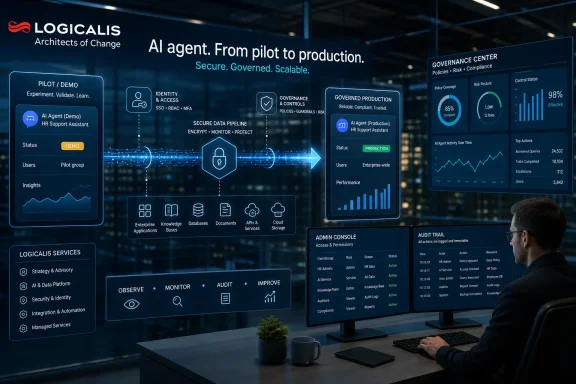 Microsoft’s AI Channel Is Moving Past the Demo Economy
For the past two years, the Microsoft ecosystem has been saturated with Copilot theatre. Partners have run workshops, built proof-of-concepts, mapped use cases, and promised productivity uplift to boards that know just enough about generative AI to be impatient. The missing middle has been less glamorous: data readiness, identity design, information protection, retention policies, user adoption, workflow redesign, and cost control.Frontier Partner status is Microsoft’s way of naming that middle as the new centre of gravity. The phrase frontier may sound like the usual vendor poetry, but the program is tied to a real shift in Microsoft’s commercial machinery. Microsoft wants partners that can help customers move from Copilot as a licensed feature to AI as an operating model.
That is why Logicalis’s announcement matters beyond the Australian channel. The company is not being recognised simply for reselling Microsoft 365 Copilot or running a few enablement sessions. The status is framed around advanced capability across Copilot, data and AI, security, governance, and managed services — the stack of services required when an organisation tries to put agents into production rather than into a slide deck.
Lisa Fortey, general manager of Logicalis Australia, described the recognition as reflecting sustained investment in people, capability, and customer outcomes. That phrasing is standard channel language, but the underlying market pressure is real. Customers are discovering that Copilot adoption is less like switching on Teams and more like introducing a new class of semi-autonomous software worker into the business.
The Badge Is Really About Production AI
Microsoft’s own partner messaging has become increasingly blunt: AI has moved from experimentation to production, and customers want measurable outcomes with security, governance, and responsible AI built in from the start. That is a very different sales motion from the first wave of generative AI adoption, where novelty alone could justify a pilot.The production phase is where enterprise AI becomes expensive, politically sensitive, and operationally messy. It is where a customer asks who owns an AI-generated decision, how sensitive files are being surfaced in prompts, whether Copilot is respecting existing access controls, and how an agent’s actions are audited. It is also where the gap between a clever demo and a reliable enterprise service becomes painfully obvious.
Logicalis is positioning itself directly in that gap. The company says its strength is helping customers move from pilots and isolated use cases to governed, enterprise-wide adoption. That is the right sentence for the moment, because many organisations are now sitting on a pile of AI experiments that never became durable business processes.
The industry has seen this pattern before. Cloud adoption began with shadow IT, trial workloads, and executive excitement before security teams, finance departments, and platform engineering dragged it into a governed model. AI is repeating that arc at much higher speed and with more reputational risk.
Copilot Specialisation Makes the Frontier Claim More Credible
The Frontier recognition lands alongside Logicalis’s Microsoft Copilot specialisation, which is arguably the more concrete customer-facing credential. Microsoft’s Copilot specialisation is meant to validate experience with Microsoft 365 Copilot, Copilot Chat, Copilot Studio, and agents. In plain terms, it says a partner has done more than sell licences; it has demonstrated capability in readiness, deployment, adoption, extension, and measurable outcomes.That matters because Copilot has become a sprawling brand. It now touches Microsoft 365, Dynamics, Security, GitHub, Power Platform, Azure AI, and the emerging agent stack. A customer can say “we’re adopting Copilot” and mean anything from summarising Teams meetings to building workflow agents that trigger actions across business systems.
The harder work begins when Copilot is extended through Copilot Studio and connected to company data, line-of-business applications, and external services. At that point, a Copilot deployment starts to look less like a productivity tool rollout and more like application development with governance, identity, compliance, and lifecycle management attached.
Logicalis’s combination of Copilot specialisation, Azure Expert MSP status, and 12 Microsoft Advanced Specialisations gives the company a stronger claim than a partner whose AI story begins and ends with prompt training. Customers should still interrogate delivery experience carefully, but the portfolio suggests Microsoft sees Logicalis as capable across the dependencies that make Copilot viable at scale.
Australia’s Microsoft Channel Is Being Sorted Into New Tiers
The CRN Australia report notes that Logicalis joins a local group associated with Frontier recognition that includes Dicker Data, Ingram Micro, and TD Synnex. That comparison is revealing because those names do not all play the same role. Distributors enable the channel at scale, while Logicalis works more directly with organisations on design, implementation, security, management, and ongoing optimisation.That distinction is important for Australian and New Zealand customers trying to understand what the badge means. A distributor-oriented Frontier designation may signal ecosystem enablement, commercial reach, marketplace motion, and partner support. A services partner designation speaks more directly to enterprise transformation, consulting, deployment, and managed operations.
Microsoft benefits from both. It needs distributors to industrialise Copilot and agent adoption across the channel, especially for smaller partners and customers. It also needs direct services partners to rescue larger enterprises from the complexity that Microsoft itself has created by embedding AI across nearly every layer of the cloud portfolio.
For Logicalis, the recognition strengthens alignment with Microsoft field teams, co-sell opportunities, strategic programs, and marketplace-led initiatives. That is not just ceremonial. In Microsoft’s ecosystem, closer alignment can influence which partners are pulled into customer opportunities, which solutions receive marketplace attention, and which organisations get early access to technical and commercial programs.
The Market Has Stopped Asking Whether AI Is Coming
Fortey’s most important point is that AI adoption is at a turning point because organisations are no longer deciding whether to adopt AI. They are trying to work out how to do it securely, responsibly, and with measurable impact. That shift is visible across almost every enterprise software discussion in 2026.The board-level curiosity phase is ending. Executives have seen enough demonstrations of summarisation, drafting, code generation, and conversational search to believe there is value somewhere. The problem is that broad belief does not automatically produce clean use cases, defensible ROI, or safe deployment patterns.
Across Australia and New Zealand, Logicalis says organisations are looking for practical ways to lift productivity, improve customer experiences, and simplify operations through AI while maintaining governance, security, and trust. That sentence captures the tension in the market: customers want speed and control, and they are discovering that the two are not naturally aligned.
The productivity case for Copilot is especially tricky. Time saved in a meeting summary or email draft is easy to imagine but harder to measure across a workforce. The more compelling enterprise cases may come from redesigned workflows, customer service automation, knowledge retrieval, software engineering acceleration, and operations support — but those are also the cases that require deeper integration and stronger guardrails.
The Agent Era Raises the Stakes for Administrators
The word agent has become unavoidable in Microsoft’s AI vocabulary. Copilot Studio, Azure AI Foundry, Microsoft 365 Copilot, GitHub Copilot, Fabric, and related services are increasingly being discussed as parts of an agentic stack. The message is that AI will not merely answer questions; it will perform tasks, coordinate workflows, and act on behalf of users or teams.For WindowsForum readers, particularly sysadmins and Microsoft 365 administrators, that should trigger both interest and caution. Agents amplify the old problems of identity, permissions, data leakage, endpoint trust, and auditability. If a user has excessive access, an AI assistant can surface excessive information faster. If a workflow is poorly controlled, an agent may automate the wrong thing at enterprise scale.
This is where Frontier Partner status becomes more than marketing. The real value of a partner is not that it can build an agent, but that it can help decide whether an agent should exist, what permissions it should hold, how it should be monitored, and when it should be retired. Enterprises do not need another unmanaged automation layer hiding inside business units.
Microsoft’s strength has always been integration. Its weakness, from an administrator’s perspective, is also integration: every new capability tends to connect with everything else. The AI stack makes that duality sharper. Copilot and agents are powerful because they can reason across mail, documents, chats, meetings, CRM records, tickets, code repositories, and workflows; they are risky for precisely the same reason.
Governance Is No Longer the Cleanup Phase
In the first cloud wave, many organisations treated governance as something to apply after adoption. Workloads moved to Azure, SaaS applications proliferated, and security teams later tried to impose policy, tagging, identity controls, and cost management. With AI, that sequence is far less forgiving.Generative AI systems interact with sensitive data in ways that are easy to underestimate. A model does not need to “leak” data in a cinematic breach scenario to create risk. It can simply reveal information to a user who technically had access but never should have been able to discover it so easily. It can summarise stale, confidential, or legally sensitive content into a polished answer that appears more authoritative than the underlying source deserves.
That is why readiness matters. Before an organisation rolls out Copilot broadly, it needs to understand data classification, oversharing, identity hygiene, retention rules, and the boundaries between sanctioned and unsanctioned AI tools. This is not glamorous work, but it determines whether AI adoption becomes a controlled capability or a compliance incident waiting for a prompt.
Logicalis’s messaging leans into this reality. The company talks about strategy, implementation, governance, security, ongoing managed services, and measurable outcomes. Those are exactly the nouns customers should be demanding from any partner that claims to be AI-ready.
Microsoft Is Rebuilding Partner Incentives Around AI Outcomes
The Frontier designation also reflects a broader shift in Microsoft’s partner economics. The Microsoft AI Cloud Partner Program has been evolving away from legacy badges and toward designations, specialisations, marketplace motion, and co-sell alignment. AI gives Microsoft a reason to accelerate that restructuring.This is not altruism. Microsoft needs partners to make Copilot and agent adoption stick because the company cannot deliver every readiness assessment, data cleanup, workflow redesign, and change-management program itself. The partner ecosystem is the scaling layer between Redmond’s product ambition and the messy reality of customer environments.
For partners, the reward is access. Frontier Partner status can bring deeper alignment with Microsoft field teams, stronger co-sell opportunities, access to strategic programs, and more marketplace collaboration. Those benefits matter because Microsoft’s sales engine remains one of the most powerful distribution systems in enterprise technology.
But there is a trade-off. The more tightly a partner aligns with Microsoft’s AI agenda, the more customers should ask whether the advice they receive is independent strategy or Microsoft-first implementation planning. That does not make the advice bad. It does mean customers should be explicit about business outcomes, architecture principles, data boundaries, and exit options before the AI roadmap becomes indistinguishable from Microsoft’s licensing roadmap.
Customers Should Read the Badge as a Starting Point, Not a Warranty
A Microsoft recognition can reduce search costs for customers, but it is not a substitute for due diligence. Frontier Partner status tells the market that Microsoft has validated a partner’s capabilities against its program criteria. It does not guarantee that every project team has deep experience in a customer’s industry, regulatory environment, or legacy architecture.The right way to use the badge is as a filter, not a final decision. Customers should still ask for evidence of production deployments, adoption metrics, security design patterns, governance frameworks, and post-launch support models. They should also ask how the partner handles failure: abandoned use cases, low user adoption, unexpected costs, data-quality problems, and controls that prove too restrictive or too loose.
This is especially important because enterprise AI projects often fail softly. They do not always explode in obvious ways. Instead, they become underused assistants, expensive pilots, disconnected automations, or tools that produce enough errors to erode trust. A good partner should be able to discuss those failure modes without turning every answer into a sales pitch.
Logicalis’s Azure Expert MSP status and advanced specialisations suggest operational maturity, but customers should map that maturity to their own needs. A bank, university, healthcare provider, manufacturer, and government agency will all have different risk profiles. The partner’s job is not to make Copilot look inevitable; it is to make adoption defensible.
The Channel Opportunity Is Really a Change-Management Opportunity
The least technical part of Copilot adoption may be the hardest. Users have to trust the tool, understand when to use it, know when not to use it, and adapt their habits without assuming the AI is either magic or useless. That requires training, champions, feedback loops, and visible leadership.Many organisations are still treating AI adoption as a software deployment problem. They assign licences, publish an acceptable-use policy, run a workshop, and wait for productivity to appear. That approach misunderstands how work actually changes.
Copilot and agents alter the relationship between employees and information. They can reduce friction in drafting, searching, summarising, and analysing, but they also require users to become better reviewers, editors, and process thinkers. A worker who blindly accepts AI output becomes a risk. A worker who refuses to use AI at all may become a bottleneck. The productive middle has to be taught.
This is why partners are talking about adoption and measurable outcomes so loudly. The technical deployment may be the easiest part of the engagement. The harder task is helping customers identify where AI changes work enough to matter, and then proving that the change is worth keeping.
ANZ Enterprises Are Right to Be Demanding
Australia and New Zealand have a particular reason to scrutinise AI adoption carefully. The region includes sophisticated financial services, public sector, healthcare, education, mining, retail, and professional services organisations with complex regulatory, privacy, and operational demands. A generic Copilot rollout plan will not survive contact with those environments.Customers also face a talent constraint. AI-ready cloud architects, data governance specialists, security engineers, Power Platform developers, adoption leads, and change managers are not sitting idle in large numbers. Partners such as Logicalis are valuable partly because they can concentrate scarce expertise across multiple customers and repeat the patterns that work.
That repetition is where Microsoft hopes the partner ecosystem will create leverage. A good partner can turn one customer’s hard-won deployment lessons into a more reliable methodology for the next. A poor partner merely repeats vendor messaging and leaves the customer to discover the traps alone.
The Frontier recognition is therefore both a credential and a challenge. Logicalis now has a stronger public claim to be one of the partners customers can trust with enterprise AI transformation. The market will judge that claim not by the announcement, but by whether customers can point to real productivity, safer processes, better service experiences, and manageable operating costs after deployment.
The Practical Test Is Whether AI Becomes Boring
The most successful enterprise technologies eventually become boring. Not irrelevant, but dependable. Email, identity, endpoint management, backup, collaboration, and cloud infrastructure all matter enormously, yet their highest form is operational normality. They work, they are governed, they are monitored, and they do not require executive theatre every quarter to justify their existence.AI is nowhere near that stage yet. It is still too novel, too uneven, too expensive, and too wrapped in strategic anxiety. But Microsoft’s Frontier Partner push is an attempt to move it in that direction: from spectacle to repeatable capability.
For Logicalis, that means the work ahead is less about being seen as innovative and more about making AI mundane enough for serious enterprises to rely on. That includes boring disciplines such as permissions reviews, data lifecycle management, prompt and agent governance, service management, cost reporting, incident response, and user support. These are not the things that get the loudest applause at an AI keynote, but they are the things that determine whether customers renew, expand, or retreat.
If the Frontier label has substance, it should show up in fewer stalled pilots and more production systems that survive scrutiny from security, legal, finance, and frontline users. That is the threshold that separates AI enthusiasm from enterprise transformation.
The Real Signal Behind Logicalis’s Frontier Badge
The announcement is best read as a marker in Microsoft’s broader campaign to professionalise enterprise AI delivery. Logicalis gains status, Microsoft gains channel capacity, and customers gain another validated route through the Copilot and agent maze. The useful details are concrete rather than ceremonial.- Logicalis Australia has added Microsoft Frontier Partner status to its Microsoft Copilot specialisation, Azure Expert MSP status, and 12 Microsoft Advanced Specialisations.
- Microsoft is using Frontier recognition to identify partners that can support AI transformation across Copilot, agents, data, security, governance, adoption, and managed services.
- The customer challenge has shifted from AI curiosity to secure implementation, measurable outcomes, and enterprise-wide adoption.
- The distinction between distributors and services partners matters because AI adoption requires both channel scale and hands-on transformation capability.
- Administrators should treat Copilot and agents as identity, data, compliance, and lifecycle-management projects, not just productivity-tool rollouts.
- The badge should help customers shortlist partners, but it should not replace scrutiny of production experience, governance methods, and post-launch support.
References
- Primary source: CRN Australia
Published: Thu, 02 Jul 2026 23:12:08 GMT
Logicalis awarded Microsoft Frontier Partner status
Joins elite group of partners with recognition of Microsoft advanced capabilities across Copilot, data and AI.www.crn.com.au - Related coverage: logicalis.com
What is Microsoft Frontier Partner status?
Discover how Logicalis’ global Microsoft Frontier Partner recognition empowers you to accelerate scalable, enterprise-wide AI transformation with proven results. www.logicalis.com
- Official source: blogs.microsoft.com
Accelerating Frontier Transformation with Microsoft partners - The Official Microsoft Blog
AI has moved quickly from experimentation to production. Customers want measurable business outcomes, along with security, governance and responsible AI built in from day one. Microsoft partners are a meaningful differentiator to deliver these objectives. They turn ideas into deployable...blogs.microsoft.com - Official source: partner.microsoft.com
Microsoft Copilot Specialization
The Microsoft Copilot specialization will help partners showcase their experience and capabilities with Microsoft 365 Copilot, including Copilot for Microsoft 365, Copilot Chat and Copilot Studio and agents.partner.microsoft.com
- Related coverage: arnnet.com.au
Logicalis boosts Microsoft skills with Frontier, Copilot designations – ARN
Logicalis has gained two badges from Microsoft in the form of its Frontier Partner status as well as securing a Copilot specialisation, reinforcing its role as a trusted partner in terms of AI. Frontier status is granted to partners with skills in delivering AI solutions via Microsoft...www.arnnet.com.au
- Official source: microsoft.com
Your request has been blocked. This could be due to several reasons.
www.microsoft.com
- Official source: learn.microsoft.com
Apply for specializations - Partner Center | Microsoft Learn
Strengthen your business profile in the Microsoft partner directory. Learn how to use Partner Center to apply for and earn advanced specializations.learn.microsoft.com - Related coverage: hso.com
Now a Microsoft Frontier Partner: HSO Earns the Badge
HSO has earned the Microsoft Frontier Partner Badge, awarded to a select group with advanced capabilities across Microsoft's Cloud and AI disciplines. www.hso.com
- Official source: adoption.microsoft.com
- Related coverage: softwareone.com
- Related coverage: novistra.com
- Related coverage: global.hitachi-solutions.com
- Official source: fpc.microsoft.com
- Official source: techcommunity.microsoft.com
Business Applications Partner Alert Microsoft Build May 21 23, 2024
PDF documenttechcommunity.microsoft.com