

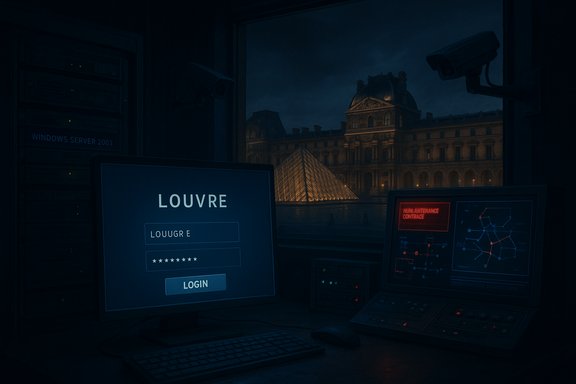
The Louvre’s security collapse reads like a horror story for IT teams: auditors found the video‑surveillance server protected by the literal, case‑sensitive password “LOUVRE,” multiple security applications left unpatched for years, and critical monitoring software still running on an unsupported Windows Server 2003 build — vulnerabilities that auditors warned about a decade ago and that now form part of the post‑heist autopsy on the October 19 daylight robbery that stripped the Galerie d’Apollon of priceless crown jewels.
Short, well‑prepared and executed: four thieves used a furniture lift to reach an upper floor, broke into display cases in the Galerie d’Apollon and walked away with eight jewels—valued publicly at about €88 million—before security response could prevent or recover the items. The operation lasted only minutes and left a stunned security establishment facing two linked, but distinct, failures: physical perimeter breaches and long‑standing cybersecurity deficiencies that auditors say were flagged years earlier. The revelations began in reporting that drew on older internal audits, notably an ANSSI review from 2014 and a later audit completed in 2017, both of which identified systemic weaknesses: trivial passwords on security servers, obsolete workstation operating systems, and failing maintenance contracts for critical security applications. Those audits recommended standard mitigations — stronger credential policies, migration to supported software, network segmentation and regular patching — yet evidence shows some systems remained outdated through 2021 and into 2025.
Fixing the problem is straightforward in principle but expensive and politically demanding in practice: it requires funding, governance, vendor cooperation and the discipline to treat museum security as critical infrastructure. The immediate imperative for any institution managing irreplaceable assets is to assume the worst: rotate credentials, isolate security networks, and patch or remove unsupported platforms — now — while creating durable governance to prevent this kind of debt from recurring. The world will watch whether the Louvre’s response becomes a roadmap for cultural institutions — or a warning they ignored at their peril.
Source: lnginnorthernbc.ca Robbery at the Louvre: password for the video surveillance system was... 'Louvre' - News Room USA | LNG in Northern BC
 Background
Short, well‑prepared and executed: four thieves used a furniture lift to reach an upper floor, broke into display cases in the Galerie d’Apollon and walked away with eight jewels—valued publicly at about €88 million—before security response could prevent or recover the items. The operation lasted only minutes and left a stunned security establishment facing two linked, but distinct, failures: physical perimeter breaches and long‑standing cybersecurity deficiencies that auditors say were flagged years earlier. The revelations began in reporting that drew on older internal audits, notably an ANSSI review from 2014 and a later audit completed in 2017, both of which identified systemic weaknesses: trivial passwords on security servers, obsolete workstation operating systems, and failing maintenance contracts for critical security applications. Those audits recommended standard mitigations — stronger credential policies, migration to supported software, network segmentation and regular patching — yet evidence shows some systems remained outdated through 2021 and into 2025. Overview of the audit findings
What the audits say, in plain language
- Security endpoints that should have been restricted and hardened were accessible with trivial credentials such as “LOUVRE” or the vendor name “THALES.”
- At least one critical control application (reported as Thales’ Sathi/Sathi‑family software) was acquired in 2003, ran on Windows Server 2003, and had no active maintenance or support contract.
- Multiple audits across 2014–2017 and follow‑up documents show repeated findings: obsolete OS instances (Windows 2000 / XP / Server 2003), insufficient network segmentation between business and security networks, and numerous security applications lacking patches.
Which claims are verified and which remain uncertain
Several independent outlets have reported the password claim and the presence of legacy Microsoft server builds in documents reviewed by journalists; the original ANSSI audit (2014) is commonly named as the source. However, whether those exact credentials were still active immediately before the October 19 heist is not publicly confirmed. Contemporary official statements note the existence of historical vulnerabilities but do not assert the thieves used remote access or exploited those specific passwords. This distinction matters: an audit’s findings document risk and exposure at the time of the audit; they are not direct proof of exploitation absent forensic confirmation.The technical anatomy of the risk
Legacy operating systems: why Windows Server 2003 matters
Windows Server 2003 reached its extended end‑of‑support on July 14, 2015. After that date Microsoft stopped shipping routine security updates, leaving systems at risk for newly discovered vulnerabilities. Running critical security management software on such an OS is effectively running unsupported code in a high‑risk environment: exploit development, automated scanning tools and known‑good exploit code are all far more likely to succeed against unpatched platforms. The lifecycle dates are public Microsoft data. Operational consequences of an unsupported server in a security control plane include:- No security patches, meaning known CVEs remain exploitable.
- Incompatible modern security agents, limiting threat detection.
- Compliance and insurance exposures from running out‑of‑support infrastructure.
- An extended maintenance debt that compounds as more interdependent systems age.
Vendor software (Sathi / partner systems) and unsupported stacks
Multiple reports identify a 2003 acquisition of a security management product (referred to in various documents as Sathi or equivalent Thales systems), with maintenance contracts lapsing and no clear migration path documented. When vendor software that controls physical security appliances is left without updates or maintenance, the risks are severe: bugs accumulate, default or hardcoded credentials are not rotated, and interfaces remain accessible to anyone able to reach them. Audit notes show eight security‑critical applications had not seen updates for years.Password hygiene and network segmentation — the classic combo for catastrophic failure
The audits repeatedly flagged trivial credentials and poor segmentation between administrative/operational networks and public or business LANs. Two simple points matter:- Weak passwords (or shared vendor default credentials) drastically lower the skill level required to achieve administrative access.
- Poor segmentation allows an attacker who compromises a low‑privilege or exposed device to pivot into the security domain and reach cameras, badge databases, and alarm systems.
How those vulnerabilities could be exploited — plausible attack chains
- Reconnaissance: public records, procurement notices, and on‑site observation reveal security system vendors and models. This information narrows the search for default passwords and known bugs.
- Initial access: exploit an exposed workstation or management console using a trivial credential or a known RCE affecting an unsupported OS.
- Lateral movement: pivot from the compromised host into the security VLAN because segmentation or ACLs are lax.
- Camera/ALMS manipulation: alter recording schedules, disable cameras in specific galleries, or adjust access rights in the badge database.
- Physical execution: with modified monitoring and delayed alerts, a small team performs a rapid in‑person smash‑and‑grab.
Governance, procurement and maintenance failures
Where museum operations went wrong
- Maintenance contracts lapsed or weren’t renewed: Critical systems rely on vendor updates and security fixes. Documents show some maintenance contracts were not renewed, leaving the museum dependant on aging binaries and unsupported integrations.
- Procurement without lifecycle planning: The usual procurement focus on acquisition cost overlooked long‑term security lifecycle and total cost of ownership. Audits note repeated calls for migration that weren’t prioritized.
- Organizational complacency and budget tradeoffs: Multiple reports indicate that, despite an annual operating budget in the hundreds of millions of euros, security upgrades were treated as adjustable items rather than essential investments. Auditors flagged “lack of willingness” to accelerate modernization in face of known risks.
Why cultural and managerial fixes matter as much as technical patches
Fixing passwords and applying patches is necessary but insufficient. Institutional priorities, procurement rules, contract management, and a security‑minded maintenance culture are the durable defenses that prevent technical debt from growing to catastrophic scale. Museums and cultural institutions often balance access, aesthetics and preservation against security, and the Louvre case illustrates how those tradeoffs can accumulate into operational exposures.Forensics, attribution and the limits of public reporting
Public reporting has focused on the dramatic — the password anecdote, the old server, and the audacity of the physical break‑in. Investigators, however, must differentiate between:- Evidence that a vulnerability existed (audit documents and procurement records); and
- Evidence that attackers used a specific vulnerability during the crime (forensic logs, chain‑of‑custody on compromised credentials, and code‑level artifacts).
The immediate operational checklist museums should follow now
(An evidence‑driven, prioritized action plan suitable for any institution managing heritage assets)- Inventory and prioritize: Map every device and application in the physical‑security and building‑management network, assign criticality, and tag any end‑of‑life software or unsupported OS instances.
- Emergency credential reset: Rotate all admin and vendor credentials on security appliances, change any default or trivial passwords immediately, and force complex passphrases plus rotation policies.
- Patch & isolate: Apply vendor security patches where available and isolate any unsupported systems behind air‑gapped or tightly controlled networks until retired.
- Enforce segmentation and zero‑trust microperimeters: Separate visitor Wi‑Fi, business LANs and security management systems with enforced access controls, VLANs and firewall rules.
- Deploy multi‑factor authentication (MFA): For all administrative consoles and remote access paths.
- Implement continuous monitoring and logging: Forward logs to a hardened, immutable SIEM with tamper protection and alerting for configuration changes.
- Re‑establish vendor maintenance contracts or plan migrations: Where vendor support lapsed, either re‑contract temporarily for security maintenance or plan and fund an immediate migration off unsupported platforms.
- Formalize change control and incident playbooks: Regularly test incident response with tabletop exercises that include both cyber and physical scenarios.
- Start a remediation fund: Create a capital budget line for ongoing lifecycle security, not one‑off upgrades.
- Commission an independent red team: Validate remediations via adversary‑emulation testing, focusing on combined cyber‑physical threat paths.
Risk assessment: how bad was the exposure?
- Threat likelihood: Elevated. Known vulnerabilities, trivial credentials and unsegmented networks increase the probability that an opportunistic or organized attacker could gain administrative control. Multiple independent audits documented these preconditions.
- Impact: Catastrophic for irreplaceable cultural assets and institutional reputation. Monetary valuations (≈€88 million) understate the cultural and historical loss and downstream legal, diplomatic and insurance consequences.
- Ease of exploitation: Medium–low technical skill required if credentials were left in default or if servers ran unsupported OS with known exploits; higher if significant lateral movement or custom malware was used. Public accounts suggest at least some preconditions were trivially exploitable.
Broader implications beyond the Louvre
The Louvre case is not merely a museum story. It’s a cautionary tale about how legacy IT — especially in operational technology (OT) or building/physical‑security systems — creates systemic risk when maintenance, procurement and cybersecurity practice drift. Similar patterns appear across healthcare, transportation, and utilities: long‑lived appliances, proprietary vendor stacks, and deferred maintenance create high‑impact, low‑frequency failure modes. Fixing them requires governance reforms, not just patching. For IT teams, the takeaways are clear:- Treat security‑control applications as critical infrastructure and budget them accordingly.
- Assume vendors will not manage indefinitely: plan migration and end‑of‑support retirements proactively.
- Test combined cyber‑physical scenarios: adversaries rarely stop at digital intrusion when physical actions pay dividends.
What we still do not know (and why it matters)
- Direct forensic link between the audited credentials/servers and the theft remains unconfirmed in public records. Without that chain — logs, preserved malware, or eyewitness accounts showing attackers used the admin console — the audit findings remain conditions that could enable a breach, not a transcript of the crime itself. Responsible reporting distinguishes these.
- The timeline of remediation between earlier audits and the October 2025 event is incompletely public. Some procurement and follow‑up documents show steps were planned; public reporting does not yet provide a comprehensive timeline proving which fixes were not completed. This gap complicates legal and managerial attribution.
- The role of third parties or insiders has not been disclosed publicly. Investigations into organized networks (such as historically suspected groups) are ongoing; speculation without evidence is unhelpful and dangerous. Official channels are refraining from definitive public linkage pending arrests and court filings.
Final analysis: strengths, failures and the path forward
Strengths:- Independent audits existed and were conducted by credible national agencies — ANSSI and national institutes — showing the institution invited scrutiny and received concrete recommendations. That is not universal across public cultural institutions and should be acknowledged as a positive process.
- The gap between audit recommendations and execution was the decisive failure. Repeated identification of risks without consistent, funded remediation turned known vulnerabilities into systemic exposure.
- Overreliance on aging vendor solutions without a clear lifecycle or funded replacement plan created single points of failure.
- Basic credential hygiene lapses (trivial or default passwords documented in audit) are inexcusable at any sufficiently resourced institution.
- Legal, diplomatic and insurance fallout for institutions that fail to demonstrate due diligence. Regulators and insurers will demand evidence of remediation and may raise premiums or apply fines for negligence.
- Copycat attacks or opportunistic criminals scanning for unsegmented security management interfaces elsewhere. Public disclosures create a predictable adversary playbook.
- Immediate credential rotation and segmentation (short‑term).
- Accelerated replacement of unsupported OS and vendor software (medium‑term).
- Institutional policy reforms: procurement, contract management, and a standing security modernization budget (long‑term).
- Formal public‑sector support mechanisms to help cultural institutions migrate and harden OT/physical‑security stacks (policy recommendation).
Conclusion
The Louvre heist has an obvious cinematic quality — brazen daylight entry and priceless jewels whisked away — but the institutional lesson is prosaic and crucial: cultural guardianship requires modern IT stewardship. The audits and reporting reveal a predictable, avoidable chain of neglect: outdated platforms, lapsed maintenance contracts, trivial credentials and weak network segmentation. Those are tactical failures with strategic consequences.Fixing the problem is straightforward in principle but expensive and politically demanding in practice: it requires funding, governance, vendor cooperation and the discipline to treat museum security as critical infrastructure. The immediate imperative for any institution managing irreplaceable assets is to assume the worst: rotate credentials, isolate security networks, and patch or remove unsupported platforms — now — while creating durable governance to prevent this kind of debt from recurring. The world will watch whether the Louvre’s response becomes a roadmap for cultural institutions — or a warning they ignored at their peril.
Source: lnginnorthernbc.ca Robbery at the Louvre: password for the video surveillance system was... 'Louvre' - News Room USA | LNG in Northern BC
