

The Louvre’s security story after the October heist is less a thriller’s last-act twist and more an institutional autopsy: auditors once logged that the server driving the museum’s video surveillance accepted the literal password LOUVRE, a detail that has become shorthand for a decade of deferred maintenance, weak procurement discipline, and the real-world consequences of digital neglect.
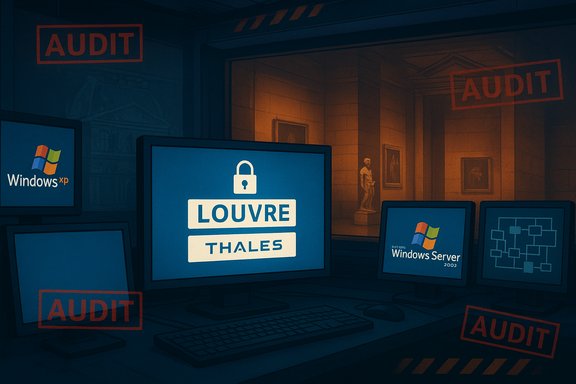
On 19 October 2025, thieves executed a rapid daytime burglary at the Musée du Louvre’s Galerie d’Apollon, using a truck‑mounted lift to reach a balcony, cutting through display cases, and fleeing in minutes with several pieces of historic crown jewellery. Authorities and multiple news agencies reported the stolen items’ estimated value at roughly €88 million (≈US$100–102 million), and the event prompted arrests, parliamentary questions, and an administrative review of museum security. What followed the heist was not just criminal investigation but a cascade of leaked and republished audit material dating back to 2014. Those audits—most notably an ANSSI (France’s National Agency for the Security of Information Systems) engagement—documented systemic weaknesses: trivial credentials, unsupported operating systems on security appliances, incomplete camera coverage, and procurement arrangements that failed to budget for lifecycle replacements. The now‑viral detail that underlines the scandal is simple and symbolic: auditors said typing “LOUVRE” could grant access to a surveillance server, while the vendor stack used the password “THALES.”
It is important to be precise: while ANSSI’s engagement demonstrated the possibility of such compromises in 2014, publicly available reporting and leaked excerpts do not yet provide a forensic chain proving the thieves used the LOUVRE credential during the October 2025 operation. That distinction—documented exposure versus proven exploitation—matters legally, technically, and reputationally.
Short term (0–7 days)
Reputation damage is less quantifiable but long‑lasting: the LOUVRE password anecdote condenses complex systemic neglect into a single, memorable image—an image that donors, visitors, and diplomacy cannot easily forget. That political and public pressure is useful insofar as it drives sustained investment, but it can also produce reactive, short‑term purchases unless governance and contractual changes lock in long‑term discipline.
Source: ED Times Even You Could’ve Guessed Louvre's Security Password
 Background / Overview
On 19 October 2025, thieves executed a rapid daytime burglary at the Musée du Louvre’s Galerie d’Apollon, using a truck‑mounted lift to reach a balcony, cutting through display cases, and fleeing in minutes with several pieces of historic crown jewellery. Authorities and multiple news agencies reported the stolen items’ estimated value at roughly €88 million (≈US$100–102 million), and the event prompted arrests, parliamentary questions, and an administrative review of museum security. What followed the heist was not just criminal investigation but a cascade of leaked and republished audit material dating back to 2014. Those audits—most notably an ANSSI (France’s National Agency for the Security of Information Systems) engagement—documented systemic weaknesses: trivial credentials, unsupported operating systems on security appliances, incomplete camera coverage, and procurement arrangements that failed to budget for lifecycle replacements. The now‑viral detail that underlines the scandal is simple and symbolic: auditors said typing “LOUVRE” could grant access to a surveillance server, while the vendor stack used the password “THALES.” How a Famous Museum Ended Up with a Famous Password
The audit trail: ANSSI’s 2014 assessment and subsequent reviews
ANSSI’s 2014 assessment—later described in French reporting and summarized in international coverage—was a penetration‑style engagement on the museum’s security network. Testers documented that they could obtain administrative access to systems that mediate CCTV, alarm logic, and badge databases using trivial credentials, and they flagged workstations and appliances running obsolete Microsoft operating systems. The audit recommended immediate hardening, stronger credential policies, migration off unsupported platforms, and improved network segmentation. A follow‑up audit in 2017 and later administrative inspections reiterated similar failings: legacy OS instances, insufficient camera coverage in key galleries, and fragmented maintenance contracts that left essential control‑plane components with no scheduled upgrade path. Those repeated warnings—documentary and prescriptive—are the “long fuse” that reframes the October theft as a governance failure rather than the result of a single operational lapse.Why the password mattered (even if it wasn’t the heist’s smoking gun)
A password like LOUVRE is not merely embarrassing; it is an operational weakness with concrete attack vectors. Predictable credentials:- Allow automated scripts and rudimentary human guesswork to succeed quickly.
- Lower the effort threshold for lateral movement once an adversary reaches any internal node.
- Make administrative consoles controlling cameras and logs trivially accessible.
It is important to be precise: while ANSSI’s engagement demonstrated the possibility of such compromises in 2014, publicly available reporting and leaked excerpts do not yet provide a forensic chain proving the thieves used the LOUVRE credential during the October 2025 operation. That distinction—documented exposure versus proven exploitation—matters legally, technically, and reputationally.
The Technical Anatomy of the Failure
Legacy operating systems and unsupported stacks
The audits noted security‑critical appliances and workstations running Windows 2000, Windows XP and even applications tethered to Windows Server 2003—platforms that had long passed mainstream and extended support windows. Microsoft’s lifecycle calendar records extended support for Windows Server 2003 ended on 14 July 2015, which means any systems still running it in later years would have lacked routine vendor security patches. Running control‑plane software on EOL platforms increases the blast radius for known, automatable exploits.Network segmentation and blast radius
The auditors and follow‑up reviewers repeatedly flagged insufficient network segmentation. Administrative workstations could reach security servers in ways that permitted lateral movement; vendor remote access paths and business networks were not strictly isolated from the security VLAN. In a properly segmented design, a compromised office PC would not directly access CCTV or access‑control servers—here, the architecture allowed privilege chaining to become realistic.Observability and forensic readiness
Critical forensic questions remain unanswered publicly: Were logs forwarded to an immutable, off‑site SIEM? Were administrative actions on camera consoles timestamped and cryptographically preserved? Audits suggested logging and monitoring were incomplete or misconfigured in places. Without robust forensic trails, it becomes far harder to prove or disprove whether someone tampered with cameras or alarm logic contemporaneous with the theft.What We Can Verify — And What We Must Treat with Caution
- Verified: A daylight heist at the Louvre on 19 October 2025 removed eight pieces of historic crown jewellery; the incident triggered arrests and a national administrative review.
- Verified: The estimated public valuation reported by prosecutors and multiple outlets placed the stolen items at roughly €88 million (≈US$100–102M). Different early accounts circulated slightly varying figures, so reporting variances should not be surprising.
- Verified: ANSSI performed an audit in and around 2014 whose public reporting (via investigative outlets) documented trivial credentials—examples cited include “LOUVRE” for a surveillance server and “THALES” for a vendor application—and flagged obsolete OS usage.
- Unproven (public record): That the thieves exploited the literal LOUVRE credential or remotely disabled cameras at the time of the theft. Public officials and prosecutors have not released an explicit forensic timeline tying a named credential use to the criminal act. Responsible reporting must keep this gap explicit.
- Verified: Windows Server 2003 entered extended support end-of-life on 14 July 2015; any security applications dependent on that OS after that date were operating without vendor security patching. This fact contextualizes the auditors’ concern about legacy stacks.
The Governance Failures That Created Technical Debt
Audits, procurement records, and subsequent administrative reviews paint a repeated pattern:- Projectized procurement that acquires vendor‑specific technology without binding lifecycle and migration funding.
- Fragmented maintenance contracts that leave critical control systems in “run until failed” mode.
- Diffuse accountability: no single CISO‑level owner with explicit remediation authority and a budget line for lifecycle replacement.
- Prioritization choices that favored acquisitions and visible renovation projects over invisible but critical security infrastructure.
What the Louvre Has Said — And What Officials Have Done
Museum leadership and French ministers have acknowledged failings in perimeter protection while defending that alarms and cameras were functioning during the theft. Senior officials accepted the political consequences: the director offered to resign (an offer later refused), and ministers ordered accelerated security upgrades and audits. The Court of Accounts and parliamentary committees have since flagged only partial progress on recommendations and planned modernization timelines extending years into the future. At the operational level, public reporting indicates a commitment to major overhauls: plans to increase CCTV coverage, create a dedicated security department, and accelerate capital projects. However, institutionalizing lifecycle funding, creating contractual migration clauses with vendors, and establishing a single accountable security executive remain the heavier lifts—and they require consistent budgetary discipline, not just press‑driven investment.Practical, Prioritised Remediation Checklist for Cyber‑Physical Security
For institutions that guard high‑value physical assets—museums, archives, utilities, or industrial sites—the Louvre case is a textbook that maps to clear, actionable mitigations.Short term (0–7 days)
- Rotate credentials for all administrative consoles; remove defaults and trivial strings immediately.
- Disable vendor remote access until MFA and robust logging are in place.
- Isolate unsupported servers and appliances behind hardened firewall rules or an air‑gap.
- Enable centralized, write‑once logging and forward to an off‑site SIEM for immutable retention.
- Migrate vendor applications off unsupported OS (no exceptions) or place compensating virtual patches and micro‑segmentation while migration is funded.
- Deploy Multi‑Factor Authentication (MFA) for all privileged access and implement RBAC with least privilege.
- Install Endpoint Detection & Response (EDR) on administrative workstations and servers.
- Commission independent penetration tests and red‑team exercises that simulate cyber‑physical attack chains.
- Contractually embed lifecycle funding and published vendor end‑of‑life roadmaps into procurement frameworks.
- Institutionalize a senior security officer (CISO or equivalent) with explicit remedial authority and budget ownership.
- Run cross‑discipline incident exercises including curators, facility managers, guards, IT, and law enforcement.
- Publish regular, verifiable remediation timelines in public‑facing accountability reports.
The Broader Implications: Insurance, Law, and Public Trust
The Louvre’s status as a national cultural symbol amplifies every consequence. Investigations will weigh whether repeated warnings were ignored and whether governance choices exposed the institution to predictable risk. Insurers will demand documented risk registers and remediation; donors and taxpayers will want proof that stewardship is competent. Parliamentary and auditor reviews can reshape how cultural funding frameworks account for security lifecycles—potentially forcing other institutions to reframe procurement and maintenance budgets in legally enforceable ways.Reputation damage is less quantifiable but long‑lasting: the LOUVRE password anecdote condenses complex systemic neglect into a single, memorable image—an image that donors, visitors, and diplomacy cannot easily forget. That political and public pressure is useful insofar as it drives sustained investment, but it can also produce reactive, short‑term purchases unless governance and contractual changes lock in long‑term discipline.
Why This Should Matter to IT and Security Professionals
The Louvre episode is a practical case study in how cyber vulnerabilities can manifest as physical loss. For security professionals it offers these lessons:- Credential hygiene is foundational. Weak passwords allow trivial escalation into critical control planes.
- Unsupported software is an invitation. End‑of‑life OS instances are predictable, automatable attack surfaces whose presence should be intolerable in security networks.
- Segmentation and least privilege are non‑negotiable. Treat physical‑security systems like mission‑critical infrastructure, not secondary IT projects.
- Forensics and log integrity matter. Without immutable logs and offsite retention, proving exploitation versus exposure becomes nearly impossible.
The Biggest Uncertainties and the Responsible Caveats
- The public record shows incontrovertible exposure—that trivial credentials and legacy stacks once existed. Multiple investigative reports and audit excerpts document that.
- What remains unresolved in available public materials is whether the October 2025 perpetrators used the specific credentials documented years earlier or whether the theft was achieved entirely through physical planning and execution without any cyber intervention. Law enforcement has not released a complete forensic affidavit tying a network compromise to the crime. Treat the leap from exposure to proven exploitation as unresolved unless prosecutors or independent forensic reports present new evidence.
Conclusion
The Louvre’s public humiliation over a password named after itself is an easily digestible meme—but the underlying lesson is far from funny. It is a sober reminder that custodians of priceless physical assets must manage cyber‑physical control planes with the same rigor they apply to the objects those systems protect. The audit excerpts citing LOUVRE and THALES are verified examples of persistent configuration and lifecycle failings; whether those particular strings were wielded by the thieves remains publicly unproven. The real takeaway is stark and unromantic: lasting resilience requires lifecycle budgeting, enforceable procurement clauses, clear security ownership, robust credential and segmentation policies, and immutable forensic readiness—discipline that prevents symbolic embarrassments from becoming tangible, historic loss.Source: ED Times Even You Could’ve Guessed Louvre's Security Password
