

LTIMindtree’s expanded collaboration with Microsoft marks a decisive push to move enterprise AI from pilots into production by bundling deep Azure engineering, Microsoft Copilot-era capabilities, and a productized set of migration, security and governance services designed to shorten time-to-value for customers committed to the Microsoft cloud platform. The formalized Microsoft Business Unit, a Microsoft Cloud Generative AI Center of Excellence, and product suites that embed Azure OpenAI, Microsoft 365 Copilot and Microsoft Fabric signal a partner play that is both strategic and tactical — intended to accelerate Azure adoption, capture co-sell motion economics, and offer an auditable path for regulated enterprises that must manage security and governance risk while scaling generative AI.
LTIMindtree formed from the integration of L&T Infotech and Mindtree has positioned itself as a full‑stack systems integrator with a sharpened Microsoft focus over the last few years. The company’s recent public messaging emphasizes a “360°” partnership model with Microsoft that includes joint go‑to‑market activity, transactable IP, and a dedicated Microsoft-facing organization to coordinate sales, engineering and delivery. Those moves build on existing Microsoft specializations and documented Microsoft customer stories where LTIMindtree has deployed Microsoft endpoint and security tooling at scale. At the same time, LTIMindtree’s push arrives against a market backdrop where enterprise buyers are demanding demonstrable governance, clear runbooks for AI safety, and cost predictability for model-driven workloads. Microsoft has evolved Azure to be an “AI-first” platform — offering Microsoft 365 Copilot, Azure OpenAI Service, Microsoft Fabric and a broadened security portfolio — and partners that align closely with that platform can offer customers a reduced‑friction path from PoC to production. LTIMindtree’s announcement explicitly maps its IP and delivery artifacts to these Azure building blocks.
Source: Press Trust of India Press Trust Of India
 Background
LTIMindtree formed from the integration of L&T Infotech and Mindtree has positioned itself as a full‑stack systems integrator with a sharpened Microsoft focus over the last few years. The company’s recent public messaging emphasizes a “360°” partnership model with Microsoft that includes joint go‑to‑market activity, transactable IP, and a dedicated Microsoft-facing organization to coordinate sales, engineering and delivery. Those moves build on existing Microsoft specializations and documented Microsoft customer stories where LTIMindtree has deployed Microsoft endpoint and security tooling at scale. At the same time, LTIMindtree’s push arrives against a market backdrop where enterprise buyers are demanding demonstrable governance, clear runbooks for AI safety, and cost predictability for model-driven workloads. Microsoft has evolved Azure to be an “AI-first” platform — offering Microsoft 365 Copilot, Azure OpenAI Service, Microsoft Fabric and a broadened security portfolio — and partners that align closely with that platform can offer customers a reduced‑friction path from PoC to production. LTIMindtree’s announcement explicitly maps its IP and delivery artifacts to these Azure building blocks. What LTIMindtree and Microsoft are promising
Core commitments and productized offers
- A Microsoft Business Unit inside LTIMindtree to run joint GTM, co-sell, and field engineering for Azure and Microsoft 365 transformations.
- A Microsoft Cloud Generative AI Center of Excellence (GenAI CoE) to prototype, govern and scale generative AI solutions for enterprise workloads.
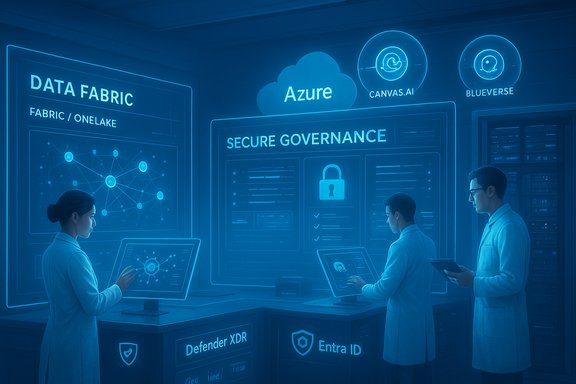
- Embedding Azure OpenAI Service and Microsoft Foundry patterns into LTIMindtree product IP (Canvas.AI, BlueVerse) to create domain copilots and knowledge agents.
- Packaged Copilot for Microsoft 365 adoption services and governance-first rollouts designed to reduce deployment risk for productivity copilots.
- An operational stack that integrates Azure security components — Defender XDR, Sentinel, Intune, Windows Autopatch and Entra ID — to deliver auditable security and incident-response automation at scale.
- Commercial levers such as Microsoft Azure Consumption Commitment (MAAC) acceleration, Cloud Accelerate Factory and marketplace listings to smooth procurement and fund migrations.
Technical architecture patterns highlighted
- Retrieval‑Augmented Generation (RAG) pipelines built on unified data stores (Microsoft Fabric / OneLake) and Azure Cognitive Search or vector indexing for semantic retrieval.
- Model hosting via Azure OpenAI and Microsoft Foundry control plane to centralize model management and governance.
- Containerized microservices and GPU-backed inference on Azure Kubernetes Service (AKS) for custom model workloads.
- Copilot integrations across Microsoft 365 with staged rollouts, DLP and Entra-based access controls to reduce data‑exposure risk.
Why this matters for enterprise IT buyers
Enterprises face four common barriers when attempting to scale generative AI: governance (who’s accountable), operations (how to run models reliably), cost (how to predict and control spend), and integration (how to embed AI into workflows). The LTIMindtree–Microsoft alignment addresses each barrier with practical levers:- Governance and auditability: Using Microsoft’s security and identity controls as the backbone and pairing that with a GenAI CoE creates an auditable path for model provenance and lifecycle management.
- Operational scale: Productized accelerators, migration factories and Azure Expert MSP-style managed services shorten the engineering lead time to production.
- Commercial predictability: MAAC and co‑sell frameworks convert committed consumption into funded migrations and joint investments—reducing upfront cost friction for customers. Enterprises must, however, insist on transparent re-baselining and exit terms.
- Domain relevance: Prebuilt vertical copilots and agent templates reduce the bespoke engineering required for industry-specific outcomes — a compelling benefit when rapid ROI is required.
Strengths: where the announcement delivers clear value
1. Platform-aligned delivery reduces integration risk
LTIMindtree’s Microsoft credentials (solution partner designations and Azure Expert MSP posture) and Microsoft’s rich enterprise controls provide a low‑friction path for customers that choose Azure as the primary execution environment. Using platform-native services for data, identity and model hosting reduces custom glue code and helps external auditors validate compliance.2. Productization shortens time to measurable outcomes
Product IP such as Canvas.AI and BlueVerse, plus migration accelerators and Cloud Accelerate Factory, are designed to convert pilots into repeatable, measurable deployments. For procurement teams, a productized approach is easier to budget and quicker to operationalize than purely custom builds.3. Security-first posture backed by operational evidence
LTIMindtree’s internal case study of large endpoint migration and early production adoption of Copilot for Security demonstrate operational experience in integrating Defender, Sentinel and Intune across a large estate — a meaningful reference for customers in regulated sectors.4. Joint GTM and co-sell accelerate adoption velocity
Microsoft’s co-sell engine and marketplace distribution can materially shorten sales cycles for partners with validated solutions — an immediate commercial advantage that benefits customers through funded pilots and faster procurement.Risks and trade-offs enterprises must evaluate
Vendor concentration and lock‑in
A tightly coupled Azure + Microsoft toolchain can accelerate delivery but also concentrates risk with a single hyperscaler. Organizations with multi‑cloud requirements, sovereign data constraints, or pre-existing AWS/GCP investments should insist on portability clauses, containerized deployments, and documented data egress paths to avoid long-term lock‑in. LTIMindtree can operate multi‑cloud engagements, but when a GTM emphasizes Azure-first tooling, governance and contractual clarity become essential negotiation points.Consumption economics and hidden LLM costs
Generative AI workloads have variable and sometimes unpredictable consumption patterns. MAAC-style commitments and model inference fees can lead to overruns if workloads scale differently than forecast. Enterprises must require clear TCO models, tag-based cost governance, rightsizing strategies, and monthly reconciliation mechanisms as contractual deliverables.Model hosting and data residency concerns
Microsoft’s Foundry and multi-vendor model catalogs may include third-party models hosted outside a customer’s Azure tenancy. Customers with strict data residency requirements must obtain firm guarantees about where inference occurs, what telemetry is shared with model providers, and whether prompt data or training telemetry is retained outside approved boundaries. These are technical and legal details that should be included in SOWs.Governance maturity mismatch
Packaged Copilot rollouts promise rapid productivity gains, but those gains depend on disciplined staging, DLP configuration, red-team testing and continuous monitoring. Organizations that rush Copilot adoption without a mature governance model risk data leakage, regulatory exposure, and reputational damage. The vendor’s GenAI CoE mitigates this risk — if its artifacts (runbooks, red-team results, retention policies) are contractually provided and externally verifiable.Practical diligence checklist for procurement and IT leaders
- Require proof-of-value that maps to your industry and regulatory profile: request measurable pilot KPIs (time saved, error rates, cost deltas) and client references.
- Insist on a detailed model-governance annex: model hosting locations, telemetry retention, prompt/data usage policy, and red-team findings.
- Negotiate MAAC terms with rebaseline and exit clauses: ensure consumption commitments include mechanisms to reforecast and unwind if usage differs materially.
- Ask for security artifacts: architecture diagrams, SOC runbooks, penetration test reports and data‑flow diagrams showing how Copilot and Azure OpenAI access your data.
- Define portability and escape hatches: containerize critical inference workloads, retain trained artifacts or checkpoints and document data export procedures for migration to another cloud or on‑prem stack.
How to evaluate outcomes and vendor accountability
- Require service-level KPIs for model availability, inference latency, MTTR for security incidents, and monthly spend variance thresholds.
- Make runbooks and audit logs contractually available to internal and third‑party auditors.
- Insist on quarterly governance reviews and documented remediation plans for model drift, hallucination incidents, or compliance gaps.
- Use incremental funding for multi‑year MAACs — tie tranches of committed consumption to clearly defined migration and modernization milestones.
Market context and LTIMindtree’s momentum
LTIMindtree has been active on two commercial fronts that make the Microsoft alignment strategically sensible: it has been winning large, outcome‑based deals that demand managed services and AI capability at scale, and it has invested in productized IP to avoid purely time-and-materials projects. Recent large multi-year contracts and GTM activity at Microsoft events (including a visible presence at Microsoft Ignite) underline the company’s ambition to be a principal systems integrator for Azure-first AI programs. For customers, that translates into a partner with scale — but also into a partner whose commercial health depends on a steady pipeline of large deals. Buyers should therefore validate references and delivery performance for similar contract sizes and verticals.Conclusion — measured optimism and contractual rigor
LTIMindtree’s strengthened relationship with Microsoft is a pragmatic, platform-aligned response to where enterprise AI projects need to go: from experimentation to production with verifiable governance, security and operating models. The combination of Azure native services (Copilot, Azure OpenAI, Fabric) and LTIMindtree’s productized delivery IP offers a credible path to accelerate adoption and reduce engineering lift for Microsoft‑centric organizations. That credibility is real — but the commercial and governance trade-offs are tangible. Enterprises must insist on transparent cost modeling, explicit model‑hosting guarantees, auditable governance artifacts, and portability clauses if they want to keep strategic options open. Where LTIMindtree scores is in packaging Azure‑native capabilities into repeatable, auditable plays that can materially reduce time-to-value — provided customers apply procurement discipline and operational validation before committing multi‑year consumption contracts. For IT leaders evaluating LTIMindtree + Microsoft offerings, the sensible path is clear: run focused, high-impact pilots with explicit KPIs, secure governance and cost controls up front, and treat the vendor partnership as a strategic accelerator rather than a turnkey guarantee. When those conditions are met, the combined stack can deliver measurable productivity and security improvements — but only when the legal, technical and financial guardrails are contractually enforced.Source: Press Trust of India Press Trust Of India
