

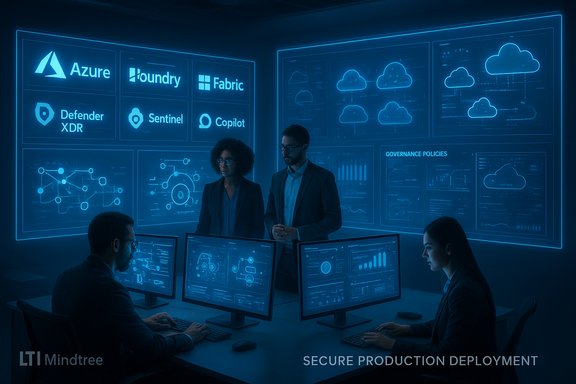
LTIMindtree’s expanded collaboration with Microsoft, announced on November 19, 2025, is a clear, strategic push to move enterprise Azure and AI adoption from fragmented pilots into broad production deployments—combining LTIMindtree’s systems-integration scale with Microsoft’s Foundry, Azure OpenAI, Microsoft 365 Copilot, and Fabric capabilities, alongside a full-stack security posture built on Defender XDR, Sentinel, Intune, Windows Autopatch, and Entra ID.
The announcement formalizes a deeper Global System Integrator (GSI) relationship between LTIMindtree and Microsoft with a stated focus on accelerating Azure consumption, accelerating cloud migrations, and embedding generative-AI across business workflows. LTIMindtree positions itself as a 360° Microsoft partner—customer, vendor, and system integrator—and says it has already adopted Microsoft’s security and productivity stack internally, including Microsoft 365 Copilot and the Microsoft security portfolio.
This expansion emphasizes three linked priorities:
However, the path is not without hazards. Vendor lock-in, cost surprises, regulatory compliance, and the operational complexity of AI safety are real and require disciplined mitigation. Enterprises should treat the LTIMindtree offering as a platform acceleration opportunity—not a turnkey cure—and should demand architectural transparency, cost controls, and rigorous governance.
Recommendations for enterprise leaders:
LTIMindtree’s announcement represents a mature phase in enterprise AI adoption: converging platform capabilities, systems-integration muscle, and security-first operations. For organizations willing to invest in the operational and governance disciplines required, the LTIMindtree–Microsoft stack offers a practical route to convert generative AI promise into measurable business effect.
Source: Tech in Asia https://www.techinasia.com/news/indias-ltimindtree-expands-microsoft-partnership-azure/
 Background
The announcement formalizes a deeper Global System Integrator (GSI) relationship between LTIMindtree and Microsoft with a stated focus on accelerating Azure consumption, accelerating cloud migrations, and embedding generative-AI across business workflows. LTIMindtree positions itself as a 360° Microsoft partner—customer, vendor, and system integrator—and says it has already adopted Microsoft’s security and productivity stack internally, including Microsoft 365 Copilot and the Microsoft security portfolio.This expansion emphasizes three linked priorities:
- Cloud migration and modernization (Azure migration programs and accelerators).
- Enterprise AI at scale (Azure OpenAI through Microsoft Foundry, Microsoft 365 Copilot, and Microsoft Fabric).
- Security and governance-first adoption (Defender XDR + Sentinel + Entra ID + Intune + Windows Autopatch).
Overview of the technical components
Microsoft Foundry and Azure OpenAI
Microsoft Foundry is Microsoft’s enterprise-grade platform for building, operating, and governing generative AI applications. It unifies models, tooling, agents, and operational controls to help organizations move quickly from prototype to production. LTIMindtree’s use of Azure OpenAI through Microsoft Foundry signals that it will build customer-facing solutions—chat, automation, and analytics—on top of purpose-built governance controls, model selection, and managed runtimes.Microsoft 365 Copilot and Fabric
Microsoft 365 Copilot brings generative AI directly into the productivity stack (Word, Excel, Outlook, Teams, etc., and LTIMindtree reports internal adoption with a governance-first rollout. Microsoft Fabric is Microsoft’s integrated data analytics platform (OneLake, Fabric experiences, and Copilot in Fabric) designed to combine data engineering, analytics, and AI—key when transforming data estates for LLM-based reasoning and business intelligence.Security stack: Defender XDR, Sentinel, Intune, Windows Autopatch, Entra ID
The security posture LTIMindtree has deployed is comprehensive and cloud-native:- Defender XDR provides endpoint and cross-environment detection and response.
- Microsoft Sentinel offers cloud-native SIEM and SOAR capabilities for telemetry and automated playbooks.
- Intune handles endpoint management and device compliance.
- Windows Autopatch automates Windows and related patching.
- Entra ID (formerly Azure AD) is the identity and access control backbone.
What LTIMindtree is promising customers
LTIMindtree’s public messaging outlines several customer-facing offerings and outcomes:- Faster Azure migration and time-to-value through migration accelerators and Azure consumption programs.
- AI-led automation for industry-specific use cases using Azure OpenAI + Foundry tooling.
- Workplace modernization and productivity lift via Microsoft 365 Copilot integration into business workflows.
- Data modernization and real-time analytics using Microsoft Fabric and Copilot-in-Fabric experiences.
- Security-first transformation with a pre-integrated Microsoft security stack and governance playbooks.
- Commercial levers such as Azure Consumption Commitment (MAAC) to optimize costs and co-sell programs with Microsoft to accelerate procurement and deployment.
Why this matters: strategic implications for enterprises
The LTIMindtree–Microsoft deepen signals several important trends and practical implications for enterprise IT decision makers.- From pilots to platformized production: Enterprises are past the ‘exploratory’ phase for AI. The value lies in integrating LLMs into daily processes (sales, service, finance) and operating them reliably. A GSI-anchored approach helps standardize platform design choices and governance frameworks so pilot projects don’t stall or proliferate unmanaged.
- Security and identity are non-negotiable: The explicit emphasis on Defender XDR, Sentinel, Entra ID, and Intune is a recognition that LLMs and large-scale cloud adoption enlarge the attack surface. Embedding security at the platform and telemetry level (and not as an afterthought) materially reduces operational risk.
- Commercial alignment matters: Programs like Azure Consumption Commitment (MAAC) and co-sell motions can reduce cost friction and accelerate procurement—important for enterprises managing cloud spend while scaling production workloads.
- Data modernization underpins AI ROI: Microsoft Fabric’s OneLake and analytics services are core to enabling grounded LLM experiences. Without data hygiene, lineage, and governance, Copilot or custom agents will produce unreliable or noncompliant outcomes.
Strengths of the expanded partnership
- End-to-end capability: LTIMindtree brings industry domain expertise, migration experience, and managed services. Microsoft supplies platform-level AI, security, and productivity tools. The combination reduces vendor fragmentation and shortens delivery timelines.
- Production-ready governance through Foundry: Microsoft Foundry’s built-in observability, model cataloging, and governance features reduce the operational burden of running LLMs at scale.
- Security-first posture: By deploying Microsoft’s security stack internally, LTIMindtree demonstrates operational experience with the components they will recommend to customers—this increases credibility versus vendors who only resell tools.
- Commercial and co-sell leverage: The partnership can lower procurement friction and align incentives between customer, integrator, and cloud provider for adoption velocity.
- Built-in productivity uplift: Microsoft 365 Copilot, when governed correctly, can deliver near-term productivity gains for knowledge workers—a tangible, measurable outcome for executives.
Potential gaps and risks to watch
- Lock-in and platform concentration: A deep co-dependence on a single cloud and productivity vendor increases vendor lock-in risk. Organizations must evaluate multi-cloud or model-agnostic portability plans to avoid being overly dependent on one commercial stack.
- Governance vs. speed trade-offs: LTIMindtree’s “governance-first” language is positive but must be implemented in practice. Governance frameworks often slow down teams; enterprises must balance compliance and velocity.
- Operationalizing LLM safety: Technical controls (rate limits, prompt design, watermarking) must be combined with human-in-the-loop processes, continuous monitoring, and domain-specific safety testing. These are non-trivial to implement at scale.
- Data residency and privacy compliance: Industry and regional regulations (finance, healthcare, public sector) require stringent data controls. Integrators must map Foundry, Fabric, and Azure OpenAI controls to regulatory requirements and publish compliant architectures.
- Hidden TCO and consumption spikes: LLM inference and data egress can create large, unpredictable cloud bills. While Azure consumption commitments help, enterprises should model worst-case consumption and deploy cost governance controls.
- Skill and cultural gaps: Successful AI adoption needs cross-functional teams (data, security, domain SMEs, legal) and re-engineered processes. GSIs can accelerate this, but organizational change management remains the critical path.
Practical guidance for IT leaders evaluating this offering
If you are evaluating the LTIMindtree–Microsoft offering, consider the following practical checklist to reduce risk and accelerate value:- Start with a prioritized use-case list: pick 2–3 high-impact processes with measurable KPIs (time saved, revenue uplift, case resolution).
- Demand a reproducible reference architecture: Foundry + Fabric + Sentinel + Entra ID + Intune, with explicit decisions on data residency and model selection.
- Require a consumption-control plan: quotas, cost alerts, reserved capacity options, and a staged scale-up approach.
- Insist on security and privacy mapping: data flows, retention policies, access controls, and an incident response plan tied to Microsoft Sentinel playbooks.
- Plan for human oversight: establish review cadences and escalation paths for Copilot outputs and automated agents.
- Build a multi-model strategy: avoid single-model dependence; require a model-agnostic abstraction layer where feasible to preserve flexibility.
- Quantify expected ROI and time-to-value: include a detailed MAAC structure and expected cloud spend baseline vs projected.
- Validate LTIMindtree’s internal adoption: audit their internal Copilot and security deployments as practical proof points before full rollout.
Implementation considerations—technical and organizational
Technical design
- Use Microsoft Foundry as the control plane for agent orchestration and model governance. Ensure AI Gateways or API-level controls route model calls through managed gateways for telemetry and policy enforcement.
- House critical enterprise data in OneLake / Fabric with tight RBAC and sensitivity labels enforced by Entra ID and Microsoft Purview (if part of the deployment).
- Instrument Sentinel top-to-bottom: ingest logs from Foundry, Fabric, Defender XDR, and Intune for correlated detection and automated remediation.
- Design for autoscaling but with hard spend limits and tagging to attribute consumption to business units.
Organizational design
- Create a cross-functional AI steering committee (IT, legal, compliance, HR, business owners) to set acceptable-use policies for Copilot and custom agents.
- Define Service Level Objectives (SLOs) for model latency, uptime, and response quality, with SLAs between LTIMindtree and internal business units.
- Establish a prompt and model evaluation lab to continuously test outputs against bias, safety, and accuracy metrics.
Competitive and market context
The LTIMindtree–Microsoft tie-up is part of a larger strategic alignment trend where major integrators partner deeply with hyperscalers to package AI production capabilities. Competitors in the GSI space are forming similar pacts with other cloud providers and model vendors, creating multiple vendor-led stacks:- Some integrators emphasize multi-cloud neutrality and open-source models to reduce lock-in.
- Others partner closely with hardware vendors for on-prem or hybrid inference.
- Vertical specialists are packaging industry-specific copilots (banking, insurance, manufacturing) with tuned prompts and compliance controls.
Commercial dynamics and cost management
The announcement highlights the use of Azure Consumption Commitments (MAAC) and co-sell motions—mechanisms that can lower initial costs and provide predictable pricing. However, a few realities require attention:- MAACs often require contractual minimums and forecasting—ensure your consumption model is realistic.
- LLM workloads are bursty; use reservations, capacity commitments, and regional placement to control costs.
- Review licensing implications for Microsoft 365 Copilot—enterprise licensing tiers and per-seat costs affect ROI modeling.
- Negotiate transparent reporting and tagging from LTIMindtree for monthly cloud usage across projects.
Governance, compliance, and responsible AI
A responsible AI program should include these elements as part of any LTIMindtree–Microsoft deployment:- Data provenance and lineage: track the source and transformation of datasets that inform models.
- Model validation and evaluation: regular accuracy testing, distributional checks, and drift monitoring.
- Explainability and human review: especially for regulated decisions, maintain audit trails and human sign-offs.
- Privacy-by-design: minimize PII in prompts and apply synthetic or anonymized datasets where possible.
- Policy enforcement: use Foundry’s governance tools and Azure policy to automate compliance guardrails.
Measuring success: KPIs and business metrics
To move from experimentation to sustained value, align metrics with outcomes:- Operational KPIs: reduction in mean time to resolution (MTTR), agent productivity, average handling time.
- Financial KPIs: cost-per-transaction, cloud spend per use-case, incremental revenue from AI-driven features.
- Risk KPIs: number of Copilot-related policy violations, security incidents attributable to AI components, false positive/negative rates for automatic decisions.
- Adoption KPIs: number of users actively leveraging Copilot, frequency of Copilot-enabled workflows, satisfaction scores.
What success looks like—case outcomes to expect
When executed well, enterprises should expect:- Faster cloud migration timelines via repeatable accelerators and validated blueprints.
- Measurable productivity gains from Copilot integration (reduced drafting time, automated reporting).
- Improved customer experiences by embedding agentic assistants in service channels.
- A hardened security posture with consolidated telemetry and automated incident playbooks.
- Predictable costs through committed consumption and active cost governance.
Final analysis: strengths, cautions, and recommendations
The LTIMindtree–Microsoft expansion is a pragmatic advancement for organizations seeking to industrialize AI on Azure. The combined strengths—platform depth (Foundry, Fabric), productivity integration (Copilot), and a pre-validated security stack—create a credible path from pilot to production.However, the path is not without hazards. Vendor lock-in, cost surprises, regulatory compliance, and the operational complexity of AI safety are real and require disciplined mitigation. Enterprises should treat the LTIMindtree offering as a platform acceleration opportunity—not a turnkey cure—and should demand architectural transparency, cost controls, and rigorous governance.
Recommendations for enterprise leaders:
- Insist on staged, measurable pilots with clear success criteria before broad rollouts.
- Require multi-model and portability options where strategic independence is important.
- Audit LTIMindtree’s internal Copilot and security deployments as working references.
- Establish active cost governance and model monitoring with Sentinel-backed detection.
- Include legal and compliance teams from day one to map regulatory obligations to platform designs.
LTIMindtree’s announcement represents a mature phase in enterprise AI adoption: converging platform capabilities, systems-integration muscle, and security-first operations. For organizations willing to invest in the operational and governance disciplines required, the LTIMindtree–Microsoft stack offers a practical route to convert generative AI promise into measurable business effect.
Source: Tech in Asia https://www.techinasia.com/news/indias-ltimindtree-expands-microsoft-partnership-azure/
