

Lumus’ CES 2026 showcase signaled a clear inflection point for smartglasses optics, with the company unveiling waveguides that push field-of-view, brightness and manufacturability far beyond the incremental improvements that defined earlier consumer models.
For years the smartglasses market has been constrained by a handful of hard optical tradeoffs: how to deliver a readable, full‑colour virtual image while keeping frames light, transparent and power‑efficient. Lumus built its reputation on geometric (reflective) waveguides that route projected light through glass layers using miniature reflective structures rather than diffractive gratings. That approach promises higher throughput and truer whites — advantages that matter outdoors and in bright environments.
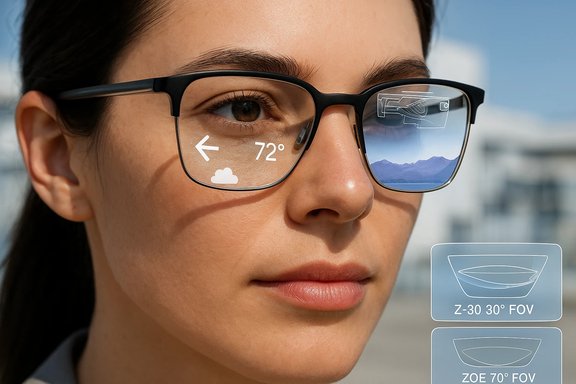
At CES 2026 Lumus presented three key advances in that lineage: an optimized Z-30 waveguide tuned for everyday wear, an ultra‑thin Z-30 2.0 preview, and a prototype ZOE waveguide that breaks the 70° field‑of‑view barrier for geometric waveguides. Taken together, these announcements make the company’s case that high‑quality, mass‑manufacturable AR optics are ready to move from concept to consumer products.
The ZOE demo also highlighted a practical truth: ultra‑wide optics create distortion challenges around the extreme edges. Lumus stated that some edge distortion visible in prototypes is addressable in production units through optical compensation and software correction.
For ZOE’s 70° FOV, Lumus reported a 1080p class specification in demonstrations, which broadens the pixel budget but also raises system‑level demands on the micro‑projector, GPU/SoC, and thermal management. In short: larger FOVs give a taste of immersion, but meaningful gains in legibility and UI detail will require matching increases in pixel count or smarter rendering techniques.
A few important technical realities and caveats:
But optics alone won’t deliver a mainstream market. Three ecosystem dimensions are critical:
That said, optics are one part of a larger system. To translate the Z-30 and ZOE demos into mainstream products, manufacturers must solve pixel density tradeoffs, thermal and battery constraints, distortion correction across prescriptions, and the software and services that make AR genuinely useful. The industry now has clearer hardware options; the next phase is multidisciplinary engineering and pragmatic product design that delivers comfortable, useful, and serviceable smartglasses people will actually wear — outdoors, indoors and in daily life.
If the innovations shown at CES become shipping reality, the next wave of smartglasses could finally move past “proof of concept” into devices that matter to everyday users, changing not only how we see information but how wearable computing integrates into the routines of daily life.
Source: Tech Edition https://www.techedt.com/lumus-showcases-wider-field-of-view-waveguides-for-smartglasses-at-ces-2026/
 Background
For years the smartglasses market has been constrained by a handful of hard optical tradeoffs: how to deliver a readable, full‑colour virtual image while keeping frames light, transparent and power‑efficient. Lumus built its reputation on geometric (reflective) waveguides that route projected light through glass layers using miniature reflective structures rather than diffractive gratings. That approach promises higher throughput and truer whites — advantages that matter outdoors and in bright environments.At CES 2026 Lumus presented three key advances in that lineage: an optimized Z-30 waveguide tuned for everyday wear, an ultra‑thin Z-30 2.0 preview, and a prototype ZOE waveguide that breaks the 70° field‑of‑view barrier for geometric waveguides. Taken together, these announcements make the company’s case that high‑quality, mass‑manufacturable AR optics are ready to move from concept to consumer products.
What Lumus showed at CES 2026
Z-30: wider, lighter, more practical
Lumus’ updated Z-30 is aimed at the “all‑day” smartglasses segment. Key claimed attributes include:- 30° field of view (up from roughly 20° in many early consumer AR glasses).
- 30% lighter and 40% thinner than prior generations.
- A practical demonstrator resolution in the 720 × 720 range.
- Engineered luminance efficiency rated in the thousands of nits per watt.
Z-30 2.0: the ultra‑thin roadmap
Lumus previewed Z-30 2.0 as a manufacturing‑friendly evolution of the Z-30, targeting a further reduction in thickness (the company cited a 40% drop in thickness versus previous designs). The goal here is straightforward: enable slimmer frames that look and feel like conventional eyewear while retaining the brightness and colour fidelity Lumus’ reflective architecture delivers.ZOE: the 70° leap toward immersion
Perhaps the most headline‑grabbing demo was ZOE, a geometric waveguide prototype with a field of view exceeding 70°. The prototype covers most of the central lens area, producing one of the largest virtual images shown in consumer‑facing smartglasses to date. Lumus describes the ZOE as a platform for “spatial entertainment, multi‑app productivity, and new modes of communication,” meaning it’s positioned toward more immersive AR scenarios than glanceable notifications.The ZOE demo also highlighted a practical truth: ultra‑wide optics create distortion challenges around the extreme edges. Lumus stated that some edge distortion visible in prototypes is addressable in production units through optical compensation and software correction.
How geometric (reflective) waveguides change the equation
To understand Lumus’ announcements you need to compare the two major waveguide camps: geometric (reflective) and diffractive/refractive architectures.- Geometric/reflective waveguides use small mirror‑like structures to redirect light. They tend to:
- Deliver higher luminance efficiency and truer whites because light follows a simpler path.
- Be more tolerant of ambient light, making outdoor readability more feasible.
- Support direct bonding to prescription and transition lenses in production workflows.
- Diffractive or holographic waveguides (used by many competitors) rely on grating structures to diffract light into the eye and can be thinner or visually subtle but often trade efficiency and colour fidelity for form factor.
Visual performance: field of view, resolution and perceived quality
Field of view (FOV) is the most visible spec for consumers: a wider FOV makes AR content feel larger and more immersive. But FOV is only one side of the quality equation; pixel density (pixels per degree) and optics uniformity are equally important.- A 720‑pixel horizontal image across 30° FOV yields roughly 24 pixels per degree (ppd).
- The same 720 pixels across 20° (typical earlier consumer glasses) yields around 36 ppd.
For ZOE’s 70° FOV, Lumus reported a 1080p class specification in demonstrations, which broadens the pixel budget but also raises system‑level demands on the micro‑projector, GPU/SoC, and thermal management. In short: larger FOVs give a taste of immersion, but meaningful gains in legibility and UI detail will require matching increases in pixel count or smarter rendering techniques.
Edge distortion and correction
Prototype ZOE units showed edge distortion, a known artifact as projection angles grow and the eye intercepts off‑axis rays. Lumus believes most of this will be corrected algorithmically and optically in production units; however, residual distortion correction typically requires:- Accurate optical calibration for each lens shape and prescription.
- Software remapping of imagery to counter pincushion/barrel artifacts.
- Potential tradeoffs in brightness at the extreme periphery.
Brightness, power efficiency and the nits-per-watt claim
Lumus emphasized luminance efficiency as a competitive advantage. The company has quoted figures such as >8,000 nits per watt for certain optical engines, and has previously suggested up to 10× the luminance efficiency of some competing waveguides.A few important technical realities and caveats:
- The “nits per watt” metric is a measure of how much luminance the optical engine produces relative to the electrical energy the projector consumes; it is useful for comparing optics but depends strongly on the micro‑projector design (LED efficiency, drive electronics), the image content (white vs. coloured scenes), and measurement methodology.
- Company‑reported luminance efficiencies are credible but should be treated as demonstration figures until validated on shipping consumer devices. Prototype conditions (short duty cycles, idealized test patterns, and thermal headroom) can inflate numbers relative to sustained real‑world usage.
- Even with high optical efficiency, system power consumption is still constrained by the projector, CPU/GPU, sensors, radios and battery capacity. The real benefit is that higher optical efficiency lowers the projector’s share of total system power, enabling smaller batteries or longer on‑device operation.
Manufacturing and supply chain — are these optics scalable?
One of the strongest non‑technical claims from Lumus is scalability. The company has been explicit about partnerships and manufacturing investments:- Long‑running manufacturing partnerships and co‑development with major component producers.
- Dedicated production lines and automated tooling to raise yields.
- An operational playbook to produce multiple FOV variants on shared infrastructure.
- Mass production partners are reportedly producing waveguides at high yields, enabling predictable supply.
- The ability to bond waveguides directly to prescription and photochromic lenses opens practical routes to retail products that are both optic‑rich and user‑friendly.
- Investment in manufacturing hubs and dedicated lines reduces the “lab‑prototype” risk that has plagued some AR optical approaches.
Integration and product design implications
The Z-30 and ZOE demonstrations suggest a distinct split in product roadmaps for manufacturers:- All‑day wearables: prioritized by Z-30/Z-30 2.0 — thinner, lighter optics that provide glanceable AR (notifications, navigation, translation) without bulky frames. OEM priorities here are cosmetics, weight, battery life, and prescription compatibility.
- Immersive AR devices: enabled by ZOE — wider FOV and larger virtual content areas enable spatial entertainment and multi‑app productivity. OEM priorities shift to higher pixel counts, advanced processing, and thermal management.
- Frame engineering to integrate projectors, batteries and sensors while preserving traditional eyewear form factors.
- Thermal solutions for higher power micro‑projectors in immersive units.
- Software layers for distortion correction, eye‑box management, and foveated rendering to optimize perceived image quality.
- Robust supply chain contracts for waveguides and bonding services to integrate Rx and photochromic lenses.
Market impact and the ecosystem question
If Lumus’ waveguides ship at announced specs, they address three of the biggest user objections to smartglasses: small virtual displays, washed‑out whites in bright light, and uncomfortable or conspicuous frames.But optics alone won’t deliver a mainstream market. Three ecosystem dimensions are critical:
- Content and UI design — wide FOVs enable new interactions, but software must evolve for spatial UX, pointer and windowing models, and glanceable experiences that respect privacy and safety.
- Silicon and thermal — higher pixel counts and wider FOVs push SoC and thermal requirements; power‑efficient GPUs or dedicated display pipelines will be necessary.
- Services and distribution — partnerships with eyewear OEMs, carriers and retail channels will determine whether the devices reach non‑tinkerers.
Risks, unresolved questions and practical caveats
While the demonstrations were compelling, several open questions and risks must be considered:- Prototype vs. shipping performance: Many headline specs are derived from prototype demos and company press materials. Prototype brightness, color accuracy and distortion correction can differ from shipping units under sustained use.
- Pixel density tradeoffs: Increasing FOV without proportional increases in pixel count reduces pixels per degree. Consumers sensitive to text legibility may notice softer UI elements unless displays scale up.
- Edge distortion and eye‑box variability: Real‑world usage brings variable pupil positions, prescriptions and facial geometry. Correcting distortion robustly across users is non‑trivial.
- Repairability and serviceability: Earlier all‑in‑one smartglasses proved difficult to repair. Bonding optics to lenses eases some integration but could complicate mid‑life service and recycling.
- Thermal and battery life: Brighter micro‑projectors and larger pixel budgets increase energy draw; efficient optics lower the projector burden but are not a cure‑all for battery constraints.
- Cost and retail price: High‑precision glass, optical bonding and dedicated manufacturing lines carry cost. Mass adoption may require continued cost reductions.
- Regulatory and safety considerations: Wider FOV AR that overlays rich content raises questions about distraction (e.g., while driving), privacy (always‑on sensors), and health (visual fatigue and accommodation conflicts).
What OEMs, developers and the industry should do next
- Prioritize system‑level design: match optical gains with projector, SoC and battery choices to deliver balanced user experiences.
- Invest in perceptual rendering: use foveated rendering, adaptive anti‑aliasing and content pipelines that preserve clarity where the eye is focused.
- Standardize calibration workflows: develop production and field calibration tools for distortion correction across Rx and frame variants.
- Expand testing regimes: measure sustained brightness, thermal behavior, and daylight legibility across realistic content sets.
- Plan serviceability: design for lens and battery replacement paths that don’t require factory disassembly.
Why this matters for the future of smartglasses
Lumus’ CES 2026 demos are meaningful for three reasons:- They show that wider FOV is not just a lab talking point but a manufacturable reality, expanding what “smartglasses” can display.
- They reaffirm that reflective geometric waveguides can deliver higher outdoor brightness and truer colour fidelity — critical for use outside controlled indoor conditions.
- They push the conversation from single‑device novelty to product category design: multiple optical engines (all‑day vs immersive) let OEMs design distinct form factors for different use cases.
Conclusion
The Lumus demonstrations at CES 2026 mark a meaningful advance in AR optics. By expanding field of view, reducing thickness and promising improved luminance efficiency at scale, the company is removing longstanding hurdles that have slowed smartglasses adoption.That said, optics are one part of a larger system. To translate the Z-30 and ZOE demos into mainstream products, manufacturers must solve pixel density tradeoffs, thermal and battery constraints, distortion correction across prescriptions, and the software and services that make AR genuinely useful. The industry now has clearer hardware options; the next phase is multidisciplinary engineering and pragmatic product design that delivers comfortable, useful, and serviceable smartglasses people will actually wear — outdoors, indoors and in daily life.
If the innovations shown at CES become shipping reality, the next wave of smartglasses could finally move past “proof of concept” into devices that matter to everyday users, changing not only how we see information but how wearable computing integrates into the routines of daily life.
Source: Tech Edition https://www.techedt.com/lumus-showcases-wider-field-of-view-waveguides-for-smartglasses-at-ces-2026/
