

Apple’s new MacBook Neo is turning out to be one of the most surprising low-end laptops of 2026, not because it is a powerhouse, but because it is much less constrained than its price suggests. In a recent test, ETA Prime ran Windows 11 ARM inside Parallels Desktop on the machine and found that several older or lighter Windows games delivered smooth, playable performance, even with only 5 GB of RAM assigned to the virtual machine. That matters because the Neo’s biggest spec-sheet compromise — its 8 GB memory ceiling — usually looks like the kind of limit that should stop this experiment before it starts. Instead, the machine appears to be strong enough for a narrow but meaningful slice of Windows gaming and app compatibility, at least when the workload is modest and the software mix cooperates. oader story here is not that a $599 Mac is suddenly a gaming laptop. It is that Apple silicon, even in a low-cost, fanless configuration built around the A18 Pro, continues to surprise by punching above its weight in the kind of workloads that depend more on responsiveness than brute force. Notebookcheck’s report framed the Neo as a value-focused Mac whose budget positioning did not prevent it from showing good real-world performance, and ETA Prime’s Windows test extends that narrative into the virtualization world.
That makes the MacBa much larger audience than the usual Mac gaming crowd. It speaks to students, travelers, developers, and office users who mostly live in browser apps but occasionally need a Windows-only program or a legacy game. For those people, the question is not whether the Neo can replace a gaming notebook. The question is whether it can do enough Windows work to remove the need for a second machine, and the answer looks like sometimes yes, but only inside carefully defined boundaries.
There is also a timing angle. The Neo ar affordable laptop and immediately triggered discussions about how much performance Apple could extract from an iPhone-derived chip in a notebook form factor. That conversation quickly expanded from macOS apps to Windows compatibility, because virtualization on Apple silicon has matured enough that “Can it run Windows?” is no longer a joke question. It is now a practical test of where a low-cost Mac belongs in the wider PC ecosystem.
Finally, the test is a reminder that Windows-on-Arm has rhardware acceleration, emulation efficiency, and virtualization software matter as much as raw CPU speed. ETA Prime used Parallels because he found it more performant than the free alternatives in this case, and the test specifically involved Windows 11 ARM, meaning the guest OS itself was not translating x86 instructions on top of virtualization. That distinction is crucial, because it explains why the Neo could look unexpectedly capable in a handful of Windows games.
ETA Prime’s setup was intentionally consers the results more interesting rather than less. He allocated just 5 GB of RAM to Windows inside Parallels, which is a tight budget for a guest operating system, but one that reflects the Neo’s reality: the machine only has 8 GB of unified memory to begin with. In other words, the test did not rely on a fantasy spec sheet. It worked within the machine’s real limits.
The test also focused on Windows 11 ARM**, not a full x86 Windows install. That means native Windows-on-Arm apps ran withohich is a major reason performance was decent in the games that behaved well. It is easy to overlook that detail, but it changes the meaning of the benchmark completely. This was not a proof that the Neo can brute-force legacy Windows software; it was a proof that the platform can handle light, modern Windows workloads surprisingly well when the software stack is aligned.
Dirt 3 was tested at 1200p with graphics set to High and averaged around 75 FPS. That is a very respectable result, and it suggests that the Neo has enough single-thread and geep older racing games fluid under Windows 11 ARM. For anyone who remembers how brittle cheap laptops used to be with games even a few years old, that figure is notable.
At the same time, the test is revealing because it draws a line between “older or lighter” and “more demanding.” The Neo did well when the games were not asking for modern AAA throughput, complex graphics pipelines, or huge memor the practical answer is not “yes, it games well,” but rather “yes, it games well within a very specific band of demand.” That distinction matters more than the raw FPS numbers.
The implication for consumers is subtle but important. If your Windows-only gaming library is mostly composed of older titles, indie games, or lightly demanding classics, the MacBook Neo may actually be a credible secondary gaming device. If your library leans toward modtiplayer anti-cheat-heavy software, or graphics-intensive blockbusters, the answer changes very quickly.
That also explains why Crossover came up in the discussion. ETA Prime noted that GTA V may run more smoothly through Crossover, which uses a Wine container and Proton layer rather than a full VM. That matters because different compatibility layers shift the bottleneck in different ways. In some cases, a translation-based approacualization, even if the setup looks less “native” on paper.
The practical takeaway is that the Neo is not a universal Windows gaming answer. It is a machine that can surprise you with the right software and disappoint you with the wrong one. That unpredictability is not unusual in the world of virtualized Windows gaming, but it becomes more visible on hardware with a tight RAM ceiling.
That is especially not purchased primarily as a gaming machine. The Neo’s core appeal remains affordability, portability, and everyday efficiency. Gaming is an added capability, not the mission. The surprising part is that the added capability is not trivial; it is strong enough to matter.
This is a good example of a broader truth in computing: software polish often becomes most visible on low-end hardware hide inefficiencies, but a tight system exposes them immediately. Parallels appears to benefit from that scrutiny by offering a smoother path through the same underlying platform constraints.
That distinction will continue to shape the future of Mac virtualization. The more software vendors support Windows on ARM directly, the more capable machines like the Neo will appeahere is, the more the Neo’s advantage gets narrowed by compatibility friction rather than hardware power.
That is a subtle but important advantage. Users do not always need maximum peak speed; they often need a system that avoids the jagged, inconsistent slowdowns that make cheap laptops feel worse th In that sense, the Neo may have a smoother quality of limitation than many inexpensive Windows PCs.
That said, companies need to be cautious about overreading the results. A virtual machine adds another layer to support, and support is often where low-end elegance turns into enterprise complexity. What looks easy in a YouTube demo can become a helpdesk burden once its or hundreds of users.
Source: Notebookcheck MacBook Neo punches above its weight in Windows 11 gaming test
That makes the MacBa much larger audience than the usual Mac gaming crowd. It speaks to students, travelers, developers, and office users who mostly live in browser apps but occasionally need a Windows-only program or a legacy game. For those people, the question is not whether the Neo can replace a gaming notebook. The question is whether it can do enough Windows work to remove the need for a second machine, and the answer looks like sometimes yes, but only inside carefully defined boundaries.
There is also a timing angle. The Neo ar affordable laptop and immediately triggered discussions about how much performance Apple could extract from an iPhone-derived chip in a notebook form factor. That conversation quickly expanded from macOS apps to Windows compatibility, because virtualization on Apple silicon has matured enough that “Can it run Windows?” is no longer a joke question. It is now a practical test of where a low-cost Mac belongs in the wider PC ecosystem.
Finally, the test is a reminder that Windows-on-Arm has rhardware acceleration, emulation efficiency, and virtualization software matter as much as raw CPU speed. ETA Prime used Parallels because he found it more performant than the free alternatives in this case, and the test specifically involved Windows 11 ARM, meaning the guest OS itself was not translating x86 instructions on top of virtualization. That distinction is crucial, because it explains why the Neo could look unexpectedly capable in a handful of Windows games.
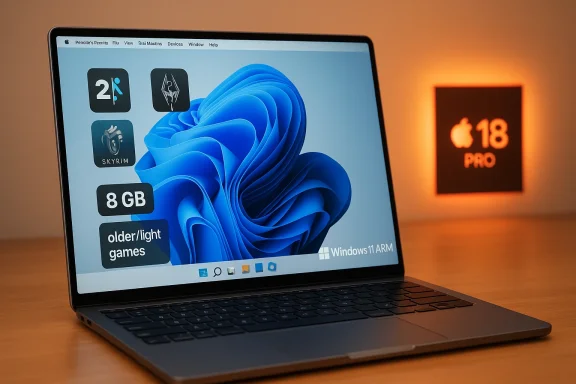 What ETA Prime Actually Tested
ETA Prime’s setup was intentionally consers the results more interesting rather than less. He allocated just 5 GB of RAM to Windows inside Parallels, which is a tight budget for a guest operating system, but one that reflects the Neo’s reality: the machine only has 8 GB of unified memory to begin with. In other words, the test did not rely on a fantasy spec sheet. It worked within the machine’s real limits.The virtualization choice matters
The YouTuber reportedly tried UTM and VMware Fusion, buts Desktop because it delivered better performance in this scenario. That is important because virtualization on Apple silicon is not a one-size-fits-all experience. Different apps can expose different bottlenecks, and on a system as tightly constrained as the Neo, even small differences in overhead can decide whether a game feels playable or choppy.The test also focused on Windows 11 ARM**, not a full x86 Windows install. That means native Windows-on-Arm apps ran withohich is a major reason performance was decent in the games that behaved well. It is easy to overlook that detail, but it changes the meaning of the benchmark completely. This was not a proof that the Neo can brute-force legacy Windows software; it was a proof that the platform can handle light, modern Windows workloads surprisingly well when the software stack is aligned.
Why the 5 GB RAM allocation matters
Giving the virtual machine 5 GB of memory leaves little headroom for anything else, and that’s exactly w weight. If Windows and the game can remain smooth under that constraint, then the underlying host system is doing real work behind the scenes. It also shows that efficiency can sometimes matter more than raw capacity for short, bursty workloads like older games or lighter apps.- Parallels was chosen over free alternatives for performance reasons.
- Windows 11 ARM ran without x86 conversion for native ARM apps.
- Only 5 GB of RAM was assigneThe Neo’s 8 GB system memory created the main constraint.
- The test targeted games with no native macOS version.
The Game Results Were Better Than Expected
The headline results are straightforward: low-to-mid-range Windows games ran smoothly enough to make the setup feel legitimate rather than experimental. Marvel Cosmic Invasion reportedly held around 60 FPS with the resolution maxed out, which is a strong showing for a fanless budget laptop running a guest OS. For a machine in this class, that is not merely adequate; it is a sign that the platform has enough spare performance to absorb the virtualization penalty.Dirt 3 was tested at 1200p with graphics set to High and averaged around 75 FPS. That is a very respectable result, and it suggests that the Neo has enough single-thread and geep older racing games fluid under Windows 11 ARM. For anyone who remembers how brittle cheap laptops used to be with games even a few years old, that figure is notable.
Portal 2 and Skyrim showed the ceiling
Portal 2 ran at more than 100 FPS on Medium settings, and Skyrim reportedly stayed around 60 FPS at 1200p with Medium visuals. Those numbers areat many classic PC titles are still mostly limited by software compatibility, not bleeding-edge GPU load. If the host device is efficient enough and the guest OS is stable, the experience can feel far closer to a real PC than people might expect from an iPhone-class chip.At the same time, the test is revealing because it draws a line between “older or lighter” and “more demanding.” The Neo did well when the games were not asking for modern AAA throughput, complex graphics pipelines, or huge memor the practical answer is not “yes, it games well,” but rather “yes, it games well within a very specific band of demand.” That distinction matters more than the raw FPS numbers.
- Marvel Cosmic Invasion: about 60 FPS at max resolution.
- Dirt 3: about 75 FPS at 1200p, High settings.
- Portal 2: over 100 FPS on Medium.
- Skyrim: about 60 FPS at 1200p, Medium settings.
- The common pattern: older or lighter games ran best.
re meaningful
These results show that the Neo’s A18 Pro is not just “good for a phone chip.” It can sustain enough host-side performance to make a Windows 11 VM useful for gaming in the right cases. That is especially striking because fanless systems usually struggle once emulation or virtualization introduces overhead, yet the Neo still appears to preserve enough responsiveness to keep frame rates healthy.The implication for consumers is subtle but important. If your Windows-only gaming library is mostly composed of older titles, indie games, or lightly demanding classics, the MacBook Neo may actually be a credible secondary gaming device. If your library leans toward modtiplayer anti-cheat-heavy software, or graphics-intensive blockbusters, the answer changes very quickly.
The GTA V Result Shows the Limits
If the earlier results looked impressive, GTA V is the necessary reality check. ETA Prime reportedly could not get the game into playable territory on the Neo through Parallels, and that is entirely consistent with what a low-memory, virtualizedld suggest. The game is old enough to tempt optimism, but it still asks for enough sustained graphics and translation efficiency to expose the edges of the platform.Compatibility is not the same as performance
This is the biggest lesson in the whole test. A game being technically launchable inside Windows 11 ARM does not mean it will play well at an acceptable frame rate. Virtualization can make software available, but not always pleasant. The Neo seems to sit righe between those two states.That also explains why Crossover came up in the discussion. ETA Prime noted that GTA V may run more smoothly through Crossover, which uses a Wine container and Proton layer rather than a full VM. That matters because different compatibility layers shift the bottleneck in different ways. In some cases, a translation-based approacualization, even if the setup looks less “native” on paper.
The practical takeaway is that the Neo is not a universal Windows gaming answer. It is a machine that can surprise you with the right software and disappoint you with the wrong one. That unpredictability is not unusual in the world of virtualized Windows gaming, but it becomes more visible on hardware with a tight RAM ceiling.
The 8 GB ceiling cha
The limit is not just raw memory. It is the combination of 8 GB unified memory, a fanless thermal design, and the extra overhead of running a guest OS. That trio shapes every benchmark result more than the chip itself does. Apple silicon is efficient, but efficiency cannot completely cancel physics.- GTA V was not pln this setup.
- Crossover may offer a better route for that specific game.
- The bottleneck is the full platform stack, not just the CPU.
- Memory headroom is extremely limited.
- The limits become more visible as games get more demanding.
What This Means for Mac Gaming
The MacBook Neo test is useful beyond the Neo itself because it shows how farcon can go when software is cooperative. It reinforces the idea that Mac gaming is no longer just about native macOS ports; it is also about virtualization, ARM compatibility, and translation layers that sometimes blur the line between platforms. The result is a wider, messier, but more interesting gaming landscape than Mac users had a few years ago.The new logic of “good enough”
A lot of gaming discussion assumes the only meaningful benchmark is whether a laptop can handle modern high-end titles. That misses a large part of the market. Many users only want to run a handful of older favorites, strategy games, platformers, or indie titles, and for them, a machine like the Neo may be “good enough” in a way that changes buying behavior.That is especially not purchased primarily as a gaming machine. The Neo’s core appeal remains affordability, portability, and everyday efficiency. Gaming is an added capability, not the mission. The surprising part is that the added capability is not trivial; it is strong enough to matter.
The ecosystem angle
If Apple continues to sell budget Macs that can handle a surprising range of Windows software, even that could weaken one of the last practical reasons some buyers cling to low-end Windows laptops. Those machines have traditionally won on price and compatibility. Apple is now making at least a partial argument that low price does not have to mean low capability. That is a meaningful competitive shift.- Low-emore useful for gaming-adjacent use cases.
- Compatibility layers now matter as much as raw hardware.
- Older and lighter titles are the sweet spot.
- Native ports remain ideal, but virtualization is narrowing the gap.
- Apple’s value positioning is becoming harder for rivals to ignore.
Why Parallels Is the Enabler Here
The choice of Parallels Desktop is not just a software footnote; it is the reason the test worked as well as it did. e suggests that Parallels remains the most polished route for Windows 11 ARM on Apple silicon when the goal is usable performance rather than merely functional booting. That makes it a strategic tool in the wider Mac-on-Windows conversation.Parallels versus free alternatives
The report says the YouTuber was not satisfied with the performance from UTM or VMware Fusion. That does not mean those tools are bad; it means the margin for inefficiency is slim when you only have 8 GB of memory to work with. On a more generously spec’d Mac, the differences might matter less. On the Neo, they matter a great deal.This is a good example of a broader truth in computing: software polish often becomes most visible on low-end hardware hide inefficiencies, but a tight system exposes them immediately. Parallels appears to benefit from that scrutiny by offering a smoother path through the same underlying platform constraints.
Windows 11 ARM is the real foundation
It is worth repeating that the test involved Windows 11 ARM, not a generic x86 Windows environment. That means the best results came from softARM-native or otherwise friendly to the architecture. The performance story would be very different if the setup depended heavily on x86 translation.That distinction will continue to shape the future of Mac virtualization. The more software vendors support Windows on ARM directly, the more capable machines like the Neo will appeahere is, the more the Neo’s advantage gets narrowed by compatibility friction rather than hardware power.
- Parallels delivered the best results in this test.
- Free alternatives may be more variable in performance.
- Windows 11 ARM is central to the good outcome.
- Native ARM software is the easiest path to success.
- The software stack matters as much as t the Neo Compares to Expectations
A cheap Mac that behaves like a smarter machine
A lot of budget laptops are cheap because they compromise on everything: display quality, chassis feel, thermal design, battery life, and internal efficiency. The Neo appears different. Even if the hardware is limited, it is limited in a way that preserves consistency, which helps explain why its Windows performance can feel so coherent in short bursts.That is a subtle but important advantage. Users do not always need maximum peak speed; they often need a system that avoids the jagged, inconsistent slowdowns that make cheap laptops feel worse th In that sense, the Neo may have a smoother quality of limitation than many inexpensive Windows PCs.
The market message is bigger than the benchmark
Apple does not need the Neo to become a universal Windows box. It only needs the machine to be good enough that buyers start seeing the low end of the laptop market differently. If a budget Mac can run office apps, browser workloads, and select Windows be credible, then the old assumption that only Windows laptops can cover those needs starts to weaken.- The Neo is more capable than its low price implies.
- Cheap does not automatically mean chaotic or slow.
- The machine benefits from consistent efficiency.
- The result changes how buyers think about entry-level lking a strategic statement, not just a product play.
Enterprise and Education Implications
For enterprises, the Neo’s promise is narrower than the consumer story, but still worth watching. A Windows VM on a Mac is not going to replace managed corporate Windows fleets, especially in environments with special drivers, tight compliance requirements, or legacy software. Still, the ability to access a few Windows-only tools ow-power laptop could be useful for mixed-device organizations.Good for selective access, not blanket replacement
The machine makes the most sense for users whose Windows needs are occasional rather than primary. Think email, browser-based business apps, light testing, or one-off access to a specialized Windows utility. In that kind of workflow, the Neo’s smoothness can be more valuable than raw power, because the system is being used as a bridge rather than a workstation.That said, companies need to be cautious about overreading the results. A virtual machine adds another layer to support, and support is often where low-end elegance turns into enterprise complexity. What looks easy in a YouTube demo can become a helpdesk burden once its or hundreds of users.
Education could be the quiet winner
Education buyers are more likely to value a device that is inexpensive, portable, and capable enough for mixed workloads. If a student can write papers in macOS and then run a Windows-only lab app or game in Parallels, the laptop becomes more flexible than its price suggests. That flexibility is not unlimited, but it may be enough for a lot of classro- Selective Windows access is the strongest enterprise use case.
- Heavy production workloads still belong on more capable systems.
- Virtualization adds support complexity.
- Education buyers may benefit most from the flexibility.
- The Neo is best treated as a bridge, not a fleet standard.
Strengths andacBook Neo’s strongest selling point is that it turns a low-cost laptop into something unusually adaptable. That is not the same thing as calling it powerful, but it is arguably more important for real-world buyers who care about usefulness per dollar rather than benchmark bragging rights.
- Excellent value positioning for a laptop that can do more than basic web tasks.
- **Unexpectedly strong single-thread brkloads.
- Decent Windows 11 ARM virtualization through Parallels.
- Playable performance in many older Windows games.
- Useful portability for students and travelers.
- Cross-platform flexibility for users who need occasional Windows access.
- A compelling secondary-device story for macOS-first households.
Risks and Concerns
The biggest risk is that people will hear “Windows 11 runs well” and assume the MacBook Neo can replace a purpose-built Windows machine. That would be a mistake. The test clearly shows that the laptop has strengths, but it also shows the hard limits imposed by 8 GB of memory, fanless cooling, and virtualization overhead.- 8 GB memory is a hard ceiling for mixed macOS and Windows use.
- Gaming compatibility varies sharply by title and runtime layer.
- Virtualization overhead can collapse performance in heavier apps.
- GTA V was not playable in the Parallels test.
- Some users may overestimate what “works” means.
- Enterprise troubleshooting can get complicated once a VM is involved.
- Graphics-heavy workloads remain a weak spot.xpectation drift. A machine that feels impressively smooth in one or two demos can become a disappointment if buyers try to stretch it into a workstation or primary gaming laptop. The Neo’s real value depends on users respecting its boundaries, and that is always harder to manage once a product becomes popular through viral testing.
Looking y next phase is more testing, not a sudden rewrite of the market. We need to see how the MacBook Neo behaves with additional Windows titles, more productivity software, and longer sustained sessions before drawing broad conclusions. Still, the early signs are strong enough to suggest that Apple’s low-cost Mac has created a legitimate new category: a budget laptop that can handle light Windows use without embarrassment.
What to watch next
- More game tests across older and newer Windows titles.
- Comparisons between Parallels, UTM, VMware Fusion, and Crossover.
- Battery life impact while running Windows 11 ARM in a VM.
- Compatibility results for common office and school software.
- Whether Apple updates the Neo line with more memory options.
- How Windows-on-Arm app support evolves tware developers optimize for Windows on ARM, the Neo’s usefulness could increase without any hardware change at all. If they do not, the machine will remain a strong but specialized tool with a clearly defined ceiling. Either way, the test has already proven that low-cost Apple silicon can do more than many people expected, and that makes the MacBook Neo one of the more interesting laptops of the year.
Source: Notebookcheck MacBook Neo punches above its weight in Windows 11 gaming test
Last edited:
