

In the mid‑1980s, when the personal computer market still felt like the wild west of hardware add‑ons and niche vendors, Microsoft quietly shipped an oddball product that now claims the dubious title of “worst‑selling Microsoft product of all time”: a tailored build of OS/2 made specifically for the Mach 20 upgrade card. According to a long‑running Microsoft developer anecdote, only 11 copies were ever sold — and eight were returned — a figure repeated across retrospectives but explicitly presented as second‑hand memory rather than hard sales records.
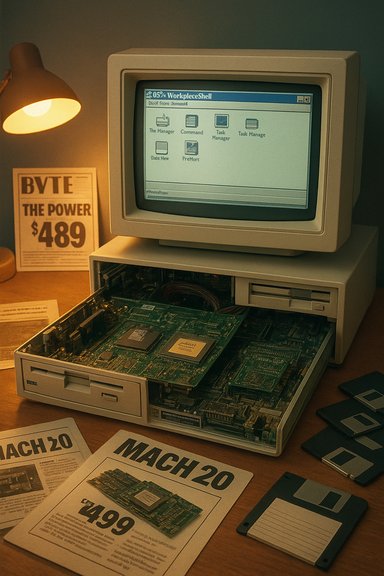
The IBM PC ecosystem of the 1980s encouraged improvisation. CPU upgrade cards — sometimes called “Turbo Cards” — let owners extend the life of an existing machine by replacing the on‑board processor with a ribbon‑cable adapter that linked to a faster chip on a full‑length expansion board. Microsoft itself sold a Mach 10 card that replaced a slow 8088 with a 9.54 MHz 8086, and later partnered with a small vendor to market the more ambitious Mach 20, which centered on an 8 MHz Intel 80286 and offered daughterboard expansion for memory and floppy connectivity. The concept was elegantly pragmatic: a cheaper incremental upgrade than buying a new PC, and an answer to the painfully limited expansion slot situation on IBM PC and PC/XT motherboards. The Mach 20’s ambitions were modest but technically noteworthy: it exposed an 80287 coprocessor socket, supported an external daughterboard that could host several megabytes of RAM (quoted advertisements and period catalogs mention memory options that sound exotic today), and even provided auxiliary connections that conserved the motherboard’s precious slots. Retail price contemporaneous listings place the Mach 20 in the several‑hundred‑dollar range — a significant sum in the late 1980s but still cheaper than a full system upgrade.
Source: Tom's Hardware The 'worst-selling Microsoft product of all time' sold just 11 times, and eight people returned it — why you've never heard of OS/2 for the Mach 20
 Background: the hardware era that made strange software possible
The IBM PC ecosystem of the 1980s encouraged improvisation. CPU upgrade cards — sometimes called “Turbo Cards” — let owners extend the life of an existing machine by replacing the on‑board processor with a ribbon‑cable adapter that linked to a faster chip on a full‑length expansion board. Microsoft itself sold a Mach 10 card that replaced a slow 8088 with a 9.54 MHz 8086, and later partnered with a small vendor to market the more ambitious Mach 20, which centered on an 8 MHz Intel 80286 and offered daughterboard expansion for memory and floppy connectivity. The concept was elegantly pragmatic: a cheaper incremental upgrade than buying a new PC, and an answer to the painfully limited expansion slot situation on IBM PC and PC/XT motherboards. The Mach 20’s ambitions were modest but technically noteworthy: it exposed an 80287 coprocessor socket, supported an external daughterboard that could host several megabytes of RAM (quoted advertisements and period catalogs mention memory options that sound exotic today), and even provided auxiliary connections that conserved the motherboard’s precious slots. Retail price contemporaneous listings place the Mach 20 in the several‑hundred‑dollar range — a significant sum in the late 1980s but still cheaper than a full system upgrade. Why Microsoft shipped OS/2 for a card
OS/2 was originally a joint effort between IBM and Microsoft meant to be the next major PC operating system. When PC add‑on cards like the Mach family tried to create AT‑class performance on older hardware, there was a logic to shipping a compatible OS image tuned to the card’s quirks. Microsoft produced a customized OS/2 build targeting the Mach 20’s hardware profile so users could, in theory, enjoy the advanced features of OS/2 — multitasking and an advanced presentation layer — without purchasing a brand‑new AT‑class machine. But hardware‑level solutions introduce new points of fragility: mismatched timings, driver issues, and the inevitable performance bottleneck imposed by an 8‑bit system bus.The sales anecdote: legend, memory, and why the number matters
Raymond Chen, veteran Microsoft engineer and author of the Old New Thing column, recounted the Mach 20/OS/2 story from the perspective of long‑ago Microsoft support staff. Chen’s post relays a colleague’s memory that only eleven boxed copies of “OS/2 for Mach 20” were sold, and eight purchasers returned their copies — leaving allegedly three non‑returned units, two of whose buyers the support specialist had spoken to directly. Chen frames the tale as recollection, urging readers to treat the quantities as anecdotal. This specific figure has been amplified by multiple outlets and retro computing sites and picked up by mainstream tech press. Some secondary articles reproduce Chen’s quote verbatim and discuss its plausibility; others use it as a hook to revisit the Mach card family and the odd choices of early software/hardware packaging. But it’s important to underline the nuance here: the “11 sold, 8 returned” figure is effectively an oral history — it’s plausible and telling, but it is not a scanned ledger or verified sales report. Multiple commentators have echoed Chen’s framing that this is “according to legend” rather than corporate accounting. Why does that anecdote matter? Because it reveals how fragile software economics were when the platform and hardware stack were both in flux. Shipping a specialized OS image for an add‑on card is an act of faith: the vendor bets that a small subset of users will value the tailored experience enough to buy, keep, and — crucially — succeed at installing and running the product. The Mach 20 case demonstrates how many things must go right for that bet to pay off: correct drivers, stable timing, solid documentation, and customers who both understand what they’re buying and have the technical confidence to install it. When even one of those factors is missing, returns pile up fast.Technical anatomy: Mach 10 and Mach 20, and the limits of upgrade cards
The Mach series solved one pressing problem of the era: performance without slot exhaustion. Remember that many early PCs shipped with only five expansion slots; drive controllers, graphic adapters, and I/O ports were all jockeying for space. By replacing the CPU socket with a ribbon‑cable adapter and consolidating auxiliary functions on the Mach board, users could reclaim slot space while gaining a more powerful processor and on‑board features like a mouse port. Key technical points that shaped the Mach 20 experience:- The Mach 20 used an Intel 80286 at higher clocks than a stock XT’s 4.77 MHz 8088, yielding meaningful CPU‑bound speedups but still constrained by the 8‑bit ISA bus.
- Expansion arrived as daughterboards attached to the Mach card itself, letting features like extra RAM and multi‑floppy drive connections avoid consuming system slots. Contemporary listings mention multi‑megabyte memory options that were uncommon on standard motherboards of the period.
- The card included an 80287 floating‑point socket for math acceleration, a standard way to boost scientific and CAD workloads that relied on floating‑point math.
OS/2 and the corporate context: technically strong, commercially challenged
OS/2’s story is well‑documented: born as a collaboration between Microsoft and IBM, it aimed to modernize the PC OS stack with protected‑mode multitasking, a more structured API, and a path beyond MS‑DOS. However, the partnership splintered in the early 1990s and Microsoft focused on Windows; IBM carried OS/2 forward. OS/2 2.0, released in 1992, represented the platform’s first broad 32‑bit release and introduced the Workplace Shell and robust virtual DOS machine support that made running multiple DOS sessions far more practical. Despite these technical merits, OS/2 struggled in marketshare against Windows for reasons that included timing, third‑party support, and distribution strategies. Two contrasting truths shape the Mach 20 OS/2 anecdote:- Technically, OS/2 offered capabilities ahead of many contemporaries — preemptive multitasking, a 32‑bit API in later releases, and advanced system services that enterprises appreciated.
- Commercially, OS/2’s philosophies and positioning made it a niche play outside specific verticals; bundling or selling a cartridge of OS/2 specifically for a nonstandard upgrade card greatly reduced its addressable market. The combination of a niche OS and niche hardware produced a tiny potential customer base, which makes the low sales figures less mysterious in context.
Preservation, provenance, and the “final boss” of software archaeology
Retro‑computing communities and software archivists have long chased rare items like an OS/2 for Mach 20 boxed copy. The anecdote about 11 sales and eight returns has become a challenge: if the shipment truly existed, where are the surviving copies? Enthusiasts treat such artifacts as “final boss” finds for collectors and preservationists because they represent a narrow intersection of platform, hardware, and corporate decision‑making that rarely survives mass production and distribution. Preservation challenges in this niche include:- Physical decay: floppy media and magnetic disks degrade, making intact installation media rare.
- Loss of peripheral hardware: an OS image tied to a particular expansion card requires the card to be functional for a faithful test.
- Sparse documentation: specialized builds often shipped with minimal or vendor‑specific readme files, so reconstructing installation procedures can demand detective work.
What the Mach 20 story tells us about product strategy and engineering discipline
There are lessons here that still resonate for product teams in 2025. Three stand out:- Niche hardware + niche software multiplies risk. Combining two narrow market bets exponentially reduces the chance of commercial success unless there’s a clear and compelling value proposition that justifies customer effort. The Mach 20’s premise of “get AT‑class performance for less” was sound, but pairing it with a specialized OS image added friction for buyers.
- Engineering and support overheads scale. Even when the engineering team can build a specialized OS image, supporting a tiny user base imposes fixed costs that are hard to recoup. Raymond Chen’s anecdote came from support staff memories — a reminder that the human cost of supporting esoteric use cases can be disproportionately high.
- Documentation and expectation management matter. Period buyers returning OS/2 copies likely did so because expectations (or instructions) didn’t match reality. Modern product teams invest heavily in onboarding and documentation precisely because early confusion drives returns and negative word of mouth.
Critical assessment: strengths, uncertainties, and risk flags
Strengths- Historical evidence shows that Microsoft experimented with hardware in the 1980s and shipped real, tangible products like the Mach cards rather than just prototypes; the Mach 20’s technical design is a clever solution to a platform limitation.
- OS/2’s technical pedigree is solid: later releases delivered 32‑bit APIs and robust multitasking features admired by enterprise users. That pedigree lends credibility to the idea of producing a tailored OS image for specialized hardware.
- The precise sales figure (eleven sold, eight returned) is based on recollection relayed by a Microsoft engineer and is therefore anecdotal. Treat it as a credible oral history but not a definitive corporate record; attempts to treat it as a factual ledger should be flagged. Raymond Chen himself characterizes it as second‑hand memory.
- Contemporary periodicals and scans confirm many Mach 20 specifications and price points, but few publicly available primary sales records or shipment manifests survive online. That absence makes absolute claims about “worst‑selling product” more rhetorical than statistically ironclad. Byte and InfoWorld advertising and review snippets confirm price and features, but not volume.
- Shipping hardware‑specific software increases the support burden and raises the chance of returns.
- Overfitting software to transient hardware (an add‑on card) risks obsolescence faster than mainstream platform targeting.
- Relying on oral history to memorialize product performance invites myths; where possible, preserve and publish archival sales and support metrics to help historians.
Practical takeaways for preservationists, hobbyists and historians
- Hunt for tangible artifacts: sealed or boxed copies, original floppies, and Mach 20 cards matter. They are the only definitive evidence that resolves open questions around distribution and packaging.
- Document oral histories responsibly: annotate memories with dates, titles, and corroborating materials, and label numerics as “recollection” where appropriate.
- Emulate with caution: reconstructing an OS/2 for Mach 20 experience in an emulator or testbed requires both the card firmware/firmware images and the OS installer; even if you find an installer, missing hardware drivers will make realistic testing hard.
Conclusion
The Mach 20 story is a compact lesson in platform economics, engineering pragmatism, and the hazards of combining two niche bets. The oft‑repeated figure — eleven sold, eight returned — is as colorful as it is fragile; it survives because veteran engineers preserved the memory and because retro communities amplified it, not because it was printed in a corporate annual report. That uncertainty is part of what makes the story valuable: it’s a reminder that technology history is shaped not only by bestselling megaproducts but also by small, stubborn experiments that illuminate the limits of innovation. For archivists, collectors, and engineers alike, the Mach 20 and the scarce OS/2 builds that accompanied it are a cautionary, fascinating footnote — a product that failed commercially but succeeded at teaching lessons about compatibility, expectation, and the cultural value of preservation.Quick reference (verified claims and provenance)
- Anecdote of “11 sold, 8 returned”: recounted by Raymond Chen on the Old New Thing blog and echoed in multiple retrospectives; presented as recollection rather than hard sales data.
- Mach 20 hardware highlights: Intel 80286 at higher clock, daughterboard memory expansions and 80287 socket; $400–$500 price range in period listings.
- OS/2 historical context: OS/2 evolved from a Microsoft–IBM collaboration; OS/2 2.0 was the major 32‑bit release that advanced the platform technically even as it faltered commercially.
Source: Tom's Hardware The 'worst-selling Microsoft product of all time' sold just 11 times, and eight people returned it — why you've never heard of OS/2 for the Mach 20
