

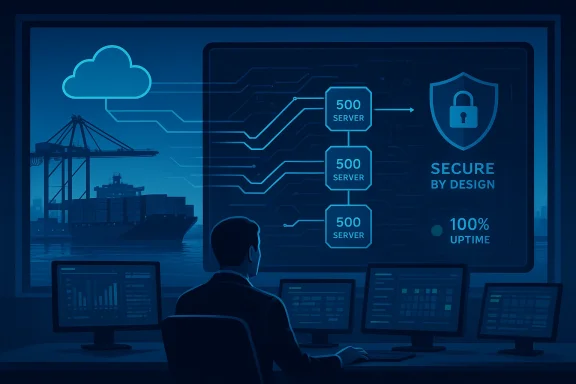
Maersk’s latest SAP-on-Azure modernization is a reminder that the biggest cloud wins in 2026 are often not flashy new apps, but the hard, unglamorous work of replacing brittle infrastructure at industrial scale. Microsoft says the shipping giant moved its business-critical SAP estate to Azure with near 100% uptime, zero post-migration incidents, and a pace that outstripped its own estimate, including the build-out of 500 servers in three weeks. That kind of execution matters because Maersk is not migrating a side project; it is replatforming the operational core of a global logistics network where delays, outages, and security gaps carry immediate financial consequences.
Maersk has spent years turning digital transformation into a competitive weapon, and this move fits a much longer trajectory than a single migration project. Microsoft first positioned Azure as a strategic cloud partner for Maersk back in 2017, when the company was already framing data, analytics, and application platforms as central to future supply-chain innovation. In that earlier era, the focus was on connected vessels, app stores, and digital products; today, the focus has shifted to the deeper plumbing of enterprise IT, especially SAP modernization and technical debt reduction.
The new Microsoft customer story describes the migration as a foundational modernization effort rather than a feature-driven transformation. That distinction is important. In many large enterprises, the first business case for cloud is not “what can we build?” but “what can we finally stop paying for?” Here, the answer seems to be a combination of lower infrastructure costs, better resilience, and a stronger security posture built on a more modern platform.
The story also lands in a broader market context where SAP customers are increasingly rethinking where and how their core ERP workloads run. Microsoft has spent years building a reputation for SAP scale, and recent customer stories from other global enterprises, such as Nestlé, reinforce the same message: Azure is being used as a hyperscale operating base for enormous SAP estates, not just a hosting layer. For organizations that run on SAP at global scale, the cloud decision is increasingly about operational control, not just IT modernization.
Just as important, this is no longer an abstract “lift and shift” narrative. Maersk’s quote trail emphasizes insourcing, autonomy, and a Secure by Design mindset. Those themes reflect a shift in enterprise strategy: the migration is now the starting point for business agility, not the endpoint. Once the platform is stable, the enterprise can move on to analytics, automation, and eventually AI-driven logistics optimization.
The operational result—near 100% uptime and zero post-migration incidents—suggests the program was designed as a business continuity exercise first and a technology change second. That is the right order of priorities for a logistics company whose customers care less about architectural elegance than about whether cargo moves on time.
It also reinforces a broader lesson about enterprise cloud programs: the hardest part is not getting to the cloud, but getting to the cloud without forcing the business to pay for your mistakes.
For Maersk, that matters because SAP does not live in isolation. It connects to customer-facing workflows, internal operations, vendor processes, and the movement of physical goods. In practice, the platform decision shapes how quickly the company can respond when conditions change.
That is where Maersk’s migration becomes more than an IT refresh. It is a move that sets up future options in logistics planning, exception management, and end-to-end supply chain visibility.
By moving to Azure, Maersk appears to be treating technical debt as a balance-sheet issue rather than a purely technical one. That framing is powerful because it links infrastructure decisions to capital allocation. Every dollar not spent propping up legacy environments can be redirected toward operational innovation.
Still, the key caveat is that cloud cost savings are notoriously dependent on governance. A successful migration can become an expensive platform if consumption is not tightly managed. That is true for nearly every hyperscale environment, and Maersk will need ongoing discipline to preserve the value it created during migration.
For SAP specifically, this is critical. ERP systems contain sensitive data about customers, suppliers, finances, inventory, and operational flow. They are not merely business systems; they are data concentration points that can become high-value targets.
Maersk’s migration therefore has a direct commercial implication. Better resilience improves the company’s ability to deliver predictable service, and predictability is one of the most valuable products in global logistics.
This is not an anti-partner message so much as a maturity signal. If a company’s systems are business-critical enough, it may be better to retain the capability to evolve them internally rather than renting that capability indefinitely.
It also explains why the current migration feels strategically important. The platform is not only modernized; the organization itself becomes more capable of making future changes without rebuilding everything from scratch.
That is also why the 500-server build-out matters. Infrastructure replication at this size is never just about provisioning machines. It is about aligning compute, storage, networking, identity, monitoring, and application behavior into one coherent environment.
A strong cloud platform can therefore function as a control tower for the business. When the data is reliable, the company can anticipate disruption earlier, route around problems faster, and improve the customer experience at scale.
This also reflects a broader industry shift. Companies are no longer asking whether cloud helps AI; they are asking whether they can do AI without cloud modernization first. In most cases, the answer is no.
In that sense, Maersk’s migration is not only about catching up. It is about creating room to compete on a different footing.
That matters commercially because large enterprise deals are still heavily shaped by peer validation. Decision-makers want to know that another globally distributed company has already done the hard part.
This is especially important as customers move toward cleaner-core strategies and away from sprawling customizations. Maersk’s story suggests that disciplined modernization can make SAP more strategic, not less.
The broader lesson for the market is that enterprise cloud modernization is entering a more pragmatic era. Buyers want proof of value, not just promises, and they are increasingly demanding evidence of stability, speed, and security before they endorse any major platform shift. Maersk’s story gives Microsoft a strong proof point, but it also raises the bar for every other vendor trying to sell the next big ERP transformation.
Source: Microsoft Maersk unlocks innovation by modernizing SAP on Azure at petabyte scale | Microsoft Customer Stories
 Overview
Maersk has spent years turning digital transformation into a competitive weapon, and this move fits a much longer trajectory than a single migration project. Microsoft first positioned Azure as a strategic cloud partner for Maersk back in 2017, when the company was already framing data, analytics, and application platforms as central to future supply-chain innovation. In that earlier era, the focus was on connected vessels, app stores, and digital products; today, the focus has shifted to the deeper plumbing of enterprise IT, especially SAP modernization and technical debt reduction.The new Microsoft customer story describes the migration as a foundational modernization effort rather than a feature-driven transformation. That distinction is important. In many large enterprises, the first business case for cloud is not “what can we build?” but “what can we finally stop paying for?” Here, the answer seems to be a combination of lower infrastructure costs, better resilience, and a stronger security posture built on a more modern platform.
The story also lands in a broader market context where SAP customers are increasingly rethinking where and how their core ERP workloads run. Microsoft has spent years building a reputation for SAP scale, and recent customer stories from other global enterprises, such as Nestlé, reinforce the same message: Azure is being used as a hyperscale operating base for enormous SAP estates, not just a hosting layer. For organizations that run on SAP at global scale, the cloud decision is increasingly about operational control, not just IT modernization.
Just as important, this is no longer an abstract “lift and shift” narrative. Maersk’s quote trail emphasizes insourcing, autonomy, and a Secure by Design mindset. Those themes reflect a shift in enterprise strategy: the migration is now the starting point for business agility, not the endpoint. Once the platform is stable, the enterprise can move on to analytics, automation, and eventually AI-driven logistics optimization.
What Maersk Actually Changed
The most striking detail in Microsoft’s account is not the word Azure, but the pace and reliability of the cutover. The company says the team built 500 servers in three weeks and achieved an outcome that beat its migration estimate. That kind of execution usually signals a mature runbook, disciplined dependency management, and a team that deeply understands both the source environment and the target architecture.A migration story built on operational discipline
Large SAP migrations often fail for reasons that have little to do with the cloud itself. The usual culprits are incomplete inventory, hidden integrations, fragile batch jobs, and underappreciated dependencies between business units. Maersk appears to have avoided those traps by leaning on institutional knowledge and very careful planning.The operational result—near 100% uptime and zero post-migration incidents—suggests the program was designed as a business continuity exercise first and a technology change second. That is the right order of priorities for a logistics company whose customers care less about architectural elegance than about whether cargo moves on time.
Why speed matters in a business like Maersk’s
For a carrier and logistics provider, every hour of downtime can cascade across booking systems, customs workflows, customer notifications, and downstream partners. In that sense, speed is not simply a project-management trophy; it is a risk-reduction metric. A faster migration compresses the period of uncertainty and reduces exposure to the kinds of operational drift that can happen when dual environments run too long.- Faster cutovers reduce the time systems remain in a fragile transitional state.
- Shorter migrations lower the chance of version drift between old and new environments.
- Teams retain more of their context and memory when change is tightly sequenced.
- Business users experience less disruption when “big bang” risk is managed well.
The significance of zero post-migration incidents
Zero incidents after migration is especially notable because it implies more than a clean technical handoff. It suggests that the system interfaces, identity flows, business processes, and infrastructure behaviors were all stabilized before the switch. That is a major differentiator from migrations that succeed on paper but generate weeks of corrective work afterward.It also reinforces a broader lesson about enterprise cloud programs: the hardest part is not getting to the cloud, but getting to the cloud without forcing the business to pay for your mistakes.
Why SAP on Azure Remains a Strategic Bet
Microsoft’s long-running message around SAP on Azure has been consistency, scale, and integration. The company has spent years emphasizing that Azure can handle very large SAP systems, and customer stories like Nestlé’s show how that pitch is being validated in the field. Maersk now joins a cohort of large enterprises using Azure not as a temporary landing zone, but as a long-term operating platform for core ERP.SAP workloads need more than raw compute
SAP environments are notoriously demanding because they sit at the center of finance, logistics, procurement, planning, and operational execution. The infrastructure must support heavy memory loads, strict availability requirements, and complex integration patterns. Microsoft’s SAP messaging has therefore evolved beyond basic VM sizing into a broader promise of cloud maturity: availability zones, resilient recovery, security controls, and integration pathways into analytics and AI.For Maersk, that matters because SAP does not live in isolation. It connects to customer-facing workflows, internal operations, vendor processes, and the movement of physical goods. In practice, the platform decision shapes how quickly the company can respond when conditions change.
How Azure compares in the enterprise cloud race
The competitive story here is not that Azure is the only cloud capable of hosting SAP. It is that Microsoft has created a specific narrative around SAP modernization that blends infrastructure scale with enterprise software familiarity. That matters in boardrooms. CIOs and transformation leaders often want fewer vendors, fewer handoff points, and a cloud platform that feels aligned with existing enterprise controls.- Azure benefits from close alignment with Microsoft’s enterprise ecosystem.
- SAP customers can pair ERP modernization with security and identity tooling they already know.
- The platform story is increasingly tied to data, analytics, and AI readiness.
- Large migrations become stepping stones to broader modernization programs.
The enterprise architecture implication
The most interesting strategic shift is that SAP on Azure is no longer just about hosting legacy ERP in a different data center. It is about building a more modular enterprise platform around it. Microsoft’s customer stories increasingly frame the cloud as an enabler for predictive analytics, intelligent automation, and faster product or process change.That is where Maersk’s migration becomes more than an IT refresh. It is a move that sets up future options in logistics planning, exception management, and end-to-end supply chain visibility.
Cost Savings Without the Usual Cloud Hype
One of the strongest parts of the story is the way Maersk frames value creation. Kulczykowski’s comment makes clear that this was not about shiny new features. It was about remediating technical debt, reducing costs, and freeing up money for innovation and customer-facing assets. That is a much more credible cloud story than the usual “digital transformation” language that often means everything and nothing.Technical debt as a strategic tax
Heritage systems do not just consume maintenance budgets. They create organizational drag, force teams into defensive mode, and make even small changes disproportionately expensive. When an enterprise spends too much keeping old systems alive, it reduces its ability to invest in new capabilities that actually affect customers.By moving to Azure, Maersk appears to be treating technical debt as a balance-sheet issue rather than a purely technical one. That framing is powerful because it links infrastructure decisions to capital allocation. Every dollar not spent propping up legacy environments can be redirected toward operational innovation.
Cost reduction is only part of the equation
The real value of cost savings in a project like this is not the savings themselves, but the reinvestment opportunity. Once a company can operate more efficiently, it can fund data initiatives, workflow automation, resilience improvements, and customer-facing digital services. In a margin-sensitive industry like logistics, that flexibility can become a competitive edge.- Lower run costs improve the economics of modernization.
- Reduced vendor dependence can lower long-term services overhead.
- Better platform efficiency can unlock follow-on investment.
- Stability can reduce the hidden costs of outage recovery and firefighting.
Why this kind of savings is hard to fake
A lot of cloud programs promise savings but merely shift spend from one line item to another. The difference here is that Maersk is talking about eliminating outdated infrastructure and reducing the attack surface, not simply moving workloads to a different billing model. That suggests a more structural improvement, one that should show up in operational discipline over time.Still, the key caveat is that cloud cost savings are notoriously dependent on governance. A successful migration can become an expensive platform if consumption is not tightly managed. That is true for nearly every hyperscale environment, and Maersk will need ongoing discipline to preserve the value it created during migration.
Security and Resilience as Business Enablers
Maersk’s comments about improving its cybersecurity posture should be read as more than standard vendor language. Legacy infrastructure tends to accumulate risk, especially when systems remain in service longer than originally intended. Replacing that environment with a more standardized Azure foundation can reduce vulnerabilities, simplify patching, and create a more manageable security model.Security is now inseparable from platform modernization
The company says moving to Azure reduced vulnerabilities and attack vectors while supporting a Secure by Design environment. That matters because a modern security posture is increasingly architectural rather than reactive. Enterprises do not want to bolt on protection after the fact; they want the platform itself to be built around fewer trust assumptions and better control points.For SAP specifically, this is critical. ERP systems contain sensitive data about customers, suppliers, finances, inventory, and operational flow. They are not merely business systems; they are data concentration points that can become high-value targets.
Resilience is a customer experience issue
The typical way to talk about resilience is in technical terms like failover, recovery time, and uptime. But in logistics, resilience is a service-level issue. When systems stay up, customers get visibility, shipments move, and partners can rely on the platform. When systems fail, even briefly, the ripples can extend far beyond IT.Maersk’s migration therefore has a direct commercial implication. Better resilience improves the company’s ability to deliver predictable service, and predictability is one of the most valuable products in global logistics.
Operational security benefits that are easy to overlook
There is also a governance angle here. A standardized cloud platform can make it easier for internal teams to see what is running, who owns it, and how it is protected. That kind of clarity matters when companies are trying to tighten controls across sprawling global operations.- Standardization can reduce configuration drift.
- Cloud-native controls can improve visibility into platform behavior.
- Centralized identity and access management can simplify governance.
- Modern infrastructure often shortens patch and remediation cycles.
Insourcing and the Return of Internal Expertise
Maersk’s emphasis on autonomy is one of the most revealing parts of the story. Post-migration, the company says it gained greater control over its SAP systems and reduced dependence on third-party vendors. Clarke’s comment suggests that internal knowledge, not outsourcing, was one of the decisive factors in the program’s speed and quality.Internal teams can move faster when they own the system
There is a familiar pattern in enterprise transformation projects: external partners bring broad experience, but internal teams bring the memory of how the business really works. That memory becomes priceless when migrations touch core workflows. Maersk’s claim that its own team could design, build, and run the platform faster than a third party is a strong argument for insourcing in strategic systems.This is not an anti-partner message so much as a maturity signal. If a company’s systems are business-critical enough, it may be better to retain the capability to evolve them internally rather than renting that capability indefinitely.
The “designed, built, and delivered by Maersk” model
That phrase, used in earlier SAP coverage of Maersk, captures the company’s operating philosophy well. It suggests that transformation is not just about procuring better technology but about developing a technology organization that can sustain change. In that model, cloud migration becomes a platform for talent-building and operating-model change.It also explains why the current migration feels strategically important. The platform is not only modernized; the organization itself becomes more capable of making future changes without rebuilding everything from scratch.
Why vendor dependence matters in practice
Overreliance on third parties can slow modernization in several ways. It can create bottlenecks in change management, dilute institutional knowledge, and make the enterprise too dependent on outside calendars and staffing models. Maersk’s experience implies that internal ownership helped it avoid those problems.- Internal teams understand the business context behind workflows.
- Faster decisions are possible when architecture and operations sit together.
- Knowledge retention improves when expertise stays inside the company.
- Long-term responsiveness can be better than a pure outsourced model.
Data Scale, Logistics Scale, and the Petabyte Problem
The phrase “petabyte scale” is not just marketing flourish. It captures the reality that global logistics firms operate in an environment of massive transaction volumes, historical records, and interconnected operational data. At this scale, the challenge is not only storage, but making sure the right systems can access, process, and protect the right data at the right time.Scale changes the nature of the migration
At ordinary enterprise scale, a migration can be judged mainly by whether systems come back up. At petabyte scale, the assessment is broader. The enterprise must preserve data integrity, performance predictability, and business continuity across many regions and workflows. That is why the fact pattern around Maersk’s migration is so impressive: the company appears to have managed both scale and stability without a visible service penalty.That is also why the 500-server build-out matters. Infrastructure replication at this size is never just about provisioning machines. It is about aligning compute, storage, networking, identity, monitoring, and application behavior into one coherent environment.
Logistics data is different from generic enterprise data
Maersk’s data is tied to physical movement, contractual obligations, timing constraints, and customer commitments. That makes it more sensitive to latency and more exposed to operational consequences. A delayed container release or a broken workflow can have real-world cost, not just system inconvenience.A strong cloud platform can therefore function as a control tower for the business. When the data is reliable, the company can anticipate disruption earlier, route around problems faster, and improve the customer experience at scale.
The future value of a unified data foundation
Once systems are on a modern cloud platform, the next move is usually better analytics. That can mean real-time dashboards, predictive maintenance, automated exception handling, and eventually AI-enabled optimization. In a company like Maersk, those capabilities are not add-ons; they are tools for deciding where to position assets, how to route freight, and how to serve customers more consistently.AI and the Next Phase of Logistics Modernization
Maersk’s leaders frame the migration as foundational work for future innovation, including advanced tools and business agility. That language is significant because it shows how cloud projects now serve as a prerequisite for AI ambitions rather than a separate initiative. Enterprises cannot usually do serious AI work on top of fragmented, unstable, or overly customized core systems.Why cloud modernization comes before AI
AI needs clean, accessible, governed data. It also needs a predictable operating model. If the underlying SAP environment is still too brittle or too siloed, AI initiatives quickly become expensive experiments rather than operational assets. Maersk’s move to Azure should therefore be seen as an enabling layer for future automation and analytics.This also reflects a broader industry shift. Companies are no longer asking whether cloud helps AI; they are asking whether they can do AI without cloud modernization first. In most cases, the answer is no.
Where Maersk could go next
Logistics is a natural fit for AI-driven decision support because it is full of exceptions, forecastable patterns, and high-value optimization problems. Route selection, customs clearance, demand planning, warehouse orchestration, and customer communications all benefit from more intelligent systems. A stable SAP-on-Azure base can provide the foundation for those use cases.- Predictive analytics could improve disruption response.
- Automation could reduce manual exception handling.
- AI assistants could speed up customer and employee workflows.
- Better data integration could support more accurate planning.
- Real-time visibility could improve service commitments.
The strategic risk of moving too slowly
There is also a competitive angle. If a logistics giant modernizes its core faster than rivals, it can turn infrastructure competence into a market advantage. Conversely, companies that delay modernization may find themselves stuck with higher costs and weaker responsiveness precisely when customers expect more visibility and faster decision-making.In that sense, Maersk’s migration is not only about catching up. It is about creating room to compete on a different footing.
Competitive Implications for Microsoft, SAP, and the Cloud Market
This story is valuable for Microsoft because it reinforces a simple but powerful message: Azure is not only a place to run cloud-native apps; it is a place where some of the world’s largest and most demanding SAP estates can be modernized with low disruption. That is a critical proof point in an environment where cloud buyers are more skeptical, more cost-conscious, and more likely to demand evidence than slogans.Microsoft’s SAP narrative gets another enterprise anchor
Microsoft has long used customer stories to prove that Azure can handle big SAP workloads. Maersk adds a recognizable logistics brand to that portfolio, complementing examples like Nestlé and Microsoft’s own SAP modernization messaging. The combination of scale, speed, and near-zero disruption makes the story particularly compelling.That matters commercially because large enterprise deals are still heavily shaped by peer validation. Decision-makers want to know that another globally distributed company has already done the hard part.
SAP benefits when its ecosystem modernizes cleanly
SAP also benefits from successful cloud migrations because they validate the ongoing relevance of core ERP in a world increasingly obsessed with AI and digital experiences. The more SAP environments become modern, connected, and cloud-enabled, the easier it is for SAP to position itself as the system of record underpinning intelligent operations.This is especially important as customers move toward cleaner-core strategies and away from sprawling customizations. Maersk’s story suggests that disciplined modernization can make SAP more strategic, not less.
Hyperscaler competition continues to hinge on trust
The cloud market is no longer just about raw infrastructure capability. It is about trust, operational maturity, and the ability to make legacy modernization feel safe. For that reason, stories like this are as much about reassurance as they are about technology.- Enterprises want proof that large workloads can move without drama.
- They need confidence that migration partners understand the business.
- They care about future flexibility, not just current compute capacity.
- They increasingly evaluate cloud providers based on ecosystem fit.
Strengths and Opportunities
The Maersk-Azure migration stands out because it aligns business value with technical execution. It reduces risk while opening the door to a more flexible operating model, and it does so in a way that feels credible rather than promotional. For Microsoft, SAP, and Maersk alike, the result is a platform story with real strategic depth.- Near-zero disruption builds confidence in future transformation programs.
- Lower technical debt frees capital for growth-oriented investment.
- Improved security posture reduces the likelihood of legacy-driven exposure.
- Internal ownership speeds up future change and improves institutional memory.
- Cloud standardization simplifies governance across a global estate.
- AI readiness improves once the ERP foundation is modern and connected.
- Customer-facing agility becomes more realistic when the core platform is stable.
Risks and Concerns
Even with an apparently flawless migration, the long-term challenge is preserving the gains. Cloud estates can become complex, expensive, and hard to govern if consumption grows faster than discipline. Maersk’s success on day one does not guarantee success over the next five years, and that is where the real test begins.- Cloud cost creep can erode savings if governance weakens.
- Integration complexity may grow as new services are layered onto SAP.
- Vendor lock-in concerns could become more visible over time.
- Security posture still depends on ongoing operational discipline.
- Talent retention matters if internal expertise is concentrated in too few people.
- Change fatigue is possible if modernization accelerates too quickly.
- AI expectations may outpace the quality of the underlying data foundation.
Looking Ahead
The next phase will likely be judged less by infrastructure metrics and more by what Maersk does with the platform now that the heavy lifting is done. If the company can translate this modernization into stronger forecasting, faster exception handling, and better customer visibility, the migration will look like a defining strategic move rather than just a technical success. If not, it will still be a solid platform project, but not the innovation engine Microsoft is clearly hoping to showcase.The broader lesson for the market is that enterprise cloud modernization is entering a more pragmatic era. Buyers want proof of value, not just promises, and they are increasingly demanding evidence of stability, speed, and security before they endorse any major platform shift. Maersk’s story gives Microsoft a strong proof point, but it also raises the bar for every other vendor trying to sell the next big ERP transformation.
- Watch for follow-on AI initiatives built on the modernized SAP foundation.
- Track cost outcomes over time to see whether savings hold.
- Monitor resilience metrics to determine whether zero incidents remains the norm.
- Observe how much remains in-house versus outsourced in the operating model.
- Look for customer-facing improvements in supply-chain visibility and responsiveness.
Source: Microsoft Maersk unlocks innovation by modernizing SAP on Azure at petabyte scale | Microsoft Customer Stories
