
Maharashtra has unveiled MahaCrimeOS AI, an AI-driven investigation platform developed with CyberEye and Microsoft India Development Center that promises to accelerate cybercrime investigations, standardize workflows across police stations, and position the state as an early national model for AI-powered policing.
Since 2024 Maharashtra has pursued an aggressive strategy to embed artificial intelligence into public safety and governance through a state-owned special purpose vehicle called MARVEL (Maharashtra Advanced Research and Vigilance for Enforcement of Reformed Laws). That program has already produced fielded projects in Nagpur—ranging from investigative-assist tools to crowd-management pilots—and MahaCrimeOS AI is the latest, highest-profile output of that policy push.
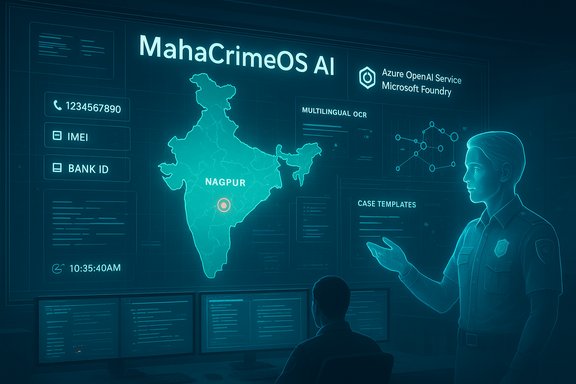
The system was publicly revealed during a major Microsoft AI Tour event in Mumbai, where Microsoft’s CEO highlighted cloud and generative-AI technologies as transformational for public safety. The platform is currently operational in a pilot footprint across several dozen police stations in Nagpur and is slated for a rapid expansion to cover the state’s full complement of roughly 1,100 police stations. Built with Microsoft cloud technologies and developed by CyberEye in collaboration with MARVEL, MahaCrimeOS AI aims to serve as an AI copilot for investigators, automating routine tasks and surfacing leads from otherwise unwieldy digital evidence.
The announced statewide rollout is also important because it signals a move from local, one-off pilots to operational scale. A consistent, centrally managed platform can:
However, scaling across states amplifies the risks previously described: cross-jurisdictional data-sharing must be carefully governed; differing local laws and state policies complicate uniform safeguards; and the temptation to centralize sensitive datasets at a national level raises sovereignty and misuse concerns.
A prudent national approach would favor an interoperable federation of regional instances—each with consistent API standards and common minimum safeguards—rather than a single, centralized database controlled by any one authority or vendor.
Yet the power of AI in policing demands equally powerful governance: explicit data protections, auditable chains of custody, human oversight, bias testing, and independent review. Technical choices—cloud-first architecture, LLM-backed assistants, and RAG retrieval—are modern and capable, but they do not obviate legal or ethical obligations.
The real test will be how Maharashtra balances speed and efficiency with privacy, fairness, and accountability as MahaCrimeOS AI moves from pilot to statewide service. If the state builds transparent safeguards, commits to independent audits, and treats human verification as the default, MahaCrimeOS AI could become a model for responsible, effective digital policing. If those measures are neglected, the platform risks concentrating power, amplifying systemic biases, and eroding public trust at exactly the moment when citizens most need protection.
Source: Devdiscourse Maharashtra Leads with AI-Powered Policing Revolution | Business
 Background
Since 2024 Maharashtra has pursued an aggressive strategy to embed artificial intelligence into public safety and governance through a state-owned special purpose vehicle called MARVEL (Maharashtra Advanced Research and Vigilance for Enforcement of Reformed Laws). That program has already produced fielded projects in Nagpur—ranging from investigative-assist tools to crowd-management pilots—and MahaCrimeOS AI is the latest, highest-profile output of that policy push.The system was publicly revealed during a major Microsoft AI Tour event in Mumbai, where Microsoft’s CEO highlighted cloud and generative-AI technologies as transformational for public safety. The platform is currently operational in a pilot footprint across several dozen police stations in Nagpur and is slated for a rapid expansion to cover the state’s full complement of roughly 1,100 police stations. Built with Microsoft cloud technologies and developed by CyberEye in collaboration with MARVEL, MahaCrimeOS AI aims to serve as an AI copilot for investigators, automating routine tasks and surfacing leads from otherwise unwieldy digital evidence.
Overview: what MahaCrimeOS AI does
MahaCrimeOS AI is positioned as a purpose-built platform to speed up cybercrime case intake, triage, evidence extraction, and investigator workflows. Key capabilities announced include:- Instant case creation from complaints and uploads, converting unstructured evidence (screenshots, chats, PDFs, images) into searchable case records.
- Multilingual extraction and entity recognition to parse names, bank details, transaction IDs, IPs, and timestamps across Indian languages.
- Contextual legal assistance that helps investigators map facts to applicable sections of Indian criminal statutes and recommended next steps.
- RAG (retrieval-augmented generation)-style assistants for investigative summaries, linking related cases, and drafting FIR notes.
- Automated lead generation by correlating identifiers (phone numbers, IMEIs, bank accounts) across databases and flagging potential suspects or mule accounts.
- Case-linking and intelligence to connect disparate complaints, identify patterns, and prioritize investigations.
Why this matters: operational and social impact
Cybercrime in India has surged in recent years, with central reporting systems logging millions of incidents in 2024 and significant monetary losses to citizens and institutions. For a police force that already faces backlogs and manual paperwork, an AI assistant that extracts structured data from screenshots, links cases, and automates repetitive drafting can materially shorten investigative cycles and reduce clerical strain.The announced statewide rollout is also important because it signals a move from local, one-off pilots to operational scale. A consistent, centrally managed platform can:
- Standardize investigative workflows across districts, reducing variance in case quality.
- Make victim support more responsive with faster case registration and assistance.
- Enable centralized analytics and hotspot detection for preventive policing.
- Provide an auditable digital trail of investigative steps if built with proper logging and chain-of-custody controls.
Anatomy of the platform: what’s under the hood
Cloud, models, and retrieval
MahaCrimeOS AI’s core intelligence is delivered via cloud-hosted language models and search indexes. The platform reportedly uses:- Azure OpenAI Service to host LLMs that are tasked with summarization, semantic search, multilingual parsing, and drafting investigative text.
- Retrieval-augmented generation (RAG) frameworks that combine vector search over evidence corpora with model-generated synthesis to produce context-aware outputs.
- Microsoft Foundry patterns for enterprise architecture: secure tenancy, deployment pipelines, and observability.
Evidence ingestion and metadata extraction
The platform ingests diverse digital artifacts—images of bank statements, chat logs, screenshots, PDFs—and runs automated extraction to pull structured fields. Optical Character Recognition (OCR), named-entity recognition (NER), and heuristics are used to capture:- Identifiers (phone numbers, IMEIs, bank UPI IDs)
- Time and date stamps
- Transaction amounts and reference numbers
- Social-media handles and URLs
Legal and investigative overlays
MahaCrimeOS AI includes modules that map facts to Indian statutes and procedural steps, offering recommended investigation pathways and compliance checklists. This is framed as contextual legal assistance, not legal representation: investigators receive suggestions but retain operational and legal responsibility.Strengths: what MahaCrimeOS AI gets right
- Operational leverage at scale. Deploying a standardized AI platform across all stations can address inconsistent investigative practices and reduce time-to-action for digital evidence.
- Vendor + government partnership. Working with an established cloud provider (Microsoft) and a local ISV (CyberEye) couples global engineering practices with domain-localization—language models tuned for Indian languages and legal context.
- Focus on frontline productivity. The product emphasizes routine automation—case creation, extraction, triage—where AI can deliver high ROI by replacing repetitive human labor.
- Built-in cloud security and enterprise tooling. Using mature cloud services provides access to hardened security controls, identity, and encryption features that smaller, ad-hoc systems often lack.
- Integration with MARVEL. Placing the platform under an existing government SPV creates a governance channel for policy, data sharing agreements, and cross-agency coordination.
Risks and unanswered questions
The technological promise is tempered by serious legal, ethical, and operational risks that require proactive mitigation.1. Data privacy and legal exemptions
The new Indian data-protection framework has been evolving; while legal protections for personal data have been enacted at the national level, law enforcement and state instrumentalities often have carve-outs. That means government deployments may be exempt from some consent-based requirements—raising questions about oversight, proportionality, and transparency in the use of citizen data.2. Evidence admissibility and model hallucination
Generative models are prone to producing plausible but incorrect outputs. If outputs from MahaCrimeOS AI are used to draft police reports or to suggest leads, there must be rigorous human verification and an auditable chain-of-custody. Unverified model outputs cannot be treated as admissible evidence without corroboration.3. Bias and differential impact
AI models reflect the data they were trained on. If the system’s search or ranking elevates certain communities or geographic areas as “high risk” due to data imbalances, the platform could inadvertently entrench biased policing practices. Independent bias testing and periodic audits are essential.4. Security and supply-chain risks
Centralizing investigative data in a cloud-hosted system increases the stakes of a breach. Threat actors targeting sensitive police evidence could cause catastrophic privacy and operational harms. Dependence on a single cloud vendor also raises concerns about resilience, vendor lock-in, and geopolitical risk.5. Overreliance and skill erosion
Automating routine investigative tasks can free up time but may also reduce skill development among junior officers if automation becomes a black box. Agencies must balance automation with training and retention of core investigative competencies.6. Transparency and public trust
Deploying AI in policing without clear public communication, redress mechanisms, and independent oversight risks eroding public trust—especially where systems touch vulnerable populations or where investigative errors can cause wrongful harm.Implementation checklist: how to deploy responsibly
To reduce the risks above, a robust rollout should follow a defensible governance playbook. Recommended steps:- Establish an independent oversight committee composed of legal experts, technologists, civil-society representatives, and police leadership.
- Define explicit data-sharing agreements and SOPs that detail what data is ingested, retention durations, access controls, and permissible use-cases.
- Mandate human-in-the-loop verification for every AI-generated investigative artifact before it becomes part of an official case file.
- Adopt a rigorous model validation program: bias testing, adversarial red-team exercises, and periodic model evaluation on representative, anonymized datasets.
- Implement immutable logging, tamper-evident audit trails, and end-to-end chain-of-custody controls for all evidence processed by AI.
- Require encryption at rest and in transit, role-based access, multi-factor authentication, and least-privilege policies for system access.
- Create transparent public reporting: periodic transparency reports, independent audit summaries, and a citizen redress mechanism for harms or errors.
- Train frontline officers not only to use the platform but to understand its limitations: when to trust outputs, when to escalate, and how to validate findings.
- Build contingency and offline workflows for stations with intermittent connectivity so investigations are not blocked by network outages.
- Negotiate for technical portability and open APIs to avoid vendor lock-in and to allow independent forensic review of model outputs when necessary.
Operational challenges: from connectivity to change management
The state-level ambition to deploy MahaCrimeOS AI across 1,100 stations is technically feasible but operationally complex. Practical challenges include:- Connectivity gaps. Many rural stations lack reliable, high-throughput internet—cloud-first solutions must provide offline caches or local processing fallbacks.
- Hardware and peripherals. Effective OCR and evidence ingestion require quality scanners, cameras, and secure devices—supply and maintenance costs must be budgeted.
- Skill and culture change. Police staff must be trained on new digital workflows; resistance to change is common when procedures become more auditable.
- Interoperability with legacy systems. Integration with existing records management and forensic labs will require careful data-mapping and testing.
- Sustainability and O&M. Long-term software maintenance, model updates, and operating budgets must be secured to avoid systems degrading into brittle tools.
Legal and regulatory horizon
India’s national data-protection framework has matured in recent years, and the legislative environment now includes a digital personal data protection law with rules under development. That evolving regulatory context creates both constraints and enforcement obligations for police deployments:- Certain provisions of data-protection laws have selective exemptions for state instrumentalities. That does not remove the need for strong internal governance, ethical standards, or transparency.
- Rules around data minimization, breach notification, and verifiable consent are being operationalized—public agencies implementing large-scale data processing should prepare for compliance and independent scrutiny.
- Courts will increasingly be asked to weigh the admissibility of AI-generated investigative products; clear policies about human verification and documentation of model outputs will help preserve legal validity.
Recommendations for Maharashtra and other states considering similar systems
- Prioritize a phased, auditable rollout that starts with low-risk automation (data entry, OCR, indexing) before progressively enabling higher-impact recommendations (legal mapping, lead scoring).
- Commission independent external audits—both technical (security and model evaluation) and legal (data-protection compliance and constitutional safeguards).
- Publish a public, plain-language explanation of the platform’s capabilities, limits, and safeguards so citizens understand how their data may be used and how to seek redress.
- Build an iterative training program for officers that includes ethics, digital evidence best practices, and forensic standards—treat human oversight as a core feature, not an afterthought.
- Maintain a dual-archival system: original evidence must be preserved in its raw form alongside AI-processed derivatives to ensure transparency and contestability in courts.
- Ensure vendor contracts include clauses for data portability, independent verification access, and clear liability terms for errors or breaches.
- Partner with academic institutions for independent impact assessments on bias, differential outcomes, and civil-rights implications.
Beyond Maharashtra: national potential and caution
If implemented responsibly, MahaCrimeOS AI could offer a template for other states and central agencies seeking to modernize digital evidence processing. Benefits of a well-governed, interoperable platform include faster victim support, better detection of cross-jurisdictional fraud rings, and more consistent investigative quality.However, scaling across states amplifies the risks previously described: cross-jurisdictional data-sharing must be carefully governed; differing local laws and state policies complicate uniform safeguards; and the temptation to centralize sensitive datasets at a national level raises sovereignty and misuse concerns.
A prudent national approach would favor an interoperable federation of regional instances—each with consistent API standards and common minimum safeguards—rather than a single, centralized database controlled by any one authority or vendor.
What remains unverifiable or opaque
Public announcements and vendor statements describe the platform’s capabilities and the intended expansion plan, but several technical and policy details remain opaque and should be treated cautiously until independently verified:- Precise model types, training data provenance, and tuning procedures for the LLMs supporting MahaCrimeOS AI.
- Data retention periods, exact access-control policies, and whether certain categories of sensitive personal data are excluded or anonymized.
- The full scope of legal exemptions or special authorizations under which police data may be processed.
- The contractual terms between the state, CyberEye, and Microsoft—especially clauses on data ownership, portability, and liability.
Conclusion
Maharashtra’s roll-out of MahaCrimeOS AI marks a significant moment in the adoption of generative and cloud AI for public safety. The platform’s promise—to automate tedious tasks, speed case processing, and help investigators focus on complex judgment calls—is compelling and, if implemented with robust safeguards, could improve outcomes for victims and communities.Yet the power of AI in policing demands equally powerful governance: explicit data protections, auditable chains of custody, human oversight, bias testing, and independent review. Technical choices—cloud-first architecture, LLM-backed assistants, and RAG retrieval—are modern and capable, but they do not obviate legal or ethical obligations.
The real test will be how Maharashtra balances speed and efficiency with privacy, fairness, and accountability as MahaCrimeOS AI moves from pilot to statewide service. If the state builds transparent safeguards, commits to independent audits, and treats human verification as the default, MahaCrimeOS AI could become a model for responsible, effective digital policing. If those measures are neglected, the platform risks concentrating power, amplifying systemic biases, and eroding public trust at exactly the moment when citizens most need protection.
Source: Devdiscourse Maharashtra Leads with AI-Powered Policing Revolution | Business
