

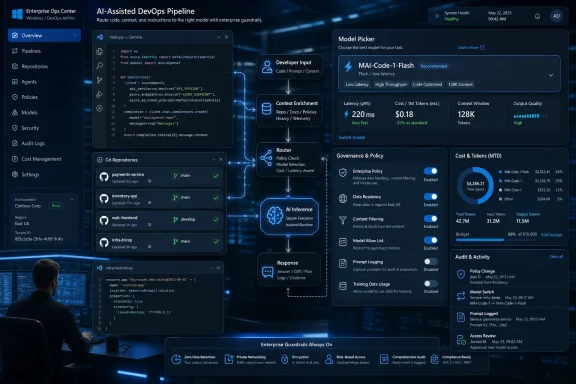
Microsoft made MAI-Code-1-Flash generally available for GitHub Copilot Business and Copilot Enterprise on June 26, 2026, giving organization administrators access to Microsoft’s in-house coding model after its earlier rollout to individual Copilot users. The headline is not merely that Copilot has another model in the picker. It is that Microsoft is moving its own AI stack into the part of software development where enterprise customers notice cost, latency, governance, and vendor dependence first. For Windows developers and IT leaders, this is the moment Copilot starts looking less like a wrapper around other people’s frontier models and more like a Microsoft-controlled developer platform.
MAI-Code-1-Flash arrived earlier this month as part of Microsoft’s broader push to show that its AI organization can produce shipping models, not just product integrations. Microsoft described it as a coding model built for fast, efficient assistance in everyday developer workflows, trained from the ground up on clean, traceable, enterprise-grade data and without distillation from third-party models. That phrasing is doing a lot of work.
For years, Copilot’s identity has been inseparable from the OpenAI era. GitHub Copilot began as one of the first mass-market proofs that large language models could become a daily software development tool rather than a research spectacle. But enterprise buyers do not only buy capability; they buy predictability, contractual clarity, data assurances, support channels, and cost controls.
That is why the June 26 expansion matters. Individual developers could already experiment with MAI-Code-1-Flash, but Business and Enterprise availability turns the model into something administrators must evaluate. It is now a policy decision, a billing decision, and a governance decision.
GitHub says Copilot Business and Enterprise administrators must enable the MAI-Code-1-Flash policy before users can access it. That default-off stance is important. Microsoft is not simply forcing the new model into enterprise workflows overnight; it is asking organizations to opt into another provider surface inside Copilot’s increasingly crowded model economy.
MAI-Code-1-Flash is explicitly positioned as a fast, low-latency coding model for high-volume, iterative agentic coding workflows. In plain English, Microsoft wants it to be the model you use when a developer or agent is making repeated requests, modifying code, running checks, and coming back for another pass. This is not the glamorous corner of AI marketing, but it is where the bills accumulate.
Coding assistants are not used like a chatbot demo. A developer might ask for a refactor, request tests, inspect an error, ask for a patch, generate documentation, compare two implementations, and then repeat the entire cycle after the build fails. Multiply that by a team, a department, or a global engineering organization, and small differences in latency and token consumption become procurement issues.
Microsoft claims MAI-Code-1-Flash can solve harder problems with up to 60 percent fewer tokens in some benchmarked scenarios. That claim deserves the usual caution applied to vendor benchmarks, especially benchmarks run in the vendor’s own production harness. But even if the real-world gain is smaller, the direction of travel is clear: Microsoft is optimizing not only for “smartest model,” but for cost per useful coding interaction.
That is the logic behind the “Flash” branding. The term signals that Microsoft is not presenting MAI-Code-1-Flash as the universal champion for every software engineering problem. It is presenting it as a practical workhorse. In a mature development organization, that may be the more consequential role.
Most teams do not spend their day asking AI to solve greenfield architecture riddles. They ask for boilerplate, test cases, framework migrations, code explanations, SQL tweaks, PowerShell snippets, YAML fixes, API wrappers, bug triage, and repetitive refactors. A smaller, faster coding model tuned for Copilot’s actual environment may be sufficient for a large slice of that work.
This is where WindowsForum readers should pay attention. The Microsoft ecosystem is full of development work that is not glamorous but is critical: maintaining internal Windows applications, automating administrative tasks, modernizing .NET codebases, writing deployment scripts, supporting Azure-connected services, and keeping legacy systems alive without turning every change request into a six-week project. A fast coding model integrated into Copilot can matter more there than another abstract benchmark victory.
Owning a model changes the economics. Microsoft can tune it for GitHub Copilot’s production harnesses, integrate it into its own telemetry loops, price it within its own platform strategy, and decide where it should sit in the model-routing hierarchy. That does not mean it will outperform every competing model in every scenario. It means Microsoft can optimize for the entire product system instead of treating the model as a black-box dependency.
This matters in enterprise negotiations. When customers complain that AI coding costs are too hard to forecast, Microsoft can point to a lower-latency, efficiency-tuned option. When customers ask about provenance, Microsoft can talk about traceable and enterprise-grade training data. When customers worry about provider concentration, Microsoft can say Copilot is not merely a front end for one lab.
The move also complicates the competitive story. GitHub Copilot is no longer just competing with standalone AI coding tools on interface and distribution. It is competing on the ability to route work across models, enforce enterprise policies, meter usage, and plug the whole experience into Windows, Visual Studio Code, Visual Studio, GitHub, Azure, and Microsoft 365-adjacent workflows. That is a platform play, not a feature race.
Administrators will want to know what code and prompts are sent where, how model access interacts with existing Copilot policies, whether usage is visible through reporting tools, and how the model affects spending under usage-based billing. They will also want to test whether the model behaves differently across languages, frameworks, and internal coding standards. A faster model that produces more review churn is not cheaper in any meaningful sense.
Microsoft’s framing around clean and traceable data is clearly aimed at enterprise anxieties over training provenance. The software industry has spent years debating whether AI coding tools create copyright, licensing, or compliance exposure. Microsoft has strong incentives to present its own model as safer and more governable than a generic coding model pulled into the workflow from elsewhere.
Still, administrators should avoid treating “Microsoft-built” as a synonym for “automatically approved.” The right move is pilot deployment. Enable it for a controlled group, compare output quality and review time against existing Copilot models, monitor cost and usage, and document which tasks it handles well. The model’s most valuable role may be narrower than Microsoft’s marketing language implies.
Token efficiency is not just a backend metric. It affects latency, responsiveness, and the psychological rhythm of using an assistant. Developers abandon tools that feel sluggish, and they misuse tools that feel free. An efficient model can make AI assistance feel more like autocomplete and less like a meter running in the corner.
The interesting question is whether Microsoft can make model routing feel invisible without making it unaccountable. GitHub Copilot’s Auto picker may route tasks to MAI-Code-1-Flash as rollout progresses, while the model picker may let users choose it directly. That split captures a tension every AI platform now faces: users want control when something goes wrong, but they want automation when everything works.
Enterprise administrators will not want a mysterious model roulette wheel. They will want reporting, policy, exceptions, and plain explanations of what happens when a developer chooses Auto. If Microsoft can make model routing legible, Copilot gains trust. If it cannot, every surprising bill or strange answer will become another argument for locking down model choice.
That also makes the claims harder for outsiders to verify. Public benchmarks provide comparability, but production harnesses are proprietary by nature. Microsoft can say the model performs well in Copilot-like workflows because Microsoft controls Copilot-like workflows. That does not make the claim false; it makes it a platform claim rather than a neutral laboratory result.
The comparison to Claude Haiku 4.5 is similarly revealing. Microsoft is not trying to frame MAI-Code-1-Flash against the largest, most expensive flagship models. It is positioning the model against the efficiency tier: models meant to be quick, inexpensive, and broadly capable. That is where enterprise volume lives.
For developers, the only benchmark that ultimately matters is whether the model helps with their actual repositories. A model that performs well on SWE-Bench may still stumble on an internal monolith, a proprietary framework, or a deeply idiosyncratic build system. The practical evaluation should be local, repeatable, and tied to tasks developers already perform.
The center of gravity is especially clear for Visual Studio Code. Microsoft can tune a coding model for the editor experience, GitHub repositories, terminal output, diagnostics, and extension-driven workflows. That does not guarantee better results than a rival tool, but it gives Microsoft a distribution and context advantage that standalone coding assistants must fight uphill to match.
Visual Studio users are also part of the story. Enterprise Windows development still contains a large amount of C#, C++, .NET, WinUI, WPF, desktop tooling, and internal business software that lives closer to Microsoft’s traditional developer base than to Silicon Valley’s web-stack fashion cycle. If MAI-Code-1-Flash proves reliable in those environments, Microsoft will have an argument that Copilot is not merely a trendy coding chatbot but the default assistant for the Microsoft developer estate.
There is also a sysadmin angle. Many WindowsForum readers write code reluctantly: PowerShell scripts, deployment automation, configuration glue, remediation tools, Intune helpers, Azure scripts, and one-off utilities. A fast, cheap-enough coding assistant embedded in familiar tooling can make those tasks less painful. The risk is that it can also make bad scripts easier to produce at scale.
A low-latency model encourages iteration. That is good for productivity, but it can also produce more diffs, more generated tests of uneven quality, and more code that reviewers assume someone else understood. If organizations enable MAI-Code-1-Flash widely, they should pair it with secure coding guidance, code scanning, dependency review, and clear rules about when generated code must be treated as untrusted.
The model’s agentic positioning raises another concern. Agentic coding workflows do not merely answer questions; they can plan, edit, and interact with tools. That makes context boundaries more important. Developers and administrators should know what repository content, terminal output, secrets-adjacent material, and internal documentation could be included in prompts.
Microsoft’s advantage is that GitHub already has security products, policy controls, and enterprise reporting surfaces. Its challenge is making those controls feel like part of the Copilot workflow rather than a separate compliance afterthought. The more Copilot becomes an agentic development layer, the more security must be built into the route, not bolted onto the review.
Microsoft’s claim that MAI-Code-1-Flash uses adaptive solution length control is more interesting than it sounds. One of the most common annoyances with coding models is verbosity. A developer asks for a two-line fix and receives a lecture; another asks for a complex refactor and receives a shallow patch. If Microsoft can tune response depth well, the model could feel faster and smarter even when its raw reasoning capability is not state of the art.
That is why “Flash” should not be dismissed as a cheaper-model label. In interactive tooling, speed changes behavior. A model that responds quickly invites smaller prompts, tighter loops, and more frequent use. A model that takes too long pushes developers toward fewer, larger requests, which often increases ambiguity and failure.
The best version of MAI-Code-1-Flash is not a model that replaces every other Copilot option. It is a model that handles the annoying middle: the endless stream of small and medium coding tasks where waiting for a heavyweight model feels wasteful but using no assistant at all feels slower than it should.
But MAI-Code-1-Flash makes Microsoft’s in-house AI effort more concrete. It is not a research paper, not a lab demo, and not a consumer novelty. It is now available to Business and Enterprise customers inside a paid developer product. That makes it operationally real.
The strategic benefit is optionality. Microsoft can use external frontier models when they make sense, its own models when they are efficient, and routing logic to blend the two. Over time, the value may shift away from any single model and toward the orchestration layer that knows which model to use, when, and under which policy.
That should sound familiar to anyone who watched cloud computing mature. Enterprises did not standardize on cloud because every VM was magical. They standardized when provisioning, billing, identity, policy, monitoring, and integration became manageable. AI coding tools are moving through the same transition, only faster and with more hype.
The sensible rollout pattern is controlled experimentation. Pick teams with representative repositories, establish a baseline for common tasks, and compare MAI-Code-1-Flash against other available Copilot models. Measure not only response time and apparent correctness, but review effort, rework, test failures, and developer satisfaction.
A model can be cheaper per request and still more expensive in practice if it creates subtle defects. Conversely, a model can be less capable on elite benchmarks and still valuable if it handles routine work quickly and safely. The enterprise answer will likely be segmentation: use MAI-Code-1-Flash where speed and efficiency matter, reserve heavier models for complex design, architecture, or stubborn debugging sessions.
This is where Microsoft’s admin controls become crucial. Organizations need to decide whether developers can choose freely, whether Auto routing is acceptable, whether certain teams get access first, and whether usage-based billing should be monitored by department or project. AI model governance is becoming part of software engineering management.
 Microsoft Moves Its Coding Model From Demo Ware to Enterprise Plumbing
MAI-Code-1-Flash arrived earlier this month as part of Microsoft’s broader push to show that its AI organization can produce shipping models, not just product integrations. Microsoft described it as a coding model built for fast, efficient assistance in everyday developer workflows, trained from the ground up on clean, traceable, enterprise-grade data and without distillation from third-party models. That phrasing is doing a lot of work.For years, Copilot’s identity has been inseparable from the OpenAI era. GitHub Copilot began as one of the first mass-market proofs that large language models could become a daily software development tool rather than a research spectacle. But enterprise buyers do not only buy capability; they buy predictability, contractual clarity, data assurances, support channels, and cost controls.
That is why the June 26 expansion matters. Individual developers could already experiment with MAI-Code-1-Flash, but Business and Enterprise availability turns the model into something administrators must evaluate. It is now a policy decision, a billing decision, and a governance decision.
GitHub says Copilot Business and Enterprise administrators must enable the MAI-Code-1-Flash policy before users can access it. That default-off stance is important. Microsoft is not simply forcing the new model into enterprise workflows overnight; it is asking organizations to opt into another provider surface inside Copilot’s increasingly crowded model economy.
The Model Picker Is Becoming the New Cloud Region
The old developer-tooling question was which IDE, which repo host, which CI/CD system, which cloud. The new question is which model handles which part of the work, under which policy, at what price, and with what acceptable error profile. Copilot’s model picker is starting to resemble cloud region selection: a routine interface that hides a significant amount of architecture, contracting, latency management, and operational risk.MAI-Code-1-Flash is explicitly positioned as a fast, low-latency coding model for high-volume, iterative agentic coding workflows. In plain English, Microsoft wants it to be the model you use when a developer or agent is making repeated requests, modifying code, running checks, and coming back for another pass. This is not the glamorous corner of AI marketing, but it is where the bills accumulate.
Coding assistants are not used like a chatbot demo. A developer might ask for a refactor, request tests, inspect an error, ask for a patch, generate documentation, compare two implementations, and then repeat the entire cycle after the build fails. Multiply that by a team, a department, or a global engineering organization, and small differences in latency and token consumption become procurement issues.
Microsoft claims MAI-Code-1-Flash can solve harder problems with up to 60 percent fewer tokens in some benchmarked scenarios. That claim deserves the usual caution applied to vendor benchmarks, especially benchmarks run in the vendor’s own production harness. But even if the real-world gain is smaller, the direction of travel is clear: Microsoft is optimizing not only for “smartest model,” but for cost per useful coding interaction.
Efficiency Is the Enterprise Feature Everyone Pretends Is Boring
The AI industry has spent the last several years training users to equate quality with model size, leaderboard placement, and theatrical reasoning depth. Enterprise IT has a colder lens. If a model is good enough for many daily coding tasks, responds quickly, and consumes fewer billable resources, it can be more valuable than a larger model that is marginally smarter but materially slower or more expensive.That is the logic behind the “Flash” branding. The term signals that Microsoft is not presenting MAI-Code-1-Flash as the universal champion for every software engineering problem. It is presenting it as a practical workhorse. In a mature development organization, that may be the more consequential role.
Most teams do not spend their day asking AI to solve greenfield architecture riddles. They ask for boilerplate, test cases, framework migrations, code explanations, SQL tweaks, PowerShell snippets, YAML fixes, API wrappers, bug triage, and repetitive refactors. A smaller, faster coding model tuned for Copilot’s actual environment may be sufficient for a large slice of that work.
This is where WindowsForum readers should pay attention. The Microsoft ecosystem is full of development work that is not glamorous but is critical: maintaining internal Windows applications, automating administrative tasks, modernizing .NET codebases, writing deployment scripts, supporting Azure-connected services, and keeping legacy systems alive without turning every change request into a six-week project. A fast coding model integrated into Copilot can matter more there than another abstract benchmark victory.
Microsoft’s In-House Model Is Also a Negotiating Position
There is an obvious strategic subtext: Microsoft does not want Copilot’s economics or roadmap to depend entirely on outside model providers. The company remains deeply linked to OpenAI, and Copilot continues to support models from multiple providers. But MAI-Code-1-Flash gives Microsoft a lever it did not have in the same way before.Owning a model changes the economics. Microsoft can tune it for GitHub Copilot’s production harnesses, integrate it into its own telemetry loops, price it within its own platform strategy, and decide where it should sit in the model-routing hierarchy. That does not mean it will outperform every competing model in every scenario. It means Microsoft can optimize for the entire product system instead of treating the model as a black-box dependency.
This matters in enterprise negotiations. When customers complain that AI coding costs are too hard to forecast, Microsoft can point to a lower-latency, efficiency-tuned option. When customers ask about provenance, Microsoft can talk about traceable and enterprise-grade training data. When customers worry about provider concentration, Microsoft can say Copilot is not merely a front end for one lab.
The move also complicates the competitive story. GitHub Copilot is no longer just competing with standalone AI coding tools on interface and distribution. It is competing on the ability to route work across models, enforce enterprise policies, meter usage, and plug the whole experience into Windows, Visual Studio Code, Visual Studio, GitHub, Azure, and Microsoft 365-adjacent workflows. That is a platform play, not a feature race.
The Governance Switch Tells IT What Microsoft Really Thinks
The requirement that administrators enable MAI-Code-1-Flash for Business and Enterprise users is not a footnote. It is an acknowledgment that AI model choice is now part of enterprise governance. A model available to an individual developer is a feature; a model available across an organization is a risk-managed service.Administrators will want to know what code and prompts are sent where, how model access interacts with existing Copilot policies, whether usage is visible through reporting tools, and how the model affects spending under usage-based billing. They will also want to test whether the model behaves differently across languages, frameworks, and internal coding standards. A faster model that produces more review churn is not cheaper in any meaningful sense.
Microsoft’s framing around clean and traceable data is clearly aimed at enterprise anxieties over training provenance. The software industry has spent years debating whether AI coding tools create copyright, licensing, or compliance exposure. Microsoft has strong incentives to present its own model as safer and more governable than a generic coding model pulled into the workflow from elsewhere.
Still, administrators should avoid treating “Microsoft-built” as a synonym for “automatically approved.” The right move is pilot deployment. Enable it for a controlled group, compare output quality and review time against existing Copilot models, monitor cost and usage, and document which tasks it handles well. The model’s most valuable role may be narrower than Microsoft’s marketing language implies.
Copilot’s Usage-Based Future Makes Token Discipline Unavoidable
MAI-Code-1-Flash lands in a Copilot environment where usage and billing are becoming more visible and more sensitive. That timing is not accidental. The more AI coding tools are metered, the more customers care about how many tokens a model burns to complete routine work.Token efficiency is not just a backend metric. It affects latency, responsiveness, and the psychological rhythm of using an assistant. Developers abandon tools that feel sluggish, and they misuse tools that feel free. An efficient model can make AI assistance feel more like autocomplete and less like a meter running in the corner.
The interesting question is whether Microsoft can make model routing feel invisible without making it unaccountable. GitHub Copilot’s Auto picker may route tasks to MAI-Code-1-Flash as rollout progresses, while the model picker may let users choose it directly. That split captures a tension every AI platform now faces: users want control when something goes wrong, but they want automation when everything works.
Enterprise administrators will not want a mysterious model roulette wheel. They will want reporting, policy, exceptions, and plain explanations of what happens when a developer chooses Auto. If Microsoft can make model routing legible, Copilot gains trust. If it cannot, every surprising bill or strange answer will become another argument for locking down model choice.
Benchmarks Are Useful, but Production Harnesses Are the Real Claim
Microsoft says MAI-Code-1-Flash was trained and evaluated with GitHub Copilot production harnesses and tested on software engineering tasks, repository question answering, refactoring, and telemetry-grounded tasks adapted from real Copilot usage. That is the strongest part of the pitch. It suggests Microsoft is not merely chasing leaderboard scores but optimizing for the messy way coding assistants are actually used.That also makes the claims harder for outsiders to verify. Public benchmarks provide comparability, but production harnesses are proprietary by nature. Microsoft can say the model performs well in Copilot-like workflows because Microsoft controls Copilot-like workflows. That does not make the claim false; it makes it a platform claim rather than a neutral laboratory result.
The comparison to Claude Haiku 4.5 is similarly revealing. Microsoft is not trying to frame MAI-Code-1-Flash against the largest, most expensive flagship models. It is positioning the model against the efficiency tier: models meant to be quick, inexpensive, and broadly capable. That is where enterprise volume lives.
For developers, the only benchmark that ultimately matters is whether the model helps with their actual repositories. A model that performs well on SWE-Bench may still stumble on an internal monolith, a proprietary framework, or a deeply idiosyncratic build system. The practical evaluation should be local, repeatable, and tied to tasks developers already perform.
Windows Developers Get Another Reason to Stay Inside the Microsoft Stack
For Windows developers, the significance is not limited to GitHub.com. Copilot’s reach now spans Visual Studio Code, Visual Studio, command-line workflows, JetBrains integrations, GitHub’s web surfaces, and increasingly agentic workflows that can inspect, edit, and iterate on code. MAI-Code-1-Flash gives Microsoft another way to make that stack feel coherent.The center of gravity is especially clear for Visual Studio Code. Microsoft can tune a coding model for the editor experience, GitHub repositories, terminal output, diagnostics, and extension-driven workflows. That does not guarantee better results than a rival tool, but it gives Microsoft a distribution and context advantage that standalone coding assistants must fight uphill to match.
Visual Studio users are also part of the story. Enterprise Windows development still contains a large amount of C#, C++, .NET, WinUI, WPF, desktop tooling, and internal business software that lives closer to Microsoft’s traditional developer base than to Silicon Valley’s web-stack fashion cycle. If MAI-Code-1-Flash proves reliable in those environments, Microsoft will have an argument that Copilot is not merely a trendy coding chatbot but the default assistant for the Microsoft developer estate.
There is also a sysadmin angle. Many WindowsForum readers write code reluctantly: PowerShell scripts, deployment automation, configuration glue, remediation tools, Intune helpers, Azure scripts, and one-off utilities. A fast, cheap-enough coding assistant embedded in familiar tooling can make those tasks less painful. The risk is that it can also make bad scripts easier to produce at scale.
The Security Problem Is Not That the Model Writes Code
Security teams sometimes frame AI coding assistants as if the danger is that a machine writes code. That is too simple. Humans have always written insecure code, copied snippets from dubious sources, and shipped changes they did not fully understand. The real issue is that AI changes the speed and volume of code generation.A low-latency model encourages iteration. That is good for productivity, but it can also produce more diffs, more generated tests of uneven quality, and more code that reviewers assume someone else understood. If organizations enable MAI-Code-1-Flash widely, they should pair it with secure coding guidance, code scanning, dependency review, and clear rules about when generated code must be treated as untrusted.
The model’s agentic positioning raises another concern. Agentic coding workflows do not merely answer questions; they can plan, edit, and interact with tools. That makes context boundaries more important. Developers and administrators should know what repository content, terminal output, secrets-adjacent material, and internal documentation could be included in prompts.
Microsoft’s advantage is that GitHub already has security products, policy controls, and enterprise reporting surfaces. Its challenge is making those controls feel like part of the Copilot workflow rather than a separate compliance afterthought. The more Copilot becomes an agentic development layer, the more security must be built into the route, not bolted onto the review.
The Developer Experience Will Be Won in the Annoying Middle
The AI coding market loves dramatic demos: build an app from a sentence, migrate a framework in minutes, fix a bug across a repository while the audience applauds. The everyday reality is less cinematic. Developers judge assistants on whether they interrupt flow, whether they understand project structure, whether they stop over-explaining, whether they write plausible nonsense, and whether they recover gracefully after a failed attempt.Microsoft’s claim that MAI-Code-1-Flash uses adaptive solution length control is more interesting than it sounds. One of the most common annoyances with coding models is verbosity. A developer asks for a two-line fix and receives a lecture; another asks for a complex refactor and receives a shallow patch. If Microsoft can tune response depth well, the model could feel faster and smarter even when its raw reasoning capability is not state of the art.
That is why “Flash” should not be dismissed as a cheaper-model label. In interactive tooling, speed changes behavior. A model that responds quickly invites smaller prompts, tighter loops, and more frequent use. A model that takes too long pushes developers toward fewer, larger requests, which often increases ambiguity and failure.
The best version of MAI-Code-1-Flash is not a model that replaces every other Copilot option. It is a model that handles the annoying middle: the endless stream of small and medium coding tasks where waiting for a heavyweight model feels wasteful but using no assistant at all feels slower than it should.
Microsoft’s AI Independence Is Still Partial, but It Is No Longer Theoretical
It would be easy to overstate this launch as Microsoft breaking from OpenAI or declaring full model independence. That is not what happened. Copilot remains a multi-model product, and Microsoft’s broader AI strategy still includes major partnerships, external models, and Azure as a hosting and distribution layer for other providers.But MAI-Code-1-Flash makes Microsoft’s in-house AI effort more concrete. It is not a research paper, not a lab demo, and not a consumer novelty. It is now available to Business and Enterprise customers inside a paid developer product. That makes it operationally real.
The strategic benefit is optionality. Microsoft can use external frontier models when they make sense, its own models when they are efficient, and routing logic to blend the two. Over time, the value may shift away from any single model and toward the orchestration layer that knows which model to use, when, and under which policy.
That should sound familiar to anyone who watched cloud computing mature. Enterprises did not standardize on cloud because every VM was magical. They standardized when provisioning, billing, identity, policy, monitoring, and integration became manageable. AI coding tools are moving through the same transition, only faster and with more hype.
The Real Test Starts After Administrators Flip the Policy
The launch gives Microsoft a talking point, but enterprise adoption will depend on what happens after administrators enable the model. Developers will compare it with their existing favorites. Finance teams will watch usage. Security teams will ask about data handling. Engineering managers will look for measurable improvements rather than vibes.The sensible rollout pattern is controlled experimentation. Pick teams with representative repositories, establish a baseline for common tasks, and compare MAI-Code-1-Flash against other available Copilot models. Measure not only response time and apparent correctness, but review effort, rework, test failures, and developer satisfaction.
A model can be cheaper per request and still more expensive in practice if it creates subtle defects. Conversely, a model can be less capable on elite benchmarks and still valuable if it handles routine work quickly and safely. The enterprise answer will likely be segmentation: use MAI-Code-1-Flash where speed and efficiency matter, reserve heavier models for complex design, architecture, or stubborn debugging sessions.
This is where Microsoft’s admin controls become crucial. Organizations need to decide whether developers can choose freely, whether Auto routing is acceptable, whether certain teams get access first, and whether usage-based billing should be monitored by department or project. AI model governance is becoming part of software engineering management.
The Copilot Button Now Comes With a Procurement Shadow
The practical meaning of this launch is narrower than the AI hype cycle and broader than a changelog entry. It is a new model, yes, but it is also a new unit of enterprise decision-making inside Copilot. The organizations that benefit most will be the ones that treat it as a tool to evaluate, not a miracle to assume.- Microsoft made MAI-Code-1-Flash generally available to GitHub Copilot Business and Enterprise customers on June 26, 2026.
- Administrators must enable a Copilot policy before organization users can access the model.
- Microsoft positions the model as a fast, low-latency option for high-volume agentic coding workflows.
- The strongest enterprise argument is efficiency, especially if lower token usage translates into lower cost and smoother developer interaction.
- The main caution is that Microsoft’s benchmark and production-harness claims still need validation against each organization’s own repositories, languages, and review standards.
- The bigger strategic shift is that Copilot is becoming a governed multi-model platform rather than a single AI assistant.
References
- Primary source: TestingCatalog AI News
Published: Sat, 27 Jun 2026 17:57:27 GMT
Loading…
www.testingcatalog.com - Independent coverage: Neowin
Published: Fri, 26 Jun 2026 19:38:00 GMT
Loading…
www.neowin.net - Official source: microsoft.ai
Introducing MAI-Code-1-Flash | Microsoft AI
 microsoft.ai
- Related coverage: github.blog
MAI-Code-1-Flash for Copilot Business and Copilot Enterprise - GitHub Changelog
MAI-Code-1-Flash, Microsoft AI’s in-house coding model, is now generally available for GitHub Copilot Business and Copilot Enterprise, building on its recent expansion across Copilot surfaces. Purpose-built for coding and optimized…github.blog
- Official source: docs.github.com
Loading…
docs.github.com - Related coverage: techtimes.com
Microsoft Build 2026: MAI-Thinking-1 Is First In-House Reasoning Model, Trained Without OpenAI Data
Microsoft Build 2026 launched MAI-Thinking-1, the company’s first in-house reasoning model, trained without OpenAI data. MAI-Code-1-Flash rolls out to all GitHub Copilot plans today. Independentwww.techtimes.com
- Related coverage: enterprisedna.co
Microsoft Launches MAI-Code-1-Flash at Build 2026 — Enterprise DNA
MAI-Code-1-Flash is Microsoft's first coding model built entirely without OpenAI: 5B params, 60% fewer tokens, rolling out now in GitHub Copilot.enterprisedna.co - Related coverage: aidose.in
Microsoft Launches MAI-Code-1-Flash Coding Model Across GitHub Copilot Plans
Microsoft rolled out MAI-Code-1-Flash, its first in-house coding model, to every GitHub Copilot plan. The model outperforms Claude Haiku 4.5 across core coding benchmarks and solves harder problems with up to 60 percent fewer tokens.www.aidose.in - Related coverage: letsdatascience.com
Loading…
letsdatascience.com - Related coverage: sonnetcode.com
Loading…
www.sonnetcode.com - Related coverage: decodethefuture.org
Microsoft MAI-Code-1-Flash: Copilot's New Coding Model
Microsoft's MAI-Code-1-Flash is its first in-house coding model for GitHub Copilot: 137B MoE, 256K context, $0.75/$4.50 per 1M tokens. What it means. decodethefuture.org
- Related coverage: aitoolly.com
Loading…
aitoolly.com - Related coverage: awesomeagents.ai
MAI-Code-1-Flash | Awesome Agents
Microsoft's first in-house coding model, a 137B sparse MoE built natively for GitHub Copilot, beating Claude Haiku 4.5 on SWE-Bench Pro by 16 points.awesomeagents.ai - Related coverage: insidelegalai.com
Loading…
www.insidelegalai.com - Related coverage: windowscentral.com
Microsoft's new AI delivers 10x faster responses with lower latency | Windows Central
Microsoft recently unveiled a new small language model called Phi-4-mini-flash-reasoning designed to bolster adaptive learning platforms and on-device due to its reduced latency, improved throughput, and math reasoning.www.windowscentral.com - Related coverage: techradar.com
From code-first to intent-first: Microsoft Build 2026 could be the end of programming as we know it | TechRadar
Redefining what it means to be a developer with agentic AIwww.techradar.com - Related coverage: tomsguide.com
Biggest Microsoft Build 2026 announcements — agentic AI, RTX Spark Dev Box, GitHub Copilot app, new MAI models, and more | Tom's Guide
All the big news from Microsoft's AI-focused eventwww.tomsguide.com - Official source: download.microsoft.com
Loading…
download.microsoft.com