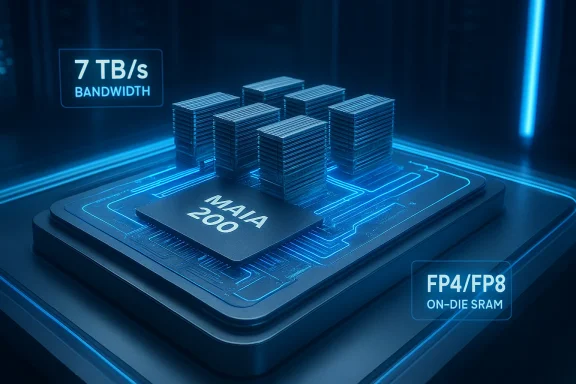
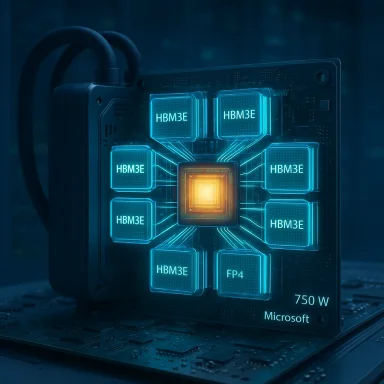
Microsoft’s revelation that its Maia 200 inference accelerator pairs a mammoth 216 GB of on‑package HBM3E with the claim that SK hynix is the exclusive supplier has sent shockwaves through the AI memory market and escalated the Korea‑based rivalry over high‑performance HBM for hyperscaler ASICs. The claim — reported by multiple Korean outlets and market watchers — if accurate, locks a strategically important, high‑margin component to one supplier for Microsoft’s newest inference‑first SoC, deepening the role memory makers play at the center of cloud AI infrastructure. s://www.ajupress.com/view/20260127154706081)
Maia 200 represents Microsoft’s second publicly disclosed in‑house accelerator and a deliberate, inference‑first engineering pivot: the chip is designed to maximize tokens‑per‑dollar and tokens‑per‑second for production LLM serving rather than to be a universal training workhorse. Microsoft’s own technical brief frames the device as a tightly integrated system — silicon, memory, interconnect and software — tuned to low‑precision formats (FP4/FP8) and massive on‑package memory capacity. Those design choices are central to Microsoft’s messaging about efficiency gains and cost reductions for clou.
The most load‑bearing hardware facts Microsoft released are straightforward and consequential:
Independent English‑language outlets and market reaction pieces corroborate the same narrative: trade reporting and market commentators noted SK hynix’s central role in the HBM supply chain and the apparent Microsoft deal, and equity headlines show SK hynix shares moving higher on the news. At least one market summary traced the reports back to Korean business papers and brokerage sources. However, as of the time of this article, the customer‑supplier linkage is described in news reports as industry‑sourced rather than through an explicit confirmation published by Microsoft or an SK hynix press release. Several outlets note SK hynix declined to publicly confirm customer details, citing standard confidentiality practices.
Key, verifiable points and their strength of confirmation:
Medium‑term: Samsung remains a competitive alternative. Samsung’s ongoing certifications and qualification efforts with other AI accelerator programs mean the HBM competition will not be decided by a single deal. Supply chain expansion plans, capital expenditure cadence and the vendors’ success in bringing HBM4 to market will determine the competitive landscape over the next 12–24 months.
Strategically, memory vendors should anticipate a multi‑customer approach: even with a large customer like Microsoft, global hyperscaler demand is big enough that lead suppliers will still need to target multiple large customers to fully utilize long‑cycle production capacity.
However, the most consequential phrasing — exclusive supplier — remains an industry‑reported claim that should be treated with caution until either Microsoft or SK hynix confirms it in a public, traceable statement. The memory market will be watching for that confirmation, subsequent supply‑chain disclosures, and independent technical benchmarking that validates Microsoft’s performance‑per‑dollar claims under production inference workloads. In the meantime, the news is a clear escalation in the HBM arms race and shifts the spotlight onto memory vendors as strategic enablers of cloud AI economics.
Whether SK hynix’s reported exclusivity becomes a long‑term contract or a near‑term tactical allocation, the Maia 200 announcement and its memory profile reinforce a larger point: the value of AI compute at scale will increasingly be decided by the systems that control both compute and data movement — and the suppliers who can deliver those components reliably at the volumes and timelines cloud vendors require. That’s why the coming months of supplier confirmations, yield updates and independent benchmarks will matter far more than the PR headlines: they will determine who actually earns the revenue — and who keeps the margin.
Conclusion: Microsoft’s Maia 200 is a deliberate inference‑first statement of intent from one of the largest cloud vendors, and the industry reports tying SK hynix to Maia 200’s HBM3E supply chain are plausible and market‑moving. Yet, prudent readers and IT decision‑makers should treat the exclusivity language as reported — credible and consequential, but awaiting direct vendor confirmation and independent benchmarking before converting the narrative into procurement or strategic bets.
Source: 매일경제 [Exclusive] SK hynix to be sole supplier of HBM3E for Microsoft’s next-generation AI chip - MK
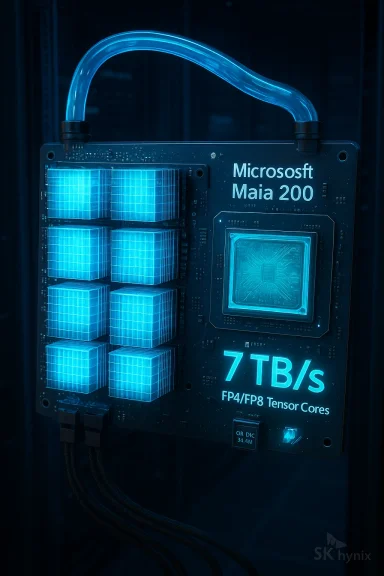 Background: why Maia 200 matters — and why memory is the story here
Maia 200 represents Microsoft’s second publicly disclosed in‑house accelerator and a deliberate, inference‑first engineering pivot: the chip is designed to maximize tokens‑per‑dollar and tokens‑per‑second for production LLM serving rather than to be a universal training workhorse. Microsoft’s own technical brief frames the device as a tightly integrated system — silicon, memory, interconnect and software — tuned to low‑precision formats (FP4/FP8) and massive on‑package memory capacity. Those design choices are central to Microsoft’s messaging about efficiency gains and cost reductions for clou. The most load‑bearing hardware facts Microsoft released are straightforward and consequential:
- Fabrication: TSMC 3 nm (N3) class process; vendor‑stated transistor budget above 140 billion.
- Compute posture: native FP4/FP8 tensor cores with vendor peak claims of >10 petaFLOPS (FP4) and >5accelerator.
- Memory: 216 GB HBM3E on‑package deliver aggregate HBM bandwidth, plus ~272 MB of on‑die SRAM to act as a hot cache and collective buffer.
- Power & deployment: a quoted SoC envelope near 750 W and initial Azure rollouts already active in U.S. Central (Iowa) with U.S. West (Arizona) following.
The claim: SK hynix as sole HBM3E supplier — what’s reported, and what we can verify
Multiple Korean industry outlets reported that SK hynix will be the exclusive supplier of HBM3E stacks for Maia 200, supplying six 12‑layer HBM3E stacks per accelerator to reach the 216 GB total. Those reports appeared in translated dispatches and industry news wires over the day following Microsoft’s Maia 200 announcement.Independent English‑language outlets and market reaction pieces corroborate the same narrative: trade reporting and market commentators noted SK hynix’s central role in the HBM supply chain and the apparent Microsoft deal, and equity headlines show SK hynix shares moving higher on the news. At least one market summary traced the reports back to Korean business papers and brokerage sources. However, as of the time of this article, the customer‑supplier linkage is described in news reports as industry‑sourced rather than through an explicit confirmation published by Microsoft or an SK hynix press release. Several outlets note SK hynix declined to publicly confirm customer details, citing standard confidentiality practices.
Key, verifiable points and their strength of confirmation:
- Maia 200 uses 216 GB of HBM3E (six 12‑layer stacks) — claimed by Microsoft in technical materials and independently repeated in reporting. This HBM total and stack architecture is consistent across Microsoft’s technical brief and multiple coverage pieces.
- Reports that SK hynix is the exclusive supplier are widespread in Korean media and have been picked up by market wires; however, neither Microsoft’s published Maia 200 materials nor a public SK hynix press release explicitly states an exclusive supply contract in the same breath. This is therefore an industry‑reported (credible) claim but not a fully public, vendor‑issued confirmation in Microsoft’s PR. Exercise caution when repeating the exclusivity language as definitive until either party confirms it.
Technical anatomy: Maia 200’s memory configuration and why HBM3E matters
Understanding why HBM3E is central requires unpacking what those stacks represent:- HBM3E is the latest high‑bandwidth memory generation used in top‑end accelerators. A 12‑layer HBM3E stack typically provides high capacity and high per‑stack bandwidth; six such stacks ing choice to achieve very large on‑package capacity without moving to multi‑package module networks. Microsoft’s published figure of 216 GB implies the six‑stack configuration (six × 36 GB or equivalent per stack depending on vendor implementation).
- On‑package memory at this scale reduces the need to shard models across many devices purely for capacity reasons. That improves tail latency and raises per‑device effective throughput for autoregressive workloads that repeatedly access weight subsets and large KV caches. The addition of a sizeable on‑die SRAM (~272 MB) functions as a fast scratchpad for hot weights and collective buffering to reduce trips to HBM for frequently reused tensors.
- HBM3E’s role is not only capacity — it’s bandwidth and the latency characteristics of near memory. Microsoft cites an aggregate HBM bandwidth of roughly 7 TB/s for Maia 200; that bandwidth, combined with hierarchical on‑die SRAM and a DMA/NoC design tuned to narrow datatypes (FP4/FP8), is what Microsoft argues will keep Maia’s tensor units fed in real production workloads.
Competitive context: Samsung, Micron, SK hynix — the HBM battleground
Historically, HBM supply for large accelerators has been split among a small set of vendors — primarily SK hynix, Samsung, and Micron. The new generation of hyperscaler ASICs is driving both higher per‑device HBM capacity and a premium on early delivery and tight customization with large cloud buyers.- Samsung has been visible as a large HBM supplier to several GPU and ASIC customers and has publicly pursued certifications for HBM3/HBM3E for major accelerators. Samsung’s push to qualify with tier‑one GPU vendors means it remains a major competitive force.
- SK hynix’s previous deals, notably with Nvidia and other AI accelerator programs, and its early HBM3E production lead, position it to be a dominant supplier this cycle — if the Microsoft reports are confirmed, that position strengthens further and raises the commercial stakes.
- Micron’s HBM play has been more muted in public reporting for HBM3E, but the overall market dynamic is that supply concentration matters: large, exclusive agreements or near‑exclusive volume commitments can shift mix and margins for memory vendors in both the short and medium term.
What this means for cloud AI economics and hyperscaler strategies
The Maia program is Microsoft’s effort to internalize cost and capacity for inference. If Maia 200’s spec sheet holds under real‑world workloads, and if Microsoft lands favorable manufacturing and memory supply terms, the strategic benefits include:- Lowered per‑token operating cost for services such as Microsoft 365 Copilot, Azure OpenAI hosting and other inference‑heavy production services. Microsoft’s materials explicitly claim ~30% better performance‑per‑dollar versus the prior fleet. Those are company estimates that will require independent workload benchmarks to validate.
- Reduced dependence on a single ecosystem (i.e., Nvidia) for inference capacity. Public hyperscaler chips allow cloud vendors to optimize both hardware and software stack for their own services and to hedge supplier concentration risk.
- For memory vendors, the move increases the commercial value of HBM product lines: high capacity, high bandwidth memory is now a differentiator in the carrier for inference economics, not merely a commodity component.
Critical technical and market caveats — what to watch and what could go wrong
The headlines are big; so are the caveats. Below are the major technical and commercial risks analysts and engineers should watch.- Supplier confirmation vs. market reports. The “exclusive SK hynix” phrasing is currently an industry report widely cited by Korean press and market wires, not a Microsoft‑public, SK hynix‑public joint statement. Treat exclusivity as likely but not fully vendor‑confirmed.
- Concentration and single‑point risk. Using a single HBM vendor simplifies integration but creates supply concentration risk. Any yield disruption, factory outage, or geopolitical issue affecting SK hynix would directly impact Maia 200 rollouts unless contingency buffers exist in supply contracts. - Capacity planning will be crucial, especially as other hyperscaler programs also absorb HBM3E capacity.
- HBM stacking and thermal integration. Packing six 12‑layer stacks onto a single package increases package complexity, thermals and assembly sensitivity. Maia 200’s quoted ~750 W TDP and Microsoft’s emphasis on liquid cooling reflect that integration challenge; data center rack design, cooling and power provisioning are nontrivial at this scale. Support teams will need to validate long‑term reliability under heavy inference workloads.
- Quantization and software maturity. Maia 200’s heavy emphasis on FP4 and FP8 means model quantization pipelines and inference toolchains must be mature. Aggressive quantization yields large efficiency wins but requires careful calibration, fallback paths to higher precision for sensitive operators, and high‑quality tooling. Microsoft offers an SDK and toolchain, but third‑party and open ecosystem support will determine how broadly the platform can run arbitrary models with acceptable accuracy.
- Market share vs. headline peak numbers. Vendor peak FLOPS are useful marketing numbers but are not direct measures of real‑world inference throughput. Architects and SREs will need to measure token throughput, latency tail percentiles, and cost per 1,000 tokens for real workloads before concluding Maia 200’s comparative value versus alternatives. Microsoft’s claims of 3× FP4 throughput versus AWS Trainium Gen3 and performance above Google TPU v7 are vendor comparisons that require independent benchmarking to validate across representative workloads.
Financial & strategic implications for SK hynix and Samsung
Short‑term: SK hynix’s stained — is a tactical revenue anchor and can help lift near‑term margins given HBM3E’s higher ASPs. Market reactions to the initial reports showed SK hynix shares moving higher on the day the news broke, reflecting investor sensitivity to large hyperscaler memory contracts.Medium‑term: Samsung remains a competitive alternative. Samsung’s ongoing certifications and qualification efforts with other AI accelerator programs mean the HBM competition will not be decided by a single deal. Supply chain expansion plans, capital expenditure cadence and the vendors’ success in bringing HBM4 to market will determine the competitive landscape over the next 12–24 months.
Strategically, memory vendors should anticipate a multi‑customer approach: even with a large customer like Microsoft, global hyperscaler demand is big enough that lead suppliers will still need to target multiple large customers to fully utilize long‑cycle production capacity.
Practical takeaways for IT architects, cloud teams and chip watchers
- Treat the SK hynix exclusivity reports as material but provisionally verified. Expect a formal confirmation or at least more detailed purchasing commentary in subsequent Microsoft and SK hynix statements; until then, factor the reports into planning but avoid single‑point assumptions.
- If you run or design for Azure infrastructure, anticipate new rack‑level requirements (liquid cooling, denser power distribution) in regions where Maia 200 is deployed; Microsoft’s materials and early rollouts indicate rack and cooling integration is a core part
- For enterprise AI procurement teams, this development reinforces the importance of memory capacity and memory bandwidth in system selection for large‑context inference workloads; mere peak FLOPS comparisons are insufficient.
What to watch next — milestones that will confirm or refute the market narrative
- Official confirmation from Microsoft or SK hynix explicitly naming the supplier and, ideally, disclosing contract cadence or volumes.
- Independent workload benchmarks measuring real token throughput, latency percentiles and cost per 1,000 tokens across Maia 200, TPU v7 and Trainium3.
- Public statements by Samsung or Micron about shifts in HBM allocation or new qualification wins for HBM3E/HBM4.
- Broader supply‑chain signals: HBM3E yield reports, lead times and pricing trends in earnings calls from memory makers.
- Microsoft’s own follow‑on rollouts and whether Maia 200 expands rapidly beS West regions into global Azure regions.
Verdict: significant development, credible reporting, but not a closed loop yet
The combination of Microsoft’s Maia 200 technical push for memory‑centric inference compute and the industry reporting that SK hynix will be the sole HBM3E supplier presents a credible, market‑moving narrative. Multiple independent outlets and local market coverage corroborate that SK hynix is the supplier named in industry sources, and Microsoft’s published Maia 200 materials confirm the unusually large HBM configuration that makes a supplier decision strategically meaningful.However, the most consequential phrasing — exclusive supplier — remains an industry‑reported claim that should be treated with caution until either Microsoft or SK hynix confirms it in a public, traceable statement. The memory market will be watching for that confirmation, subsequent supply‑chain disclosures, and independent technical benchmarking that validates Microsoft’s performance‑per‑dollar claims under production inference workloads. In the meantime, the news is a clear escalation in the HBM arms race and shifts the spotlight onto memory vendors as strategic enablers of cloud AI economics.
Final thoughts: what this says about the evolution of cloud AI infrastructure
We are in the middle of a structural shift: hyperscalers are moving from buying general‑purpose GPUs toward co‑designing or procuring first‑party ASICs for inference. In that evolution, memory is no longer a commoditized complement — it is a strategic lever that determines model residency, latency, and ultimately the unit economics of AI services.Whether SK hynix’s reported exclusivity becomes a long‑term contract or a near‑term tactical allocation, the Maia 200 announcement and its memory profile reinforce a larger point: the value of AI compute at scale will increasingly be decided by the systems that control both compute and data movement — and the suppliers who can deliver those components reliably at the volumes and timelines cloud vendors require. That’s why the coming months of supplier confirmations, yield updates and independent benchmarks will matter far more than the PR headlines: they will determine who actually earns the revenue — and who keeps the margin.
Conclusion: Microsoft’s Maia 200 is a deliberate inference‑first statement of intent from one of the largest cloud vendors, and the industry reports tying SK hynix to Maia 200’s HBM3E supply chain are plausible and market‑moving. Yet, prudent readers and IT decision‑makers should treat the exclusivity language as reported — credible and consequential, but awaiting direct vendor confirmation and independent benchmarking before converting the narrative into procurement or strategic bets.
Source: 매일경제 [Exclusive] SK hynix to be sole supplier of HBM3E for Microsoft’s next-generation AI chip - MK