

Microsoft technical fellow Marcus Fontoura is leaving Microsoft in June 2026 after more than a year as CTO of Azure Core, capping a short second stint at the company that coincided with Azure’s most consequential infrastructure cycle in the AI era. His exit, reported by GeekWire alongside a slate of Pacific Northwest executive moves, is not just another nameplate change in Redmond. It lands at a moment when cloud architecture, AI capacity, commercial sales, and trust infrastructure are all being reorganized around the same hard problem: who can build platforms that scale without collapsing under their own complexity.
That is the through-line in this week’s moves. Fontoura leaves Azure Core after publishing A Platform Mindset, Xealth appoints its first chief revenue officer after being acquired by Samsung, GE Aerospace adds Microsoft commercial chief Judson Althoff to its board, Slalom names a new Pacific Northwest leader, and Digimarc installs a CEO to sell digital trust into the AI boom. The names differ, but the market signal is consistent: companies are no longer merely hiring technologists. They are hiring translators between systems, customers, workflows, and capital.
Fontoura’s departure matters because Azure Core is not a peripheral engineering group. It is the infrastructure substrate under Microsoft’s cloud, and therefore under much of the company’s AI strategy, enterprise growth story, and developer credibility. When the CTO of that layer leaves, even without drama or a disclosed destination, it invites a larger question about how Microsoft keeps continuity inside systems that now must serve both traditional cloud workloads and GPU-hungry AI services.
Fontoura’s résumé reads like a map of modern distributed computing. Before his latest Microsoft stint, he had worked at Google, Yahoo, IBM, and Stone, and his earlier Microsoft run included roles tied to Azure and Bing. That background helps explain why his public writing around platforms has focused not merely on architecture diagrams, but on the organizational disciplines required to make large systems work.
That is the underappreciated part of the story. Cloud platforms are not just technical achievements; they are social machines. They require teams to make tradeoffs about latency, resilience, customer promises, billing models, developer ergonomics, and capacity planning in ways that compound over years. A brilliant architecture can still fail if the organization operating it cannot learn fast enough.
Microsoft’s timing makes the departure more visible. Azure has become the company’s central answer to investors asking whether huge AI infrastructure spending can become durable revenue. The company has reported strong Azure growth in recent quarters, helped by enterprise AI demand, but that growth also increases the stress on the platform. The faster Azure expands, the more Microsoft needs leaders who can convert scale into reliability rather than sprawl.
That changes the kind of leadership that matters. The cloud is no longer a relatively invisible utility behind enterprise modernization projects. It is the stage on which AI ambitions either become usable services or remain expensive demos. Every executive in the cloud stack now has to think like an infrastructure operator and a political economist.
Fontoura’s exit, then, should not be exaggerated into a crisis. Large companies survive senior departures all the time, and Microsoft has one of the deepest technical benches in the industry. But the news still highlights how much institutional knowledge sits inside a small number of people who understand both the physics of hyperscale systems and the internal machinery of Microsoft.
Azure’s challenge is not simply to add more servers. It is to make a platform feel coherent while the company races to satisfy AI demand from enterprises, developers, OpenAI-linked services, Microsoft 365 Copilot, GitHub, security products, and internal workloads. That is a managerial problem as much as an engineering one.
Microsoft is not shrinking from ambition. It is reorganizing around AI at a speed that makes even successful executives reassess where they fit. Some leave for startups or adjacent giants; others are elevated into new roles; others extend Microsoft’s influence by joining outside boards. The old map of Redmond power, built around Windows, Office, Azure, Xbox, and enterprise sales, is being redrawn around AI platforms and commercialization.
Jose Calzada’s promotion to vice president software engineer on Microsoft’s AI platform sits neatly beside Fontoura’s exit. One technical leader leaves Azure Core; another rises within the AI platform. That is not a one-for-one replacement story, but it shows the internal gravity shift. Microsoft is still a cloud company, but cloud and AI are now so intertwined that the boundary is increasingly artificial.
For WindowsForum readers, this matters because the Windows ecosystem is downstream of these decisions. Windows, Microsoft 365, Intune, Defender, Azure Virtual Desktop, developer tooling, and enterprise identity all depend on Microsoft’s ability to maintain platform discipline while injecting AI features into nearly every product surface. Leadership churn in the platform layers can eventually show up as product velocity, service reliability, pricing pressure, or administrative complexity.
GE Aerospace is not looking for a generic tech celebrity. It is adding an executive whose job is to understand how large organizations buy, implement, and operationalize Microsoft technology. That experience is valuable in a sector where digital transformation cannot be allowed to become a slogan. Aerospace has safety, manufacturing, compliance, simulation, maintenance, supply chain, and data challenges that demand disciplined execution.
This is where Microsoft’s enterprise advantage still matters. The company’s AI story is often told through consumer-facing demos or developer tools, but its commercial power comes from embedding itself inside institutional workflows. Althoff’s board seat reflects that reality. AI in industrial companies will be less about chatbots with glossy interfaces and more about operational systems that reduce downtime, improve forecasting, strengthen design processes, and navigate regulation.
It also reinforces Microsoft’s preferred role in the AI economy. The company wants to be the partner of choice for incumbents that cannot simply burn down their existing systems and start over. That makes commercial leadership as important as model quality. The winners will be the firms that can carry AI from pilot projects into messy, audited, budget-constrained organizations.
Moore’s background as a pediatric nurse before moving into health technology gives the appointment a useful narrative fit. Healthcare technology often fails not because clinicians reject innovation, but because the tools arrive as another layer of work. The hospital does not need one more dashboard as much as it needs systems that connect to clinical workflows without making everyone’s day worse.
That explains the chief revenue officer role. Xealth’s challenge is not just product-market fit in the abstract. It must convince health systems, payers, clinicians, and technology partners that its platform can turn fragmented digital health options into something operationally useful. That is a sales problem, but also a trust problem.
Samsung’s ownership adds another layer. Consumer electronics companies have long wanted a larger role in healthcare, and Samsung has devices, sensors, screens, and consumer reach. But healthcare does not bend easily to consumer tech logic. Xealth will need enterprise-grade integration, privacy discipline, and clinical credibility if it is to become more than a distribution channel for digital tools.
The consulting market is going through its own AI reckoning. Clients are asking whether they still need armies of consultants when generative AI can accelerate analysis, code generation, documentation, and process mapping. At the same time, those same clients are discovering that AI adoption is harder than buying licenses. They still need help redesigning workflows, data systems, governance, and change management.
That contradiction creates opportunity for firms like Slalom, but only if they can avoid sounding like every other transformation vendor. The Pacific Northwest market is packed with cloud customers, software companies, retailers, health organizations, public-sector agencies, and manufacturers that already know the language of digital modernization. They will not be impressed by generic AI roadmaps.
Foster’s Accenture background may help Slalom compete for more complex enterprise work while preserving its regional brand. The risk is that consulting firms become trapped between expensive human delivery models and AI-enabled client expectations. The firms that win will be those that use AI to sharpen judgment, not merely to cut labor.
The company’s own positioning leans into that shift, arguing that humans and intelligent systems need scalable ways to verify what is real. That is a clean pitch for 2026. It also comes with a burden: every vendor in the trust, identity, security, and content-authenticity space is now trying to attach itself to the AI boom.
Carreiro’s background in enterprise software suggests Digimarc is prioritizing commercialization at scale. That makes sense. The technical argument for provenance can be compelling, but the business only works if customers integrate it into supply chains, media workflows, packaging, compliance systems, or machine-readable verification processes. Trust infrastructure is valuable only when adoption is broad enough to matter.
The hard part is that watermarking is not a magic wand. Bad actors can crop, transform, regenerate, strip metadata, or route around systems. Meanwhile, legitimate users worry about interoperability, standards, false positives, privacy, and vendor lock-in. Digimarc’s opportunity is real, but so is the need to explain exactly where watermarking fits in a layered trust model.
The Pacific Northwest has benefited from decades of compounding advantages: Microsoft, Amazon, the University of Washington, venture capital, cloud expertise, gaming, life sciences, aerospace, and a strong bench of technical workers. But those advantages do not automatically translate into livability. If the region cannot house workers and sustain a healthy civic fabric, its innovation engine becomes brittle.
Scott Whalen’s recognition as the Department of Energy’s National Innovator of the Year adds another reminder that not all important technology work looks like software. His work at Pacific Northwest National Laboratory in applied materials and manufacturing points to the physical side of the innovation economy. AI may dominate headlines, but energy, materials, manufacturing, and national lab research remain essential to competitiveness.
That mix is what makes the Pacific Northwest such an interesting beat. It is not just a software region, not just a cloud region, and not just an AI region. It is a place where enterprise platforms, healthcare, public policy, aerospace, materials science, and consumer technology constantly collide.
That is why the roles are so varied. A cloud CTO, a chief revenue officer, a board director, a market leader, a CEO, a promoted AI platform engineer, a city policy executive, and a national lab scientist do not share a job description. But they all sit near systems that must scale beyond the intuition of any one person.
The phrase platform mindset is useful here because it captures more than technical architecture. It describes a way of thinking in which the goal is not to solve one problem once, but to create reusable foundations that let many teams solve many problems without re-litigating the basics. That is the promise. The danger is that platforms become so abstract, centralized, and politically powerful that they slow the very innovation they were built to enable.
Microsoft knows this tension well. Windows became powerful because it was a platform; it became vulnerable when platform stewardship lagged user expectations. Azure’s version of the problem is different, but the principle is familiar. The company must make its cloud and AI layers dependable enough for enterprises while moving fast enough to satisfy a market that now treats AI leadership as a quarterly referendum.
The concrete lessons are narrower than the hype cycle but more useful:
That is the through-line in this week’s moves. Fontoura leaves Azure Core after publishing A Platform Mindset, Xealth appoints its first chief revenue officer after being acquired by Samsung, GE Aerospace adds Microsoft commercial chief Judson Althoff to its board, Slalom names a new Pacific Northwest leader, and Digimarc installs a CEO to sell digital trust into the AI boom. The names differ, but the market signal is consistent: companies are no longer merely hiring technologists. They are hiring translators between systems, customers, workflows, and capital.
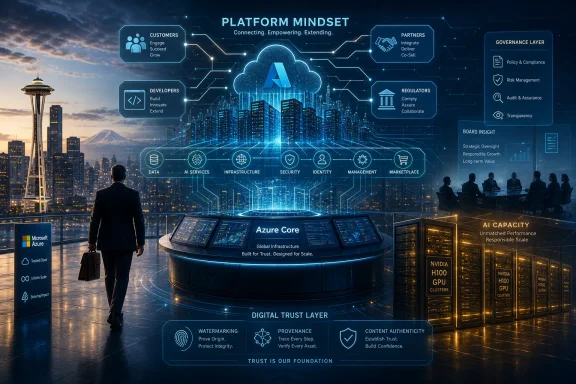 Azure Loses a Platform Thinker as the Platform Becomes the Product
Fontoura’s departure matters because Azure Core is not a peripheral engineering group. It is the infrastructure substrate under Microsoft’s cloud, and therefore under much of the company’s AI strategy, enterprise growth story, and developer credibility. When the CTO of that layer leaves, even without drama or a disclosed destination, it invites a larger question about how Microsoft keeps continuity inside systems that now must serve both traditional cloud workloads and GPU-hungry AI services.Fontoura’s résumé reads like a map of modern distributed computing. Before his latest Microsoft stint, he had worked at Google, Yahoo, IBM, and Stone, and his earlier Microsoft run included roles tied to Azure and Bing. That background helps explain why his public writing around platforms has focused not merely on architecture diagrams, but on the organizational disciplines required to make large systems work.
That is the underappreciated part of the story. Cloud platforms are not just technical achievements; they are social machines. They require teams to make tradeoffs about latency, resilience, customer promises, billing models, developer ergonomics, and capacity planning in ways that compound over years. A brilliant architecture can still fail if the organization operating it cannot learn fast enough.
Microsoft’s timing makes the departure more visible. Azure has become the company’s central answer to investors asking whether huge AI infrastructure spending can become durable revenue. The company has reported strong Azure growth in recent quarters, helped by enterprise AI demand, but that growth also increases the stress on the platform. The faster Azure expands, the more Microsoft needs leaders who can convert scale into reliability rather than sprawl.
The AI Buildout Turns Cloud Executives Into Capacity Diplomats
A decade ago, a senior cloud departure would mostly have been read through the lens of product roadmaps and competitive positioning against AWS or Google Cloud. In 2026, the frame is broader. Cloud executives now sit at the junction of energy procurement, chip supply, data center construction, model deployment, sovereignty requirements, and customer anxiety over cost.That changes the kind of leadership that matters. The cloud is no longer a relatively invisible utility behind enterprise modernization projects. It is the stage on which AI ambitions either become usable services or remain expensive demos. Every executive in the cloud stack now has to think like an infrastructure operator and a political economist.
Fontoura’s exit, then, should not be exaggerated into a crisis. Large companies survive senior departures all the time, and Microsoft has one of the deepest technical benches in the industry. But the news still highlights how much institutional knowledge sits inside a small number of people who understand both the physics of hyperscale systems and the internal machinery of Microsoft.
Azure’s challenge is not simply to add more servers. It is to make a platform feel coherent while the company races to satisfy AI demand from enterprises, developers, OpenAI-linked services, Microsoft 365 Copilot, GitHub, security products, and internal workloads. That is a managerial problem as much as an engineering one.
Microsoft’s Leadership Churn Is Becoming a Feature of the AI Transition
Fontoura’s move also lands amid a broader pattern of Microsoft executive motion. GeekWire has tracked a steady stream of departures, promotions, board appointments, and role changes across Microsoft’s ecosystem this year. One week does not make a trend, but the accumulation tells us something about the company’s current phase.Microsoft is not shrinking from ambition. It is reorganizing around AI at a speed that makes even successful executives reassess where they fit. Some leave for startups or adjacent giants; others are elevated into new roles; others extend Microsoft’s influence by joining outside boards. The old map of Redmond power, built around Windows, Office, Azure, Xbox, and enterprise sales, is being redrawn around AI platforms and commercialization.
Jose Calzada’s promotion to vice president software engineer on Microsoft’s AI platform sits neatly beside Fontoura’s exit. One technical leader leaves Azure Core; another rises within the AI platform. That is not a one-for-one replacement story, but it shows the internal gravity shift. Microsoft is still a cloud company, but cloud and AI are now so intertwined that the boundary is increasingly artificial.
For WindowsForum readers, this matters because the Windows ecosystem is downstream of these decisions. Windows, Microsoft 365, Intune, Defender, Azure Virtual Desktop, developer tooling, and enterprise identity all depend on Microsoft’s ability to maintain platform discipline while injecting AI features into nearly every product surface. Leadership churn in the platform layers can eventually show up as product velocity, service reliability, pricing pressure, or administrative complexity.
Judson Althoff’s GE Aerospace Seat Shows Where Microsoft Wants Its Influence Felt
The appointment of Judson Althoff, CEO of Microsoft’s Commercial Business, to GE Aerospace’s board is the least surprising and perhaps most strategically revealing item in the batch. Althoff has long been central to Microsoft’s enterprise selling machine. Putting him on the board of an aerospace giant underscores how AI and cloud are now boardroom governance issues, not just IT procurement decisions.GE Aerospace is not looking for a generic tech celebrity. It is adding an executive whose job is to understand how large organizations buy, implement, and operationalize Microsoft technology. That experience is valuable in a sector where digital transformation cannot be allowed to become a slogan. Aerospace has safety, manufacturing, compliance, simulation, maintenance, supply chain, and data challenges that demand disciplined execution.
This is where Microsoft’s enterprise advantage still matters. The company’s AI story is often told through consumer-facing demos or developer tools, but its commercial power comes from embedding itself inside institutional workflows. Althoff’s board seat reflects that reality. AI in industrial companies will be less about chatbots with glossy interfaces and more about operational systems that reduce downtime, improve forecasting, strengthen design processes, and navigate regulation.
It also reinforces Microsoft’s preferred role in the AI economy. The company wants to be the partner of choice for incumbents that cannot simply burn down their existing systems and start over. That makes commercial leadership as important as model quality. The winners will be the firms that can carry AI from pilot projects into messy, audited, budget-constrained organizations.
Xealth’s First CRO Is a Bet That Digital Health Needs Fewer Apps and More Workflow
Travis Moore becoming Xealth’s first chief revenue officer is a smaller move than a Microsoft technical fellow leaving Azure, but it may say just as much about where software markets are headed. Xealth, a Seattle-based digital health startup acquired last year by Samsung Electronics, is no longer merely trying to prove that digital health tools can exist. It is trying to sell coordination.Moore’s background as a pediatric nurse before moving into health technology gives the appointment a useful narrative fit. Healthcare technology often fails not because clinicians reject innovation, but because the tools arrive as another layer of work. The hospital does not need one more dashboard as much as it needs systems that connect to clinical workflows without making everyone’s day worse.
That explains the chief revenue officer role. Xealth’s challenge is not just product-market fit in the abstract. It must convince health systems, payers, clinicians, and technology partners that its platform can turn fragmented digital health options into something operationally useful. That is a sales problem, but also a trust problem.
Samsung’s ownership adds another layer. Consumer electronics companies have long wanted a larger role in healthcare, and Samsung has devices, sensors, screens, and consumer reach. But healthcare does not bend easily to consumer tech logic. Xealth will need enterprise-grade integration, privacy discipline, and clinical credibility if it is to become more than a distribution channel for digital tools.
Slalom’s Pacific Northwest Change Reflects a Consulting Market Under Pressure
Eric Foster’s new role leading Slalom’s Pacific Northwest market also belongs in the same strategic frame. Slalom, headquartered in Seattle, built much of its reputation around local consulting relationships, business transformation, and technology delivery. Bringing in an Accenture veteran with 14 years across three stints suggests the firm wants both regional intimacy and big-consulting operating discipline.The consulting market is going through its own AI reckoning. Clients are asking whether they still need armies of consultants when generative AI can accelerate analysis, code generation, documentation, and process mapping. At the same time, those same clients are discovering that AI adoption is harder than buying licenses. They still need help redesigning workflows, data systems, governance, and change management.
That contradiction creates opportunity for firms like Slalom, but only if they can avoid sounding like every other transformation vendor. The Pacific Northwest market is packed with cloud customers, software companies, retailers, health organizations, public-sector agencies, and manufacturers that already know the language of digital modernization. They will not be impressed by generic AI roadmaps.
Foster’s Accenture background may help Slalom compete for more complex enterprise work while preserving its regional brand. The risk is that consulting firms become trapped between expensive human delivery models and AI-enabled client expectations. The firms that win will be those that use AI to sharpen judgment, not merely to cut labor.
Digimarc Recasts Watermarking as the Trust Layer of the AI Internet
Digimarc naming Paul Carreiro as CEO, effective July 6, 2026, is another move that looks routine until placed in the AI context. Digimarc has long worked in digital watermark technology, but the market around it has changed dramatically. In an era of synthetic media, automated content generation, and AI-assisted fraud, watermarking is no longer a niche anti-counterfeit tool. It is part of a broader contest over provenance.The company’s own positioning leans into that shift, arguing that humans and intelligent systems need scalable ways to verify what is real. That is a clean pitch for 2026. It also comes with a burden: every vendor in the trust, identity, security, and content-authenticity space is now trying to attach itself to the AI boom.
Carreiro’s background in enterprise software suggests Digimarc is prioritizing commercialization at scale. That makes sense. The technical argument for provenance can be compelling, but the business only works if customers integrate it into supply chains, media workflows, packaging, compliance systems, or machine-readable verification processes. Trust infrastructure is valuable only when adoption is broad enough to matter.
The hard part is that watermarking is not a magic wand. Bad actors can crop, transform, regenerate, strip metadata, or route around systems. Meanwhile, legitimate users worry about interoperability, standards, false positives, privacy, and vendor lock-in. Digimarc’s opportunity is real, but so is the need to explain exactly where watermarking fits in a layered trust model.
Public-Sector and Research Moves Round Out the Regional Platform Story
Seattle Mayor Katie Wilson’s reshuffling of Nicole Vallestero Soper into a director role focused on affordability, housing, and economic development may seem far removed from Azure and AI infrastructure. It is not. Technology regions increasingly live or die by the civic systems around them. Housing affordability, transportation, permitting, workforce development, and startup density are all part of the platform on which a regional tech economy runs.The Pacific Northwest has benefited from decades of compounding advantages: Microsoft, Amazon, the University of Washington, venture capital, cloud expertise, gaming, life sciences, aerospace, and a strong bench of technical workers. But those advantages do not automatically translate into livability. If the region cannot house workers and sustain a healthy civic fabric, its innovation engine becomes brittle.
Scott Whalen’s recognition as the Department of Energy’s National Innovator of the Year adds another reminder that not all important technology work looks like software. His work at Pacific Northwest National Laboratory in applied materials and manufacturing points to the physical side of the innovation economy. AI may dominate headlines, but energy, materials, manufacturing, and national lab research remain essential to competitiveness.
That mix is what makes the Pacific Northwest such an interesting beat. It is not just a software region, not just a cloud region, and not just an AI region. It is a place where enterprise platforms, healthcare, public policy, aerospace, materials science, and consumer technology constantly collide.
The Platform Talent Market Is No Longer Just About Engineering
The most useful way to read this week’s executive moves is not as a gossip sheet of who went where. It is as a labor-market snapshot of the platform economy. Companies are hunting for people who can make complex systems legible to customers, boards, regulators, clinicians, developers, and investors.That is why the roles are so varied. A cloud CTO, a chief revenue officer, a board director, a market leader, a CEO, a promoted AI platform engineer, a city policy executive, and a national lab scientist do not share a job description. But they all sit near systems that must scale beyond the intuition of any one person.
The phrase platform mindset is useful here because it captures more than technical architecture. It describes a way of thinking in which the goal is not to solve one problem once, but to create reusable foundations that let many teams solve many problems without re-litigating the basics. That is the promise. The danger is that platforms become so abstract, centralized, and politically powerful that they slow the very innovation they were built to enable.
Microsoft knows this tension well. Windows became powerful because it was a platform; it became vulnerable when platform stewardship lagged user expectations. Azure’s version of the problem is different, but the principle is familiar. The company must make its cloud and AI layers dependable enough for enterprises while moving fast enough to satisfy a market that now treats AI leadership as a quarterly referendum.
The Week’s Moves Point to One Uncomfortable Truth for Tech Leaders
This was not a week of one dramatic rupture. It was a week of signals, and the signals point toward a more demanding executive job description across the technology economy. The new leaders being installed or elevated are expected to sell complexity, govern complexity, or tame complexity.The concrete lessons are narrower than the hype cycle but more useful:
- Microsoft’s Azure leadership change is significant because Azure Core sits beneath the company’s cloud and AI ambitions, even if a single departure does not imply operational trouble.
- Judson Althoff’s GE Aerospace board appointment shows that AI commercialization is becoming a board-level industrial strategy, not merely an enterprise software sales motion.
- Xealth’s first chief revenue officer suggests digital health companies are shifting from tool proliferation toward workflow integration and measurable clinical adoption.
- Slalom’s Pacific Northwest appointment reflects a consulting market where clients want AI transformation but still need human help to make it organizationally real.
- Digimarc’s CEO transition shows how authentication, watermarking, and provenance vendors are repositioning themselves as trust infrastructure for an AI-saturated internet.
- The regional public-sector and national-lab moves are a reminder that technology ecosystems depend on housing, policy, materials research, manufacturing, and civic capacity as much as code.
References
- Primary source: GeekWire
Published: Fri, 12 Jun 2026 17:31:43 GMT
Microsoft exec departs; Xealth gets CRO; Slalom names PNW leader
Microsoft technical fellow and Azure Core CTO Marcus Fontura is departing; Xealth named its first CRO; and Slalom recruited a PNW lead from Accenture.www.geekwire.com - Related coverage: linkedin.com
Microsoft's Azure Core CTO on Fostering Creativity for Innovation | Microsoft posted on the topic | LinkedIn
Who are the artists of technology? In a visit to Microsoft Vancouver, Marcus Fontoura — Technical Fellow, CVP and CTO, Azure Core — shared his perspective on the importance of fostering creativity for innovation.www.linkedin.com
