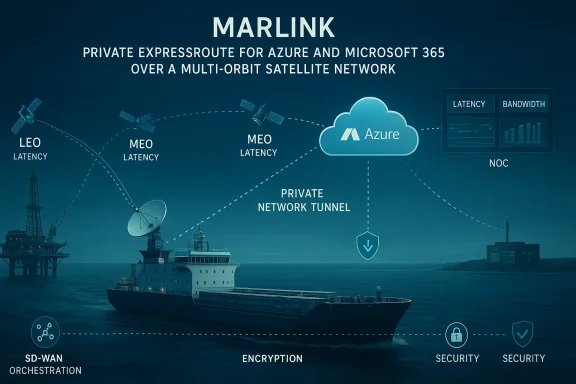
Marlink’s new managed ExpressRoute offering formally brings private Azure and Microsoft 365 ingress to vessels and remote sites, promising shipowners dedicated, predictable connectivity to Microsoft cloud services delivered over Marlink’s multi‑orbit satellite fabric and global Points of Presence. The announcement closes an important gap between shipboard networks and shore‑side cloud infrastructures by packaging Microsoft ExpressRoute as a fully managed maritime service — but the real value and the real risks will be revealed when fleets test performance, resiliency and cost at scale.
Marlink announced on February 18, 2026 that it has integrated Microsoft ExpressRoute into its managed services portfolio, enabling customers to extend on‑premises networks and shipboard systems directly into Microsoft Azure and Microsoft 365 over private, dedicated circuits. The company positions the capability as part of its “Possibility Platform,” combining satellite connectivity, SD‑WAN and cybersecurity with private cloud on‑ramps delivered as a managed service.
ExpressRoute is Microsoft’s product for private connections into the Microsoft backbone: it allows enterprises to bypass the public internet and exchange traffic directly at Microsoft peering locations. The platform is built for predictable latency, higher reliability and isolation from internet routing variability — properties that are particularly attractive for remote and satellite‑connected users where the public internet often introduces jitter, packet loss and unpredictable performance.
Marlink’s announcement is consistent with Microsoft’s published ExpressRoute model (private circuits, dual BGP sessions, peering locations and a global ecosystem of connectivity providers) and with publicly available listings that explicitly name satellite operators as valid connectivity providers for ExpressRoute. The Marlink press material includes executive comments from Marlink and Microsoft, underscores managed provisioning and PoP orchestration, and highlights target verticals such as shipping, energy and humanitarian operations.
Satellite links — whether GEO, MEO or LEO — introduce constraints that matter to cloud apps: higher latency, potential for packet loss during handoffs or rain fade, and variable throughput. When traffic traverses the public internet after the satellite hop, it inherits a second layer of variability from internet routing, peering congestion and path instability. That combination makes real‑time collaboration, timely data replication, and remote control applications brittle.
The maritime industry has responded by adopting hybrid networking architectures: on‑ship SD‑WANs, local caching, aggressive QoS, and traffic steering to preferred routes. Marlink’s ExpressRoute integration converts the ship‑to‑cloud path into a managed private circuit (from ship via satellite to a Marlink PoP, thence directly into Microsoft’s edge) — aiming to remove the public internet from the equation and reduce the variability that breaks cloud‑native workflows.
Commoditisation of satellite capacity (especially with LEO entrants) will continue to squeeze per‑GB costs, but value will increasingly be created in the orchestration layer — the managed path, security, and integration with cloud providers — rather than raw airtime alone.
However, the announcement is a starting point, not the final answer. Fleet IT leaders should respond with disciplined pilots, carefully negotiated SLAs, and a balanced architecture that includes redundancy, encryption, and cost controls. Treat vendor performance claims as hypotheses to be tested. Where performance and compliance requirements are critical, insist on measurable acceptance criteria and staged rollouts.
The direction is clear: private cloud connectivity at sea is moving from concept to commercial reality. The question for each operator is not whether the technology exists — it does — but whether the specific configuration, cost and resiliency model meets the operational, regulatory and financial realities of their fleet. For those willing to pilot and validate, Marlink’s managed ExpressRoute could be the network foundation that finally lets Azure‑native operations run smoothly, securely and predictably across the world’s oceans.
Source: Digital Ship https://thedigitalship.com/news/maritime-software/marlink-and-microsoft-tighten-cloud-links-at-sea/
 Background
Marlink announced on February 18, 2026 that it has integrated Microsoft ExpressRoute into its managed services portfolio, enabling customers to extend on‑premises networks and shipboard systems directly into Microsoft Azure and Microsoft 365 over private, dedicated circuits. The company positions the capability as part of its “Possibility Platform,” combining satellite connectivity, SD‑WAN and cybersecurity with private cloud on‑ramps delivered as a managed service.ExpressRoute is Microsoft’s product for private connections into the Microsoft backbone: it allows enterprises to bypass the public internet and exchange traffic directly at Microsoft peering locations. The platform is built for predictable latency, higher reliability and isolation from internet routing variability — properties that are particularly attractive for remote and satellite‑connected users where the public internet often introduces jitter, packet loss and unpredictable performance.
Marlink’s announcement is consistent with Microsoft’s published ExpressRoute model (private circuits, dual BGP sessions, peering locations and a global ecosystem of connectivity providers) and with publicly available listings that explicitly name satellite operators as valid connectivity providers for ExpressRoute. The Marlink press material includes executive comments from Marlink and Microsoft, underscores managed provisioning and PoP orchestration, and highlights target verticals such as shipping, energy and humanitarian operations.
Why this matters: the problem at sea
Modern fleets are increasingly cloud‑first. Ship operators run:- Crew collaboration tools (email, Microsoft Teams, file sharing)
- Cloud‑hosted enterprise systems (ERP, CMMS, crewing portals)
- Remote monitoring and analytics (predictive maintenance, fuel optimisation)
- Real‑time operational services (voyage optimisation, navigation aids)
Satellite links — whether GEO, MEO or LEO — introduce constraints that matter to cloud apps: higher latency, potential for packet loss during handoffs or rain fade, and variable throughput. When traffic traverses the public internet after the satellite hop, it inherits a second layer of variability from internet routing, peering congestion and path instability. That combination makes real‑time collaboration, timely data replication, and remote control applications brittle.
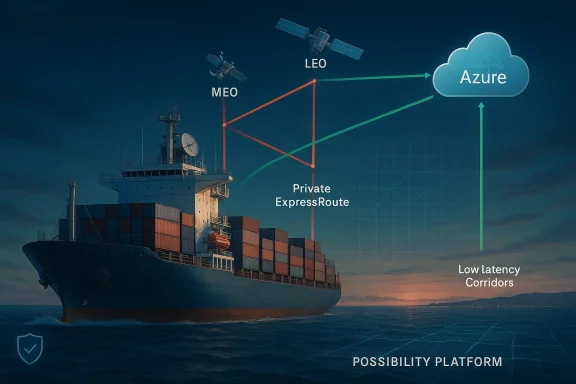
The maritime industry has responded by adopting hybrid networking architectures: on‑ship SD‑WANs, local caching, aggressive QoS, and traffic steering to preferred routes. Marlink’s ExpressRoute integration converts the ship‑to‑cloud path into a managed private circuit (from ship via satellite to a Marlink PoP, thence directly into Microsoft’s edge) — aiming to remove the public internet from the equation and reduce the variability that breaks cloud‑native workflows.
What Marlink is offering (technical and service outline)
Marlink’s product framing contains three linked elements:- Private ExpressRoute access: a dedicated, private connection from the Marlink network into Microsoft Azure and Microsoft 365 that avoids the public internet for peered traffic.
- Multi‑orbit integration: the private path is delivered as part of Marlink’s multi‑orbit satellite fabric (GEO/MEO/LEO + terrestrial handoffs), meaning customers can use a mix of satellite technologies depending on bandwidth, latency and cost requirements.
- Fully managed service: Marlink will provision, operate and support the ExpressRoute connectivity across its global PoPs, and integrate the service with its SD‑WAN, security and observability tooling.
- Predictable latency and reduced packet loss by avoiding the public internet.
- Higher reliability and security for business‑critical workloads, helping meet compliance and operational SLAs.
- Integration with fleet networking (SD‑WAN and QoS) so that cloud traffic is routed onto ExpressRoute when appropriate.
- Simplified access for operators: Marlink handles the circuit provisioning, BGP routing and PoP orchestration rather than forcing each shipowner into a DIY ExpressRoute deployment.
Operational benefits: what fleets can expect
The practical gains if the service works as described are substantial:- More consistent user experience for cloud apps. By eliminating the variability of internet routing, teleconferencing, file sync and SaaS applications stand a better chance of delivering predictable responsiveness to on‑board users and shore teams.
- Reduced troubleshooting complexity. With Marlink responsible for the end‑to‑end managed circuit, fleet IT teams trade integration headaches for an outsourced operational model with a single point of accountability for ship‑to‑Azure traffic.
- Improved security posture. Private circuits reduce exposure to internet‑borne threats and provide a cleaner boundary for compliance regimes that require physical or logical isolation of cloud traffic.
- Enabler for real‑time telemetry and edge‑to‑cloud workflows. Applications that depend on timely ingestion of sensor data (predictive maintenance, emissions monitoring, voyage optimisation) become more viable when the uplink behaves predictably.
- Simplified cloud adoption. For organisations standardising on Azure and Microsoft 365, a managed ExpressRoute path reduces the operational friction of connecting many distributed endpoints scattered across oceanic routes and remote sites.
But don’t accept marketing claims at face value: the caveats
The technical promises are attractive, but there are important caveats and real‑world constraints fleet IT leaders must evaluate.- Vendor claims vs verified SLAs
- Marlink’s statement about “predictable latency” and “reduced packet loss” is credible in principle, but the actual performance will depend on satellite segment characteristics, traffic engineering choices and the terrestrial handoff. ExpressRoute removes internet variability on the post‑handoff leg, but it does not magically eliminate satellite physics or local radio impairments.
- Operators should insist on measurable performance targets in an SLA and validate them through controlled pilots and synthetic monitoring before rolling the solution fleet‑wide.
- Redundancy and single points of failure
- Microsoft recommends dual BGP sessions and, for high‑availability scenarios, multiple ExpressRoute circuits in different peering locations. At sea, replicating that recommended redundancy is operationally harder and could be costly.
- A failure in the satellite hop or an outage affecting a particular PoP still disrupts service. The managed model mitigates some complexity, but it does not remove the underlying geographic and physical failure modes.
- Cost and bandwidth economics
- Private circuits into cloud providers are typically priced at a premium compared with best‑effort internet access. When you combine ExpressRoute circuit charges, PoP interconnect fees and potentially higher satellite airtime for guaranteed performance, the overall bill for absolute consistency can be substantial.
- Fleets must perform use‑case level cost modelling: which applications justify dedicated connectivity vs which can be run with optimized best‑effort paths, caching and async sync.
- Latency floor and application suitability
- Even with a private circuit, satellite connectivity imposes a latency floor — GEO links remain high latency, LEO and MEO reduce latency but introduce other operational tradeoffs (e.g., handovers, terminal compatibility).
- Not all applications benefit equally. Interactive command‑and‑control or telemedicine use cases might require different designs from bulk data replication or analytics.
- Vendor lock‑in and cloud architecture tradeoffs
- A managed ExpressRoute pathway optimised for Microsoft Azure and M365 naturally biases architecture towards Microsoft‑native services. Organisations should be mindful of cloud portability and avoid creating single‑vendor dependencies that later constrain procurement or negotiation leverage.
- Regulatory and data sovereignty concerns
- Moving shipboard data over private circuits to shore‑side or cross‑border Azure regions raises questions about jurisdiction, retention, and regulatory compliance. Fleet operators must map data flows to regulatory requirements across flag states and port countries.
- Security is multifaceted
- Private circuits reduce exposure to the public internet but do not replace encryption, identity controls or defence‑in‑depth. Misconfigurations (BGP, routing filters), supply‑chain threats, or compromised endpoints remain significant risks.
Technical anatomy: how the ship‑to‑Azure path looks
A typical Marlink ExpressRoute service for a vessel will involve these components:- Shipboard network and terminal
- Onboard router/SD‑WAN appliance manages local networks, QoS, traffic classification and failover between satellite links (LEO/MEO/GEO) or between satellite and shore (when available).
- Satellite link and ground station
- Satellite airtime provides the physical link from vessel to Marlink ground infrastructure. Marlink’s multi‑orbit approach selects the best constellation for the session (higher throughput from LEO, ubiquity and availability from GEO).
- Marlink Point of Presence (PoP)
- The vessel’s traffic terminates at the nearest Marlink PoP. There, traffic can be optimized, cached, inspected (security), and steered onto the appropriate backhaul.
- ExpressRoute circuit at the PoP
- From the PoP, Marlink hands off selected traffic to the ExpressRoute circuit into Microsoft’s edge routers. The ExpressRoute link is a private path that bypasses the internet and enters Microsoft’s backbone directly.
- Microsoft Azure / Microsoft 365
- Traffic reaches Azure services or Microsoft 365 backends inside Microsoft’s network with predictable routing and peering policies.
- Provisioning and lifecycle management of the ExpressRoute circuit
- BGP configuration and route management
- Integration with on‑ship SD‑WAN policies and QoS
- Security filtering, DDoS mitigation and visibility into path metrics
- Incident management and PoP failover orchestration
Recommended adoption and deployment checklist for fleet IT
If you are responsible for a fleet IT strategy and are considering Marlink’s ExpressRoute service, the following checklist translates best practices into practical steps.- Use‑case assessment
- Identify which applications require predictable latency and which can survive best‑effort connectivity. Prioritise those for pilot trials.
- Proof‑of‑Concept (PoC)
- Run an on‑vessel PoC with a defined test plan: synthetic latency/jitter testing, Teams/TCP/UDP session stability, packet loss under load, and failover scenarios.
- SLA negotiation
- Define measurable SLAs for latency, packet loss, availability and MTTR. Include penalties or remedies for missed targets.
- Redundancy planning
- Design for redundancy: secondary links, alternate PoPs, multi‑circuit topologies where required.
- Security baseline
- Enforce end‑to‑end encryption (TLS/IPsec as appropriate), identity and access controls, least privilege, and continuous monitoring. Do not rely on private circuits alone.
- Cost modelling and pricing transparency
- Ask for a full cost breakdown: ExpressRoute circuit fees, PoP handoff charges, satellite airtime for the profile you’ll need, and managed service fees. Model costs per ship and per service type.
- Compliance and data flows
- Map where data is stored, processed, and routed. Confirm jurisdictional impacts and retention policies for cross‑border transmissions.
- Integration and operations
- Plan for integration with your existing SOC, NOC and ITSM processes. Ensure visibility into routing changes and alerts.
- Training and runbooks
- Create runbooks for failover, incident escalation and diagnostics for shore‑based and onboard crews.
- Phased rollout
- Start with a targeted fleet subset (e.g., vessels on long ocean routes with high cloud dependency) before fleet‑wide rollout.
Where this fits in the maritime networking landscape
Marlink’s move is part of an accelerating trend: satellite operators and maritime network providers are converging with cloud providers. There are three parallel dynamics to track:- Satellite operators are increasingly offering managed networking functions (PoPs, routing, QoS, SD‑WAN).
- Cloud providers are expanding their “cloud on‑ramp” ecosystem to accommodate remote and edge scenarios, naming satellite partners explicitly.
- Enterprise customers are shifting more mission‑critical workloads to cloud platforms, pushing network providers to provide predictable ingress points and enterprise‑grade SLAs.
Commoditisation of satellite capacity (especially with LEO entrants) will continue to squeeze per‑GB costs, but value will increasingly be created in the orchestration layer — the managed path, security, and integration with cloud providers — rather than raw airtime alone.
Strategic implications for vendors and operators
- For system integrators and maritime ISVs, private cloud ingress simplifies delivery of Azure‑native solutions to ships. Vendors can design with fewer compensations for jitter and packet loss.
- For shipowners, the ability to operate business‑critical workloads from the cloud reduces the need for heavy on‑board compute and software distribution complexity.
- For cloud providers, partnerships with maritime connectivity specialists enlarge the addressable market into remote industries.
- For telecom and satellite competitors, Marlink’s announcement raises the bar: competing offers will need to match managed orchestration and cloud on‑ramps, not just raw capacity.
Risks and open questions
- Performance variance across orbit types: ExpressRoute begins at the PoP, but the satellite leg remains a deterministic factor. Operators must benchmark LEO vs MEO vs GEO performance for their routes.
- Pricing transparency: total cost of ownership (airtime + managed circuit fees + Microsoft connectivity charges) will determine ROI. Test before standardising.
- Resilience during shared failures: PoP congestion, regional outages and extreme weather events may still degrade service. Multiple independent PoPs/circuits are the safest configuration but increase cost.
- Data jurisdiction and compliance: shipping touches many legal jurisdictions. Operators need to map the cloud region used for workloads to regulatory requirements for data at rest and in transit.
- Long‑term vendor commitment: a managed ExpressRoute path to Azure may accelerate lock‑in to Azure and its tooling unless mitigations (multi‑cloud architectures, abstracted data formats) are put in place.
Practical scenarios where this will help — and where it won’t
This solution is especially well‑suited to:- Fleets that rely on real‑time analytics streamed to cloud aggregation services for operational decisioning.
- Operators standardising on Microsoft 365 and Teams for shore‑to‑ship collaboration who need predictable meeting quality during critical operations.
- Regulated workloads where private connectivity simplifies compliance and audit trails.
- Low‑bandwidth, non‑time‑sensitive applications where asynchronous batch uploads at port would suffice.
- Fleets for whom airtime budget is the overriding constraint and who prioritise minimal recurring costs over interactive performance.
- Situations requiring absolute millisecond‑level latency — satellite physics still apply.
Conclusion — buy, pilot, or wait?
Marlink’s managed ExpressRoute integration is a meaningful step for maritime digitalisation. It formalises a private, managed pathway for Azure and Microsoft 365 traffic and aligns two clear industry trajectories: cloud‑first enterprise software and advanced satellite network orchestration. For shipowners who need predictable, secure access to Microsoft cloud services, the capability will make previously impractical cloud workflows viable.However, the announcement is a starting point, not the final answer. Fleet IT leaders should respond with disciplined pilots, carefully negotiated SLAs, and a balanced architecture that includes redundancy, encryption, and cost controls. Treat vendor performance claims as hypotheses to be tested. Where performance and compliance requirements are critical, insist on measurable acceptance criteria and staged rollouts.
The direction is clear: private cloud connectivity at sea is moving from concept to commercial reality. The question for each operator is not whether the technology exists — it does — but whether the specific configuration, cost and resiliency model meets the operational, regulatory and financial realities of their fleet. For those willing to pilot and validate, Marlink’s managed ExpressRoute could be the network foundation that finally lets Azure‑native operations run smoothly, securely and predictably across the world’s oceans.
Source: Digital Ship https://thedigitalship.com/news/maritime-software/marlink-and-microsoft-tighten-cloud-links-at-sea/